Hidden massive eclipsing binaries in red supergiant systems: The hierarchical triple system KQ Puppis and other candidates
Pith reviewed 2026-05-21 21:39 UTC · model grok-4.3
The pith
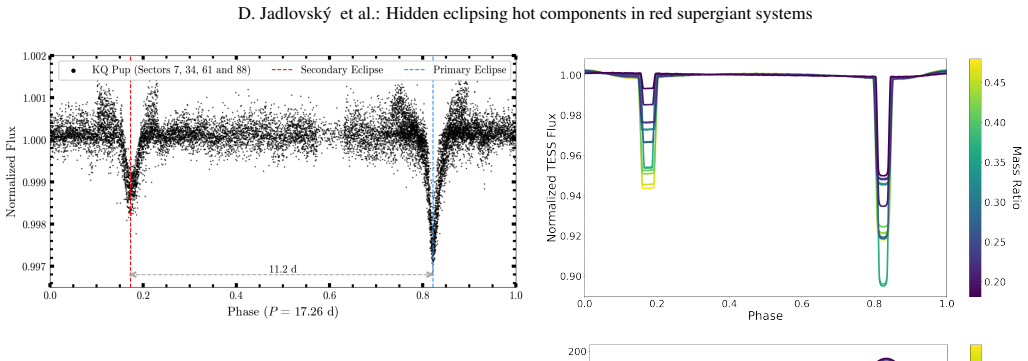
KQ Puppis is a hierarchical triple in which the B-type companion is an eclipsing binary with a 17.26-day period.
A machine-rendered reading of the paper's core claim, the machinery that carries it, and where it could break.
Core claim
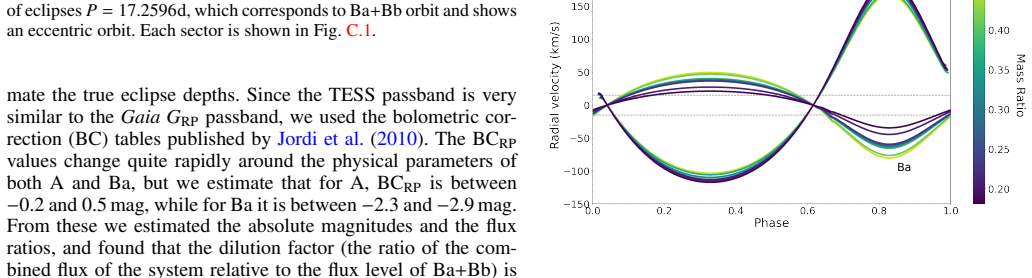
KQ Puppis consists of red supergiant A orbiting a Ba+Bb pair that is itself a 17.2596-day eclipsing binary. VLTI-GRAVITY detection of the Brγ line traces the orbital motion of the inner pair relative to A and determines the astrometric orbit of the wide system. Dynamical masses are approximately 10 solar masses for KQ Pup A and 14 solar masses for Ba+Bb. An orbital parallax of 1.24 mas is obtained, the first for any red supergiant. Balmer emission variability and the Brγ detection mark accretion onto the inner pair near periastron via Wind Roche Lobe Overflow from the red supergiant's atmosphere, with the accretion disk dissipating by apastron.
What carries the argument
The 17.26-day photometric eclipses detected in TESS data and associated with the B-type component, confirmed by the Brγ line in VLTI-GRAVITY spectra that tracks the inner binary's motion relative to the red supergiant.
If this is right
- Dynamical masses agree with independent estimates from asteroseismology and evolutionary models.
- Mass transfer proceeds via Wind Roche Lobe Overflow from the red supergiant's extended atmosphere rather than direct Roche-lobe contact.
- The accretion disk around the inner pair dissipates by apastron.
- Roughly 10 percent of known Galactic red supergiant binaries host eclipsing inner systems and may therefore be hierarchical triples.
Where Pith is reading between the lines
- Confirmation in additional systems would require binary-evolution models of massive stars to incorporate more frequent triple interactions.
- Targeted TESS searches of other red supergiants could uncover more hidden inner binaries.
- The orbital parallax supplies a new anchor point for calibrating red-supergiant distances and luminosities.
Load-bearing premise
The short-period photometric signal arises from eclipses within the B-type companion rather than from intrinsic variability of the red supergiant.
What would settle it
Failure of high-resolution spectroscopy to detect periodic radial-velocity shifts in the B-type component that match the 17.26-day photometric period would rule out the inner eclipsing binary.
Figures


read the original abstract
The majority of massive stars are part of binary systems that may interact during their evolution. However, not many RSGs are known binaries, and only a few have constrained orbital parameters. We search the available TESS photometry for eclipsing companions of RSGs. We focus on the best candidate, VV Cephei type binary KQ Pup, which is made up of a RSG, KQ Pup A, and a B-type companion, KQ Pup B (orbital period of 26 yr). We use photometry, spectroscopy, and newly taken interferometric data with VLTI-GRAVITY. Using TESS, we discovered eclipses with a period of $17.2596 \: \rm d$, associated with KQ Pup B, making it a Ba+Bb binary. The detection of the hydrogen Br$\gamma$ line with VLTI-GRAVITY enabled us to track the orbital motion of the Ba+Bb pair relative to A and determine the astrometric orbit of A+B. The dynamical masses agree with independent estimates from asteroseismology and evolutionary models. The results give a mass of $ \sim 10 \: \rm M_{\odot} $ for the RSG KQ Pup A and $ \sim 14 \: \rm M_{\odot} $ for the sum of the hot components Ba+Bb. We determined an orbital parallax of $\pi = 1.24^{+0.05}_{-0.04}\, \rm mas $, which is the first such parallax measurement for a RSG. KQ Pup represents a unique demonstration of mass transfer mechanism in wide eccentric RSG systems. The variability of Balmer emission lines and the detection of Br$\gamma$ are a strong signature of accretion to Ba+Bb near periastron. With the RSG filling its Roche lobe only by $\sim 70\%$ at periastron, the mass transfer is instead driven by accretion from its extended atmosphere via the Wind Roche Lobe Overflow. The accretion disk dissipates by apastron. Overall, we discovered that several previously assumed RSG binaries host eclipsing inner systems, corresponding to $\sim 10 \%$ of all known Galactic RSG binaries. This suggests that many of the other RSG binaries may also be hierarchical triples.
Editorial analysis
A structured set of objections, weighed in public.
Referee Report
Summary. The manuscript claims that KQ Puppis is a hierarchical triple system in which the known 26-year B-type companion is itself a 17.2596-day eclipsing binary (Ba+Bb). Combining TESS photometry that reveals the short-period eclipses, VLTI-GRAVITY interferometry that detects Brγ emission and tracks the astrometric motion of the Ba+Bb center of mass relative to the red supergiant A, and existing spectroscopic data, the authors derive dynamical masses of approximately 10 M⊙ for KQ Pup A and 14 M⊙ for the inner pair, together with the first orbital parallax for any red supergiant (π = 1.24 mas). They interpret the system as exhibiting Wind Roche Lobe Overflow mass transfer near periastron, with the accretion disk dissipating by apastron, and note that ~10% of known Galactic RSG binaries may similarly host inner eclipsing systems.
Significance. If the central results hold, the work is significant for providing the first dynamical mass and orbital parallax constraints on a red supergiant, for demonstrating a concrete example of Wind RLOF in a wide eccentric RSG system, and for suggesting that hierarchical triples are common among RSG binaries. The strength lies in the cross-validation across independent datasets (TESS timestamps, VLTI baselines, and Brγ radial velocities) that yields consistent orbital elements without obvious circularity.
major comments (1)
- [VLTI-GRAVITY observations] § on VLTI-GRAVITY observations and orbital fitting: the claim that Brγ traces the Ba+Bb center-of-mass motion relative to A requires explicit demonstration that the line profile is not contaminated by emission from the accretion flow or the RSG wind at the epochs of observation; without this, the astrometric orbit solution and resulting dynamical masses rest on an untested assumption.
minor comments (3)
- [TESS photometry] TESS analysis section: the periodogram and eclipse modeling should include a quantitative comparison of the 17.26 d signal amplitude and shape against the expected range of RSG pulsational variability to strengthen the attribution to the inner binary.
- [Orbital solution] Table of orbital elements: the reported uncertainties on the inner period and eccentricity should be propagated through to the periastron separation used for the Roche-lobe filling factor calculation.
- [Mass transfer interpretation] Abstract and § on mass transfer: the statement that the RSG fills its Roche lobe by ~70% at periastron should cite the exact radius and mass-ratio values adopted from the literature or derived here.
Simulated Author's Rebuttal
We thank the referee for their positive assessment of the manuscript and the constructive feedback. We address the major comment below and have made revisions to the manuscript accordingly.
read point-by-point responses
-
Referee: [VLTI-GRAVITY observations] § on VLTI-GRAVITY observations and orbital fitting: the claim that Brγ traces the Ba+Bb center-of-mass motion relative to A requires explicit demonstration that the line profile is not contaminated by emission from the accretion flow or the RSG wind at the epochs of observation; without this, the astrometric orbit solution and resulting dynamical masses rest on an untested assumption.
Authors: We thank the referee for this important comment. We acknowledge that while the manuscript uses the Brγ line to track the astrometric motion, a more detailed justification against contamination was needed. In the revised manuscript, we have included an explicit analysis of the Brγ line profiles observed with VLTI-GRAVITY. At the epochs of the observations, the line appears narrow and is centered at the radial velocity corresponding to the center of mass of the Ba+Bb pair, showing no signs of broad components from an accretion disk or shifts from the RSG wind. The timing of the VLTI observations near apastron further supports minimal contamination, as the accretion disk is described to dissipate by that phase. This addition bolsters the reliability of the orbital fit and the derived dynamical masses and orbital parallax. We believe this addresses the referee's concern directly. revision: yes
Circularity Check
No significant circularity in derivation chain
full rationale
The paper obtains dynamical masses (~10 M⊙ for KQ Pup A, ~14 M⊙ for Ba+Bb) and the first orbital parallax for a red supergiant (1.24 mas) via standard visual-spectroscopic orbit fitting applied to TESS photometry (17.2596 d eclipses), VLTI-GRAVITY Brγ astrometry, and radial velocities that track the inner pair's center-of-mass motion relative to the RSG. These inputs are external benchmarks (TESS timestamps, VLTI baselines) rather than quantities defined or fitted from the target results themselves. The Wind RLOF interpretation follows from the derived periastron separation combined with an independent RSG radius estimate. No step reduces a claimed prediction to a self-defined input, renames a fitted parameter, or relies on a load-bearing self-citation chain; the attribution of the short-period signal rests on its incompatibility with RSG pulsation timescales plus direct Brγ confirmation. The derivation remains self-contained against external benchmarks.
Axiom & Free-Parameter Ledger
free parameters (2)
- inner orbital period =
17.2596 d
- orbital elements of A+B
axioms (2)
- standard math Keplerian two-body motion governs the relative orbit of A and the Ba+Bb center of mass
- domain assumption The Brγ line traces the motion of the hot inner binary rather than the red supergiant
Forward citations
Cited by 1 Pith paper
-
VLTI-GRAVITY measurements of cool evolved stars: II. Pulsation properties and mass-loss process of the Mira star R Car and the red supergiant VX Sgr
Interferometric time series show steady mass loss in Miras tied to large-amplitude fundamental-mode pulsations, while RSGs like VX Sgr undergo extreme mass-loss events linked to pulsation mode changes and shocks.
Reference graph
Works this paper leans on
-
[1]
, " * write output.state after.block = add.period write newline
ENTRY address archiveprefix author booktitle chapter edition editor howpublished institution eprint journal key month note number organization pages publisher school series title type volume year label extra.label sort.label short.list INTEGERS output.state before.all mid.sentence after.sentence after.block FUNCTION init.state.consts #0 'before.all := #1 ...
-
[2]
" write newline "" before.all 'output.state := FUNCTION n.dashify 't := "" t empty not t #1 #1 substring "-" = t #1 #2 substring "--" = not "--" * t #2 global.max substring 't := t #1 #1 substring "-" = "-" * t #2 global.max substring 't := while if t #1 #1 substring * t #2 global.max substring 't := if while FUNCTION word.in bbl.in " " * FUNCTION format....
-
[3]
Ake , T. B. & Griffin , E., eds. 2015, Astrophysics and Space Science Library, Vol. 408, Giants of Eclipse: The Aurigae Stars and Other Binary Systems
work page 2015
- [4]
-
[5]
Altamore , A., Rossi , C., Viotti , R., & Baratta , G. B. 1992, , 92, 685
work page 1992
- [6]
- [7]
-
[8]
Arroyo-Torres , B., Wittkowski , M., Chiavassa , A., et al. 2015, , 575, A50
work page 2015
-
[9]
Ash , A. L., Pinsonneault , M. H., Vrard , M., & Zinn , J. C. 2025, , 979, 135
work page 2025
-
[10]
Bailer-Jones , C. A. L., Rybizki , J., Fouesneau , M., Demleitner , M., & Andrae , R. 2021, , 161, 147
work page 2021
-
[11]
B \'a nyai , E., Kiss , L. L., Bedding , T. R., et al. 2013, , 436, 1576
work page 2013
-
[12]
Bauer , W. H. & Bennett , P. D. 2000, , 112, 31
work page 2000
-
[13]
Bernini-Peron , M., Marcolino , W. L. F., Sander , A. A. C., et al. 2023, , 677, A50
work page 2023
-
[14]
Bernini-Peron , M., Sander , A. A. C., Ramachandran , V., et al. 2024, , 692, A89
work page 2024
- [15]
-
[16]
2017, VizieR Online Data Catalog: JMMC Stellar Diameters Catalogue - JSDC
Bourges , L., Mella , G., Lafrasse , S., et al. 2017, VizieR Online Data Catalog: JMMC Stellar Diameters Catalogue - JSDC. Version 2 (Bourges+, 2017) , VizieR On-line Data Catalog: II/346. Originally published in: 2014ASPC..485..223B
work page 2017
- [17]
-
[18]
A., Tenenbaum , P., Twicken , J
Caldwell , D. A., Tenenbaum , P., Twicken , J. D., et al. 2020, Research Notes of the American Astronomical Society, 4, 201
work page 2020
- [19]
-
[20]
E., Kochoska , A., Hey , D., et al
Conroy , K. E., Kochoska , A., Hey , D., et al. 2020, , 250, 34
work page 2020
-
[21]
Cowley , A. P. 1965, , 142, 299
work page 1965
-
[22]
Cowley , A. P. 1969, , 81, 297
work page 1969
-
[23]
Cruzal \`e bes , P., Petrov , R. G., Robbe-Dubois , S., et al. 2019, , 490, 3158
work page 2019
-
[24]
Daflon , S., Cunha , K., Smith , V. V., & Butler , K. 2003, , 399, 525
work page 2003
- [25]
-
[26]
de Vries , N., Portegies Zwart , S., & Figueira , J. 2014, , 438, 1909
work page 2014
- [27]
- [28]
-
[29]
Dorn-Wallenstein , T. Z., Levesque , E. M., Neugent , K. F., et al. 2020, , 902, 24
work page 2020
- [30]
-
[31]
Dupree , A. K. 1986, , 24, 377
work page 1986
-
[32]
Dupree , A. K. & Reimers , D. 1987, in Astrophysics and Space Science Library, Vol. 129, Exploring the Universe with the IUE Satellite, ed. Y. Kondo & W. Wamsteker , 321
work page 1987
-
[33]
Dupree , A. K., Strassmeier , K. G., Calderwood , T., et al. 2022, , 936, 18
work page 2022
-
[34]
Eggleton , P. P. 1983, , 268, 368
work page 1983
-
[35]
Ercolino , A., Jin , H., Langer , N., & Dessart , L. 2024, , 685, A58
work page 2024
-
[36]
Fitzpatrick , E. L. 1999, , 111, 63
work page 1999
-
[37]
J., Bodensteiner , J., Rivinius , T., et al
Frost , A. J., Bodensteiner , J., Rivinius , T., et al. 2022, , 659, L3
work page 2022
-
[38]
Gaia Collaboration , Brown , A. G. A., Vallenari , A., et al. 2021, , 649, A1
work page 2021
-
[39]
Gaia Collaboration , Vallenari , A., Brown , A. G. A., et al. 2023, , 674, A1
work page 2023
-
[40]
A., Joyce , M., & Moln \'a r , L
Goldberg , J. A., Joyce , M., & Moln \'a r , L. 2024, , 977, 35
work page 2024
-
[41]
Goldberg , J. A., O'Grady , A. J. G., Joyce , M., et al. 2025, arXiv e-prints, arXiv:2505.18375
-
[42]
2002, in Astronomical Society of the Pacific Conference Series, Vol
Gonz \'a lez-Riestra , R., Rossi , C., & Viotti , R. 2002, in Astronomical Society of the Pacific Conference Series, Vol. 261, The Physics of Cataclysmic Variables and Related Objects, ed. B. T. G \"a nsicke , K. Beuermann , & K. Reinsch , 281
work page 2002
-
[43]
Gonz \'a lez-Riestra , R., Rossi , C., & Viotti , R. F. 2003, , 399, 681
work page 2003
-
[44]
Gonz \'a lez-Tor \`a , G., Wittkowski , M., Davies , B., & Plez , B. 2024, , 683, A19
work page 2024
-
[45]
Gosset , E., Hutsemekers , D., Surdej , J., & Swings , J. P. 1985, , 153, 71
work page 1985
-
[46]
Gr \"a fener , G., Koesterke , L., & Hamann , W. R. 2002, , 387, 244
work page 2002
-
[47]
GRAVITY Collaboration , Abuter , R., Accardo , M., et al. 2017, , 602, A94
work page 2017
-
[48]
Gustafsson , B., Edvardsson , B., Eriksson , K., et al. 2008, , 486, 951
work page 2008
-
[49]
Hainich , R., Ramachandran , V., Shenar , T., et al. 2019, , 621, A85
work page 2019
-
[50]
Harmanec , P., Yang , S., Koubsk \'y , P., et al. 2025, , 699, A321
work page 2025
-
[51]
Healy , S., Horiuchi , S., Colomer Molla , M., et al. 2024, , 529, 3630
work page 2024
-
[52]
Howell , S. B., Ciardi , D. R., Clark , C. A., et al. 2025, , 988, L47
work page 2025
-
[53]
Huber , D., Bedding , T. R., Stello , D., et al. 2011, , 743, 143
work page 2011
-
[54]
Humphreys , R. M. & Jones , T. J. 2022, , 163, 103
work page 2022
- [55]
- [56]
- [57]
- [58]
- [59]
- [60]
- [61]
- [62]
-
[63]
Kloppenborg , B. K., Stencel , R. E., Monnier , J. D., et al. 2015, , 220, 14
work page 2015
-
[64]
Kochanek , C. S., Shappee , B. J., Stanek , K. Z., et al. 2017, , 129, 104502
work page 2017
-
[65]
Kourniotis , M., Kraus , M., Arias , M. L., & Cidale , L. S. 2025, , 540, L28
work page 2025
- [66]
-
[67]
Kraus , M., Oksala , M. E., Nickeler , D. H., et al. 2013, , 549, A28
work page 2013
-
[68]
C., Henrique de Amorim , T., et al
Labadie-Bartz , J., Carciofi , A. C., Henrique de Amorim , T., et al. 2022, , 163, 226
work page 2022
- [69]
-
[70]
Lamers , H. J. G. L. M., Zickgraf , F.-J., de Winter , D., Houziaux , L., & Zorec , J. 1998, , 340, 117
work page 1998
-
[71]
Lechien , T., de Mink , S. E., Valli , R., et al. 2025, arXiv e-prints, arXiv:2505.14780
-
[72]
Levesque, E. M. 2017, Astrophysics of Red Supergiants, 2514-3433 (IOP Publishing)
work page 2017
-
[73]
Lidov , M. L. 1962, , 9, 719
work page 1962
-
[74]
Lightkurve Collaboration , Cardoso , J. V. d. M., Hedges , C., et al. 2018, Lightkurve: Kepler and TESS time series analysis in Python , Astrophysics Source Code Library, record ascl:1812.013
work page 2018
- [75]
-
[76]
Manset , N. & Donati , J.-F. 2003, in Society of Photo-Optical Instrumentation Engineers (SPIE) Conference Series, Vol. 4843, Polarimetry in Astronomy, ed. S. Fineschi , 425--436
work page 2003
- [77]
- [78]
-
[79]
2022, in Society of Photo-Optical Instrumentation Engineers (SPIE) Conference Series, Vol
M \'e rand , A. 2022, in Society of Photo-Optical Instrumentation Engineers (SPIE) Conference Series, Vol. 12183, Optical and Infrared Interferometry and Imaging VIII, ed. A. M \'e rand , S. Sallum , & J. Sanchez-Bermudez , 121831N
work page 2022
-
[80]
2019, Research Notes of the American Astronomical Society, 3, 28
Merc , J., G \'a lis , R., & Wolf , M. 2019, Research Notes of the American Astronomical Society, 3, 28
work page 2019
discussion (0)
Sign in with ORCID, Apple, or X to comment. Anyone can read and Pith papers without signing in.