REVIEW 3 major objections 4 minor 1 cited by
Symmetry and Self-Bound Droplets in Dipolar Molecular Gases
T0 review · 3 major / 4 minor · reviewed 2026-08-04 · deepseek-v4-flash
Pith's one-line read Elliptically microwave-dressed dipolar gases have a hidden D3 symmetry that maps every interaction state into a sextet of equivalent configurations, and this symmetry fixes where self-bound droplets form and how their energy and density sca
desk verdict A genuinely useful symmetry organizer for molecular droplet physics, with the finite-N quantitative predictions the main soft spot; worth a serious referee. read the letter →
The pith
A machine-rendered reading of the paper's core claim, the machinery that carries it, and where it could break.
The reading
What carries the argument
The central objects are (i) the D3 dihedral symmetry group acting on the interaction-parameter plane (ε0, ε2), generated by reflections and rotations by 2πn/3, which makes every state one of a sextet of coordinate-permuted but energetically identical configurations; and (ii) the LDA quantum-fluctuation coefficient Q5(ε0, ε2) defined by the angular integral of [1+Ū(k)]^{5/2}. The symmetry reduces the parameter plane to a fundamental domain and provides an exact variational identity for the interaction energy in terms of the anisotropy functions f and f2, while Q5 enters the extended Gross–Pitaevskii equation and fixes both the thermodynamic-limit instability boundary and the large-N droplet e
What would settle it
Measure the profile of a self-bound molecular droplet as a function of (ε0, ε2) across one sextet predicted by the D3 tiling (e.g., the six points equivalent to ε0=3, ε2=0). If the five partner points do not reproduce the same three-axis shape up to a rigid rotation, the symmetry is broken. A direct calculation: evaluate Re Q5(ε0, ε2) by the numerical angular integration at, say, (ε0, ε2)=(0,√3) and (1.5,0); if the predicted large-N energy (8) does not match the observed droplet energy per particle scaled by (εlim−1)³/[Q5]², the LDA treatment of quantum fluctuations fails.
Extended reading notes
Core claim
Every pair of interaction strengths (ε0, ε2) lies in a sextet of equivalent parameter sets generated by the dihedral group D3: because the potential is a quadratic form in x², y², z², permuting the coordinates corresponds to reflecting or rotating the (ε0, ε2) plane. On the three symmetry axes ε2=0 and ε0=±ε2/√3 the sextet collapses and the gas is cylindrically symmetric. Using this symmetry and the LDA quantum-fluctuation coefficient Q5(ε0, ε2), the author derives the thermodynamic-limit droplet condition (ε0+√3|ε2|>1 or ε0<−1/2), the large-N energy E/N = −50π²(εlim−1)³/[3(64Q5)²] E0, and peak density n_peak a_s³ = 25π(εlim−1)²/[64Q5]², independent of N; these are confirmed by eGPE numerics
Load-bearing premise
The entire symmetry and droplet phase diagram assumes the effective two-body interaction is exactly the two-parameter quadrupolar potential of Eq. (1); if the real microwave-shielded molecular interaction contains additional angular or density-dependent components, the D3 sextet structure and the derived phase boundaries will be modified.
Editorial extensions
If this is right
- The D3 tiling means an experiment performed at one point in the (ε0, ε2) plane can be reproduced, up to rotation of coordinates, at five other points; scanning any sextet tests the symmetry directly.
- Self-bound droplets exist in the thermodynamic limit exactly when ε0+√3|ε2|>1 or ε0<−1/2, and the boundary is approached from inside as N grows.
- The droplet energy per particle and peak density become independent of N in the large-N limit, a liquid-like signature, with explicit formulas that depend only on εlim and Q5.
- The asymmetric case ε0=0 has a fixed long-width aspect ratio λ≈1.964, so the droplet shape in that sector is universal, independent of ε2 and N.
- Because the symmetry is exact at the level of the two-parameter effective potential, it also constrains trapped-gas shapes and any future supersolid or layering calculations that use this interaction.
Reading between the lines
- If the real shielding interaction contains additional terms beyond the two-parameter quadrupolar form — e.g. dual-shielding contributions or higher multipoles — the D3 symmetry would be broken into a subgroup; measuring droplet shapes at asymmetric points could reveal such corrections.
- The same sextet structure should organise not just ground states but excited states and collective modes; a Bogoliubov analysis on each member of a sextet would yield spectra related by the same coordinate permutations, which could be tested with Bragg or rf spectroscopy.
- The universal large-N scaling suggests droplets of molecular gases will behave like incompressible liquids; an immediate experimental check is to measure the peak density as N is increased by an order of magnitude and verify it plateaus.
- The aspect-ratio constant λ≈1.964 for ε0=0 might correspond to a fixed point of the variational flow, and it would be interesting to see whether self-bound droplets in the ε0=0 sector exist only above a critical N for any ε2, or whether the threshold N diverges at the intersection of the instability lines.
Editorial analysis
A structured set of objections, weighed in public.
Referee Report
Summary. The manuscript studies zero-temperature ground states of a microwave-dressed dipolar molecular Bose gas, described by the two-parameter anisotropic interaction potential U(r) in Eq. (1). It shows that the interaction energy depends on the parameters (ε0, ε2) through a quadratic form, so any parameter point is related to five others by coordinate permutations; this D3 dihedral symmetry tiles the (ε0, ε2) plane. The paper identifies the cylindrical-symmetry axes, the ordering of principal widths, and the prolate/oblate sectors. It then couples this symmetry to a beyond-mean-field extended Gross-Pitaevskii equation (eGPE) with an LDA quantum-fluctuation term, develops a variational Gaussian ansatz, and derives thermodynamic-limit formulas for the energy and peak density of self-bound droplets, Eqs. (8) and (10). Numerical solutions of the eGPE are used to map the finite-N droplet phase diagram (Fig. 2), typical profiles (Fig. 3), and droplet properties (Fig. 4), with the symmetry used to organize the results. The central analytic claims are internally consistent: the symmetry argument is exact for the model potential, and the large-N formulas follow from the stated LDA functional.
Significance. The symmetry tiling of the interaction plane is an elegant and useful organizing principle for the newly accessible molecular gases with elliptical microwave dressing. The paper is not purely formal: it contains analytic checks (e.g., Eq. (B5) for Q5 at ε0=-1/2, the functional relation for f2 in Eq. (7)), a variational theory, and large-N asymptotics that are compared with numerical eGPE results. If the quantitative droplet boundaries and properties are reliable, the phase diagrams in Figs. 2–4 will be directly useful for interpreting experiments such as refs. [26,44]. The main reservation is the treatment of the imaginary part of the quantum-fluctuation coefficient Q5: it is discarded without a quantitative estimate of the resulting error in the finite-N droplet boundary and in Eqs. (8) and (10). This is the weakest link between the exact symmetry statement and the paper's quantitative predictions.
major comments (3)
- [After Eq. (5), and Fig. 2] The finite-N E=0 boundary is computed after discarding Im Q5. The text admits this, but Fig. 2 shows contours Im Q5 = Re Q5/4 crossing directly through the droplet boundary region. Since Q5 enters Eqs. (8) and (10) squared, a relative imaginary part of 0.25 changes the energy denominator by roughly 6%, which translates directly into shifts of the large-N energy and peak density, and into the position of the finite-N boundary. The paper provides no estimate of this systematic error. Please quantify the shift in the E=0 boundary and in Eqs. (8) and (10) from the Im Q5 truncation, or determine the boundary with an alternative treatment of the unstable modes that does not simply drop the imaginary part.
- [Appendix B, Eq. (B2)] The definition Re{Q5} = (2/π)∫ dφ |Re I(φ)| is not the real part of the angular integral. In the droplet region, the integrand changes sign because 1+U(k)<0 in some directions; taking the absolute value can therefore alter Re Q5 itself, not just the imaginary part. This branch prescription is not physically justified. I ask for a concrete test: compute droplet energies using the literal real part of the integral, or a principal-value prescription, and compare. The sensitivity of the phase diagram and of Eqs. (8) and (10) to this choice should be reported.
- [Eq. (1) and Conclusions] The symmetry classification and the entire phase diagram rest on the two-parameter quadrupolar potential U(r) imported from ref. [42]. The paper presents the sextet tiling as a property of the molecular interaction landscape, but if the physical interaction contains additional terms—e.g., dual-shielding contributions from [41], higher multipoles, or density-dependent dressing—the D3 symmetry is only approximate and the phase boundaries shift. This is a correctness-risk concern for the applicability of the central claim, not an internal inconsistency. Please state the expected experimental regime where Eq. (1) is a faithful complete interaction, and note that deviations from sextet-related profiles would signal missing beyond-(1) terms.
minor comments (4)
- [Fig. 2 caption] The color scale for the variational energy background is not defined. Please specify the units of E/N E0 and the colormap range.
- [After Eq. (2)] The reflection T that sends (ε0,ε2) to (ε0,-ε2) is not written explicitly. Stating the matrix would help readers connect the text to the D3 group description.
- [Appendix B, Eq. (B6)] The small-parameter expansion Q5 ≈ 1 + 3/2 (ε0² + ε2²) is used in Fig. 5 but no derivation or reference is given. A one-line derivation or a citation would be useful.
- [Fig. 1] The figure is information-dense, especially in the labeling of the colored regions and their symmetry copies. Consider making the sextet relation more explicit in one figure panel or in a table of equivalent parameter sets.
Circularity Check
No significant circularity: the symmetry classification, thermodynamic-limit formulas, and finite-N droplet boundaries are derived from the stated interaction and LDA functional, with no fitted parameters renamed as predictions.
full rationale
The derivation chain is self-contained. The D3 sextet symmetry follows algebraically from Eq. (2): U(r) is rewritten in coordinates {x,y,z} so that parameter transformations are coordinate permutations; this is a mathematical consequence of the assumed interaction, not a circular definition. The eGPE (3), the quantum-fluctuation coefficient Q5 (4), and the instability condition (5) are standard inputs or direct consequences of the Fourier-transformed interaction. The large-N energy and peak density, Eqs. (8) and (10), are derived in Appendix D from the LDA energy functional (D1) and then compared with numerical eGPE solutions in Fig. 4; they are not fits to those numerics. The ε2 = 0 sector is benchmarked against independent published results [45,46,48,49]. Self-citations [20,21,28,55] are prior published results and are not used as a uniqueness or forcing argument. The practice of discarding Im{Q5}, after Eq. (5), cites [21,22] with an independent co-citation; the approximation is disclosed by plotting Im{Q5} contours in Fig. 2. The branch prescription in Eq. (B2) for Re{Q5} is a stated numerical convention and a limitation on quantitative finite-N boundaries, but it is not a circular reduction: the predicted boundary is still computed from the equations, not defined to match the target result. Overall, the paper's central claims reduce to its input model and standard LDA, but not to themselves.
Assumptions & free parameters
assumptions (6)
- domain assumption Effective two-body interaction of microwave-dressed molecules is exactly U(r) = (3gs/4πr³)[ε0(1−3cos²θ) + √3ε2 sin²θ cos 2φ] (Eq. 1, from ref [42]).
- domain assumption The extended Gross-Pitaevskii equation with local-density quantum fluctuations, γ_QF = 32 g_s a_s^{3/2} Q5/(3√π) (Eqs. 3–4), describes the molecular gas.
- ad hoc to paper The imaginary part of Q5 (arising where the homogeneous gas is unstable, Eq. 5) can be discarded for droplet calculations.
- domain assumption The variational Gaussian ansatz with scaling form n(x) = n_s(x²/lx² + y²/ly² + z²/lz²) captures the ground state.
- domain assumption Large-N droplet limit: flat-top density with negligible kinetic energy, with ∫|ψ|^p → n_peak^{p/2−1} N (Appendix D).
- standard math Fourier-transform identities, the spherical-wave expansion of the plane wave, and elliptic-integral evaluations in Appendices A–C.
Cite this review
Pith. "Pith review of Symmetry and Self-Bound Droplets in Dipolar Molecular Gases." pith.science (2026). https://pith.science/paper/H46XQM5V
@misc{pith2026251004634,
  author       = {Pith},
  title        = {Pith review of: Symmetry and Self-Bound Droplets in Dipolar Molecular Gases},
  year         = {2026},
  howpublished = {\url{https://pith.science/paper/H46XQM5V}},
  note         = {Machine review of arXiv:2510.04634}
}
read the original abstract
Recent experiments with degenerate molecular gases dressed by elliptically polarized microwave fields have enabled new control of dipolar interactions via engineered anisotropy. We reveal a symmetry structure of the dipolar interaction that generates degeneracies among the interaction parameters, enabling a classification of spatial symmetries and equilibrium shapes of the gases. Exploiting these symmetries, we analyze solutions including beyond-meanfield quantum fluctuations, and develop a complementary variational theory. We map out the phase diagram of self-bound droplets and characterize their widths, energies, and densities.
Figures


Figures from the paper (1 more)

Forward citations
Cited by 1 Pith paper
-
Self-Bound Droplets of Ultracold Dipolar Molecules under Tunable Double Microwave Shielding
Ground-state path integral Monte Carlo simulations of NaCs polar molecules with double microwave shielding show self-bound droplets forming above an ellipticity threshold of ~3 degrees, with an estimated superfluid fr...
Reference graph
Works this paper leans on
-
[42]
Deng, X.-Y
F. Deng, X.-Y . Chen, X.-Y . Luo, W. Zhang, S. Yi, and T. Shi, Effective potential and superfluidity of microwave-shielded po- lar molecules, Phys. Rev. Lett.130, 183001 (2023)
2023
- [41]
-
[1]
K. K. Ni, S. Ospelkaus, M. H. G. de Miranda, A. Pe’er, B. Neyenhuis, J. J. Zirbel, S. Kotochigova, P. S. Julienne, D. S. Jin, and J. Ye, A high phase-space-density gas of polar molecules, Science322, 231 (2008)
2008
-
[2]
Ospelkaus, K.-K
S. Ospelkaus, K.-K. Ni, D. Wang, M. H. G. de Miranda, B. Neyenhuis, G. Qu ´em´ener, P. S. Julienne, J. L. Bohn, D. S. Jin, and J. Ye, Quantum-state controlled chemical reactions of ultracold potassium-rubidium molecules, Science327, 853 (2010)
2010
-
[3]
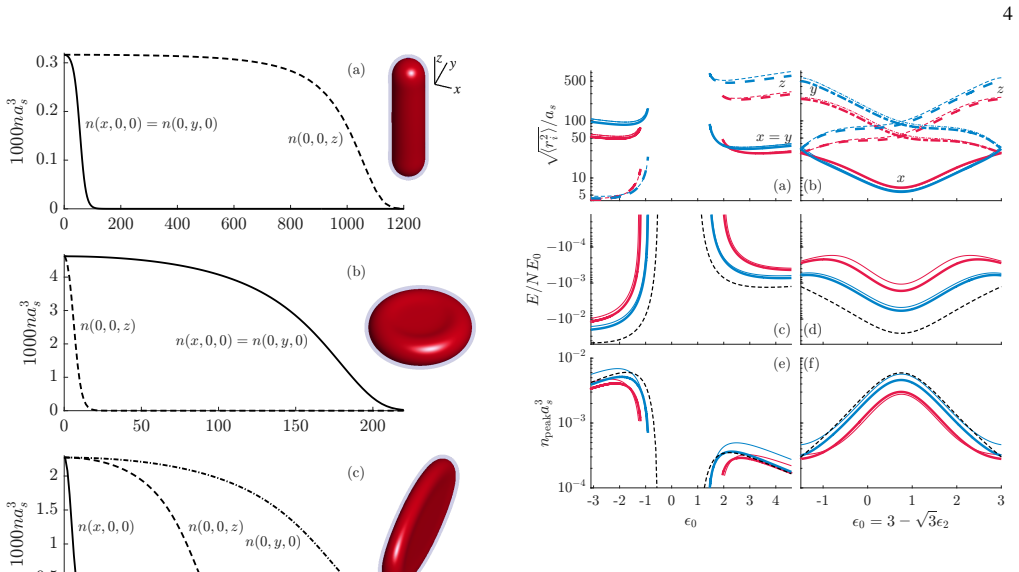
(9) The energy (8) is achieved with peak density (see also [53, 54]) npeaka3 s = 25π(ϵlim −1) 2 [64Q5(ϵ0, ϵ2)]2 ,(10) 02 0 0.5 1 1.5 2 2.5 00 -2 -1.5 -1 -0.5 0 0.5 1 1.5 2 2.5 3 3.5 nodroplet ImfQ5gRefQ5g=110 ImfQ5gRefQ5g=14 3(a) 3(b) 3(c) 4(b) -3 -2 -1 01000E=NE0 FIG. 2. Phase diagram forN= 1000using the eGPE (red cir- cles and thick curve) and variation...
-
[4]
De Marco, G
L. De Marco, G. Valtolina, K. Matsuda, W. G. Tobias, J. P. Covey, and J. Ye, A degenerate Fermi gas of polar molecules, Science363, 853 (2019)
2019
-
[5]
K.-K. Ni, S. Ospelkaus, D. Wang, G. Quemener, B. Neyenhuis, M. H. G. de Miranda, J. L. Bohn, J. Ye, and D. S. Jin, Dipo- lar collisions of polar molecules in the quantum regime, Nature 464, 1324 (2010)
2010
-
[6]
Lassabli `ere and G
L. Lassabli `ere and G. Qu ´em´ener, Controlling the scattering length of ultracold dipolar molecules, Phys. Rev. Lett.121, 163402 (2018)
2018
Show all 60 references
-
[7]
Karman and J
T. Karman and J. M. Hutson, Microwave shielding of ultracold polar molecules, Phys. Rev. Lett.121, 163401 (2018)
2018
-
[8]
Bigagli, C
N. Bigagli, C. Warner, W. Yuan, S. Zhang, I. Stevenson, T. Kar- man, and S. Will, Collisionally stable gas of bosonic dipolar ground-state molecules, Nature Physics19, 1579 (2023)
2023
-
[9]
Anderegg, S
L. Anderegg, S. Burchesky, Y . Bao, S. S. Yu, T. Karman, E. Chae, K.-K. Ni, W. Ketterle, and J. M. Doyle, Observation of microwave shielding of ultracold molecules, Science373, 779 (2021)
2021
-
[10]
Langen, G
T. Langen, G. Valtolina, D. Wang, and J. Ye, Quantum state ma- nipulation and cooling of ultracold molecules, Nature Physics 20, 702 (2024)
2024
-
[11]
Bigagli, W
N. Bigagli, W. Yuan, S. Zhang, B. Bulatovic, T. Karman, I. Stevenson, and S. Will, Observation of Bose–Einstein con- densation of dipolar molecules, Nature631, 289 (2024)
2024
-
[12]
Z. Shi, Z. Huang, F. Deng, W.-J. Jin, S. Yi, T. Shi, and D. Wang, Bose-Einstein condensate of ultracold sodium- rubidium molecules with tunable dipolar interactions (2025), arXiv:2508.20518
2025 arXiv
-
[13]
Self-bound droplets in two-component atomic condensates have since been observed [24, 25]
and macrodroplets [14] led to the realization of a self- bound dipolar droplet [15], stable in free-space without exter- nal confinement, stabilized by quantum fluctuations [16] (see also [17–23]). Self-bound droplets in two-component atomic condensates have since been observe...
2025 arXiv
-
[14]
J. Lin, G. Chen, M. Jin, Z. Shi, F. Deng, W. Zhang, G. Qu´em´ener, T. Shi, S. Yi, and D. Wang, Microwave shielding of bosonic NaRb molecules, Phys. Rev. X13, 031032 (2023)
2023
-
[15]
Kadau, M
H. Kadau, M. Schmitt, M. Wenzel, C. Wink, T. Maier, I. Ferrier- Barbut, and T. Pfau, Observing the Rosensweig instability of a quantum ferrofluid, Nature530, 194 (2016)
2016
-
[16]
Chomaz, S
L. Chomaz, S. Baier, D. Petter, M. J. Mark, F. W¨achtler, L. San- tos, and F. Ferlaino, Quantum-fluctuation-driven crossover from a dilute Bose-Einstein condensate to a macrodroplet in a dipolar quantum fluid, Phys. Rev. X6, 041039 (2016)
2016
-
[17]
Schmitt, M
M. Schmitt, M. Wenzel, F. B ¨ottcher, I. Ferrier-Barbut, and T. Pfau, Self-bound droplets of a dilute magnetic quantum liq- uid, Nature539, 259 (2016)
2016
-
[18]
D. S. Petrov, Quantum mechanical stabilization of a collapsing Bose-Bose mixture, Phys. Rev. Lett.115, 155302 (2015)
2015
-
[19]
Lahaye, C
T. Lahaye, C. Menotti, L. Santos, M. Lewenstein, and T. Pfau, The physics of dipolar bosonic quantum gases, Rep. Prog. Phys. 72, 126401 (2009)
2009
-
[20]
Chomaz, I
L. Chomaz, I. Ferrier-Barbut, F. Ferlaino, B. Laburthe-Tolra, B. L. Lev, and T. Pfau, Dipolar physics: a review of experiments with magnetic quantum gases, Rep. Prog. Phys.86, 026401 (2022)
2022
-
[21]
Chomaz, Quantum-stabilized states in magnetic dipolar quantum gases (2025), arXiv:2504.06221
L. Chomaz, Quantum-stabilized states in magnetic dipolar quantum gases (2025), arXiv:2504.06221
2025 arXiv
-
[22]
Baillie, R
D. Baillie, R. M. Wilson, R. N. Bisset, and P. B. Blakie, Self- bound dipolar droplet: A localized matter wave in free space, Phys. Rev. A94, 021602(R) (2016)
2016
-
[23]
R. N. Bisset, R. M. Wilson, D. Baillie, and P. B. Blakie, Ground-state phase diagram of a dipolar condensate with quan- tum fluctuations, Phys. Rev. A94, 033619 (2016)
2016
-
[24]
W ¨achtler and L
F. W ¨achtler and L. Santos, Quantum filaments in dipolar Bose- Einstein condensates, Phys. Rev. A93, 061603 (2016)
2016
-
[25]
W ¨achtler and L
F. W ¨achtler and L. Santos, Ground-state properties and elemen- tary excitations of quantum droplets in dipolar Bose-Einstein condensates, Phys. Rev. A94, 043618 (2016)
2016
-
[26]
C. R. Cabrera, L. Tanzi, J. Sanz, B. Naylor, P. Thomas, P. Cheiney, and L. Tarruell, Quantum liquid droplets in a mix- ture of Bose-Einstein condensates, Science359, 301 (2018)
2018
-
[27]
Semeghini, G
G. Semeghini, G. Ferioli, L. Masi, C. Mazzinghi, L. Wol- swijk, F. Minardi, M. Modugno, G. Modugno, M. Inguscio, and M. Fattori, Self-bound quantum droplets of atomic mixtures in free space, Phys. Rev. Lett.120, 235301 (2018)
2018
-
[28]
Zhang, W
S. Zhang, W. Yuan, N. Bigagli, H. Kwak, T. Karman, I. Steven- son, and S. Will, Observation of self-bound droplets of ultracold dipolar molecules (2025), arXiv:2507.15208
2025
-
[29]
Giovanazzi, A
S. Giovanazzi, A. G ¨orlitz, and T. Pfau, Tuning the dipolar inter- action in quantum gases, Phys. Rev. Lett.89, 130401 (2002)
2002
-
[30]
Baillie and P
D. Baillie and P. B. Blakie, Rotational tuning of the dipole- dipole interaction in a Bose gas of magnetic atoms, Phys. Rev. A101, 043606 (2020)
2020
-
[31]
Y . Tang, W. Kao, K.-Y . Li, and B. L. Lev, Tuning the dipole- dipole interaction in a quantum gas with a rotating magnetic field, Phys. Rev. Lett.120, 230401 (2018)
2018
-
[32]
Wenzel,Macroscopic states of dipolar quantum gases, Ph.D
M. Wenzel,Macroscopic states of dipolar quantum gases, Ph.D. thesis, University of Stuttgart, Germany (2018)
2018
-
[33]
Mukherjee, T
K. Mukherjee, T. A. Cardinale, L. Chergui, P. St ¨urmer, and S. M. Reimann, Droplets and supersolids in ultra-cold atomic quantum gases, EPJ ST232, 3417 (2023)
2023
-
[34]
Mukherjee, M
K. Mukherjee, M. N. Tengstrand, T. A. Cardinale, and S. M. Reimann, Supersolid stacks in antidipolar Bose-Einstein con- densates, Phys. Rev. A108, 023302 (2023)
2023
-
[35]
W.-J. Jin, F. Deng, S. Yi, and T. Shi, Bose-Einstein condensates of microwave-shielded polar molecules (2024), arXiv:2406.06412
2024 arXiv
-
[36]
Zhang, K
W. Zhang, K. Chen, S. Yi, and T. Shi, Quantum phases for finite-temperature gases of bosonic polar molecules shielded by dual microwaves (2025), arXiv:2503.02644. 6
2025 arXiv
-
[37]
Langen, J
T. Langen, J. Boronat, J. S ´anchez-Baena, R. Bomb ´ın, T. Kar- man, and F. Mazzanti, Dipolar droplets of strongly interacting molecules (2024), arXiv:2407.09391
2024 arXiv
-
[38]
Ciardi, K
M. Ciardi, K. R. Pedersen, T. Langen, and T. Pohl, Self-bound superfluid membranes and monolayer crystals of ultracold polar molecules, Phys. Rev. Lett.135, 153401 (2025)
2025
-
[39]
C. J. Polterauer and R. E. Zillich, Phases of a Bose-Einstein condensate of microwave-shielded dipolar molecules (2025), arXiv:2507.18986
2025 arXiv
-
[40]
T. A. Cardinale, T. Bland, and S. M. Reimann, Exploring molecular supersolidity via exact and mean-field theories: sin- gle microwave shielding (2025), arXiv:2509.18051
2025
-
[43]
Karman, N
T. Karman, N. Bigagli, W. Yuan, S. Zhang, I. Steven- son, and S. Will, Double microwave shielding (2025), arXiv:2501.08095
2025
-
[44]
See [39] for an alternative
Our choice ofϵ 2 matches [26]. See [39] for an alternative
-
[45]
Not to be confused with the vacuum permittivity
-
[46]
W. Yuan, S. Zhang, N. Bigagli, H. Kwak, C. Warner, T. Kar- man, I. Stevenson, and S. Will, Extreme loss suppression and wide tunability of dipolar interactions in an ultracold molecular gas (2025), arXiv:2505.08773
2025 arXiv
-
[47]
A. R. P. Lima and A. Pelster, Quantum fluctuations in dipolar Bose gases, Phys. Rev. A84, 041604(R) (2011)
2011
-
[48]
A. R. P. Lima and A. Pelster, Beyond mean-field low-lying exci- tations of dipolar Bose gases, Phys. Rev. A86, 063609 (2012)
2012
-
[49]
By taking the Fourier transform, changing variables tou i = liki, integrating the angular variables, and changing variables back tok i
-
[50]
Giovanazzi, P
S. Giovanazzi, P. Pedri, L. Santos, A. Griesmaier, M. Fattori, T. Koch, J. Stuhler, and T. Pfau, Expansion dynamics of a dipo- lar Bose-Einstein condensate, Phys. Rev. A74, 013621 (2006)
2006
-
[51]
Glaum and A
K. Glaum and A. Pelster, Bose-Einstein condensation temper- ature of dipolar gas in anisotropic harmonic trap, Phys. Rev. A 76, 023604 (2007)
2007
-
[52]
We align our dipoles alongzwhereas [48] aligns alongx, but our functionf(x, y)is exactly the same as theirs
-
[53]
For0< y≪1, asxis reducedf 2(x, y)changes sharply from ≈ −1forx≫y, through zero atx=y, to1atx= 0
-
[54]
Santos, G
L. Santos, G. V . Shlyapnikov, P. Zoller, and M. Lewenstein, Bose-Einstein condensation in trapped dipolar gases, Phys. Rev. Lett.85, 1791 (2000)
2000
-
[55]
Ferrier-Barbut, H
I. Ferrier-Barbut, H. Kadau, M. Schmitt, M. Wenzel, and T. Pfau, Observation of quantum droplets in a strongly dipolar Bose gas, Phys. Rev. Lett.116, 215301 (2016)
2016
-
[56]
Dalibard, Magnetic interactions between cold atoms: Quan- tum droplets and supersolid states, Coll `ege de France, Lecture Series (2024)
J. Dalibard, Magnetic interactions between cold atoms: Quan- tum droplets and supersolid states, Coll `ege de France, Lecture Series (2024)
2024
-
[57]
Baillie, R
D. Baillie, R. M. Wilson, and P. B. Blakie, Collective excita- tions of self-bound droplets of a dipolar quantum fluid, Phys. Rev. Lett.119, 255302 (2017)
2017
-
[58]
J. D. Jackson,Classical electrodynamics, 3rd ed. (Wiley, New York, 1999)
1999
-
[59]
Ronen, D
S. Ronen, D. C. E. Bortolotti, and J. L. Bohn, Bogoliubov modes of a dipolar condensate in a cylindrical trap, Phys. Rev. A74, 013623 (2006)
2006
-
[60]
(4)], but the imaginary part ofQ 5 will then be significant
For larger parametersQ 5 increases like|ϵ 0|5/2 or|ϵ 2|5/2 [see Eq. (4)], but the imaginary part ofQ 5 will then be significant. END MA TTER Appendix A: Momentum-space interaction–We use a grid that is shaped to amply cover our density, which is generally a different size in e...
Reviewed August 4, 2026 · model on record in the stance chip above.
Discussion (0). Sign in to comment.