CAZ catalog and optical light curves of 7918 blazar-selected active galactic nuclei
Pith reviewed 2026-05-18 05:54 UTC · model grok-4.3
The pith
A catalog of 7918 blazars and candidates supplies the largest collection of optical light curves yet and shows that flares rise faster than they decay.
A machine-rendered reading of the paper's core claim, the machinery that carries it, and where it could break.
Core claim
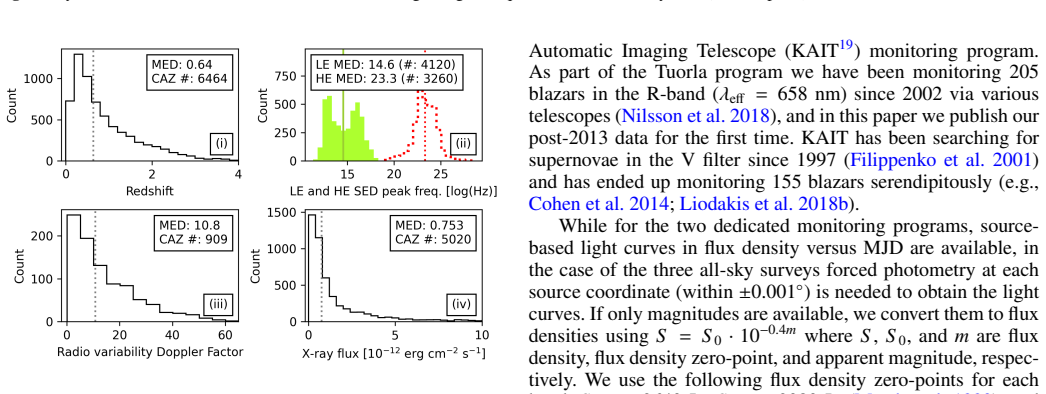
The paper presents the CAZ catalog of 7918 blazars and candidates together with their optical light curves, Bayesian blocks, and identified flaring periods. It reports four main results: optical flares generally rise faster than they decay, optical brightness and variability depend strongly on the synchrotron peak frequency, flat-spectrum radio quasars and BL Lac objects display comparable optical variability and flare properties when they share the same synchrotron peak frequency, and optical flare timescales shorten while amplitudes grow as the radio variability Doppler factor increases.
What carries the argument
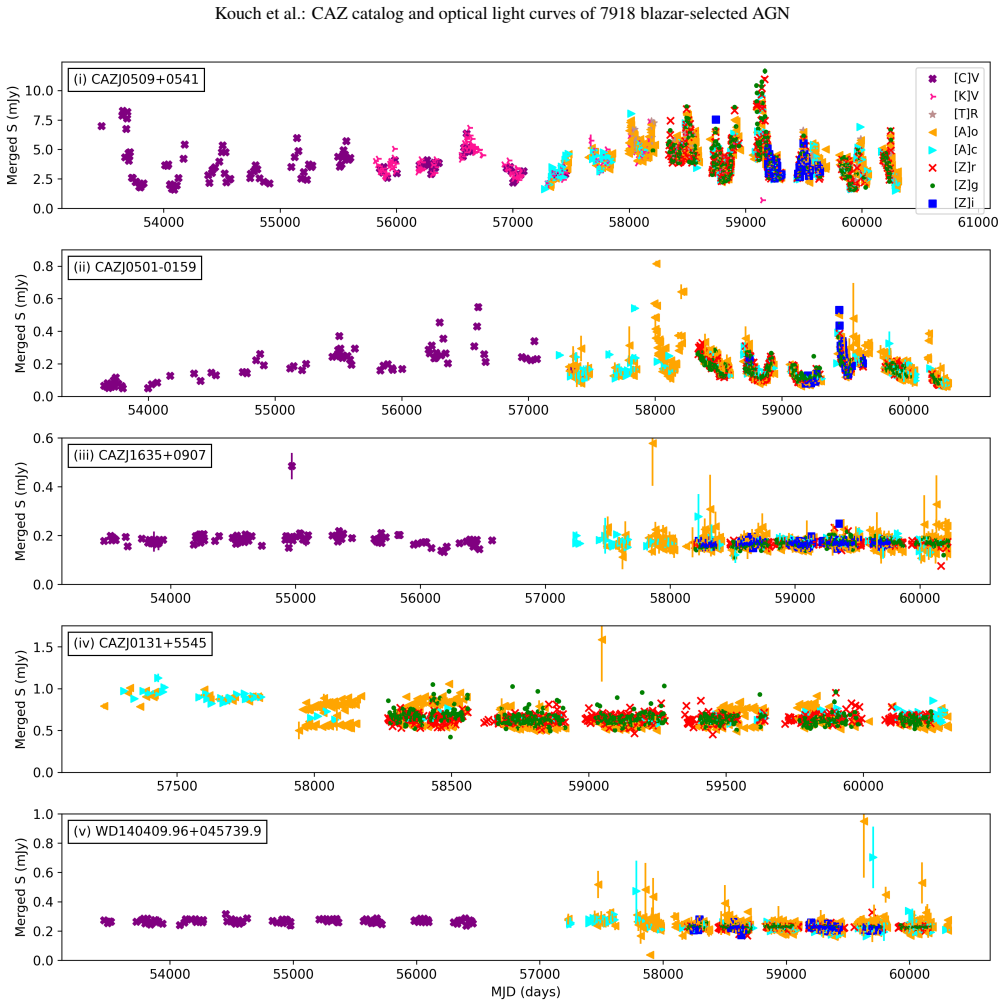
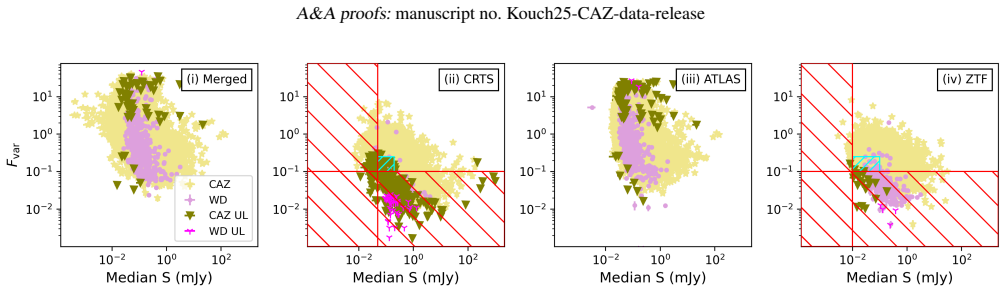
Nightly optical flux densities drawn from the CRTS, ATLAS, and ZTF all-sky surveys, processed with the Bayesian blocks algorithm to locate flaring periods within the light curves.
If this is right
- Optical flares in blazars rise more quickly than they fall on average.
- Optical brightness levels and the strength of variability both track the synchrotron peak frequency of each source.
- Flat-spectrum radio quasars and BL Lac objects exhibit nearly identical optical flare rise times, decay times, and amplitudes once they are compared at the same synchrotron peak frequency.
- Sources with larger radio variability Doppler factors display shorter but higher-amplitude optical flares.
Where Pith is reading between the lines
- The catalog size now supports statistical tests that separate the effects of viewing angle from changes in the intrinsic jet emission region.
- Cross-matching the optical flare times with simultaneous radio or gamma-ray monitoring could reveal whether the same events drive variability across wavebands.
- The observed trend with Doppler factor implies that future monitoring of newly discovered blazars can predict the expected optical flare duration from radio data alone.
- Extending the same light-curve extraction to newer survey releases would test whether the reported flare statistics remain stable over longer time baselines.
Load-bearing premise
The objects taken from prior blazar-dominated AGN samples are correctly identified as blazars or candidates and the nightly optical measurements from the surveys are free of large calibration errors or source confusion.
What would settle it
Re-processing a sizable subset of the light curves with an independent photometric calibration or re-classifying a sample of sources that eliminates the reported faster rise times or the correlation with synchrotron peak frequency would falsify the central findings.
Figures





read the original abstract
Active galactic nuclei (AGN) are some of the brightest and most variable objects in the Universe. Those with relativistic jets observed at small viewing angles are blazars. Due to Doppler boosting, blazars exhibit extreme stochastic variability. While the origin of this variability is thought to be changes in the accretion flow and jet dynamics, much about blazar variability remains unknown. In this paper we use several blazar-dominated AGN samples to form a catalog of 7918 blazars and candidates -- the largest to date. We also collected source types, redshifts, peak frequencies of the spectral energy distribution, radio variability Doppler factors, and X-ray flux densities for as many sources as possible. We used all-sky surveys (CRTS, ATLAS, and ZTF, abbreviated as ``CAZ'') to extract their optical multiband flux density on a nightly basis between 2007 and 2023, and we constructed as long and as high cadence light curves as possible for as many sources as attainable. We quantified the variability of the light curves and applied the Bayesian blocks algorithm to determine their flaring periods. The CAZ catalog and light curves as well as the corresponding Bayesian blocks and flaring periods are all provided in the accompanying electronic tables, with the goal of enabling analyses involving jetted AGN variability with unprecedented sample sizes. Overall, we find (1) optical flares generally have a faster rise than decay; (2) optical brightness and variability are strongly dependent on the synchrotron peak frequency; (3) flat spectrum radio quasars and BL Lac objects have comparable optical variability and flare characteristics at the same synchrotron peak frequency; and (4) optical flare times tend to decrease while amplitudes increase with an increasing radio variability Doppler factor.
Editorial analysis
A structured set of objections, weighed in public.
Referee Report
Summary. The manuscript constructs the CAZ catalog of 7918 blazar-selected AGN by aggregating existing blazar-dominated samples and compiling ancillary data (types, redshifts, synchrotron peak frequencies, radio Doppler factors, X-ray fluxes). Nightly optical flux densities are extracted from CRTS, ATLAS, and ZTF surveys (2007–2023) to build light curves, to which the Bayesian blocks algorithm is applied to identify flaring intervals. The catalog, light curves, blocks, and flare parameters are released publicly. Four statistical results are reported: optical flares rise faster than they decay; brightness and variability correlate strongly with synchrotron peak frequency; FSRQs and BL Lacs exhibit comparable variability at fixed peak frequency; and flare timescales shorten while amplitudes grow with increasing radio Doppler factor.
Significance. If the input classifications and nightly CAZ photometry are reliable, the work supplies the largest public optical variability dataset for jetted AGN to date. The four headline trends provide direct observational constraints on jet physics, flare asymmetry, and Doppler boosting that can be compared against theoretical models. Public release of the full light-curve and flare tables is a clear community service that enables future statistical studies with unprecedented sample sizes.
major comments (2)
- [§2] §2 (Sample construction): The paper aggregates multiple pre-existing blazar catalogs without a quantitative assessment of classification purity or completeness; residual non-blazar contaminants or inconsistent type assignments would directly propagate into the reported synchrotron-peak and FSRQ/BL Lac comparisons.
- [§4.3] §4.3 (Light-curve extraction): Nightly flux densities from CRTS/ATLAS/ZTF are combined without an explicit cross-calibration or confusion analysis; any survey-specific zero-point offsets or source-blending effects in dense fields would affect the measured flare amplitudes and rise/decay times that underpin results (1) and (4).
minor comments (3)
- [Table 1] Table 1: the column descriptions for the Bayesian-block start/stop times should explicitly state the time system (MJD or JD) and whether the blocks are computed on the combined CAZ light curve or per survey.
- [Figure 7] Figure 7: the legend for the FSRQ vs. BL Lac symbols is too small; enlarging it and adding a note on the number of sources in each bin would improve readability.
- [§5.2] The text in §5.2 refers to “optical brightness” but the plotted quantity is actually the median flux density; consistent terminology would avoid confusion.
Simulated Author's Rebuttal
We thank the referee for the careful review and recommendation for minor revision. We address each major comment below and have revised the manuscript to incorporate clarifications and additional discussion where appropriate.
read point-by-point responses
-
Referee: [§2] §2 (Sample construction): The paper aggregates multiple pre-existing blazar catalogs without a quantitative assessment of classification purity or completeness; residual non-blazar contaminants or inconsistent type assignments would directly propagate into the reported synchrotron-peak and FSRQ/BL Lac comparisons.
Authors: We agree that the current manuscript does not include a new, self-contained quantitative assessment of overall purity and completeness for the aggregated sample. The CAZ catalog is formed by combining established blazar-dominated samples from the literature, each of which has been vetted and characterized in its original publication. To address the concern, we will expand §2 with a concise summary of the selection criteria and known limitations drawn from the source catalogs, including citations to any available purity or completeness studies. We will also note how residual contamination or type inconsistencies could affect the synchrotron-peak and FSRQ/BL Lac comparisons, thereby providing better context for the statistical results. revision: yes
-
Referee: [§4.3] §4.3 (Light-curve extraction): Nightly flux densities from CRTS/ATLAS/ZTF are combined without an explicit cross-calibration or confusion analysis; any survey-specific zero-point offsets or source-blending effects in dense fields would affect the measured flare amplitudes and rise/decay times that underpin results (1) and (4).
Authors: We acknowledge that §4.3 does not present an explicit cross-calibration between the three surveys or a dedicated confusion analysis. Each survey's nightly photometry is adopted as published, with the analysis emphasizing relative variability and flare detection within individual light-curve segments. We will revise §4.3 to describe the data ingestion procedure more explicitly, report any internal consistency checks performed on overlapping epochs, and add a brief discussion of possible zero-point offsets and blending effects in crowded fields. These additions will clarify the robustness of the flare rise/decay times and amplitudes used in results (1) and (4). revision: yes
Circularity Check
No significant circularity; results are direct observational statistics
full rationale
The paper assembles a catalog from pre-existing blazar-dominated AGN samples, extracts nightly optical flux densities from public all-sky surveys (CRTS, ATLAS, ZTF), computes standard variability metrics, and applies the off-the-shelf Bayesian blocks algorithm to segment light curves into flaring periods. The four headline results are purely statistical summaries of these measured quantities (rise/decay asymmetry, synchrotron-peak dependence, FSRQ/BL Lac similarity at fixed peak frequency, and Doppler-factor trends). No model is fitted, no parameter is predicted from a self-defined quantity, and no load-bearing step reduces to a self-citation or ansatz. The derivation chain is therefore self-contained against external benchmarks.
Axiom & Free-Parameter Ledger
axioms (1)
- domain assumption Existing blazar classifications and auxiliary parameters (redshifts, peak frequencies, Doppler factors) from prior samples are sufficiently accurate for statistical use.
Lean theorems connected to this paper
-
IndisputableMonolith/CostJcost uniqueness (washburn_uniqueness_aczel) unclear?
unclearRelation between the paper passage and the cited Recognition theorem.
We quantify the variability of the light curves... using fractional variability (Fvar)...
What do these tags mean?
- matches
- The paper's claim is directly supported by a theorem in the formal canon.
- supports
- The theorem supports part of the paper's argument, but the paper may add assumptions or extra steps.
- extends
- The paper goes beyond the formal theorem; the theorem is a base layer rather than the whole result.
- uses
- The paper appears to rely on the theorem as machinery.
- contradicts
- The paper's claim conflicts with a theorem or certificate in the canon.
- unclear
- Pith found a possible connection, but the passage is too broad, indirect, or ambiguous to say the theorem truly supports the claim.
Forward citations
Cited by 1 Pith paper
-
VLTI-GRAVITY observations of blazars
First VLTI-GRAVITY near-infrared observations of blazars indicate possible detection of unresolved or partially resolved jet emission in Ton 599, though data cannot distinguish extended structure from instrumental coh...
Reference graph
Works this paper leans on
-
[1]
Abrahamyan, H. V ., Mickaelian, A. M., Paronyan, G. M., & Mikayelyan, G. A. 2019, Astronomische Nachrichten, 340, 437
work page 2019
-
[2]
Ackermann, M., Ajello, M., Allafort, A., et al. 2011, ApJ, 743, 171
work page 2011
- [3]
-
[4]
2025, arXiv e-prints, arXiv:2505.01832
Agudo, I., Liodakis, I., Otero-Santos, J., et al. 2025, arXiv e-prints, arXiv:2505.01832
-
[5]
Aharonian, F., Akhperjanian, A. G., Bazer-Bachi, A. R., et al. 2007, ApJ, 664, L71
work page 2007
- [6]
-
[7]
2007, ApJ, 669, 862 Astropy Collaboration, Price-Whelan, A
Albert, J., Aliu, E., Anderhub, H., et al. 2007, ApJ, 669, 862 Astropy Collaboration, Price-Whelan, A. M., Lim, P. L., et al. 2022, ApJ, 935, 167
work page 2007
-
[8]
Atwood, W. B., Abdo, A. A., Ackermann, M., et al. 2009, ApJ, 697, 1071 Balokovi´c, M., Paneque, D., Madejski, G., et al. 2016, ApJ, 819, 156
work page 2009
- [9]
- [10]
-
[11]
Bellm, E. C., Kulkarni, S. R., Graham, M. J., et al. 2019, PASP, 131, 018002
work page 2019
- [12]
-
[13]
Blandford, R. D. & Königl, A. 1979, ApJ, 232, 34
work page 1979
-
[14]
Blinov, D., Pavlidou, V ., Papadakis, I., et al. 2015, MNRAS, 453, 1669
work page 2015
-
[15]
Bonning, E., Urry, C. M., Bailyn, C., et al. 2012, ApJ, 756, 13 Böttcher, M. 2019, Galaxies, 7, 20
work page 2012
-
[16]
Caplar, N., Lilly, S. J., & Trakhtenbrot, B. 2017, ApJ, 834, 111
work page 2017
-
[17]
Carini, M. T., Walters, R., & Hopper, L. 2011, AJ, 141, 49
work page 2011
-
[18]
Cerutti, B., Werner, G. R., Uzdensky, D. A., & Begelman, M. C. 2012, ApJ, 754, L33
work page 2012
-
[19]
L., Arsioli, B., Giommi, P., Padovani, P., & Brandt, C
Chang, Y . L., Arsioli, B., Giommi, P., Padovani, P., & Brandt, C. H. 2019, A&A, 632, A77
work page 2019
-
[20]
Chatterjee, R., Bailyn, C. D., Bonning, E. W., et al. 2012, ApJ, 749, 191
work page 2012
-
[21]
Cohen, D. P., Romani, R. W., Filippenko, A. V ., et al. 2014, ApJ, 797, 137
work page 2014
-
[22]
2001, A&A, 371, 512 de Jaeger, T., Shappee, B
Costamante, L., Ghisellini, G., Giommi, P., et al. 2001, A&A, 371, 512 de Jaeger, T., Shappee, B. J., Kochanek, C. S., et al. 2023, MNRAS, 519, 6349
work page 2001
- [23]
-
[24]
Drake, A. J., Djorgovski, S. G., Mahabal, A., et al. 2009, ApJ, 696, 870
work page 2009
-
[25]
Eisenstein, D. J. & Hut, P. 1998, ApJ, 498, 137 Fichet de Clairfontaine, G., Meliani, Z., Zech, A., & Hervet, O. 2021, A&A, 647, A77
work page 1998
-
[26]
Filippenko, A. V ., Li, W. D., Treffers, R. R., & Modjaz, M. 2001, in Astronom- ical Society of the Pacific Conference Series, V ol. 246, IAU Colloq. 183: Small Telescope Astronomy on Global Scales, ed. B. Paczynski, W.-P. Chen, & C. Lemme, 121
work page 2001
- [27]
-
[28]
M., Perucho, M., Mimica, P., & Ros, E
Fromm, C. M., Perucho, M., Mimica, P., & Ros, E. 2016, A&A, 588, A101
work page 2016
-
[29]
Fuhrmann, L., Larsson, S., Chiang, J., et al. 2014, MNRAS, 441, 1899
work page 2014
-
[30]
Gehrels, N., Chincarini, G., Giommi, P., et al. 2004, ApJ, 611, 1005
work page 2004
-
[31]
Ghisellini, G., Righi, C., Costamante, L., & Tavecchio, F. 2017, MNRAS, 469, 255
work page 2017
-
[32]
Ghisellini, G., Tavecchio, F., Foschini, L., et al. 2010, MNRAS, 402, 497
work page 2010
- [33]
- [34]
-
[35]
Harris, C. R., Millman, K. J., van der Walt, S. J., et al. 2020, Nature, 585, 357
work page 2020
- [36]
-
[37]
Hickox, R. C., Mullaney, J. R., Alexander, D. M., et al. 2014, ApJ, 782, 9
work page 2014
- [38]
- [39]
-
[40]
Hovatta, T., Lindfors, E., Kiehlmann, S., et al. 2021, A&A, 650, A83
work page 2021
- [41]
-
[42]
Hovatta, T., Tornikoski, M., Lainela, M., et al. 2007, A&A, 469, 899
work page 2007
-
[43]
Hovatta, T., Valtaoja, E., Tornikoski, M., & Lähteenmäki, A. 2009, A&A, 494, 527
work page 2009
-
[44]
Hunter, J. D. 2007, Computing in Science and Engineering, 9, 90
work page 2007
- [45]
-
[46]
2016, ApJ, 833, 77 Ivezi´c, Ž., Kahn, S
Itoh, R., Nalewajko, K., Fukazawa, Y ., et al. 2016, ApJ, 833, 77 Ivezi´c, Ž., Kahn, S. M., Tyson, J. A., et al. 2019, ApJ, 873, 111
work page 2016
- [47]
-
[48]
2018, Master’s thesis, University of Turku
Jormanainen, J. 2018, Master’s thesis, University of Turku
work page 2018
- [49]
-
[50]
Jormanainen, J., Hovatta, T., Lindfors, E., et al. 2025, A&A, 694, A206
work page 2025
-
[51]
Jorstad, S. G., Marscher, A. P., Raiteri, C. M., et al. 2022, Nature, 609, 265
work page 2022
-
[52]
Jorstad, S. G., Marscher, A. P., Smith, P. S., et al. 2013, ApJ, 773, 147
work page 2013
-
[53]
C., Bechtold, J., & Siemiginowska, A
Kelly, B. C., Bechtold, J., & Siemiginowska, A. 2009, ApJ, 698, 895
work page 2009
-
[54]
Kembhavi, A. K. & Narlikar, J. V . 1999, Quasars and active galactic nuclei : an introduction
work page 1999
-
[55]
Kotilainen, J. K., Falomo, R., & Scarpa, R. 1998, A&A, 336, 479
work page 1998
-
[56]
Kovalev, Y . Y ., Petrov, L., Fomalont, E. B., & Gordon, D. 2007, AJ, 133, 1236 Lähteenmäki, A. & Valtaoja, E. 2003, ApJ, 590, 95 León-Tavares, J., Valtaoja, E., Tornikoski, M., Lähteenmäki, A., & Nieppola, E. 2011, A&A, 532, A146
work page 2007
-
[57]
J., Hovatta, T., Nilsson, K., et al
Lindfors, E. J., Hovatta, T., Nilsson, K., et al. 2016, A&A, 593, A98
work page 2016
- [58]
-
[59]
2025, arXiv e-prints, arXiv:2505.13603
Liodakis, I., Zhang, H., Boula, S., et al. 2025, arXiv e-prints, arXiv:2505.13603
-
[60]
Lister, M. L. & Marscher, A. P. 1997, ApJ, 476, 572 MAGIC Collaboration, Abe, S., Abhir, J., et al. 2024, A&A, 685, A117
work page 1997
- [61]
-
[62]
Marscher, A. P. 2014, ApJ, 780, 87
work page 2014
-
[63]
Marshall, H. L., Liodakis, I., Marscher, A. P., et al. 2024, ApJ, 972, 74
work page 2024
- [64]
-
[65]
Mead, A. R. G., Ballard, K. R., Brand, P. W. J. L., et al. 1990, A&AS, 83, 183
work page 1990
-
[66]
Meng, N., Zhang, X., Wu, J., Ma, J., & Zhou, X. 2018, ApJS, 237, 30
work page 2018
- [67]
- [68]
- [69]
-
[70]
Nieppola, E., Hovatta, T., Tornikoski, M., et al. 2009, AJ, 137, 5022
work page 2009
- [71]
- [72]
-
[73]
A., Becerra González, J., et al
Otero-Santos, J., Acosta-Pulido, J. A., Becerra González, J., et al. 2022, MN- RAS, 511, 5611
work page 2022
-
[74]
A., Becerra González, J., et al
Otero-Santos, J., Acosta-Pulido, J. A., Becerra González, J., et al. 2023, MN- RAS, 523, 4504
work page 2023
-
[75]
Paggi, A., Kouch, P. M., Liodakis, I., & et al. 2025, Submitted to A&A
work page 2025
-
[76]
Paliya, V . S., Stalin, C. S., Ajello, M., & Kaur, A. 2017, ApJ, 844, 32
work page 2017
- [77]
-
[78]
M., Phillips, C., & Horiuchi, S
Petrov, L., de Witt, A., Sadler, E. M., Phillips, C., & Horiuchi, S. 2019, MNRAS, 485, 88 Planck Collaboration, Ade, P. A. R., Aghanim, N., et al. 2014, A&A, 571, A16
work page 2019
-
[79]
Potter, W. J. 2018, MNRAS, 473, 4107
work page 2018
-
[80]
Poutanen, J., Zdziarski, A. A., & Ibragimov, A. 2008, MNRAS, 389, 1427
work page 2008
discussion (0)
Sign in with ORCID, Apple, or X to comment. Anyone can read and Pith papers without signing in.