Paramagnetic electron-nuclear spin entanglement in HoCo2Zn20
Pith reviewed 2026-05-18 05:17 UTC · model grok-4.3
The pith
The true paramagnetic ground state in HoCo2Zn20 is a quasi-sextet formed by entanglement of the f-electron spin and the holmium nuclear spin.
A machine-rendered reading of the paper's core claim, the machinery that carries it, and where it could break.
Core claim
Analyses of magnetization and specific heat data determine the cubic CEF parameters, magnetic exchange constant, and hyperfine coupling constant. These show that the Gamma5 CEF ground state is split by the hyperfine coupling into an energy width of 1.3 K at 0 T. The true paramagnetic ground state is therefore a quasi-sextet arising primarily from entanglement between the f-electron effective spin S = 1 and the 165Ho nuclear spin I = 7/2. Depending on the CEF parameters, the paramagnetic ground state can switch to an electron-nuclear coupled dectet.
What carries the argument
Hyperfine coupling between the 4f magnetic moment and the 165Ho nuclear spin that splits the Gamma5 CEF level into a quasi-sextet.
If this is right
- The Gamma5 CEF ground state splits into states with a 1.3 K energy width at zero magnetic field.
- The ground state is a quasi-sextet dominated by entanglement of S=1 electron spin and I=7/2 nuclear spin.
- The paramagnetic ground state can change to an electron-nuclear coupled dectet when CEF parameters are varied.
- Accurate identification of the full electron-nuclear level scheme is required to explain low-temperature properties in rare-earth compounds that contain spin-active nuclei.
Where Pith is reading between the lines
- Similar electron-nuclear entanglement may need to be considered in other cubic rare-earth compounds with large nuclear spins when interpreting data below 2 K.
- Experiments that directly probe the nuclear spin polarization or the detailed level spacing below 1 K could test the quasi-sextet structure.
- The possibility of switching between sextet and dectet ground states suggests that chemical substitution or pressure could be used to tune between different entangled states.
Load-bearing premise
The Gamma5 level is the crystalline-electric-field ground state and the hyperfine interaction splits this level as a simple perturbation without mixing in higher CEF states.
What would settle it
Low-temperature specific heat or magnetization data showing a different degeneracy or a splitting width clearly different from 1.3 K at zero field would contradict the claimed quasi-sextet ground state.
Figures




read the original abstract
We investigated electron-nuclear spin entanglement in the paramagnetic ground state of the Ho-based cubic compound HoCo2Zn20. From analyses of magnetization and specific heat data, we determined the cubic crystalline electric field (CEF) parameters, the magnetic exchange constant, and the hyperfine coupling constant between the 4f magnetic moment and the 165Ho nuclear spin. Our results show that the Gamma5 CEF ground state is split by the hyperfine coupling, with an energy width of 1.3 K at 0 T, and that the true paramagnetic ground state is a quasi-sextet arising primarily from entanglement between the f-electron effective spin S = 1 and the 165Ho nuclear spin I = 7/2. We further demonstrate that, depending on the CEF parameters, the paramagnetic ground state can switch to an electron-nuclear coupled dectet. These findings underscore the importance of accurately identifying the electron-nuclear level scheme for understanding the low-temperature properties of rare-earth compounds containing spin-active nuclei.
Editorial analysis
A structured set of objections, weighed in public.
Referee Report
Summary. The manuscript investigates electron-nuclear spin entanglement in the paramagnetic ground state of HoCo2Zn20. From fits to magnetization and specific heat data, the authors extract cubic CEF parameters, a magnetic exchange constant, and the hyperfine coupling constant. They conclude that the Gamma5 CEF ground state is split by hyperfine coupling into a 1.3 K wide quasi-sextet arising from entanglement between the effective f-electron spin S=1 and the 165Ho nuclear spin I=7/2, and that the ground state can switch to an electron-nuclear dectet depending on the CEF parameters.
Significance. If the central analysis holds, the work highlights how hyperfine interactions can entangle electronic and nuclear degrees of freedom to produce a composite paramagnetic ground state in rare-earth compounds containing spin-active nuclei. This has implications for the interpretation of low-temperature thermodynamic and magnetic properties in such systems, and the parameter-dependent switching between sextet and dectet states illustrates the sensitivity of the ground state to CEF details.
major comments (2)
- [Results section on thermodynamic data analysis] The extraction of cubic CEF parameters, magnetic exchange constant, and hyperfine coupling constant from magnetization and specific heat data is presented without error bars, raw data, fitting details, or goodness-of-fit metrics. This is load-bearing for the central claim because the identification of the Gamma5 level as the isolated ground state (split by 1.3 K hyperfine interaction) rests directly on these fitted values.
- [Discussion of Gamma5 splitting and quasi-sextet formation] The perturbation treatment of hyperfine coupling on an isolated Gamma5 triplet assumes the gap to the first excited CEF level greatly exceeds the 1.3 K hyperfine scale so that mixing remains negligible. The manuscript does not explicitly verify this condition using the fitted CEF parameters (e.g., by reporting the calculated gap and comparing it to the hyperfine width), which is required to confirm that the true ground state is the claimed quasi-sextet.
minor comments (2)
- An energy-level diagram showing the hyperfine-split quasi-sextet (and the alternative dectet) would clarify the entanglement picture for readers.
- [Abstract and main text] The abstract states an energy width of 1.3 K but does not specify whether this is the full splitting or a characteristic scale; a precise definition in the main text would help.
Simulated Author's Rebuttal
We thank the referee for the careful and constructive review of our manuscript. We address each major comment below, providing clarifications and indicating where revisions will be made to improve the rigor and transparency of the analysis.
read point-by-point responses
-
Referee: [Results section on thermodynamic data analysis] The extraction of cubic CEF parameters, magnetic exchange constant, and hyperfine coupling constant from magnetization and specific heat data is presented without error bars, raw data, fitting details, or goodness-of-fit metrics. This is load-bearing for the central claim because the identification of the Gamma5 level as the isolated ground state (split by 1.3 K hyperfine interaction) rests directly on these fitted values.
Authors: We acknowledge that additional details on the fitting procedure would enhance the presentation. The magnetization and specific heat datasets are shown with overlaid model curves in the relevant figures. In the revised manuscript we will report the fitted parameters together with their uncertainties from the least-squares minimization, include the reduced chi-squared values as goodness-of-fit metrics, and add a brief description of the simultaneous fitting protocol (including the relative weighting of the two datasets). Raw data files will be provided in the supplementary information or made available upon request. revision: yes
-
Referee: [Discussion of Gamma5 splitting and quasi-sextet formation] The perturbation treatment of hyperfine coupling on an isolated Gamma5 triplet assumes the gap to the first excited CEF level greatly exceeds the 1.3 K hyperfine scale so that mixing remains negligible. The manuscript does not explicitly verify this condition using the fitted CEF parameters (e.g., by reporting the calculated gap and comparing it to the hyperfine width), which is required to confirm that the true ground state is the claimed quasi-sextet.
Authors: We agree that an explicit check of the perturbation validity is warranted. Using the fitted cubic CEF parameters, the lowest excited level lies approximately 8 K above the Gamma5 ground state, which is more than six times the 1.3 K hyperfine width. This separation ensures that mixing between the ground and excited manifolds is negligible at the temperatures of interest. We will add this numerical comparison, together with a short statement justifying the isolated-Gamma5 approximation, to the revised text. revision: yes
Circularity Check
No significant circularity; derivation self-contained against thermodynamic data
full rationale
The paper fits cubic CEF parameters, magnetic exchange constant, and hyperfine coupling constant directly to experimental magnetization and specific-heat curves. The Gamma5 ground-state identification and its hyperfine-induced splitting into a 1.3 K quasi-sextet then follow by constructing and diagonalizing the full electron-nuclear Hamiltonian with those fitted values. This is a standard forward calculation from independently constrained parameters; the low-energy spectrum is not presupposed but emerges from the fit. No self-definitional loop, no fitted quantity relabeled as an independent prediction, and no load-bearing self-citation or imported uniqueness theorem appears. The chain remains falsifiable against the same thermodynamic datasets and is therefore scored as non-circular.
Axiom & Free-Parameter Ledger
free parameters (3)
- cubic CEF parameters
- magnetic exchange constant
- hyperfine coupling constant
axioms (2)
- domain assumption The Gamma5 level is the crystalline-electric-field ground state of the Ho 4f electrons in cubic symmetry.
- domain assumption Hyperfine coupling acts as a weak perturbation that splits but does not strongly mix higher CEF levels.
Lean theorems connected to this paper
-
IndisputableMonolith/Cost/FunctionalEquation.leanwashburn_uniqueness_aczel unclear?
unclearRelation between the paper passage and the cited Recognition theorem.
the Gamma5 CEF ground state is split by the hyperfine coupling... effective spin S=1 and the 165Ho nuclear spin I=7/2... F=5/2 sextet
-
IndisputableMonolith/Foundation/AlexanderDuality.leanalexander_duality_circle_linking unclear?
unclearRelation between the paper passage and the cited Recognition theorem.
Hcubic_CEF = W {x O4^0 +5 O4^4 /60 + (1-|x|) O6^0 -21 O6^4 /13860}
What do these tags mean?
- matches
- The paper's claim is directly supported by a theorem in the formal canon.
- supports
- The theorem supports part of the paper's argument, but the paper may add assumptions or extra steps.
- extends
- The paper goes beyond the formal theorem; the theorem is a base layer rather than the whole result.
- uses
- The paper appears to rely on the theorem as machinery.
- contradicts
- The paper's claim conflicts with a theorem or certificate in the canon.
- unclear
- Pith found a possible connection, but the passage is too broad, indirect, or ambiguous to say the theorem truly supports the claim.
Reference graph
Works this paper leans on
-
[1]
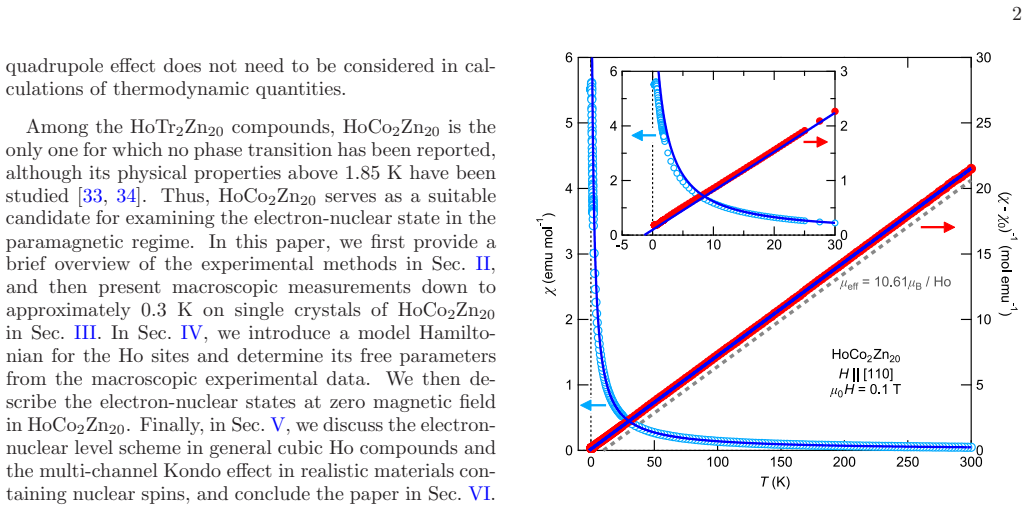
The inset shows an enlarged view of χ and ( χ − χ 0)− 1 below 30 K
The blue solid line represents a fit to the modified Curie–Weiss law, and the gray dashed line indicates the expected slope of the inverse susceptibility for free Ho 3+ ions. The inset shows an enlarged view of χ and ( χ − χ 0)− 1 below 30 K. TABLE I. Effective magnetic moment µ eff , Curie–Weiss tem- perature θC, and temperature-independent susceptibility χ ...
-
[2]
10.58(2) -1.4(3) 2.1(1)
-
[3]
10.58(2) -1.7(3) 5.1(1) III. EXPERIMENTAL RESULTS A. Overview of HoCo 2Zn20 Figure 1 shows the temperature dependence of the magnetization divided by the applied magnetic field µ 0H = 0 . 1 T in HoCo 2Zn20. In this paper, we de- fine χ as M/H for H = 0 . 1 T, and omit the data for H ∥ [100] and [111] from Fig. 1, since χ measured by MPMS is nearly isotropic...
-
[4]
7(a) and is used for the level- scheme analysis in Sec
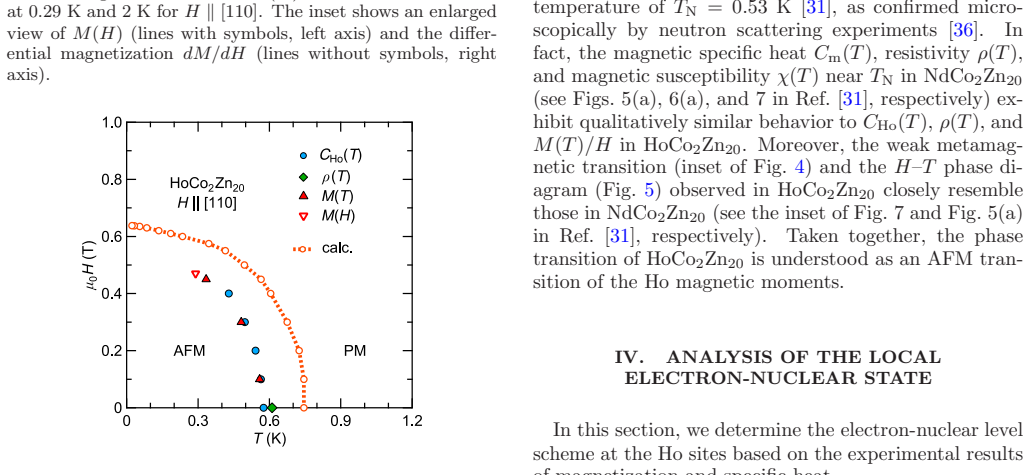
is shown in Fig. 7(a) and is used for the level- scheme analysis in Sec. IV. The procedure for estimating Cnonmag + Cnuc Co + Cnuc Zn from LuCo 2Zn20 is described in Appendix B 2. B. Phase transition of HoCo 2Zn20 To investigate the nature of the low-temperature phase below 0.6 K, we performed specific heat and magneti- zation measurements under weak magne...
-
[5]
using the refined parameters given in Secs. IV B and IV C. maximum in M (T ), also observed at 0.45 T, suggests the onset of antiferromagnetic (AFM) order. At 0.55 T, M (T ) increases monotonically upon cooling down to the base temperature of 0.28 K. We also measured the field dependence of the magnetization M (H) along the [110] direction at 0.29 K and 2 K...
-
[6]
Details of each term are given below
correspond, respectively, to the crystalline 5 electric field (CEF) term, the Zeeman term for 4 f elec- trons, the nuclear Zeeman term, the hyperfine interac- tion, and the intersite exchange interaction. Details of each term are given below. The term Hcubic CEF represents the CEF Hamiltonian for the Ho 3+ ion in cubic symmetry and is expressed as [ 38] Hcu...
-
[7]
Since the enhancement of CHo due to FIG. 6. Magnetization curves of HoCo 2Zn20 at (a) 2 K and (b) 10 K. Open circles represent the experimental data, and soli d lines indicate the calculated results based on the Hamilton ian excluding nuclear spin terms (see Sec. IV B for details). nuclear spin contributions becomes significant below ap- proximately 2 K (F...
-
[8]
5) are well reproduced using the refined parameters
and the H–T phase diagram (Fig. 5) are well reproduced using the refined parameters. D. Level scheme of Ho sites at 0 T Since all free parameters in Eq. ( 4) have been deter- mined, we calculate the energy-level scheme of the Ho sites at 0 T in the paramagnetic state by diagonalizing the single-site Hamiltonian at 0 T, given in Eq. (
-
[9]
The resulting level scheme is shown in Fig
as H0T = Hcubic CEF + AHFI ·J. The resulting level scheme is shown in Fig. 8(a). In the absence of both CEF ef- fects and hyperfine coupling, the ground state of the 4 f 10 configuration is a J = 8 multiplet, and the 165Ho nuclear spin I = 7/ 2 remains degenerate. Thus, the ground state consists of 17 × 8 = 136 degenerate eigenstates. Under the cubic CEF, t...
-
[10]
Experimental results Figure 11 shows the temperature dependence of the observed specific heat, Cobs(T ), in LuCo 2Zn20, a non- magnetic reference compound for HoCo 2Zn20. The mag- netic field was applied along [110], as in the specific heat measurements of HoCo 2Zn20 shown in Fig
-
[11]
Compar- ing Cobs at 0, 1, 4, 6, and 9 T at the same tempera- ture, we find that Cobs increases with increasing field, and this increase becomes more pronounced at lower temper- atures. These behaviors indicate the presence of nuclear specific heat arising from Lu, Co, and Zn isotopes listed in Table II. However, comparison of the vertical scales in Fig. 2(a)...
-
[12]
Estimation of Cnonmag + C nuc Co + C nuc Zn Although Cnuc Co + Cnuc Zn in Eq. (
-
[13]
is negligible in our study, Cnonmag + Cnuc Co + Cnuc Zn of HoCo 2Zn20 can be es- timated using the specific heat data of LuCo 2Zn20. The observed specific heat of LuCo 2Zn20, Cobs, can be de- composed into four contributions: Cobs = Cnonmag + Cnuc Lu + Cnuc Co + Cnuc Zn , (B1) FIG. 10. Comparison of (a) χ − 1(T ), (b) χ (T ), and (c) M (H) for H ∥ [110] bet...
-
[14]
Method in Section IV B In Sec. IV B, the cubic CEF parameters W and x, along with the magnetic exchange constant Jex, were refined by comparing the observed magnetization curves M (H) at 2 K and 10 K for H ∥ [100], [110], and [111] (Fig. 6) with calculations based on a model without Ho nuclear spins. The six M (H) curves, sampled every 0.5 T from 0.5 T to ...
-
[15]
Method in Section IV C In Sec. IV C, the hyperfine coupling constant AHF was refined by comparing the specific heat CHo(T ) below 3 K at 1, 4, and 9 T. As shown by the open circles in Fig. 7(a), five equally spaced interpolated points of CHo(T ) on a logarithmic temperature scale between 0.38 K and 3 K were used for this refinement. We optimized AHF with the J...
work page 2000
-
[16]
by substituting α = α ′, and the eigenenergy of the non-interacting octet are plotted as closed circles in Fig. 8(b). (iv) Γ 3 ⊕ Γ 5 subspace: The coefficients of the Γ 3 and Γ 5 wavefunctions for x = 2/ 3 are (a1, a 2, a 3) = 1 16 ( √ 5 2 , √ 91, − √ 286 2 ) , (D15) (b1, b 2) = ( d1, d 2) = ( 1√ 2 , 0 ) , (D16) (c1, c 2, c 3, c 4) = 1 32 √ 2 ( 3 √ 15, √ 45...
-
[17]
(D20) Therefore, we must consider the composite state formed by coupling the I = 7/ 2 nuclear spin with the direct-sum space Γ 3 ⊕ Γ 5. Numerical diagonalization of the AHFI ·J matrix of size 40 × 40 shows that the 40-fold manifold splits into seven quartets and six doublets. The eigenen- ergies, shown as triangles in Fig. 8(b), are ε/A HF = − 24. 7 (4), ...
- [18]
-
[19]
6 (4), where the numbers in parentheses indicate de- generacy
-
[20]
P. Santini, R. L´ emanski, and P. Erd˝ os, Magnetism of actinide compounds, Adv. Phys. 48, 537 (1999)
work page 1999
-
[21]
E. Gati, B. Schmidt, S. L. Bud’ko, A. P. Mackenzie, 13 and P. C. Canfield, Controlling crystal-electric field level s through symmetry-breaking uniaxial pressure in a cubic super heavy fermion, npj Quantum Mater. 8, 69 (2023)
work page 2023
-
[22]
Y. Cai, W. Ren, X. Dai, J. Kang, W. Zhuo, M. Xie, A. Zhang, J. Ji, F. Jin, Z. Zhang, and Q. Zhang, Crystalline electric field excitations and their nonlinear splitting under magnetic fields in YbOCl, Phys. Rev. Res. 6, 043061 (2024)
work page 2024
-
[23]
E. Wang, M. Zhang, C. An, Y. Zhou, Y. Zhou, J. Zhou, and Z. Yang, Crystal electric field excitation and vibra- tional properties of the quantum spin liquid candidate LiYbSe2, Phys. Rev. B 109, 174101 (2024)
work page 2024
-
[24]
R. Yamamoto, M. D. Le, D. T. Adroja, Y. Shimura, T. Takabatake, and T. Onimaru, Inelastic neutron scat- tering study of crystalline electric field excitations in the caged compounds Nd T2Zn20 (T = Co, Rh, and Ir), Phys. Rev. B 107, 075114 (2023)
work page 2023
-
[25]
V. K. Anand, D. T. Adroja, C. Ritter, D. Das, H. S. Nair, A. Bhattacharyya, L. Liborio, S. Sturniolo, F. L. Pratt, D. Le, G. Andre, H. Luetkens, A. D. Hillier, and Z. Hossain, Magnetic structure and crystal field states of Pr2Pd3Ge5: µ SR and neutron scattering investigations, Phys. Rev. B 107, 104412 (2023)
work page 2023
-
[26]
M. Tsukagoshi, S. Kishida, K. Kurauchi, D. Ito, K. Kubo, T. Matsumura, Y. Ikeda, S. Nakamura, and S. Ohara, Crystal field excitation in the chiral helimag- net YbNi 3Al9, Phys. Rev. B 107, 104425 (2023)
work page 2023
-
[27]
D. Ueta, Y. Iwata, R. Kobayashi, K. Kuwahara, T. Masuda, and S. Itoh, Neutron scattering study on dimerized 4 f 1 intermetallic compound Ce 5Si3, Phys. Rev. B 109, 205127 (2024)
work page 2024
-
[28]
X. Y. Zheng, D. T. Adroja, B. Chevalier, Z. Y. Shan, A. D. Hillier, H. Q. Yuan, and M. Smidman, Inelas- tic neutron scattering and muon spin relaxation inves- tigations of the deuterated Kondo lattices CeNiSnD x, Phys. Rev. B 109, 064401 (2024)
work page 2024
-
[29]
H. Yamauchi, N. Metoki, R. Watanuki, T. Hong, J. A. Fernandez-Baca, M. Hagihala, T. Masuda, H. Yoshizawa, and S. Itoh, Neutron Spectroscopy Study on Crystalline Electric Field Excitations in NdB 4, J. Phys. Soc. Jpn. 94, 054705 (2025)
work page 2025
-
[30]
G. Zhao, H. Li, W. Lin, Q. Ren, J. Denlinger, Y. D. Chuang, X. Zhang, L. A. Wray, and L. Miao, Determination of the crystal-field splitting of the 4f 1 state in samarium-alloyed cerium hexaboride, Phys. Rev. B 107, 245149 (2023)
work page 2023
-
[31]
A. Amorese, P. Hansmann, A. Marino, P. K¨ orner, T. Willers, A. Walters, K.-J. Zhou, K. Kummer, N. B. Brookes, H.-J. Lin, C.-T. Chen, P. Lejay, M. W. Haverkort, L. H. Tjeng, and A. Severing, Orbital selective coupling in CeRh 3B2: Coexistence of high Curie and high Kondo temperatures, Phys. Rev. B 107, 115164 (2023)
work page 2023
-
[32]
D. S. Christovam, A. Marino, J. Falke, C.-E. Liu, C.-F. Chang, C.-Y. Kuo, O. Stockert, S. Wirth, M. W. Haverkort, G. Zwicknagl, A. Severing, P. F. S. Rosa, A. M. Caffer, M. H. Carvalho, and P. G. Pagliuso, X-ray spectroscopic investigation of crystal fields in Ce 2Rh1− xIrxIn8 heavy fermions, Phys. Rev. B 110, 075161 (2024)
work page 2024
-
[33]
Z. Dun, X. Bai, J. A. M. Paddison, E. Hollingworth, N. P. Butch, C. D. Cruz, M. B. Stone, T. Hong, F. Demmel, M. Mourigal, and H. Zhou, Quantum Ver- sus Classical Spin Fragmentation in Dipolar Kagome Ice Ho3Mg2Sb3O14, Phys. Rev. X 10, 031069 (2020)
work page 2020
-
[34]
J. Gronemann, S. Chattopadhyay, T. Gottschall, E. Osmic, A. T. M. N. Islam, V. K. Anand, B. Lake, H. Kaneko, H. Suzuki, J. Wosnitza, and T. Herrmannsd¨ orfer, Impact of hyperfine contribu- tions on the ground state of spin-ice compounds, Phys. Rev. B 108, 214412 (2023)
work page 2023
-
[35]
H. Eisenlohr and M. Vojta, Limits to mag- netic quantum criticality from nuclear spins, Phys. Rev. B 103, 064405 (2021)
work page 2021
- [36]
-
[37]
R. D. McKenzie and P. C. E. Stamp, Thermodynam- ics of a quantum Ising system coupled to a spin bath, Phys. Rev. B 97, 214430 (2018)
work page 2018
-
[38]
M. Libersky, R. D. McKenzie, D. M. Silevitch, P. C. E. Stamp, and T. F. Rosenbaum, Direct Observation of Col- lective Electronuclear Modes about a Quantum Critical Point, Phys. Rev. Lett. 127, 207202 (2021)
work page 2021
- [39]
- [40]
-
[41]
L. V. Levitin, J. Knapp, P. Knappov´ a, M. Lucas, J. Ny´ eki, P. Heikkinen, V. Antonov, A. Casey, A. F. Ho, P. Coleman, C. Geibel, A. Steppke, K. Kliemt, C. Krell- ner, M. Brando, and J. Saunders, Odd-parity supercon- ductivity underpinned by antiferromagnetism in heavy fermion metal YbRh 2Si2, arXiv:2502.06420
- [42]
-
[43]
G. S. Shakurov, M. V. Vanyunin, B. Z. Malkin, B. Bar- bara, R. Y. Abdulsabirov, and S. L. Korableva, Direct measurements of anticrossings of the electron-nuclear en- ergy levels in LiYF 4:Ho3+ with submillimeter EPR spec- troscopy, Appl. Magn. Reson. 28, 251 (2005)
work page 2005
-
[44]
A. Beckert, M. Grimm, R. I. Hermans, J. R. Free- man, E. H. Linfield, A. G. Davies, M. M¨ uller, H. Sigg, S. Gerber, G. Matmon, and G. Aeppli, Precise determi- nation of the low-energy electronuclear Hamiltonian of LiY1− xHoxF4, Phys. Rev. B 106, 115119 (2022)
work page 2022
-
[45]
Lide, CRC Handbook of Chemistry and Physics , edited by J
David R. Lide, CRC Handbook of Chemistry and Physics , edited by J. R. Rumble (CRC Press, Boca Raton, 2024) pp. 14–57
work page 2024
- [46]
-
[47]
T. Onimaru, K. T. Matsumoto, Y. F. Inoue, K. Umeo, T. Sakakibara, Y. Karaki, M. Kub- ota, and T. Takabatake, Antiferroquadrupolar Or- dering in a Pr-Based Superconductor PrIr 2Zn20, Phys. Rev. Lett. 106, 177001 (2011)
work page 2011
-
[48]
T. Onimaru, N. Nagasawa, K. T. Matsumoto, K. Wakiya, K. Umeo, S. Kittaka, T. Sakakibara, Y. Mat- sushita, and T. Takabatake, Simultaneous superconduct- ing and antiferroquadrupolar transitions in PrRh 2Zn20, 14 Phys. Rev. B 86, 184426 (2012)
work page 2012
- [49]
-
[50]
R. Yamamoto, T. Onimaru, R. J. Yamada, Y. Ya- mane, Y. Shimura, K. Umeo, and T. Takabatake, Antiferromagnetic Order of Nd T2Zn20 (T = Co and Rh) with the Kramers Γ 6 Doublet Ground State, J. Phys. Soc. Jpn. 88, 044703 (2019)
work page 2019
-
[51]
A. Abragam, The Principles of Nuclear Magnetism , In- ternational series of monographs on physics (Oxford Uni- versity Press, 1961) p. 166
work page 1961
-
[52]
Jia, Magnetic properties of RT 2Zn20 R = rare earth, T = Fe, Co, Ru, Rh, Os and Ir, Ph.D
S. Jia, Magnetic properties of RT 2Zn20 R = rare earth, T = Fe, Co, Ru, Rh, Os and Ir, Ph.D. thesis, Iowa State University, 2008, https://dr.lib.iastate.edu/entities/publication/1c133771- 1dc8-4b68-a8d2-498cc9f30455
work page 2008
-
[53]
S. Jia, N. Ni, S. L. Bud’Ko, and P. C. Canfield, Magnetic properties of RFe2Zn20 and RCo2Zn20 (R = Y, Nd, Sm, Gd–Lu), Phys. Rev. B 80, 104403 (2009)
work page 2009
-
[54]
T. Sakakibara, H. Mitamura, T. Tayama, and H. Amit- suka, Faraday Force Magnetometer for High-Sensitivity Magnetization Measurements at Very Low Temperatures and High Fields, Jpn. J. Appl. Phys. 33, 5067 (1994)
work page 1994
-
[55]
Yamamoto, Two-Channel Kondo Effect in the Nd-based Caged Compound Y 1− xNdxCo2Zn20, Ph.D
R. Yamamoto, Two-Channel Kondo Effect in the Nd-based Caged Compound Y 1− xNdxCo2Zn20, Ph.D. thesis, Hiroshima University, 2023, https://hiroshima.repo.nii.ac.jp/records/2002280
- [56]
-
[57]
K. R. Lea, M. J. M. Leask, and W. P. Wolf, The raising of angular momentum degener- acy of f -Electron terms by cubic crystal fields, J. Phys. Chem. Solids 23, 1381 (1962)
work page 1962
-
[58]
K. W. H. Stevens, Matrix Elements and Operator Equiv- alents Connected with the Magnetic Properties of Rare Earth Ions, Proc. Phys. Soc. Sect. A 65, 209 (1952)
work page 1952
-
[59]
M. T. Hutchings, Point-Charge Calculations of Energy Levels of Magnetic Ions in Crystalline Electric Fields, Solid State Phys. 16, 227 (1964)
work page 1964
-
[60]
If the Ho 4 f magnetic moment is statically polarized to 1 µ B, the resulting static internal magnetic field at the Ho site due to hyperfine coupling corresponds to AHF/ (gJ gNµ N) = 43 . 7 T
-
[61]
Bleaney, Magnetic Properties of Rare Earth Metals , edited by R
B. Bleaney, Magnetic Properties of Rare Earth Metals , edited by R. J. Elliott (Springer, New York, 1972) p. 394
work page 1972
- [62]
-
[63]
Y. Aoki, T. Namiki, S. R. Saha, T. Tayama, T. Sakak- ibara, R. Shiina, H. Shiba, H. Sugawara, and H. Sato, f -Electron-Nuclear Hyperfine-Coupled Multiplets in the Unconventional Charge Order Phase of Filled Skutteru- dite PrRu 4P12, J. Phys. Soc. Jpn. 80, 054704 (2011)
work page 2011
-
[64]
This expression for the f 10 configuration is obtained by substituting the azimuthal quantum number f = 3, the number of holes N = 4, S = 2, L = 6, J = 8, and the Land´ eg-factor g = 5/ 4 into Eq. (5-21) of Ref. [ 46]
-
[65]
B. G. Wybourne, Spectroscopic Properties of Rare Earths (Interscience Publishers, New York, 1965) p. 115
work page 1965
-
[66]
P. Nozi` eres and A. Blandin, Kondo effect in real metals, J. Phys. France 41, 193 (1980)
work page 1980
-
[67]
A. M. Tsvelick, The thermodynam- ics of multichannel Kondo problem, J. Phys. C: Solid State Phys. 18, 159 (1985)
work page 1985
-
[68]
Desgranges, Thermodynamics of the n- channel Kondo problem (numerical solution), J
H.-U. Desgranges, Thermodynamics of the n- channel Kondo problem (numerical solution), J. Phys. C: Solid State Phys. 18, 5481 (1985)
work page 1985
-
[69]
P. D. Sacramento and P. Schlottmann, Low- temperature properties of a two-level system inter- acting with conduction electrons: An application of the overcompensated multichannel Kondo model, Phys. Rev. B 43, 13294 (1991)
work page 1991
-
[70]
C. Han, Z. Iftikhar, Y. Kleeorin, A. Anthore, F. Pierre, Y. Meir, A. K. Mitchell, and E. Sela, Fractional Entropy of Multichannel Kondo Systems from Conductance- Charge Relations, Phys. Rev. Lett. 128, 146803 (2022)
work page 2022
- [71]
-
[72]
T. Yanagisawa, H. Hidaka, H. Amitsuka, S. Zherlit- syn, J. Wosnitza, Y. Yamane, and T. Onimaru, Ev- idence for the Single-Site Quadrupolar Kondo Effect in the Dilute Non-Kramers System Y 1− xPrxIr2Zn20, Phys. Rev. Lett. 123, 067201 (2019)
work page 2019
- [73]
- [74]
-
[75]
D. L. Cox, N. E. Bickers, and J. W. Wilkins, Calculated properties of valence fluctuators, J. Magn. Magn. Mater. 54-57, 333 (1986)
work page 1986
-
[76]
D. L. Cox, Selection rules for two-channel Kondo models of U 4+ and Ce 3+ ions in metals, Phys. B (Amsterdam) 186-188, 312 (1993)
work page 1993
-
[77]
Hotta, Two-Channel Kondo Effect Emerging from Nd Ions, J
T. Hotta, Two-Channel Kondo Effect Emerging from Nd Ions, J. Phys. Soc. Jpn. 86, 083704 (2017)
work page 2017
-
[78]
Hotta, Three-Channel Kondo Effect Emerging from Ho Ions, J
T. Hotta, Three-Channel Kondo Effect Emerging from Ho Ions, J. Phys. Soc. Jpn. 90, 113701 (2021)
work page 2021
-
[79]
T. Hotta, Effect of Γ 7 and Γ 8 Hybridizations on Three-Channel Kondo Phase Emerging from Ho Ions, arXiv:2509.02976
-
[80]
For W > 0, if x is equal to or near x0 (∼ 0. 64) and the first excited CEF level (Γ 3) is sufficiently separated from the ground level (Γ 5), the wave functions of the Γ 5 state can be regarded as eigenstates of H0T = Hcubic CEF +AHF ˆI· ˆJ . This is because the 24-fold multiplet in the Γ 5 subspace remains degenerate due to α (x0) = 0 (see Fig. 8(b))
discussion (0)
Sign in with ORCID, Apple, or X to comment. Anyone can read and Pith papers without signing in.