Altermagnetism in an interacting model of Kagome materials
Pith reviewed 2026-05-18 05:03 UTC · model grok-4.3
The pith
Coulomb interactions alone drive altermagnetism in the Kagome Hubbard model at Dirac filling.
A machine-rendered reading of the paper's core claim, the machinery that carries it, and where it could break.
Core claim
We find altermagnetism driven by Coulomb interaction in the Kagome Hubbard model at Dirac filling with no spin-orbit coupling nor explicit spatial symmetry breaking present. We show how this insulating altermagnet is relevant to other lattices with larger unit cells such as the Lieb-Kagome lattice. The ALM found displays a characteristic magnon splitting which can be detected in inelastic neutron scattering experiments on interacting Kagome materials.
What carries the argument
The Coulomb repulsion term in the Kagome Hubbard model at Dirac filling, which stabilizes a spontaneous altermagnetic insulating ground state with compensated staggered order.
If this is right
- An insulating altermagnet forms purely from electron interactions.
- The state exhibits a characteristic splitting of magnon modes.
- The physics carries over to lattices with larger unit cells such as the Lieb-Kagome lattice.
- The order can be probed directly by inelastic neutron scattering.
Where Pith is reading between the lines
- The interaction-only route may explain altermagnetism in additional Kagome compounds that lack heavy elements and strong spin-orbit coupling.
- Similar spontaneous altermagnetic order could appear at Dirac points in other frustrated two-dimensional lattices.
- Doping studies away from exact Dirac filling would test whether the state survives or gives way to metallic or superconducting phases.
Load-bearing premise
The Hubbard model on the Kagome lattice at Dirac filling, studied without spin-orbit coupling, is assumed to capture the essential physics of the target materials and that the chosen method correctly identifies the altermagnetic ground state.
What would settle it
Absence of the predicted magnon splitting in inelastic neutron scattering on an interacting Kagome material tuned to Dirac filling would falsify the existence of this interaction-driven altermagnetic state.
Figures
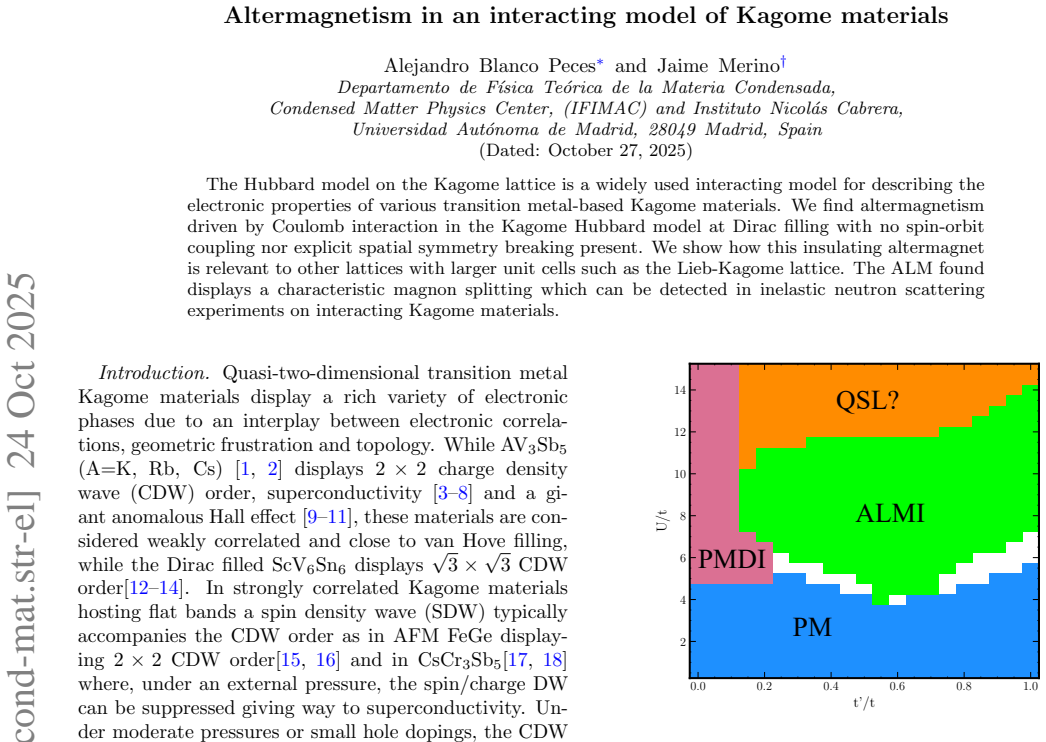


read the original abstract
The Hubbard model on the Kagome lattice is a widely used interacting model for describing the electronic properties of various transition metal-based Kagome materials. We find altermagnetism driven by Coulomb interaction in the Kagome Hubbard model at Dirac filling with no spin-orbit coupling nor explicit spatial symmetry breaking present. We show how this insulating altermagnet is relevant to other lattices with larger unit cells such as the Lieb-Kagome lattice. The ALM found displays a characteristic magnon splitting which can be detected in inelastic neutron scattering experiments on interacting Kagome materials.
Editorial analysis
A structured set of objections, weighed in public.
Referee Report
Summary. The manuscript studies the Hubbard model on the Kagome lattice at Dirac filling and reports that on-site Coulomb repulsion alone stabilizes an insulating altermagnetic state. This state breaks time-reversal symmetry with alternating spin polarization in reciprocal space while preserving lattice symmetries, without spin-orbit coupling or explicit spatial symmetry breaking. The authors extend the result to the Lieb-Kagome lattice and predict a characteristic magnon splitting detectable by inelastic neutron scattering.
Significance. If the reported altermagnetic solution is the stable ground state, the work supplies a concrete, interaction-driven mechanism for altermagnetism on a frustrated lattice relevant to transition-metal Kagome compounds. The absence of SOC or ad-hoc symmetry breaking and the proposed neutron-scattering signature constitute falsifiable predictions that could guide experiments.
major comments (2)
- [§3.2] §3.2, self-consistency loop for the altermagnetic order parameter: the mean-field decoupling is performed only for the altermagnetic channel; no comparison of the free energy or total energy against competing charge-density-wave or 120° spin-liquid solutions is shown at the same U and filling, leaving open whether the reported state is the true ground state or a metastable saddle point.
- [Figure 5] Figure 5 and associated finite-size data: the altermagnetic order parameter is plotted versus cluster size, but no extrapolation to the thermodynamic limit or scaling collapse with system size is provided; at 1/3 filling on the Kagome lattice, fluctuations are known to suppress conventional order, so the persistence of the order parameter must be demonstrated beyond small-cluster pinning.
minor comments (2)
- [§2] The definition of 'Dirac filling' is used without an explicit statement of the electron density (e.g., n=2/3 or n=4/3 per unit cell); adding this in the model section would remove ambiguity.
- In the magnon dispersion plots, the labeling of the high-symmetry points in the extended Brillouin zone is not shown; a small inset would improve readability.
Simulated Author's Rebuttal
We thank the referee for the careful reading and constructive comments on our manuscript. We address each major comment below and have revised the manuscript to incorporate additional analysis and discussion where feasible.
read point-by-point responses
-
Referee: [§3.2] §3.2, self-consistency loop for the altermagnetic order parameter: the mean-field decoupling is performed only for the altermagnetic channel; no comparison of the free energy or total energy against competing charge-density-wave or 120° spin-liquid solutions is shown at the same U and filling, leaving open whether the reported state is the true ground state or a metastable saddle point.
Authors: We agree that a direct energetic comparison to competing orders would strengthen the claim that the altermagnetic state is the ground state rather than a metastable solution. In the revised manuscript we have added a comparison of the total energy (and free energy at finite temperature) between the altermagnetic solution and a charge-density-wave ansatz at the same U and filling; the altermagnetic state is lower in energy. The 120° spin-liquid state lies outside the scope of our Hartree-Fock decoupling, which is constructed to capture the symmetry-allowed altermagnetic channel that gaps the Dirac points. We have inserted a short discussion in §3.2 noting this limitation of the mean-field approach and emphasizing that the reported state is the stable solution within the ansatz we consider. revision: partial
-
Referee: [Figure 5] Figure 5 and associated finite-size data: the altermagnetic order parameter is plotted versus cluster size, but no extrapolation to the thermodynamic limit or scaling collapse with system size is provided; at 1/3 filling on the Kagome lattice, fluctuations are known to suppress conventional order, so the persistence of the order parameter must be demonstrated beyond small-cluster pinning.
Authors: We appreciate the referee drawing attention to the finite-size behavior. The data in Figure 5 already show that the order parameter remains finite and does not decrease appreciably with the accessible cluster sizes. In the revised manuscript we have added a paragraph discussing the trend and noting that, within the mean-field approximation, the order parameter is expected to survive in the thermodynamic limit because the decoupling suppresses the fluctuations that would otherwise destabilize conventional order at 1/3 filling. A full extrapolation or scaling collapse would require substantially larger clusters and is beyond the present computational scope; we have clarified this point in the text. revision: partial
Circularity Check
No significant circularity; result emerges from model Hamiltonian
full rationale
The paper reports an emergent altermagnetic state obtained from the Hubbard model on the Kagome lattice at Dirac filling, driven by on-site Coulomb repulsion without SOC or explicit symmetry breaking. The abstract and description frame this as a computational or analytical finding (likely mean-field or cluster methods) from the standard interacting Hamiltonian. No quoted equations or steps show the altermagnetic order parameter being defined in terms of itself, a fitted quantity renamed as a prediction, or a central claim resting on a self-citation chain that reduces to tautology. The derivation remains self-contained against the model inputs and does not exhibit any of the enumerated circular patterns.
Axiom & Free-Parameter Ledger
free parameters (1)
- Coulomb interaction strength U
axioms (2)
- domain assumption The system is studied at Dirac filling on the Kagome lattice
- domain assumption No spin-orbit coupling is included
Lean theorems connected to this paper
-
IndisputableMonolith/Cost/FunctionalEquation.leanwashburn_uniqueness_aczel unclear?
unclearRelation between the paper passage and the cited Recognition theorem.
We perform an unrestricted Hartree-Fock (HF) treatment of model (1) on large finite lattices... complemented with solutions valid in the thermodynamic limit
What do these tags mean?
- matches
- The paper's claim is directly supported by a theorem in the formal canon.
- supports
- The theorem supports part of the paper's argument, but the paper may add assumptions or extra steps.
- extends
- The paper goes beyond the formal theorem; the theorem is a base layer rather than the whole result.
- uses
- The paper appears to rely on the theorem as machinery.
- contradicts
- The paper's claim conflicts with a theorem or certificate in the canon.
- unclear
- Pith found a possible connection, but the passage is too broad, indirect, or ambiguous to say the theorem truly supports the claim.
Reference graph
Works this paper leans on
-
[1]
Altermagnetism in an interacting model of Kagome materials
and temperature range. We show how the insulating ALM reported is not spe- cific of the Kagome lattice but is generally present in Lieb and Lieb-Kagome lattices consisting on larger unit cells with an odd number of sites Nc hosting an even num- ber of electrons. Under this condition, if PT -symmetry is broken through AFM order, a gap is opened stabi- arXiv...
work page internal anchor Pith review Pith/arXiv arXiv 2025
-
[2]
differs from Hubbard models on modified Lieb lattices containing an extra onsite potential naturally leading to CDW order[ 32–34]. We perform an unrestricted Hartree- Fock (HF) treatment of model ( 1) on large finite lattices [40, 41] complemented with solutions valid in the ther- modynamic limit (see Supplementary Material). At fixed U and electronic density...
-
[3]
so there will be a spin- splitting at those momenta at which |ϵAB|̸=|ϵAC|. Although |ϵAB| and |ϵAC| have the same functional form on the Kagome lattice due to the original equiv- alence of the sites, they are related by a rotation around Γ and so they are not equal except at a set of lines in mo- mentum where the spin-splitting vanishes and a change in th...
-
[4]
At t′ = 0, the largest eigenvalue peaks at the K-point indicating an instability towards √ 3× √ 3 CDW order 4 which coincides with the periodicity of the PMDI found in HF. However, when t′ = 0. 5 the peak of the dominant eigenvalue shifts to the Γ-point, and thus we expect that q = (0 , 0) order is favored under U . The increase of the susceptibility at t...
-
[5]
B. R. Ortiz, L. C. Gomes, J. R. Morey, M. Winiarski, M. Bordelon, J. S. Mangum, I. W. H. Oswald, J. A. Rodriguez-Rivera, J. R. Neilson, S. D. Wil- son, E. Ertekin, T. M. McQueen, and E. S. To- berer, New kagome prototype materials: discovery of kv3sb5, rbv3sb5, and csv 3sb5, Phys. Rev. Mater. 3, 094407 (2019)
work page 2019
-
[6]
T. Nguyen and M. Li, Electronic properties of correlated kagom´ e metals av3sb5 (a=k, rb, and cs): A perspec- tive, Journal of Applied Physics 131, 10.1063/5.0079593 (2022)
-
[7]
M. Kang, S. Fang, J. Yoo, B. R. Ortiz, Y. M. Oey, J. Choi, S. H. Ryu, J. Kim, C. Jozwiak, A. Bostwick, E. Rotenberg, E. Kaxiras, J. G. Checkelsky, S. D. Wil- son, J.-H. Park, and R. Comin, Charge order landscape and competition with superconductivity in kagome met- als, Nature Materials 22, 186 (2023)
work page 2023
-
[8]
Y. Hu, X. Wu, A. P. Schnyder, and M. Shi, Electronic landscape of kagome superconductors AV 3Sb5 (A = K, Rb, Cs) from angle-resolved photoemission spectroscopy, npj Quantum Materials 8, 67 (2023)
work page 2023
-
[9]
K. Jiang, T. Wu, J.-X. Yin, Z. Wang, M. Z. Hasan, S. D. Wilson, X. Chen, and J. Hu, Kagome superconductors A V3Sb5 (A = K, Rb, Cs), National Science Review 10, 10.1093/nsr/nwac199 (2022)
-
[10]
B. R. Ortiz, S. M. L. Teicher, Y. Hu, J. L. Zuo, P. M. Sarte, E. C. Schueller, A. M. M. Abeykoon, M. J. Krogstad, S. Rosenkranz, R. Osborn, R. Seshadri, L. Ba- lents, J. He, and S. D. Wilson, CsV 3Sb5: A Z2 topolog- ical kagome metal with a superconducting ground state, Phys. Rev. Lett. 125, 247002 (2020)
work page 2020
-
[11]
C. Mielke, D. Das, J.-X. Yin, H. Liu, R. Gupta, Y.- X. Jiang, M. Medarde, X. Wu, H. C. Lei, J. Chang, P. Dai, Q. Si, H. Miao, R. Thomale, T. Neupert, Y. Shi, R. Khasanov, M. Z. Hasan, H. Luetkens, and Z. Guguchia, Time-reversal symmetry-breaking charge order in a kagome superconductor, Nature 602, 245–250 (2022)
work page 2022
-
[12]
H. Li, T. T. Zhang, T. Yilmaz, Y. Y. Pai, C. E. Marvin- ney, A. Said, Q. W. Yin, C. S. Gong, Z. J. Tu, E. Vescovo, C. S. Nelson, R. G. Moore, S. Murakami, H. C. Lei, H. N. Lee, B. J. Lawrie, and H. Miao, Observation of uncon- ventional charge density wave without acoustic phonon anomaly in kagome superconductors A V 3Sb5 (A=Rb, Cs), Phys. Rev. X 11, 031050 (2021)
work page 2021
-
[13]
S.-Y. Yang, Y. Wang, B. R. Ortiz, D. Liu, J. Gayles, E. Derunova, R. Gonzalez-Hernandez, L. ˇSmejkal, Y. Chen, S. S. P. Parkin, S. D. Wil- son, E. S. Toberer, T. McQueen, and M. N. Ali, Giant, unconventional anomalous hall ef- fect in the metallic frustrated magnet candidate, KV3Sb5, Science Advances 6, eabb6003 (2020) , https://www.science.org/doi/pdf/10...
-
[14]
Y.-X. Jiang, J.-X. Yin, M. M. Denner, N. Shumiya, B. R. Ortiz, G. Xu, Z. Guguchia, J. He, M. S. Hossain, X. Liu, J. Ruff, L. Kautzsch, S. S. Zhang, G. Chang, I. Belopol- ski, Q. Zhang, T. A. Cochran, D. Multer, M. Litskevich, Z.-J. Cheng, X. P. Yang, Z. Wang, R. Thomale, T. Ne- upert, S. D. Wilson, and M. Z. Hasan, Unconventional chiral charge order in kag...
work page 2021
-
[15]
F. H. Yu, T. Wu, Z. Y. Wang, B. Lei, W. Z. Zhuo, J. J. Ying, and X. H. Chen, Concurrence of anomalous hall ef- fect and charge density wave in a superconducting topo- logical kagome metal, Phys. Rev. B 104, L041103 (2021)
work page 2021
-
[16]
Y. Hu, J. Ma, Y. Li, Y. Jiang, D. J. Gawryluk, T. Hu, J. Teyssier, V. Multian, Z. Yin, S. Xu, S. Shin, I. Plokhikh, X. Han, N. C. Plumb, Y. Liu, J.-X. Yin, Z. Guguchia, Y. Zhao, A. P. Schnyder, X. Wu, E. Pomjakushina, M. Z. Hasan, N. Wang, and M. Shi, Phonon promoted charge density wave in topological kagome metal ScV 6Sn6, Nature Communications 15, 1658 (2024)
work page 2024
-
[17]
H. W. S. Arachchige, W. R. Meier, M. Marshall, T. Mat- suoka, R. Xue, M. A. McGuire, R. P. Hermann, H. Cao, and D. Mandrus, Charge density wave in kagome lat- tice intermetallic ScV 6Sn6, Phys. Rev. Lett. 129, 216402 (2022)
work page 2022
-
[18]
S. Lee, C. Won, J. Kim, J. Yoo, S. Park, J. Den- linger, C. Jozwiak, A. Bostwick, E. Rotenberg, R. Comin, M. Kang, and J.-H. Park, Nature of charge density wave in kagome metal ScV 6Sn6, npj Quantum Materials 9, 15 (2024)
work page 2024
-
[19]
X. Teng, L. Chen, F. Ye, E. Rosenberg, Z. Liu, J.-X. Yin, Y.-X. Jiang, J. S. Oh, M. Z. Hasan, K. J. Neubauer, B. Gao, Y. Xie, M. Hashimoto, D. Lu, C. Jozwiak, A. Bostwick, E. Rotenberg, R. J. Birgeneau, J.-H. Chu, M. Yi, and P. Dai, Discovery of charge density wave in a kagome lattice antiferromagnet, Nature 609, 490 (2022)
work page 2022
-
[20]
X. Teng, J. S. Oh, H. Tan, L. Chen, J. Huang, B. Gao, J.-X. Yin, J.-H. Chu, M. Hashimoto, D. Lu, C. Jozwiak, A. Bostwick, E. Rotenberg, G. E. Granroth, B. Yan, R. J. Birgeneau, P. Dai, and M. Yi, Magnetism and charge density wave order in kagome fege, Nature Physics 19, 814 (2023)
work page 2023
-
[21]
Y. Li, Y. Liu, X. Du, S. Wu, W. Zhao, K. Zhai, Y. Hu, S. Zhang, H. Chen, J. Liu, Y. Yang, C. Peng, M. Hashimoto, D. Lu, Z. Liu, Y. Wang, Y. Chen, G. Cao, and L. Yang, Electron correlation and incipient flat bands 6 in the kagome superconductor CsCr 3Sb5, Nature Com- munications 16, 3229 (2025)
work page 2025
-
[22]
Y. Liu, Z.-Y. Liu, J.-K. Bao, P.-T. Yang, L.-W. Ji, S.- Q. Wu, Q.-X. Shen, J. Luo, J. Yang, J.-Y. Liu, C.-C. Xu, W.-Z. Yang, W.-L. Chai, J.-Y. Lu, C.-C. Liu, B.-S. Wang, H. Jiang, Q. Tao, Z. Ren, X.-F. Xu, C. Cao, Z.-A. Xu, R. Zhou, J.-G. Cheng, and G.-H. Cao, Superconduc- tivity under pressure in a chromium-based kagome metal, Nature 632, 1032 (2024)
work page 2024
-
[23]
M. S. Hossain, Q. Zhang, E. S. Choi, D. Ratkovski, B. L¨ uscher, Y. Li, Y.-X. Jiang, M. Litskevich, Z.-J. Cheng, J.-X. Yin, T. A. Cochran, B. Casas, B. Kim, X. Yang, J. Liu, Y. Yao, A. F. Bangura, Z. Wang, M. H. Fischer, T. Neupert, L. Balicas, and M. Z. Hasan, Un- conventional gapping behaviour in a kagome supercon- ductor, Nature Physics 21, 556 (2025)
work page 2025
-
[24]
F. H. Yu, D. H. Ma, W. Z. Zhuo, S. Q. Liu, X. K. Wen, B. Lei, J. J. Ying, and X. H. Chen, Unusual competition of superconductivity and charge-density-wave state in a compressed topological kagome metal, Nature Commu- nications 12, 3645 (2021)
work page 2021
-
[25]
Momentum- dependent spin splitting by collinear antiferromagnetic ordering,
S. Hayami, Y. Yanagi, and H. Kusunose, Momentum- dependent spin splitting by collinear antiferromagnetic ordering, Journal of the Physical Society of Japan 88, 123702 (2019) , https://doi.org/10.7566/JPSJ.88.123702
-
[26]
M. Naka, S. Hayami, H. Kusunose, Y. Yanagi, Y. Mo- tome, and H. Seo, Spin current generation in organic an- tiferromagnets, Nature Communications 10, 4305 (2019)
work page 2019
-
[27]
L. ˇSmejkal, R. Gonz´ alez-Hern´ andez, T. Jungwirth, and J. Sinova, Crystal time-reversal symmetry breaking and spontaneous hall effect in collinear antiferromagnets, Science Advances 6, eaaz8809 (2020) , https://www.science.org/doi/pdf/10.1126/sciadv.aaz8809
-
[28]
I. I. Mazin, K. Koepernik, M. D. Johannes, R. Gonz´ alez- Hern´ andez, and L. ˇSmejkal, Prediction of unconven- tional magnetism in doped FeSb 2, Proceedings of the National Academy of Sciences 118, e2108924118 (2021) , https://www.pnas.org/doi/pdf/10.1073/pnas.2108924118
-
[29]
S.-W. Cheong and F.-T. Huang, Altermagnetism with non-collinear spins, npj Quantum Materials 9, 13 (2024)
work page 2024
-
[30]
S. Lee, S. Lee, S. Jung, J. Jung, D. Kim, Y. Lee, B. Seok, J. Kim, B. G. Park, L. ˇSmejkal, C.-J. Kang, and C. Kim, Broken kramers degeneracy in altermagnetic MnTe, Phys. Rev. Lett. 132, 036702 (2024)
work page 2024
-
[31]
Mazin (The PRX Editors), Editorial: Altermagnetism—a new punch line of fundamental magnetism, Phys
I. Mazin (The PRX Editors), Editorial: Altermagnetism—a new punch line of fundamental magnetism, Phys. Rev. X 12, 040002 (2022)
work page 2022
-
[32]
L. ˇSmejkal, J. Sinova, and T. Jungwirth, Emerging re- search landscape of altermagnetism, Phys. Rev. X 12, 040501 (2022)
work page 2022
-
[33]
L. ˇSmejkal, J. Sinova, and T. Jungwirth, Beyond conven- tional ferromagnetism and antiferromagnetism: A phase with nonrelativistic spin and crystal rotation symmetry, Phys. Rev. X 12, 031042 (2022)
work page 2022
-
[34]
J. Krempask´ y, L. ˇSmejkal, S. W. D’Souza, M. Ha- jlaoui, G. Springholz, K. Uhl ´ ıˇ rov´ a, F. Alarab, P. C. Constantinou, V. Strocov, D. Usanov, W. R. Pudelko, R. Gonz´ alez-Hern´ andez, A. Birk Hellenes, Z. Jansa, H. Reichlov´ a, Z. ˇSob´ aˇ n, R. D. Gonzalez Betancourt, P. Wadley, J. Sinova, D. Kriegner, J. Min´ ar, J. H. Dil, and T. Jungwirth, Alter...
work page 2024
-
[35]
C. Xu, S. Wu, G.-X. Zhi, G. Cao, J. Dai, C. Cao, X. Wang, and H.-Q. Lin, Altermagnetic ground state in distorted Kagome metal CsCr3Sb5, Nature Communica- tions 16, 3114 (2025)
work page 2025
-
[39]
T. A. Maier and S. Okamoto, Weak-coupling theory of neutron scattering as a probe of altermagnetism, Phys. Rev. B 108, L100402 (2023)
work page 2023
-
[40]
D. S. Antonenko, R. M. Fernandes, and J. W. F. Vender- bos, Mirror chern bands and weyl nodal loops in alter- magnets, Phys. Rev. Lett. 134, 096703 (2025)
work page 2025
- [41]
-
[42]
J.-W. Dong, Y.-H. Lin, R. Fu, X. Wu, G. Su, Z. Wang, and S. Zhou, Spontaneous emergence of altermagnetism in the single-orbital extended hubbard model (2025), arXiv:2507.00837 [cond-mat.str-el]
- [43]
-
[44]
R. Scholle, P. M. Bonetti, D. Vilardi, and W. Met- zner, Comprehensive mean-field analysis of magnetic and charge orders in the two-dimensional hubbard model, Phys. Rev. B 108, 035139 (2023)
work page 2023
-
[45]
Y.-P. Lin, C. Liu, and J. E. Moore, Complex mag- netic and spatial symmetry breaking from correlations in kagome flat bands, Phys. Rev. B 110, L041121 (2024)
work page 2024
-
[46]
K. Ferhat and A. Ralko, Phase diagram of the 1 3 -filled extended hubbard model on the kagome lattice, Phys. Rev. B 89, 155141 (2014)
work page 2014
-
[47]
H. S. Kim, A. Mishra, and S. Lee, Emergent chiral spin ordering and anomalous hall effect in a kagome lat- tice at 1 3 filling, Physical Review B 102, 10.1103/phys- revb.102.155113 (2020)
-
[49]
K. Zeng, Z. Wang, K. Jiang, and Z. Wang, Electronic structure of A V3Sb5 kagome metals, Phys. Rev. B 111, 235114 (2025)
work page 2025
-
[50]
M. Roig, A. Kreisel, Y. Yu, B. M. Andersen, and D. F. Agterberg, Minimal models for altermagnetism, Phys. Rev. B 110, 144412 (2024)
work page 2024
-
[51]
L. F. Tocchio, A. Montorsi, and F. Becca, Metallic and insulating stripes and their relation with superconduc- tivity in the doped Hubbard model, SciPost Phys. 7, 021 (2019)
work page 2019
-
[52]
H. Chen, Q. Niu, and A. H. MacDonald, Anomalous hall effect arising from noncollinear antiferromagnetism, Phys. Rev. Lett. 112, 017205 (2014)
work page 2014
- [53]
- [54]
-
[55]
M. F. Ohlrich, E. M. Makaresz, H. L. Nourse, and B. J. Powell, Flat bands and unconventional superconductivity in a simple model of metal-organic frameworks, Phys. Rev. B 111, L100503 (2025)
work page 2025
-
[56]
Sutherland, Localization of electronic wave functions due to local topology, Phys
B. Sutherland, Localization of electronic wave functions due to local topology, Phys. Rev. B 34, 5208 (1986)
work page 1986
- [57]
-
[58]
L. ˇSmejkal, A. Marmodoro, K.-H. Ahn, R. Gonz´ alez- Hern´ andez, I. Turek, S. Mankovsky, H. Ebert, S. W. D’Souza, O. c. v. ˇSipr, J. Sinova, and T. c. v. Jungwirth, Chiral magnons in altermagnetic RuO 2, Phys. Rev. Lett. 131, 256703 (2023)
work page 2023
-
[59]
Z. Liu, M. Ozeki, S. Asai, S. Itoh, and T. Masuda, Chiral split magnon in altermagnetic MnTe, Phys. Rev. Lett. 133, 156702 (2024) . Supplementary Material for Altermagnetism in an interacting model f or Kagome materials Alejandro Blanco Peces ∗ and Jaime Merino † Departamento de F ´ ısica Te´ orica de la Materia Condensada, Condensed Matter Physics Center...
work page 2024
-
[60]
5t the gap opening at the Fermi level is independent of the band crossing at K
Thus, even if the Dirac point at K is protected (if the little group C3v at this point has a two-dimensional irreducible representation that forces a band degeneracy), it is not the breaking of such symmetry which makes the ALM insulating, since for t′ > 0. 5t the gap opening at the Fermi level is independent of the band crossing at K. V. ORIGIN OF AL TER...
-
[61]
is E3− E(ϵ2 AB + ϵ2 BC + ϵ2 AC)− 2ϵABϵBC ϵAC = 0 (15) which is a depressed cubic equation of the form E3 + pE + q = 0. For the bands to be degenerate (QBC, triple crossing or Dirac cone) at a given momentum, k, the discriminant ∆ = − 4p3− 27q2 must vanish: (ϵ2 AB + ϵ2 AC + ϵ2 BC )3 = 27ϵ2 ABϵ2 BC ϵ2 AC. (16) However, the arithmetic mean-geometric mean (AM...
-
[62]
In Figure 5 we show the resulting spin susceptibilities of the Kagome altermagnet
provided in Appendix G, now with the s, t, p, q indices running over orbital and spin states. In Figure 5 we show the resulting spin susceptibilities of the Kagome altermagnet. The INS signal probes the creation of S = 1 and S =− 1 magnons which, due to the spin-splitting of the ALM bands, will not have the same energy. Indeed, we find that χ +− ̸= χ − + a...
-
[63]
R. Scholle, P. M. Bonetti, D. Vilardi, and W. Metzner, Comprehensive mean-field analysis of magnetic and charge orders in the two-dimensional hubbard model, Phys. Rev. B 108, 035139 (2023)
work page 2023
-
[64]
N. Kaushal and M. Franz, Altermagnetism in modified lieb lattice hubbard model, Phys. Rev. Lett. 135, 156502 (2025)
work page 2025
-
[65]
M. D¨ urrnagel, H. Hohmann, A. Maity, J. Seufert, M. Klett, L. Klebl, and R. Thomale, Altermagnetic phase transition in a lieb metal, Phys. Rev. Lett. 135, 036502 (2025)
work page 2025
-
[66]
H. C. Jiang, Z. Y. Weng, and D. N. Sheng, Density ma- trix renormalization group numerical study of the kagome antiferromagnet, Phys. Rev. Lett. 101, 117203 (2008)
work page 2008
-
[67]
Dynamical Correlations of the Kagome S=1/2 Heisenberg Quantum Antiferromagnet
A. Laeuchli and C. Lhuillier, Dynamical correlations of the kagome S= 1 2 heisenberg quantum antiferromagnet, arXiv:0901.1065v1 [cond-mat.str-el] (2009)
work page internal anchor Pith review Pith/arXiv arXiv 2009
- [68]
discussion (0)
Sign in with ORCID, Apple, or X to comment. Anyone can read and Pith papers without signing in.