REVIEW 5 major objections 5 minor 29 references
A Simultaneous ECG-PCG Acquisition System with Real-Time Burst-Adaptive Noise Cancellation
T0 review · 5 major / 5 minor · reviewed 2026-08-04 · deepseek-v4-flash
Pith's one-line read A portable ECG–PCG device with burst-adaptive noise cancellation lifts real-world hospital signal-to-noise ratios by 30.32 dB (ECG) and 37.01 dB (PCG).
desk verdict Solid prototype and honest simulation, but the headline real-world SNR numbers are likely a fixed-filter artifact and the ANC contribution is unproven in the field. read the letter →
The pith
A machine-rendered reading of the paper's core claim, the machinery that carries it, and where it could break.
The reading
What carries the argument
The central mechanism is the burst-adaptive NLMS update: an energy tracker maintains a moving average of reference power; whenever instantaneous reference power exceeds a threshold times that average, the normalized step size is multiplied by a scaling factor, so the filter reacts quickly to noise bursts, then resumes small-step operation. The reference comes from a quad-microphone array facing outward on the stethoscope body, intended to capture ambient noise uncorrelated with heart sounds.
What would settle it
Compute the coherence between the ambient reference and the noise component in the stethoscope microphone during hospital recordings; if it is low across 20–200 Hz, the reported 37 dB gain would not generalize to other hardware placements.
Extended reading notes
Core claim
The authors set out to show that a single portable device can acquire ECG and PCG simultaneously and clean both in real time with modest compute. The specific discovery is that a normalized LMS filter, modified to boost its step size during detected energy bursts, adapts to non-stationary hospital noise faster than standard LMS/NLMS while staying stable in quiet intervals. On hospital recordings made with the prototype, the PCG pipeline improved SNR by 37.01 dB and the ECG pipeline by 30.32 dB; on a synthetic noisy PCG dataset, the burst-adaptive filter beat both LMS and NLMS on all four metrics for normal and abnormal recordings.
Load-bearing premise
The result rests on the assumption that the outward-facing ambient microphones provide a noise reference closely correlated with the noise at the stethoscope and free of heart sounds; the paper does not measure that correlation.
Editorial extensions
If this is right
- Real-time cleaning of both modalities can move onto an embedded microcontroller, so synchronized ECG–PCG screening no longer depends on offline processing or bulky equipment.
- A 37.01 dB PCG gain means murmur features that a human or algorithm needs can survive in a busy ward, not just in a quiet exam room.
- A 30.32 dB ECG gain preserves the timing landmarks needed to place S1 and S2 within the cardiac cycle when the two signals are read together.
- On burst-heavy noise, the kind produced by alarms, trolleys, and conversations, the burst-adaptive filter outperforms conventional LMS and NLMS, indicating the approach targets the noise profile that actually limits auscultation.
Reading between the lines
- The paper does not report the coherence between the ambient reference and the noise reaching the chest microphone; measuring that coherence would show whether the 37 dB gain transfers to other stethoscope geometries and body positions.
- The ECG gain comes from fixed elliptic filters rather than adaptive cancellation, so adding an adaptive ECG stage or motion-artifact rejection is a natural extension for ambulatory use.
- A testable consequence of the burst-adaptive idea is that the improvement over standard NLMS should grow with the proportion of time spent in burst events; a dataset with controlled burst density could verify that dose–response.
- Because the device uses dry electrodes and outward-facing mics, performance during physical motion is an open question; a movement-artifact protocol would map that boundary.
Signed reviews
Editorial analysis
A structured set of objections, weighed in public.
Referee Report
Summary. This paper presents a portable simultaneous ECG-PCG acquisition device with a real-time adaptive noise cancellation pipeline. The PCG channel uses a proposed burst-adaptive NLMS (BA-NLMS) algorithm that temporarily increases the step size when the reference-signal energy exceeds a moving average; the ECG channel uses a cascade of fixed elliptic filters (0.5 Hz high-pass, 150 Hz low-pass, 49.5–50.5 Hz bandstop). The BA-NLMS is evaluated on 3934 simulated noisy PCG recordings (per class) built from the AUTHHSDB dataset and hospital noise, comparing against LMS and NLMS. The complete prototype is then evaluated on a single 14-second hospital recording, reporting ΔSNR of 37.01 dB for PCG and 30.32 dB for ECG using a hand-defined SNR metric (Eq. 6). The abstract additionally states that a complexity analysis confirms the pipeline's suitability for embedded implementation, but no such analysis appears in the manuscript.
Significance. If the real-world SNR improvements were fully supported, this device would be a meaningful low-cost cardiac screening tool for noisy, resource-constrained settings. The simulation study is a genuine strength: it uses a public dataset, a large number of recordings, several power-independent metrics (NMSE, ΔSNR, CC, NMAE), and direct comparisons against LMS and NLMS. The BA-NLMS shows consistent but modest gains over NLMS in simulation (about 0.5 dB in the full noisy set and about 1.9 dB on burst-only recordings). However, the headline real-world numbers are not currently supported: the frequency bands in the SNR metric are never specified, there is no ablation isolating the adaptive contribution from fixed band-pass filtering, the ECG improvement comes entirely from fixed filters rather than adaptive cancellation, and the validation rests on a single 14-second trace. The missing complexity analysis also undercuts the embedded-suitability claim. With a proper ablation, more recordings, and a defined evaluation protocol, this work could become a useful contribution.
major comments (5)
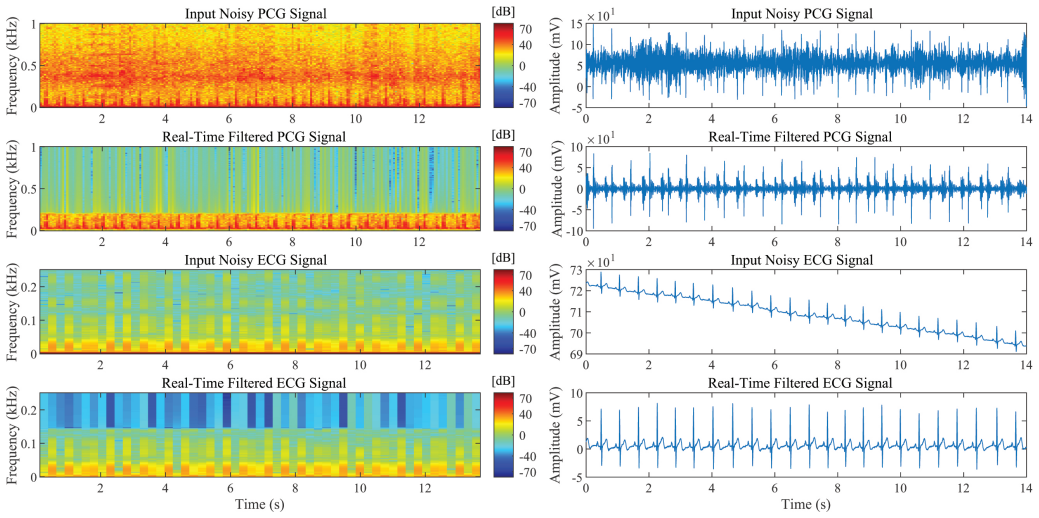
- [Section III-B, Eq. (6)] The real-world validation rests on a single 14-s recording and an undefined SNR metric. Eq. (6) defines SNR = 10 log10( P_LF / (P_LFN + P_HF) ), but the frequency ranges LF, LFN, and HF are never specified. Since the PCG pipeline ends with a 20–200 Hz band-pass filter (Section III-B), a fixed filter that removes energy outside the assumed 'signal band' will increase this ratio by construction. The reported 37.01 dB improvement may therefore largely reflect band-limiting rather than the BA-NLMS algorithm. Please specify the frequency bands, report the ΔSNR achieved by the fixed filters alone, and evaluate on more than one recording. Ideally, use a metric anchored to a known clean reference or a blind quality measure.
- [Section II-C] The ECG improvement of 30.32 dB is not attributable to the proposed adaptive noise-cancellation pipeline. Section II-C describes only a cascade of fixed elliptic IIR filters (0.5 Hz high-pass, 150 Hz low-pass, 49.5–50.5 Hz bandstop); there is no adaptive component in the ECG path. The abstract and conclusion attribute this improvement to the proposed system's noise-cancellation capabilities. Please provide an ablation showing the contribution of each stage, or clearly state that the ECG ΔSNR is a fixed-filter result and not the output of the adaptive algorithm.
- [Abstract / Section IV] The abstract states that a complexity analysis confirms the pipeline's suitability for embedded implementation, but no such analysis appears in Sections II–IV. In fact, Section IV lists 'implementing the denoising algorithms on the microcontroller for fully embedded operation' as future work, and Section II-A says data are streamed to a computer for real-time ANC. Thus the claims of an integrated, embedded, real-time system are not currently supported. Either add the complexity analysis and clarify where processing is performed, or temper the claims accordingly.
- [Section II-B] The central ANC assumption is unverified on the prototype. Section II-B states that the reference signal r(n) is uncorrelated with heart sounds but closely correlated with the noise reaching the stethoscope microphone. No measurement of that correlation is presented. In the synthetic evaluation, the reference is generated from the same noise source through a moving-average filter (Section III-A), so it is highly correlated by construction and does not test the real-world assumption. Please report the measured coherence/correlation between the ambient microphone array and the noise component in the stethoscope channel, and evaluate the algorithm under a decorrelated reference.
- [Section III-A] The BA-NLMS parameters (μ0 = 0.05, α = 0.99, η = 5, β = 6, ε = 0.001, filter length 10) are stated without a fitting procedure or sensitivity analysis. The burst-detection mechanism depends critically on η and β, and no evidence is provided that these values generalize beyond the selected AUTHHSDB subset. Please include a sensitivity study or justify the values from a principled criterion; otherwise the robustness of the simulated and real-world gains is unclear.
minor comments (5)
- [Section III-A] The sentence 'This process generated 3934 noisy recordings, each for normal and abnormal' is ambiguous. The numbers suggest 7 clean normal × 562 noise = 3934 per class; please state explicitly whether the total is 3934 or 7868.
- [Equation (6), Fig. 4] The input SNR values reported for the real-world recordings (e.g., -9.08 dB for ECG and -2.08 dB for PCG) are not defined. State whether they use the same Eq. (6) and, if so, give the exact frequency bands used.
- [Section II-B, Eqs. (2) and (5)] Notation is inconsistent: Eq. (2) uses ||r(n)||² while Eq. (5) uses r^T(n)·r(n) for the same quantity. Unify the notation.
- [Abstract] The abstract in the submission says 'the proposed system achieved signal-to-noise ratio improvements,' whereas the abstract in the full text says 'the proposed algorithms achieved.' Please use consistent wording, especially because the ECG path is not adaptive.
- [Figure 4] The time-domain plots and spectrograms lack axis labels/units (time in seconds, amplitude in what units) and the spectrogram color scale is not described. Please add these details.
Circularity Check
No significant circularity: BA-NLMS is benchmarked on external AUTHHSDB data; the weak real-world SNR metric is a validation concern, not a definitional identity.
full rationale
The paper's central algorithmic claim is the BA-NLMS filter, evaluated in Section III-A on clean AUTHHSDB PCG signals corrupted with hospital noise and compared against standard LMS/NLMS using NMSE, ΔSNR, CC, and NMAE. These metrics are not defined in terms of the filter's parameters, and the noise/reference construction follows an external MathWorks procedure; the parameter values (μ0=0.05, α=0.99, η=5, β=6, ε=0.001) are fixed and reported, not fitted to the test set, so no prediction reduces to an input by construction. The real-world validation (Section III-B) is methodologically weak: Eq. (6) leaves the LF/LFN/HF bands unspecified, the PCG pipeline includes a fixed 20-200 Hz band-pass that could alone raise a broadband-power-ratio SNR measure, and the ECG pipeline contains only fixed elliptic filters, so attributing the 30.32 dB ECG gain to the 'proposed system' is overstated. These are evaluation-design and reporting issues that affect the evidentiary value of the headline numbers; they are not circular derivations, and no equation in the paper reduces to its own inputs. The only same-group citation ([12]) is background on ECG-PCG classification and is not load-bearing. No circular step is therefore identified.
Assumptions & free parameters
free parameters (7)
- μ0 =
0.05
- α =
0.99
- η =
5
- β =
6
- ε =
0.001
- Filter length M =
10
- SNR band definitions (LF, LFN, HF) =
not specified in text
assumptions (4)
- domain assumption Reference signal r(n) is uncorrelated with heart sounds and closely correlated with the noise at the stethoscope microphone (Sec. II-B).
- domain assumption The moving-average/autoregressive procedure in the simulated test produces a valid noise-reference pair (Sec. III-A, following [29]).
- standard math Standard NLMS convergence theory applies (Eq. 1-2, citing [26],[27]).
- domain assumption Hospital noise is dominated by sudden high-energy bursts, motivating the threshold-based step control (Eq. 4).
Cite this review
Pith. "Pith review of A Simultaneous ECG-PCG Acquisition System with Real-Time Burst-Adaptive Noise Cancellation." pith.science (2026). https://pith.science/paper/CVCY7TAK
@misc{pith2026251023819,
  author       = {Pith},
  title        = {Pith review of: A Simultaneous ECG-PCG Acquisition System with Real-Time Burst-Adaptive Noise Cancellation},
  year         = {2026},
  howpublished = {\url{https://pith.science/paper/CVCY7TAK}},
  note         = {Machine review of arXiv:2510.23819}
}
read the original abstract
Cardiac auscultation is an essential clinical skill, requiring excellent hearing to distinguish subtle differences in timing and pitch of heart sounds. However, diagnosing solely from these sounds is often challenging due to interference from surrounding noise, and the information may be limited. Most of the existing solutions that adaptively cancel external noise are either non-real-time or computationally intensive, making them unsuitable for implementation in a portable system. This work proposes an end-to-end system with a real-time adaptive noise cancellation pipeline integrated into a device that simultaneously acquires electrocardiogram (ECG) and phonocardiogram (PCG) signals. We employ a burst-adaptive normalized least mean square algorithm that adjusts its adaptation in response to high-energy, non-stationary hospital noise. The algorithm's performance was initially assessed using datasets with artificially induced noise. Subsequently, the complete end-to-end system was validated using real-world hospital recordings captured with the dual-modality device. For ECG and PCG signals recorded from the device in noisy hospital settings, the proposed system achieved signal-to-noise ratio improvements of 30.32 dB and 37.01 dB, respectively. Furthermore, complexity analysis confirms the pipeline's suitability for embedded implementation. These results demonstrate the system's effectiveness in enabling reliable and accessible cardiac screening in noisy hospital environments typical of resource-constrained settings.
Figures


Figures from the paper (1 more)
Reference graph
Works this paper leans on
-
[1]
Global birth prevalence of congenital heart defects 1970- 2017: updated systematic review and meta-analysis of 260 studies,
Y . Liu, S. Chen, L. Z ¨uhlke, G. C. Black, M. K. Choy, N. Li, and B. D. Keavney, “Global birth prevalence of congenital heart defects 1970- 2017: updated systematic review and meta-analysis of 260 studies,” International Journal of Epidemiology, vol. 48, no. 2, pp. 455–463, 2019
1970
-
[2]
Global, regional, and national burden of congenital heart disease, 1990–2017: a systematic analysis for the global burden of disease study 2017,
C. A. Sable, “Global, regional, and national burden of congenital heart disease, 1990–2017: a systematic analysis for the global burden of disease study 2017,”Lancet Child & Adolescent Health, vol. 4, pp. 185–200, 2020
1990
-
[3]
Global, regional, and national epidemiology of congenital heart disease in children from 1990 to 2021,
Jiaoli Xu, Qinhong Li, Lili Deng, Jingxuan Xiong, Zugen Cheng, and Caixia Ye, “Global, regional, and national epidemiology of congenital heart disease in children from 1990 to 2021,”Frontiers in Cardiovas- cular Medicine, vol. 12, pp. 1522644, 2025
1990
-
[4]
Cardiovascular diseases (CVDs) — fact sheet,
World Health Organization, “Cardiovascular diseases (CVDs) — fact sheet,” https://www.who.int/news-room/fact-sheets/detail/ cardiovascular-diseases-(cvds), Jul 2025, Accessed: October 20, 2025
2025
-
[5]
An intelligent stethoscope with ECG and heart sound synchronous display,
Y . Lin, C. Chuang, C. Yen, S. Huang, P. Huang, J. Chen, and S. Lee, “An intelligent stethoscope with ECG and heart sound synchronous display,” in2019 IEEE International Symposium on Circuits and Systems (ISCAS), May 2019, pp. 1–4
2019
-
[6]
A low-cost 3-d printed stethoscope connected to a smartphone,
C. Aguilera-Astudillo, M. Chavez-Campos, A. Gonzalez-Suarez, and J. L. Garcia-Cordero, “A low-cost 3-d printed stethoscope connected to a smartphone,” inAnnual International Conference of the IEEE Engineering in Medicine and Biology, August 2016, pp. 4365–4368
2016
-
[7]
Features for heartbeat sound signal normal and pathological,
D. S. M. Amin and B. R. Fethi, “Features for heartbeat sound signal normal and pathological,”Recent Patents on Computer Science (Discontinued), vol. 1, no. 1, pp. 1–8, 2008
2008
-
[8]
Michael Klum, Mike Urban, Timo Tigges, Alexandru-Gabriel Pielmus, Aarne Feldheiser, Theresa Schmitt, and Reinhold Orglmeister, “Wear- able cardiorespiratory monitoring employing a multimodal digital patch stethoscope: Estimation of ECG, PEP, LVET and respiration using a 55 mm single-lead ECG and phonocardiogram,”Sensors, vol. 20, no. 7, 2020
2020
Show all 29 references
-
[9]
Assessing PEP and LVET from heart sounds: algorithms and evaluation,
Rui Pedro Paiva, P Carvalho, Xavier Aubert, Jens Muehlsteff, Jorge Henriques, and Manuel Antunes, “Assessing PEP and LVET from heart sounds: algorithms and evaluation,” in2009 Annual International Conference of the IEEE Engineering in Medicine and Biology Society. IEEE, 2009, ...
2009
-
[10]
Timing the opening and closure of the aortic valve using a phonocardiogram envelope: a performance test for systolic time intervals measurement,
A ´ıda Jim ´enez-Gonz´alez, “Timing the opening and closure of the aortic valve using a phonocardiogram envelope: a performance test for systolic time intervals measurement,”Physiological measurement, vol. 42, no. 2, pp. 025004, 2021
2021
-
[11]
NMCSE: Noise-robust multi-modal coupling signal estimation method via optimal transport for cardiovascular disease detection,
Peihong Zhang, Zhixin Li, Rui Sang, Yuxuan Liu, Yiqiang Cai, Yizhou Tan, and Shengchen Li, “NMCSE: Noise-robust multi-modal coupling signal estimation method via optimal transport for cardiovascular disease detection,”arXiv preprint arXiv:2505.18174, 2025
2025
-
[12]
A novel transfer learning-based approach for screening pre-existing heart diseases using synchronized ECG signals and heart sounds,
Ramith Hettiarachchi, Udith Haputhanthri, Kithmini Herath, Hasindu Kariyawasam, Shehan Munasinghe, Kithmin Wickramasinghe, Duminda Samarasinghe, Anjula De Silva, and Chamira U. S. Edussooriya, “A novel transfer learning-based approach for screening pre-existing heart diseases ...
2021
-
[13]
Multi-modal cardiac function signals classification algorithm based on improved DS evidence theory,
Jinghui Li, Li Ke, Qiang Du, Xiangmin Chen, and Xiaodi Ding, “Multi-modal cardiac function signals classification algorithm based on improved DS evidence theory,”Biomedical Signal Processing and Control, vol. 71, pp. 103078, 2022
2022
-
[14]
Co-learning-assisted progressive dense fusion network for cardiovascular disease detection using ECG and PCG signals,
Haobo Zhang, Peng Zhang, Fan Lin, Lianying Chao, Zhiwei Wang, Fei Ma, and Qiang Li, “Co-learning-assisted progressive dense fusion network for cardiovascular disease detection using ECG and PCG signals,”Expert Systems with Applications, vol. 238, pp. 122144, 2024
2024
-
[15]
Available: https://www
3M Littmann Stethoscopes, “3M,” [Online]. Available: https://www. littmann.com/3M/en US/littmann-stethoscopes/, [Accessed: October 21, 2025]
2025
-
[16]
Thinklabs one digital stethoscope,
Thinklabs Medical LLC, “Thinklabs one digital stethoscope,” [Online]. Available: https://www.thinklabs.com/, [Accessed: October 21, 2025]
2025
-
[17]
Available: https://www.ekohealth
Eko Devices Inc., “Eko,” [Online]. Available: https://www.ekohealth. com/, [Accessed: October 21, 2025]
2025
-
[18]
Ayu devices,
Ayu Devices Pvt. Ltd., “Ayu devices,” [Online]. Available: https://www. ayudevices.store/, [Accessed: October 21, 2025]
2025
-
[19]
A novel wearable device integrating ECG and PCG for cardiac health monitoring,
Junbin Zang, Qi An, Bo Li, Zhidong Zhang, Libo Gao, and Chenyang Xue, “A novel wearable device integrating ECG and PCG for cardiac health monitoring,”Microsystems & Nanoengineering, vol. 11, no. 1, pp. 7, 2025
2025
-
[20]
Wireless broadband acousto-mechanical sens- ing system for continuous physiological monitoring,
Jae-Young Yoo, Seyong Oh, Wissam Shalish, Woo-Youl Maeng, Emily Cerier, Emily Jeanne, Myung-Kun Chung, Shasha Lv, Yunyun Wu, Seonggwang Yoo, et al., “Wireless broadband acousto-mechanical sens- ing system for continuous physiological monitoring,”Nature Medicine, vol. 29, no. 1...
2023
-
[21]
Portable ECG and PCG wireless acquisition system and multiscale CNN feature fusion Bi-LSTM network for coronary artery disease diagnosis,
Junye Lin, Shaokui Wang, Weipeng Xuan, Ding Chen, Fuhai Liu, Jinkai Chen, Shudong Xia, Shurong Dong, and Jikui Luo, “Portable ECG and PCG wireless acquisition system and multiscale CNN feature fusion Bi-LSTM network for coronary artery disease diagnosis,”Computers in Biology a...
2025
-
[22]
Design and test of a PCG-ECG syn- chronous auscultation system,
Pengcheng Shi, Xinyi Wang, Guojun Zhang, Wendong Zhang, Jiangong Cui, Hua Tian, and Guofu Wang, “Design and test of a PCG-ECG syn- chronous auscultation system,”IEEE Transactions on Instrumentation and Measurement, vol. 73, pp. 1–14, 2024
2024
-
[23]
A robust low- cost adaptive filtering technique for phonocardiogram signal denoising,
S Hannah Pauline and Samiappan Dhanalakshmi, “A robust low- cost adaptive filtering technique for phonocardiogram signal denoising,” Signal Processing, vol. 201, pp. 108688, 2022
2022
-
[24]
An end-to-end deep learning framework for real-time denoising of heart sounds for cardiac disease detection in unseen noise,
Shams Nafisa Ali, Samiul Based Shuvo, Muhammad Ishtiaque Sayeed Al-Manzo, Anwarul Hasan, and Taufiq Hasan, “An end-to-end deep learning framework for real-time denoising of heart sounds for cardiac disease detection in unseen noise,”IEEE Access, vol. 11, pp. 87887– 87901, 2023
2023
-
[25]
Enhancing PCG signal quality through cascaded adaptive noise cancelling with metaheuristic optimization,
Madhava Rao Alla and Chandan Nayak, “Enhancing PCG signal quality through cascaded adaptive noise cancelling with metaheuristic optimization,”Circuits, Systems, and Signal Processing, pp. 1–40, 2025
2025
-
[26]
Filtering for Removal of Artifacts,
Rangaraj M. Rangayyan, “Filtering for Removal of Artifacts,” in Biomedical Signal Analysis: A Case-Study Approach, pp. 73–176. IEEE, 2002
2002
-
[27]
On the convergence behavior of the LMS and the normalized LMS algorithms,
D.T.M. Slock, “On the convergence behavior of the LMS and the normalized LMS algorithms,”IEEE Transactions on Signal Processing, vol. 41, no. 9, pp. 2811–2825, 1993
1993
-
[28]
An open access database for the evaluation of heart sound algorithms,
Chengyu Liu, David Springer, Qiao Li, Benjamin Moody, Ricardo Abad Juan, Francisco J Chorro, Francisco Castells, Jos ´e Millet Roig, Ikaro Silva, Alistair E W Johnson, Zeeshan Syed, Samuel E Schmidt, Chrysa D Papadaniil, Leontios Hadjileontiadis, Hosein Naseri, Ali Moukadem, A...
2016
-
[29]
Enhance a signal using LMS and normalized LMS algorithms,
The MathWorks Inc., “Enhance a signal using LMS and normalized LMS algorithms,” [Online]. Available: https://mathworks.com/help/dsp/ ug/enhance-a-signal-using-lms-and-normalized-lms-algorithms.html, Accessed: October 20, 2025
2025
Reviewed August 4, 2026 · model on record in the stance chip above.
Discussion (0). Continue with ORCID to comment.