Understanding, Challenging, and Demystifying Perceptions of Gig Worker Vulnerabilities
Pith reviewed 2026-05-21 19:46 UTC · model grok-4.3
The pith
Most crowdworkers believe common myths about hidden gig work vulnerabilities, and targeted counterarguments can shift those beliefs.
A machine-rendered reading of the paper's core claim, the machinery that carries it, and where it could break.
Core claim
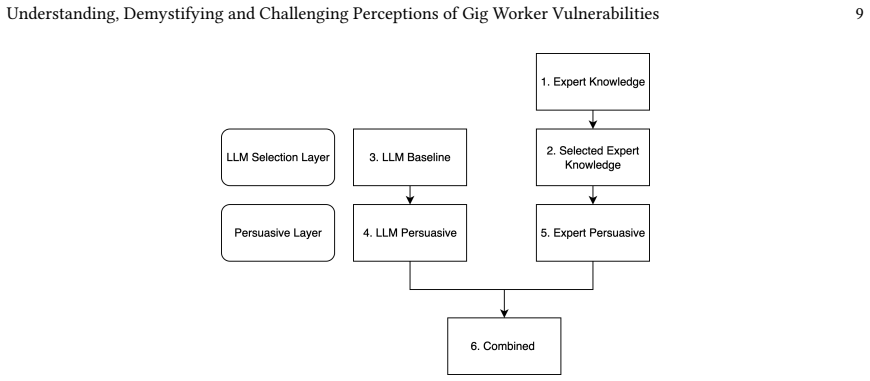
In Phase I, 227 of 236 crowdworkers expressed belief in one or more of five myths that portray gig work as safer or more flexible than it is in practice. Phase II presented expert- or LLM-generated counterarguments that directly addressed each myth. Workers showed measurable shifts away from the myths, revealing underexposure to personal and shared vulnerabilities and demonstrating that scalable persuasive interventions can raise awareness of concealed labor conditions in platform work.
What carries the argument
Five common myths about gig worker vulnerabilities paired with expert- or LLM-generated counterarguments that directly refute each myth.
If this is right
- Greater awareness of vulnerabilities can support collective bargaining efforts for platform workers.
- Scalable interventions using counterarguments can address knowledge gaps across large worker populations.
- Differences in effectiveness between expert and LLM-generated arguments can guide choice of persuasion method.
- Improved public perceptions of gig work realities can inform policy discussions on labor protections.
Where Pith is reading between the lines
- The same myth-challenging method could be tested on workers in adjacent platform sectors such as ride-hailing or delivery to check for similar belief patterns.
- Widespread use of such interventions might eventually pressure platforms to change design features that sustain the myths.
- Public education campaigns could adapt the counterargument format to reach non-workers who influence labor policy.
Load-bearing premise
The five myths accurately describe real platform practices and the counterarguments correctly identify and refute actual vulnerabilities without adding new inaccuracies.
What would settle it
A follow-up experiment in which the same workers rate the myths after the counterarguments and show no reduction in agreement levels, or an external check showing that the original myths do not match documented platform practices.
Figures


read the original abstract
Across service domains, platform-based gig workers often face a wide range of severe yet hidden vulnerabilities, including opaque pay practices, illusions of flexibility, health and safety risks, and privacy violations. To the general public and inexperienced workers such latent vulnerabilities remain largely unknown and concealed by intentional platform design that gives illusions of adequate labor protections, or $\textit{myths}$. This study examines how workers perceive (and shift their beliefs away from) five commonly held misconceptions regarding gig worker vulnerabilities. In $Phase~I$, crowdworkers ($N~=~236$) rated their agreement with five common myths surrounding vulnerabilities in gig work:$~227$ of them believed one or more myth(s). In $Phase~II$, we challenged these workers to defend their views by presenting an expert- or LLM-generated counterargument. Our findings show workers' underexposure to personal and shared vulnerabilities of gig work, revealing a knowledge gap where persuasive interventions can scalably raise awareness around such hidden labor conditions. We reflect on the effectiveness of different persuasion strategies and discuss implications for promoting more accurate public perceptions that support collective bargaining of workers' rights.
Editorial analysis
A structured set of objections, weighed in public.
Referee Report
Summary. The paper claims that gig workers face severe but hidden vulnerabilities obscured by platform design and five commonly held myths (e.g., opaque pay, illusions of flexibility). In Phase I, 236 crowdworkers were surveyed and 227 endorsed at least one myth. Phase II then exposed these participants to expert- or LLM-generated counterarguments, showing belief shifts that the authors interpret as evidence that scalable persuasive interventions can close the knowledge gap and support collective bargaining for workers' rights.
Significance. If the myths are verifiably false and the counterarguments factually accurate, the work would offer a useful empirical demonstration in HCI and labor studies of how targeted persuasion can address public misconceptions about platform work. The large Phase I sample and the explicit comparison of expert versus LLM rebuttals are strengths that could inform future intervention design.
major comments (2)
- Abstract and Phase I description: The headline finding that 227 of 236 participants believed one or more myths is interpreted as revealing a knowledge gap about real vulnerabilities. This reading requires that the five statements are verifiably false (i.e., genuine misconceptions) and that the Phase II counterarguments correctly refute actual platform practices. The manuscript presents the statements as 'commonly held misconceptions' without citing platform data, legal analyses, or independent expert review of either the myth wording or the rebuttal content.
- Phase II description: The belief-shift results are used to argue that 'persuasive interventions can scalably raise awareness around such hidden labor conditions.' This claim is load-bearing for the paper's contribution, yet the counterarguments are generated by experts or LLMs without reported external validation, source citations, or checks for factual accuracy. If any myth is actually accurate or any rebuttal contains errors, the observed shifts cannot be read as evidence of improved understanding of genuine vulnerabilities.
minor comments (2)
- Methods section: The abstract reports sample size and headline counts but provides no details on statistical analysis, effect sizes, control conditions, or how the five myths were selected and pre-validated.
- Discussion: Clarify whether the same participants were used across phases and report any attrition or order effects.
Simulated Author's Rebuttal
We thank the referee for their insightful comments, which highlight important areas for improving the rigor of our claims regarding the factual basis of the myths and counterarguments. We address each major comment below and outline the revisions we will make to the manuscript.
read point-by-point responses
-
Referee: Abstract and Phase I description: The headline finding that 227 of 236 participants believed one or more myths is interpreted as revealing a knowledge gap about real vulnerabilities. This reading requires that the five statements are verifiably false (i.e., genuine misconceptions) and that the Phase II counterarguments correctly refute actual platform practices. The manuscript presents the statements as 'commonly held misconceptions' without citing platform data, legal analyses, or independent expert review of either the myth wording or the rebuttal content.
Authors: We agree that the manuscript would be strengthened by explicit citations supporting the classification of these statements as misconceptions. The myths were selected based on recurring themes in the gig economy literature, including reports on algorithmic opacity and worker autonomy. In the revised version, we will expand the related work section and Phase I description to include specific citations to platform studies, legal analyses of gig worker rights, and independent reports that document these vulnerabilities. This will provide the necessary grounding for interpreting the survey results as evidence of a knowledge gap. Regarding the rebuttal content, we will add details on the expert consultation process used to develop the counterarguments. revision: yes
-
Referee: Phase II description: The belief-shift results are used to argue that 'persuasive interventions can scalably raise awareness around such hidden labor conditions.' This claim is load-bearing for the paper's contribution, yet the counterarguments are generated by experts or LLMs without reported external validation, source citations, or checks for factual accuracy. If any myth is actually accurate or any rebuttal contains errors, the observed shifts cannot be read as evidence of improved understanding of genuine vulnerabilities.
Authors: We recognize the need for greater transparency in the generation and validation of the counterarguments to support the interpretation of the belief shifts. While the expert counterarguments were crafted with input from labor researchers, this process was not detailed in the original submission. We will revise the Phase II section to describe the generation method, include source citations for factual claims in the rebuttals, and report any accuracy checks performed. For the LLM-generated arguments, we will specify the prompts and any human review steps. These additions will allow readers to assess the factual basis and strengthen the claim about scalable persuasive interventions. We do not believe this undermines the overall findings on belief change but enhances their credibility. revision: yes
Circularity Check
No significant circularity in empirical survey study
full rationale
The paper reports an empirical study in which 236 crowdworkers rated agreement with five statements labeled as myths about gig work vulnerabilities, with 227 endorsing at least one. Central findings derive directly from these participant responses and from observed belief shifts after exposure to counterarguments. No equations, derivations, fitted parameters, or self-referential definitions appear in the reported chain. The results do not reduce to inputs by construction, and the study remains self-contained against external benchmarks as it measures observable beliefs rather than claiming a mathematical or definitional necessity.
Axiom & Free-Parameter Ledger
axioms (2)
- domain assumption The five myths listed represent widely held and incorrect beliefs about gig work vulnerabilities.
- domain assumption Expert- or LLM-generated counterarguments are factually correct and sufficient to challenge the myths.
Reference graph
Works this paper leans on
-
[1]
Hunter Akridge, Alex Ahmed, Free S Bàssïbét, Magally A Miranda Alcázar, and Sarah Fox. 2025. “Oh, you’re watching me”: Care workers’ experiences of surveillant assemblages on the platform and in the home.New Media & Society(2025), 14614448251315759
work page 2025
-
[2]
Ira Anjali Anwar, Joyojeet Pal, and Julie Hui. 2021. Watched, but Moving: Platformization of Beauty Work and Its Gendered Mechanisms of Control. Proc. ACM Hum.-Comput. Interact.4, CSCW3, Article 250 (Jan. 2021), 20 pages. doi:10.1145/3432949 Manuscript submitted to ACM 24 S. de Jong et al
-
[3]
Mohammad Amir Anwar and Mark Graham. 2020. Hidden transcripts of the gig economy: labour agency and the new art of resistance among African gig workers.Environment and Planning A: Economy and Space52, 7 (2020), 1269–1291
work page 2020
-
[4]
Mohammad Amir Anwar and Mark Graham. 2021. Between a rock and a hard place: Freedom, flexibility, precarity and vulnerability in the gig economy in Africa.Competition & Change25, 2 (2021), 237–258. https://doi.org/10.1177/1024529420914473
-
[5]
Lisa P. Argyle, Christopher A. Bail, Ethan C. Busby, Joshua R. Gubler, Thomas Howe, Christopher Rytting, Taylor Sorensen, and David Wingate
-
[6]
Leveraging AI for democratic discourse: Chat interventions can improve online political conversations at scale.Proceedings of the National Academy of Sciences120, 41 (Oct. 2023), e2311627120. doi:10.1073/pnas.2311627120 Publisher: Proceedings of the National Academy of Sciences
-
[7]
Hui Bai, Jan Voelkel, Johannes Eichstaedt, and Robb Willer. 2023. Artificial Intelligence Can Persuade Humans on Political Issues. doi:10.21203/rs.3.rs- 3238396/v1
-
[8]
Uttam Bajwa, Denise Gastaldo, Erica Di Ruggiero, and Lilian Knorr. 2018. The health of workers in the global gig economy.Global. Health14, 1 (Dec. 2018), 124. doi:10.1186/s12992-018-0444-8
-
[9]
Arianne Renan Barzilay and Anat Ben-David. 2016. Platform inequality: Gender in the gig-economy.Seton Hall Law Rev.47 (2016), 393
work page 2016
-
[10]
Aastha Behl, K Rajagopal, Pratima Sheorey, and Ashish Mahendra. 2022. Barriers to entry of gig workers in the gig platforms: exploring the dark side of the gig economy.Aslib Journal of Information Management74, 5 (2022), 818–839
work page 2022
-
[11]
Bender, Timnit Gebru, Angelina McMillan-Major, and Shmargaret Shmitchell
Emily M. Bender, Timnit Gebru, Angelina McMillan-Major, and Shmargaret Shmitchell. 2021. On the Dangers of Stochastic Parrots: Can Language Models Be Too Big?. InProceedings of the 2021 ACM Conference on Fairness, Accountability, and Transparency(Virtual Event, Canada)(FAccT ’21). Association for Computing Machinery, New York, NY, USA, 610–623. doi:10.114...
-
[12]
Virginia Braun and Victoria Clarke. 2006. Using thematic analysis in psychology.Qualitative Research in Psychology3, 2 (2006), 77–101. doi:10.1191/ 1478088706qp063oa
work page 2006
-
[13]
Mbonigaba Celestin and N Vanitha. 2021. The gig economy and its effects on personal finance.Indo American Journal of Multidisciplinary Research and Review5, 2 (2021), 39–46
work page 2021
-
[14]
Quanze Chen, Jonathan Bragg, Lydia B. Chilton, and Dan S. Weld. 2019. Cicero: Multi-Turn, Contextual Argumentation for Accurate Crowdsourcing. InProceedings of the 2019 CHI Conference on Human Factors in Computing Systems(Glasgow, Scotland Uk)(CHI ’19). Association for Computing Machinery, New York, NY, USA, 1–14. doi:10.1145/3290605.3300761
-
[15]
Miriam A Cherry. 2018. Corporate social responsibility and crowdwashing in the gig economy.. Louis ULJ63 (2018), 1
work page 2018
-
[16]
Costello, Gordon Pennycook, and David G
Thomas H. Costello, Gordon Pennycook, and David G. Rand. 2024. Durably Reducing Conspiracy Beliefs through Dialogues with AI.Science385, 6714 (Sept. 2024), eadq1814. doi:10.1126/science.adq1814
-
[17]
Tori L Crain, Rebecca M Brossoit, Faviola Robles-Saenz, and Molly Tran. 2020. Fighting fatigue: A conceptual model of driver sleep in the gig economy.Sleep Health6, 3 (2020), 358–365
work page 2020
-
[18]
Francisco Cruz and Tania Lombrozo. 2025. How Laypeople Evaluate Scientific Explanations Containing Jargon.Nature Human Behaviour(June 2025), 1–16. doi:10.1038/s41562-025-02227-0
-
[19]
2025.Going Beyond the Gig: An Ecological Approach to Studying and Intervening in the Gig Economy
Samantha Dalal. 2025.Going Beyond the Gig: An Ecological Approach to Studying and Intervening in the Gig Economy. Ph. D. Dissertation. University of Colorado at Boulder
work page 2025
-
[20]
Samantha Dalal, Ngan Chiem, Nikoo Karbassi, Yuhan Liu, and Andrés Monroy-Hernández. 2023. Understanding Human Intervention in the Platform Economy: A case study of an indie food delivery service. InProceedings of the 2023 CHI Conference on Human Factors in Computing Systems. 1–16
work page 2023
-
[21]
Valdemar Danry, Pat Pataranutaporn, Matthew Groh, and Ziv Epstein. 2025. Deceptive Explanations by Large Language Models Lead People to Change Their Beliefs About Misinformation More Often than Honest Explanations. InProceedings of the 2025 CHI Conference on Human Factors in Computing Systems (CHI ’25). Association for Computing Machinery, New York, NY, U...
-
[22]
Prakriti Dasgupta, Anthony McDonnell, Ronan Carbery, and Stefan Jooss. 2025. A systematic review on worker voice in the platform economy: The constitution of a grassroots voice mechanism.Human Resource Management Journal35, 3 (2025), 649–666
work page 2025
-
[23]
Sander de Jong, Rune Møberg Jacobsen, Joel Wester, Senuri Wijenayake, Jorge Goncalves, and Niels van Berkel. 2025. Impact of Agent-Generated Rationales on Online Social Conformity. InProceedings of the 2025 ACM Conference on Fairness, Accountability, and Transparency (FAccT ’25). Association for Computing Machinery, New York, NY, USA, 3370–3384. doi:10.11...
-
[24]
Valerio De Stefano. 2015. The rise of the just-in-time workforce: On-demand work, crowdwork, and labor protection in the gig-economy.Comp. Lab. L. & Pol’y J.37 (2015), 471
work page 2015
-
[25]
Hans De Witte, Jaco Pienaar, and Nele De Cuyper. 2016. Review of 30 years of longitudinal studies on the association between job insecurity and health and well-being: Is there causal evidence?Australian Psychologist51, 1 (2016), 18–31
work page 2016
-
[26]
Veena Dubal. 2023. On algorithmic wage discrimination.Columbia Law Review123, 7 (2023), 1929–1992
work page 2023
-
[27]
Veena B Dubal. 2017. The drive to Precarity: A political history of work, regulation, & labor advocacy in San Francisco’s taxi & Uber economies. Berkeley Journal of Employment and Labor Law(2017), 73–135
work page 2017
-
[28]
Veena B Dubal. 2017. Winning the battle, losing the war: assessing the impact of misclassification litigation on workers in the gig economy.Wis. L. Rev.(2017), 739
work page 2017
-
[29]
James Duggan, Ultan Sherman, Ronan Carbery, and Anthony McDonnell. 2020. Algorithmic management and app-work in the gig economy: A research agenda for employment relations and HRM.Human resource management journal30, 1 (2020), 114–132
work page 2020
-
[30]
David Durward, Ivo Blohm, and Jan Marco Leimeister. 2020. The nature of crowd work and its effects on individuals’ work perception.Journal of Management Information Systems37, 1 (2020), 66–95. Manuscript submitted to ACM Understanding, Demystifying and Challenging Perceptions of Gig Worker Vulnerabilities 25
work page 2020
-
[31]
2014.Digital discrimination: The case of Airbnb
Benjamin G Edelman and Michael Luca. 2014.Digital discrimination: The case of Airbnb. com. Technical Report 14-054. Harvard Business School. doi:10.2139/ssrn.2377353
-
[32]
Franz Faul, Edgar Erdfelder, Albert-Georg Lang, and Axel Buchner. 2007. G*Power 3: a flexible statistical power analysis program for the social, behavioral, and biomedical sciences.Behavior Research Methods39, 2 (2007), 175–191. doi:10.3758/bf03193146
-
[33]
Christian Fieseler, Eliane Bucher, and Christian Pieter Hoffmann. 2019. Unfairness by design? The perceived fairness of digital labor on crowdworking platforms.Journal of Business Ethics156, 4 (2019), 987–1005
work page 2019
-
[34]
Anna Freni-Sterrantino and Vincenzo Salerno. 2021. A Plea for the Need to Investigate the Health Effects of Gig-Economy.Frontiers in Public Health 9 (Feb. 2021), 638767. doi:10.3389/fpubh.2021.638767
-
[35]
Christine Gerber. 2021. Community building on crowdwork platforms: Autonomy and control of online workers?Competition & Change25, 2 (2021), 190–211
work page 2021
-
[36]
Mark Graham, Jamie Woodcock, Richard Heeks, Paul Mungai, Jean-Paul Van Belle, Darcy du Toit, Sandra Fredman, Abigail Osiki, Anri van der Spuy, and Six M Silberman. 2020. The Fairwork Foundation: Strategies for improving platform work in a global context.Geoforum112 (2020), 100–103. doi:10.1016/j.geoforum.2020.01.023
-
[37]
Kobi Hackenburg and Helen Margetts. 2024. Evaluating the Persuasive Influence of Political Microtargeting with Large Language Models.Proceedings of the National Academy of Sciences121, 24 (June 2024), e2403116121. doi:10.1073/pnas.2403116121
-
[38]
Tappin, Luke Hewitt, Ed Saunders, Sid Black, Hause Lin, Catherine Fist, Helen Margetts, David G
Kobi Hackenburg, Ben M. Tappin, Luke Hewitt, Ed Saunders, Sid Black, Hause Lin, Catherine Fist, Helen Margetts, David G. Rand, and Christopher Summerfield. 2025. The Levers of Political Persuasion with Conversational AI. arXiv:2507.13919 [cs] doi:10.48550/arXiv.2507.13919
-
[39]
Joseph F. Hair, Rolph E. Anderson, Ronald L. Tatham, and William C. Black. 1995.Multivariate data analysis (4th ed.): with readings. Prentice-Hall, Inc., USA
work page 1995
-
[40]
Seth D Harris and Alan B Krueger. 2015.A Proposal for Modernizing Labor Laws for Twenty-First-Century Work: The" Independent Worker". Brookings Washington, DC
work page 2015
-
[41]
Joshua Healy and Andreas Pekarek. 2025. The triangular relationship in platform gig work: Consumers, platform beneficence and worker vulnerability. New Technology, Work and Employment40, 2 (2025), 265–284. doi:10.1111/ntwe.12310
-
[42]
At the end of the day, I am accountable
Rie Helene Hernandez, Qiurong Song, Yubo Kou, and Xinning Gui. 2024. " At the end of the day, I am accountable": Gig Workers’ Self-Tracking for Multi-Dimensional Accountability Management. InProceedings of the 2024 CHI Conference on Human Factors in Computing Systems. 1–20
work page 2024
-
[43]
Maya Holikatti, Shagun Jhaver, and Neha Kumar. 2019. Learning to Airbnb by Engaging in Online Communities of Practice.Proc. ACM Hum.-Comput. Interact.3, CSCW, Article 228 (Nov. 2019), 19 pages. doi:10.1145/3359330
-
[44]
John Howard. 2017. Nonstandard work arrangements and worker health and safety.Am. J. Ind. Med.60, 1 (Jan. 2017), 1–10
work page 2017
-
[45]
Jane Hsieh, Oluwatobi Adisa, Sachi Bafna, and Haiyi Zhu. 2023. Designing Individualized Policy and Technology Interventions to Improve Gig Work Conditions. InProceedings of the 2nd Annual Meeting of the Symposium on Human-Computer Interaction for Work (CHIWORK ’23). Association for Computing Machinery, New York, NY, USA, 1–9. doi:10.1145/3596671.3598576
-
[46]
Jane Hsieh, Yili Hong, Gordon Burtch, and Haiyi Zhu. 2022. A Little Too Personal: Effects of Standardization versus Personalization on Job Acquisition, Work Completion, and Revenue for Online Freelancers. InProceedings of the 2022 CHI Conference on Human Factors in Computing Systems. 1–11
work page 2022
-
[47]
Jane Hsieh, Miranda Karger, Lucas Zagal, and Haiyi Zhu. 2023. Co-Designing Alternatives for the Future of Gig Worker Well-Being: Navigating Multi-Stakeholder Incentives and Preferences. InProceedings of the 2023 ACM Designing Interactive Systems Conference (DIS ’23). Association for Computing Machinery, New York, NY, USA, 664–687. doi:10.1145/3563657.3595982
- [48]
-
[49]
Jane Hsieh, Angie Zhang, Sajel Surati, Sijia Xie, Yeshua Ayala, Nithila Sathiya, Tzu-Sheng Kuo, Min Kyung Lee, and Haiyi Zhu. 2025. Gig2Gether: Datasharing to Empower, Unify and Demystify Gig Work. InProceedings of the 2025 CHI Conference on Human Factors in Computing Systems (CHI ’25). Association for Computing Machinery, New York, NY, USA, 1–25. doi:10....
- [50]
-
[51]
Mohammad Hossein Jarrahi and Will Sutherland. 2019. Algorithmic Management and Algorithmic Competencies: Understanding and Appropriating Algorithms in Gig Work. InInformation in Contemporary Society. Springer International Publishing, 578–589
work page 2019
-
[52]
Cameron R. Jones and Benjamin K. Bergen. 2024. Lies, Damned Lies, and Distributional Language Statistics: Persuasion and Deception with Large Language Models. arXiv:2412.17128 [cs] doi:10.48550/arXiv.2412.17128
-
[53]
Reishiro Kawakami and Sukrit Venkatagiri. 2024. The impact of generative ai on artists. InProceedings of the 16th Conference on Creativity & Cognition. 79–82
work page 2024
-
[54]
Sunnie S. Y. Kim, Jennifer Wortman Vaughan, Q. Vera Liao, Tania Lombrozo, and Olga Russakovsky. 2025. Fostering Appropriate Reliance on Large Language Models: The Role of Explanations, Sources, and Inconsistencies. InProceedings of the 2025 CHI Conference on Human Factors in Computing Systems (CHI ’25). Association for Computing Machinery, New York, NY, U...
-
[55]
Andrew Konya, Luke Thorburn, Wasim Almasri, Oded Adomi Leshem, Ariel Procaccia, Lisa Schirch, and Michiel Bakker. 2025. Using Collective Dialogues and AI to Find Common Ground between Israeli and Palestinian Peacebuilders. InProceedings of the 2025 ACM Conference on Fairness, Accountability, and Transparency (FAccT ’25). Association for Computing Machiner...
-
[56]
Marina Lao. 2017. Workers in the gig economy: The case for extending the antitrust labor exemption.UCDL Rev.51 (2017), 1543
work page 2017
-
[57]
Min Kyung Lee, Daniel Kusbit, Evan Metsky, and Laura Dabbish. 2015. Working with Machines: The Impact of Algorithmic and Data-Driven Management on Human Workers. InProceedings of the 33rd Annual ACM Conference on Human Factors in Computing Systems(Seoul, Republic of Korea)(CHI ’15). Association for Computing Machinery, New York, NY, USA, 1603–1612. doi:10...
-
[58]
Vili Lehdonvirta. 2018. Flexibility in the gig economy: managing time on three online piecework platforms.New Technology, Work and Employment 33, 1 (2018), 13–29
work page 2018
-
[59]
Chen Liang, Jing Peng, Yili Hong, and Bin Gu. 2023. The hidden costs and benefits of monitoring in the gig economy.Information Systems Research 34, 1 (2023), 297–318
work page 2023
-
[60]
Pearl MC Lin, Kang-Lin Peng, Wai Ching Wilson Au, and Tom Baum. 2023. Labor market transformation in the hospitality gig economy in a post pandemic era: impacts of institutional governance.International Journal of Contemporary Hospitality Management35, 4 (2023), 1490–1510
work page 2023
-
[61]
Alexandra Mateescu and Julia Ticona. 2020. Invisible work, visible workers.Beyond the Algorithm: Qualitative Insights for Gig Work Regulation (2020)57 (2020)
work page 2020
-
[62]
2024.We don’t need Question 3 allowing unionization of rideshare drivers
Robert Melvin. 2024.We don’t need Question 3 allowing unionization of rideshare drivers. https://commonwealthbeacon.org/opinion/we-dont-need- question-3-allowing-unionization-of-rideshare-drivers/ Accessed: 2025-09-11
work page 2024
-
[63]
Joy Ming, Elizabeth Kuo, Katie Go, Emily Tseng, John Kallas, Aditya Vashistha, Madeline Sterling, and Nicola Dell. 2023. "I go beyond and beyond" examining the invisible work of home health aides.Proceedings of the ACM on Human-Computer Interaction7, CSCW1 (2023), 1–21
work page 2023
-
[64]
Gemma Newlands. 2021. Algorithmic surveillance in the gig economy: The organization of work through Lefebvrian conceived space.Organization Studies42, 5 (2021), 719–737
work page 2021
-
[65]
Sabine Pfeiffer and Sandra Kawalec. 2020. Justice expectations in crowd and platform-mediated work.The Economic and Labour Relations Review31, 4 (2020), 483–501. doi:10.1177/1035304620959750
-
[66]
Hilda Rahmah, Fitra Prasapawidya Purna, Sri Syamsiyah Lestari Sjafiie, and Yoma Bagus Pamungkas. 2025. Supporting Young Digital Workers: Acknowledging the Real Vulnerabilities of Gig Work in Today’s Marketplace System.Jurnal Ilmu Sosial dan Humaniora14, 2 (2025), 269–278
work page 2025
-
[67]
Uma Rani and Marianne Furrer. 2021. Digital labour platforms and new forms of flexible work in developing countries: Algorithmic management of work and workers.Competition & Change25, 2 (2021), 212–236
work page 2021
- [68]
-
[69]
Varun Nagaraj Rao, Samantha Dalal, Andrew Schwartz, Amna Liaqat, Dana Calacci, and Andrés Monroy-Hernández. 2025. FareShare: A Tool for Labor Organizers to Estimate Lost Wages and Contest Arbitrary AI and Algorithmic Deactivations. arXiv:2505.08904 [cs] doi:10.48550/arXiv.2505.08904
-
[70]
Noopur Raval and Paul Dourish. 2016. Standing Out from the Crowd: Emotional Labor, Body Labor, and Temporal Labor in Ridesharing. In Proceedings of the 19th ACM Conference on Computer-Supported Cooperative Work & Social Computing(San Francisco, California, USA)(CSCW ’16). Association for Computing Machinery, New York, NY, USA, 97–107. doi:10.1145/2818048.2820026
-
[71]
Alex Rosenblat and Luke Stark. 2016. Algorithmic labor and information asymmetries: A case study of Uber’s drivers.International journal of communication10 (2016), 27
work page 2016
-
[72]
Francesco Salvi, Manoel Horta Ribeiro, Riccardo Gallotti, and Robert West. 2025. On the Conversational Persuasiveness of GPT-4.Nature Human Behaviour(May 2025), 1–9. doi:10.1038/s41562-025-02194-6
-
[73]
Shamzaeffa Samsudin, Shazida Jan Mohd Khan, Junaidah Hasan, Siti Nurazira Mohd Daud, and Ng Jia Jia. 2024. Financial Vulnerability of Gig Workers: Insights and Implications for Social Protection Schemes.International Journal of Social Policy and Society (IJSPS)20 (2024), 27–44
work page 2024
-
[74]
Shruti Sannon, Billie Sun, and Dan Cosley. 2022. Privacy, Surveillance, and Power in the Gig Economy. InProceedings of the 2022 CHI Conference on Human Factors in Computing Systems(New Orleans, LA, USA)(CHI ’22). Association for Computing Machinery, New York, NY, USA, Article 619, 15 pages. doi:10.1145/3491102.3502083
- [75]
-
[76]
Vera M Schweitzer, Wladislaw Rivkin, and Fabiola Heike Gerpott. 2023. Gig Workers’ Social Support Seeking on Informal Online Platforms as a Predictor of Performance. InAcademy of management proceedings, Vol. 2023. Academy of Management Briarcliff Manor, NY 10510, 12853
work page 2023
-
[77]
Andrey Shevchuk, Denis Strebkov, and Shannon N Davis. 2019. The autonomy paradox: How night work undermines subjective well-being of internet-based freelancers.Ilr Review72, 1 (2019), 75–100
work page 2019
-
[78]
Dina Maria Denine Smit and Grey Stopforth. 2023. An overview of categories of vulnerability among on-demand workers in the gig economy (Part 2).Law, Democracy and Development27 (2023), 1–34. doi:10.17159/2077-4907/2023/ldd.v27.6
-
[79]
Emily Steel. 2025. Uber’s Festering Sexual Assault Problem.The New York Times(6 Aug. 2025). https://www.nytimes.com/2025/08/06/business/uber- sexual-assault.html Accessed: 2025-08-17
work page 2025
-
[80]
Valerio De Stefano. 2015. The Rise of the ’Just-in-Time Workforce’: On-Demand Work, Crowd Work and Labour Protection in the ’Gig-Economy’. SSRN Electronic Journal(10 2015). doi:10.2139/ssrn.2682602
discussion (0)
Sign in with ORCID, Apple, or X to comment. Anyone can read and Pith papers without signing in.