DeepFixel: Crossing white matter fiber identification through spherical convolutional neural networks
Pith reviewed 2026-05-18 00:38 UTC · model grok-4.3
The pith
DeepFixel approximates nonlinear optimization for separating crossing white matter fibers using a spherical convolutional neural network modeled on a high-resolution mesh.
A machine-rendered reading of the paper's core claim, the machinery that carries it, and where it could break.
Core claim
DeepFixel is a spherical convolutional neural network that approximates the non-convex nonlinear optimization used to fit axially symmetric fiber ODFs to diffusion-weighted data. By representing the fiber probability distribution directly on a high-resolution spherical mesh, the network achieves a median angular correlation coefficient of 0.973 (IQR 0.004) for two- and three-fiber cases, compared with 1.0 for the reference optimization and 0.988 for fixel-based separation, at a cost of 0.32 ms per voxel versus approximately 1.01 million ms for the optimization, while resolving smaller angular separations and lower volume fractions than the fixel method.
What carries the argument
Spherical convolutional neural network trained to approximate the nonlinear optimization that fits ODFs with axial-symmetry penalties to the measured diffusion signal, using a spherical mesh of higher angular resolution than spherical harmonics.
If this is right
- Separation of crossing fibers becomes feasible across entire brain volumes instead of selected regions only.
- Tractography pipelines can use higher angular resolution data without prohibitive compute cost.
- Small-angle and low-volume-fraction crossings become separable, reducing systematic underestimation of complex white-matter architecture.
Where Pith is reading between the lines
- Integration into existing diffusion pipelines could shorten analysis time for large cohort studies of brain connectivity.
- The mesh-based representation opens the possibility of adding geometric priors such as local curvature directly into the separation step.
- Similar spherical-CNN approximations might transfer to other spherical signals encountered in neuroimaging or materials science.
Load-bearing premise
The high-resolution spherical mesh representation of the fiber probability distribution captures every feature needed for accurate downstream tractography without introducing new artifacts.
What would settle it
Running the full nonlinear optimization and DeepFixel on the same real diffusion dataset and then comparing the resulting tractography streamlines or connectivity matrices for measurable differences in endpoint accuracy or false positive rate.
Figures
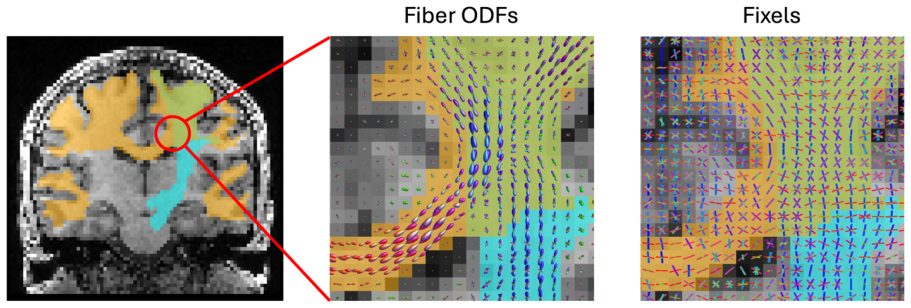


read the original abstract
Diffusion-weighted magnetic resonance imaging allows for reconstruction of models for structural connectivity in the brain, such as fiber orientation distribution functions (ODFs) that describe the distribution, direction, and volume of white matter fiber bundles in a voxel. Crossing white matter fibers in voxels complicate analysis and can lead to errors in downstream tasks like tractography. We introduce one option for separating fiber ODFs by performing a nonlinear optimization to fit ODFs to the given data and penalizing terms that are not symmetric about the axis of the fiber. However, this optimization is non-convex and computationally infeasible across an entire image (approximately 1.01 x 10⁶ ms per voxel). We introduce DeepFixel, a spherical convolutional neural network approximation for this nonlinear optimization. We model the probability distribution of fibers as a spherical mesh with higher angular resolution than a truncated spherical harmonic representation. To validate DeepFixel, we compare to the nonlinear optimization and a fixel-based separation algorithm of two-fiber and three-fiber ODFs. The median angular correlation coefficient is 1 (interquartile range of 0.00) using the nonlinear optimization algorithm, 0.988 (0.317) using a fiber bundle elements or "fixel"-based separation algorithm, and 0.973 (0.004) using DeepFixel. DeepFixel is more computationally efficient than the non-convex optimization (0.32 ms per voxel). DeepFixel's spherical mesh representation is successful at disentangling at smaller angular separations and smaller volume fractions than the fixel-based separation algorithm.
Editorial analysis
A structured set of objections, weighed in public.
Referee Report
Summary. The manuscript introduces DeepFixel, a spherical convolutional neural network that approximates a non-convex nonlinear optimization for separating crossing-fiber ODFs. Fiber probability distributions are modeled on a high-resolution spherical mesh rather than truncated spherical harmonics. On synthetic two- and three-fiber cases the method reports median angular correlation coefficients of 0.973 (IQR 0.004) versus 1.0 for the reference optimization and 0.988 for a fixel-based baseline, while reducing per-voxel runtime from ~1.01×10^6 ms to 0.32 ms and claiming better performance at small angular separations and volume fractions.
Significance. If the central performance claims hold under broader validation, the work offers a practical route to fast, accurate crossing-fiber separation that could benefit tractography pipelines. The direct comparison against both the slow nonlinear reference and an existing fixel method, together with explicit timing numbers, provides a clear efficiency-accuracy trade-off assessment. The spherical-mesh representation and CNN approximation of non-convex optimization constitute a technically interesting direction for dMRI processing.
major comments (2)
- [Abstract / Methods] Abstract and Methods (model description): The central claim that the spherical mesh representation with higher angular resolution than truncated spherical harmonics faithfully models the ODF probability distribution without introducing artifacts or information loss is load-bearing for the reported advantage at small angles and volume fractions. No quantitative reconstruction-error comparison (e.g., mesh vs. SH fidelity on known synthetic ODFs) or discretization-artifact analysis is supplied, leaving open the possibility that the 0.973 median ACC edge over fixel methods arises from training-data specifics rather than the representation itself.
- [Validation / Results] Validation section: The reported median ACC values and IQR are given only for synthetic two- and three-fiber cases; the manuscript provides no details on the distribution of training data, no real-data validation, and no error analysis that would establish whether the performance generalizes beyond the synthetic regime used to train the network to reproduce the nonlinear optimizer.
minor comments (1)
- [Abstract] The IQR for the fixel-based method is reported as 0.317 while the nonlinear optimization IQR is 0.00; clarify whether these values are correctly transcribed and whether they affect the interpretation of the cross-method comparison.
Simulated Author's Rebuttal
We thank the referee for their positive evaluation of the significance of our work and for the constructive major comments. We provide point-by-point responses below, indicating planned revisions to the manuscript.
read point-by-point responses
-
Referee: [Abstract / Methods] Abstract and Methods (model description): The central claim that the spherical mesh representation with higher angular resolution than truncated spherical harmonics faithfully models the ODF probability distribution without introducing artifacts or information loss is load-bearing for the reported advantage at small angles and volume fractions. No quantitative reconstruction-error comparison (e.g., mesh vs. SH fidelity on known synthetic ODFs) or discretization-artifact analysis is supplied, leaving open the possibility that the 0.973 median ACC edge over fixel methods arises from training-data specifics rather than the representation itself.
Authors: We acknowledge the importance of demonstrating that the spherical mesh representation does not introduce significant artifacts compared to spherical harmonics. The reported performance advantages, particularly at small angular separations, are shown through direct comparison to the nonlinear optimizer which uses the same mesh. However, to address this concern directly, we will include a quantitative analysis in a revised Methods section comparing the reconstruction error and fidelity of the mesh representation versus truncated SH on a set of known synthetic ODFs. This will help confirm that the advantages are due to the representation rather than other factors. revision: yes
-
Referee: [Validation / Results] Validation section: The reported median ACC values and IQR are given only for synthetic two- and three-fiber cases; the manuscript provides no details on the distribution of training data, no real-data validation, and no error analysis that would establish whether the performance generalizes beyond the synthetic regime used to train the network to reproduce the nonlinear optimizer.
Authors: We chose to validate primarily on synthetic data because it allows for a direct and quantitative comparison to the exact nonlinear optimization, which provides the ground truth for fiber disentanglement and is not feasible to run on real data due to computational cost. We will revise the Methods section to include more explicit details on the training data distribution, such as the specific ranges and sampling methods for angular separations, volume fractions, and other parameters. For real-data validation, we agree this would be valuable for assessing generalization; however, the current manuscript focuses on fidelity to the reference method. We will add a paragraph in the Discussion addressing the expected generalization and potential error analysis, and note that real-data experiments are planned as future work. revision: partial
Circularity Check
Network approximates independent nonlinear optimization; metrics against external reference
full rationale
The paper first defines a standalone nonlinear optimization procedure for fitting ODFs with symmetry penalties, then positions DeepFixel as a spherical CNN trained to approximate that procedure. Reported angular correlation coefficients (1.0 for nonlinear optimization, 0.988 for fixel-based, 0.973 for DeepFixel) are computed by direct comparison to these external benchmarks rather than to any quantities defined internally by the network's own parameters or mesh representation. The spherical mesh is introduced as an explicit modeling choice with higher angular resolution than truncated spherical harmonics, without any reduction to self-definition, fitted-input renaming, or load-bearing self-citation. Because the derivation chain remains anchored to independently verifiable external references and the central performance claims do not collapse by construction, the paper exhibits only minor circularity at most.
Axiom & Free-Parameter Ledger
free parameters (1)
- neural network weights
axioms (2)
- domain assumption The nonlinear optimization correctly recovers symmetric fiber ODFs when run to convergence
- domain assumption Spherical mesh with higher angular resolution than truncated spherical harmonics preserves all necessary fiber distribution information
Lean theorems connected to this paper
-
IndisputableMonolith/Foundation/AlexanderDuality.leanalexander_duality_circle_linking unclear?
unclearRelation between the paper passage and the cited Recognition theorem.
We model the probability distribution of fibers as a spherical mesh with higher angular resolution than a truncated spherical harmonic representation... output is a spherical probability distribution representing the probability of finding a fiber along a given angle.
What do these tags mean?
- matches
- The paper's claim is directly supported by a theorem in the formal canon.
- supports
- The theorem supports part of the paper's argument, but the paper may add assumptions or extra steps.
- extends
- The paper goes beyond the formal theorem; the theorem is a base layer rather than the whole result.
- uses
- The paper appears to rely on the theorem as machinery.
- contradicts
- The paper's claim conflicts with a theorem or certificate in the canon.
- unclear
- Pith found a possible connection, but the passage is too broad, indirect, or ambiguous to say the theorem truly supports the claim.
Reference graph
Works this paper leans on
-
[1]
METHODS Simulation data To investigate the feasibility of using a deep learning algorithm to approximate an algorithm for separating crossing fiber ODFs, we use simulated data. We use simulated data because we can control the direction and size of the fiber ODF, and this data can serve as ground truth to test the sensitivity of fiber separation algorithms...
-
[2]
RESULTS The single-fiber ODFs estimated from FISSILE are similar to the true single-fiber ODFs, even at very small volume fractions (Fig. 4). The ODFs from fod2fixel are close in direction to the original ODFs, but at widely varying volume fractions. DeepFixel’s outputs for both the MLP and spherical CNN appear close to the original ODFs, though the netwo...
-
[3]
Diffusion MRI fiber tractography of the brain,
DISCUSSION DeepFixel provides a deep learning approximation for the accurate but computationally expensive FISSILE algorithm for crossing fiber disentangling. Notably, FISSILE and DeepFixel succeed in disentangling crossing fibers at smaller volume fraction and smaller angular separations than fod2fixel, separating angles beyond the previously reported li...
work page 2019
-
[4]
Jeurissen, B., Tournier, J. D., Dhollander, T., Connelly, A. and Sijbers, J., “Multi-tissue constrained spherical deconvolution for improved analysis of multi-shell diffusion MRI data,” Neuroimage 103, 411–426 (2014). [15] Elaldi, A., Gerig, G. and Dey, N., “Equivariant spatio-hemispherical networks for diffusion MRI deconvolution,” Adv Neural Inf Process...
work page 2014
discussion (0)
Sign in with ORCID, Apple, or X to comment. Anyone can read and Pith papers without signing in.