Self-focusing of high-intensity beams with grid structures
Pith reviewed 2026-05-17 23:24 UTC · model grok-4.3
The pith
Grid-structured laser beams suppress self-focusing by redistributing power through nonlinear interactions between beamlets.
A machine-rendered reading of the paper's core claim, the machinery that carries it, and where it could break.
Core claim
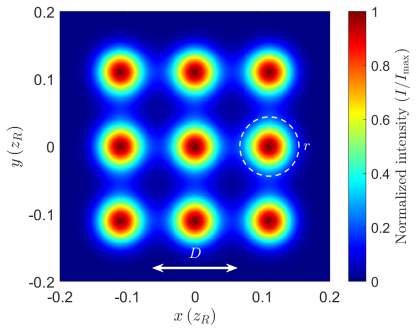
A transverse N x N grid beam structure with optimized lattice spacing undergoes dimension-dependent multi-stage self-focusing and transmits more total power than the critical self-focusing level of each beamlet would permit, because inter-beamlet nonlinear interactions redistribute optical power and thereby suppress collapse even without competing effects.
What carries the argument
The N x N grid beam structure with optimized lattice spacing, which enables inter-beamlet nonlinear interactions to redistribute optical power across the beam.
If this is right
- Total beam power can exceed the single-beam critical power while still propagating without collapse.
- Self-focusing proceeds through multiple stages whose number depends on grid dimension.
- Optimized lattice spacing allows specific grid layouts to carry higher total power than the per-beamlet critical power sum.
- A general numerical relation exists between optimal lattice spacing and beamlet size.
Where Pith is reading between the lines
- Grid shaping could extend the usable range of high-power beams in materials that support Kerr nonlinearity.
- The same redistribution idea might apply to other nonlinear propagation problems such as filamentation control.
- Experiments varying beamlet size while holding total power fixed would test how the optimal spacing scales.
Load-bearing premise
Inter-beamlet nonlinear interactions in the Kerr medium will redistribute power to suppress self-focusing without creating new instabilities or damage mechanisms.
What would settle it
Measure whether the distance to self-focus or the transmitted power for an optimized grid beam exceeds the value expected from the sum of critical powers of its individual beamlets at the same total power.
Figures


read the original abstract
Laser beams with high optical power propagating in a Kerr medium can undergo self-focusing when their power exceeds a critical power determined by the optical properties of the medium. The highly concentrated energy close to the in the region of the self-focus can lead to other nonlinear phenomena and cause significant irreversible damage to the material. We propose a transverse grid beam structure that effectively suppresses self-focusing even in the absence of other competing effects through the redistribution of optical power by inter-beamlet nonlinear interaction. We find that a beam with a $N \times N$ grid structure with optimized lattice spacing undergoes a dimension-dependent multi-stage self-focusing. We also identify specific grid layouts that can increase the total transmitted power beyond that permitted by the critical level of self-focusing for each beamlet. Lastly, we derive a general numerical relation between the optimal grid lattice spacing and the size of beamlets. Our results could potentially inform the use of beam shaping to prevent damage to optical components in high-powered and directed-energy applications.
Editorial analysis
A structured set of objections, weighed in public.
Referee Report
Summary. The manuscript proposes a transverse N×N grid beam structure with optimized lattice spacing to suppress self-focusing in Kerr media via inter-beamlet nonlinear power redistribution. It reports that such beams undergo dimension-dependent multi-stage self-focusing and identifies specific layouts permitting total transmitted power above the per-beamlet critical value. A general numerical relation between optimal lattice spacing and beamlet size is derived from simulations.
Significance. If the numerical results are robust and the relation holds across regimes, the work could inform practical beam-shaping strategies for mitigating damage in high-power laser systems and directed-energy applications by allowing higher total powers without triggering single-beamlet self-focusing.
major comments (3)
- [Abstract] Abstract and results sections: The central claim that inter-beamlet Kerr interactions redistribute power to suppress self-focusing without introducing new instabilities or filamentation is load-bearing, yet the abstract provides no metrics (e.g., peak intensity evolution, filamentation threshold comparisons, or stability criteria) used to confirm this in the simulations.
- [Results on lattice spacing] Section deriving the numerical relation: The 'general numerical relation' between optimal lattice spacing and beamlet size is presented as derived, but it is unclear whether the relation is independent of simulation parameters or reduces to a fit; without the explicit functional form, tested range of N, or sensitivity analysis to paraxiality breakdown, the claim of generality cannot be evaluated.
- [Power transmission analysis] Power-increase results: The identification of grid layouts exceeding per-beamlet critical power requires quantitative validation (e.g., total transmitted power vs. single-beamlet reference, with error analysis or ensemble runs) to ensure the multi-stage focusing does not seed local intensities above damage thresholds.
minor comments (2)
- [Abstract] Abstract: Typo in sentence 'The highly concentrated energy close to the in the region of the self-focus' (likely 'close to the self-focus in the region').
- [Methods] Notation: The manuscript should define the propagation equation (presumably the NLSE) and beamlet size metric explicitly at first use to aid reproducibility.
Simulated Author's Rebuttal
We thank the referee for the thorough review and valuable suggestions. We believe the points raised will help improve the clarity and robustness of our findings on grid-structured beams suppressing self-focusing in Kerr media. We respond to each major comment below.
read point-by-point responses
-
Referee: [Abstract] Abstract and results sections: The central claim that inter-beamlet Kerr interactions redistribute power to suppress self-focusing without introducing new instabilities or filamentation is load-bearing, yet the abstract provides no metrics (e.g., peak intensity evolution, filamentation threshold comparisons, or stability criteria) used to confirm this in the simulations.
Authors: We agree that incorporating quantitative metrics into the abstract would strengthen the presentation of our central claim. In the revised manuscript, we will modify the abstract to include key simulation metrics, such as the peak intensity reduction achieved through power redistribution and comparisons of filamentation thresholds between grid and single-beamlet configurations. This will be supported by references to the stability criteria detailed in the results section. revision: yes
-
Referee: [Results on lattice spacing] Section deriving the numerical relation: The 'general numerical relation' between optimal lattice spacing and beamlet size is presented as derived, but it is unclear whether the relation is independent of simulation parameters or reduces to a fit; without the explicit functional form, tested range of N, or sensitivity analysis to paraxiality breakdown, the claim of generality cannot be evaluated.
Authors: The relation is obtained from systematic numerical simulations and holds across the tested regimes. To clarify, we will explicitly state the functional form in the revised section, specify the range of N (e.g., 2×2 to 8×8) over which it was tested, and provide a brief discussion on its independence from specific simulation parameters within the paraxial regime. Regarding sensitivity to paraxiality breakdown, our simulations remain within the paraxial approximation, and we will add a note on the validity range. revision: yes
-
Referee: [Power transmission analysis] Power-increase results: The identification of grid layouts exceeding per-beamlet critical power requires quantitative validation (e.g., total transmitted power vs. single-beamlet reference, with error analysis or ensemble runs) to ensure the multi-stage focusing does not seed local intensities above damage thresholds.
Authors: We have compared the total transmitted power in grid configurations to single-beamlet cases in our simulations. To provide the requested quantitative validation, we will include additional figures or tables in the revised manuscript showing total transmitted power as a function of propagation distance, with comparisons to the single-beamlet critical power, and incorporate error analysis from repeated simulations with varied initial conditions. This will confirm that multi-stage focusing does not lead to intensities exceeding damage thresholds for the optimized layouts. revision: yes
Circularity Check
No circularity: claims rest on simulation results rather than definitional reduction or self-citation chains
full rationale
The paper's central results concern a proposed N×N grid beam structure that redistributes power via inter-beamlet Kerr interactions, leading to dimension-dependent multi-stage self-focusing and higher total transmitted power. The 'general numerical relation' between optimal lattice spacing and beamlet size is described as derived from the authors' analysis (abstract), which aligns with standard numerical exploration of the NLSE rather than a fitted parameter renamed as a prediction or a self-definitional loop. No load-bearing self-citations, uniqueness theorems imported from prior author work, or ansatzes smuggled via citation are evident in the provided text. The derivation chain is self-contained against external benchmarks of nonlinear beam propagation simulations.
Axiom & Free-Parameter Ledger
free parameters (1)
- lattice spacing
axioms (1)
- domain assumption Standard Kerr nonlinear response governs beam propagation
Lean theorems connected to this paper
-
IndisputableMonolith/Cost/FunctionalEquation.leanwashburn_uniqueness_aczel unclear?
unclearRelation between the paper passage and the cited Recognition theorem.
We derive a general numerical relation between the optimal grid lattice spacing and the size of beamlets... D_optimal(N,r0)≈2.53 r0 (even N)
-
IndisputableMonolith/Foundation/DimensionForcing.leanalexander_duality_circle_linking unclear?
unclearRelation between the paper passage and the cited Recognition theorem.
a beam with a N×N grid structure... undergoes a dimension-dependent multi-stage self-focusing
What do these tags mean?
- matches
- The paper's claim is directly supported by a theorem in the formal canon.
- supports
- The theorem supports part of the paper's argument, but the paper may add assumptions or extra steps.
- extends
- The paper goes beyond the formal theorem; the theorem is a base layer rather than the whole result.
- uses
- The paper appears to rely on the theorem as machinery.
- contradicts
- The paper's claim conflicts with a theorem or certificate in the canon.
- unclear
- Pith found a possible connection, but the passage is too broad, indirect, or ambiguous to say the theorem truly supports the claim.
Reference graph
Works this paper leans on
-
[1]
G. A. Askar’yan, “The self-focusing effect,” Sov. Phys. Uspekhi16, 680 (1974)
work page 1974
-
[2]
Y.-r. Shen, “Self-focusing: experimental,” Prog. quantum electronics4, 1–34 (1975)
work page 1975
-
[3]
R. W. Boyd, S. G. Lukishova, and Y. R. Shen,Self-focusing: Past and present: Fundamentals and prospects, vol. 114 (Springer, 2009)
work page 2009
-
[4]
Boyd,Nonlinear Optics(Academic Press, 2020)
R. Boyd,Nonlinear Optics(Academic Press, 2020)
work page 2020
-
[5]
Observationofself-phasemodulationandsmall-scalefilamentsincrystalsandglasses,
R.R.AlfanoandS.Shapiro,“Observationofself-phasemodulationandsmall-scalefilamentsincrystalsandglasses,” Phys. Rev. Lett.24, 592 (1970)
work page 1970
-
[6]
Nonlinear combining of laser beams,
P. M. Lushnikov and N. Vladimirova, “Nonlinear combining of laser beams,” Opt. Lett.39, 3429–3432 (2014)
work page 2014
-
[7]
Small-scale trapped filaments in intense laser beams,
R. G. Brewer, J. Lifsitz, E. Garmire,et al., “Small-scale trapped filaments in intense laser beams,” Phys. Rev.166, 326 (1968)
work page 1968
-
[8]
Femtosecond filamentation in transparent media,
A. Couairon and A. Mysyrowicz, “Femtosecond filamentation in transparent media,” Phys. reports441, 47–189 (2007)
work page 2007
-
[9]
Generation of caustics and rogue waves from nonlinear instability,
A. Safari, R. Fickler, M. J. Padgett, and R. W. Boyd, “Generation of caustics and rogue waves from nonlinear instability,” Phys. Rev. Lett.119, 203901 (2017)
work page 2017
-
[10]
Suppression of nonlinear optical rogue wave formation using polarization-structured beams,
A. N. Black, S. Choudhary, E. S. Arroyo-Rivera,et al., “Suppression of nonlinear optical rogue wave formation using polarization-structured beams,” Phys. Rev. Lett.129, 133902 (2022)
work page 2022
-
[11]
Controlling nonlinear rogue-wave formation using the coherence length of phase noise,
S. Choudhary, A. N. Black, A. Antikainen, and R. W. Boyd, “Controlling nonlinear rogue-wave formation using the coherence length of phase noise,” Phys. Rev. Res.6, 013174 (2024)
work page 2024
-
[12]
Laser-induceddamageandtheroleofself-focusing,
M.Soileau,W.E.Williams,N.Mansour,andE.W.VanStryland,“Laser-induceddamageandtheroleofself-focusing,” Opt. Eng.28, 1133–1144 (1989)
work page 1989
-
[13]
Atmospheric propagation and combining of high-power lasers,
W. Nelson, P. Sprangle, and C. Davis, “Atmospheric propagation and combining of high-power lasers,” Appl. optics 55, 1757–1764 (2016)
work page 2016
-
[14]
B. Rouzé, L. Lombard, H. Jacqmin,et al., “Coherent beam combination of seven 1.5𝜇m fiber amplifiers through up to 1 km atmospheric turbulence: near-and far-field experimental analysis,” Appl. optics60, 8524–8533 (2021)
work page 2021
-
[15]
M. Malik, M. O’Sullivan, B. Rodenburg,et al., “Influence of atmospheric turbulence on optical communications using orbital angular momentum for encoding,” Opt. express20, 13195–13200 (2012)
work page 2012
-
[16]
Z. Zhu, M. Janasik, A. Fyffe,et al., “Compensation-free high-dimensional free-space optical communication using turbulence-resilient vector beams,” Nat. communications12, 1666 (2021)
work page 2021
-
[17]
Beam shaping technology and its application in metal laser additive manufacturing: a review,
J. Bi, L. Wu, S. Li,et al., “Beam shaping technology and its application in metal laser additive manufacturing: a review,” J. Mater. Res. Technol.26, 4606–4628 (2023)
work page 2023
-
[18]
Modeling of nonlinear combining of multiple laser beams in Kerr medium,
P. M. Lushnikov and N. Vladimirova, “Modeling of nonlinear combining of multiple laser beams in Kerr medium,” Opt. Express23, 31120–31125 (2015)
work page 2015
-
[19]
Self-trapping of optical beams,
R. Y. Chiao, E. Garmire, and C. H. Townes, “Self-trapping of optical beams,” Phys. review letters13, 479 (1964)
work page 1964
-
[20]
Self-similar optical wave collapse: observation of the Townes profile,
K. Moll, A. L. Gaeta, and G. Fibich, “Self-similar optical wave collapse: observation of the Townes profile,” Phys. Rev. Lett.90, 203902 (2003)
work page 2003
-
[21]
Nonlinear Schrödinger equations and sharp interpolation estimates,
M. I. Weinstein, “Nonlinear Schrödinger equations and sharp interpolation estimates,” Commun. Math. Phys.87, 567 – 576 (1982)
work page 1982
-
[22]
Y. S. Kivshar and G. P. Agrawal,Optical solitons: from fibers to photonic crystals(Academic press, 2003)
work page 2003
-
[23]
Dispersion-managed solitons in fibre systems and lasers,
S. K. Turitsyn, B. G. Bale, and M. P. Fedoruk, “Dispersion-managed solitons in fibre systems and lasers,” Phys. Reports521, 135–203 (2012). Dispersion-Managed Solitons in Fibre Systems and Lasers
work page 2012
-
[24]
Filamentation in Kerr media from pulsed bessel beams,
P. Polesana, M. Franco, A. Couairon,et al., “Filamentation in Kerr media from pulsed bessel beams,” Phys. Rev. A 77, 043814 (2008)
work page 2008
-
[25]
Self-focusing of multiple interacting laguerre-gauss beams in Kerr media,
L. Sá and J. Vieira, “Self-focusing of multiple interacting laguerre-gauss beams in Kerr media,” Phys. Rev. A100, 013836 (2019)
work page 2019
-
[26]
Polarization shaping for control of nonlinear propagation,
F. Bouchard, H. Larocque, A. M. Yao,et al., “Polarization shaping for control of nonlinear propagation,” Phys. Rev. Lett.117, 233903 (2016)
work page 2016
-
[27]
Self-focusing propagation characteristics of a radially-polarized beam in nonlinear media,
L. Lu, Z. Wang, and Y. Cai, “Self-focusing propagation characteristics of a radially-polarized beam in nonlinear media,” Opt. Express30, 15905–15912 (2022)
work page 2022
-
[28]
Self-focusing effect analysis of a perfect optical vortex beam in atmospheric turbulence,
S. Wang, M. Cheng, X. Yang,et al., “Self-focusing effect analysis of a perfect optical vortex beam in atmospheric turbulence,” Opt. Express31, 20861–20871 (2023)
work page 2023
-
[29]
Self-focusing dynamics of coupled optical beams,
A. A. Ishaaya, T. D. Grow, S. Ghosh,et al., “Self-focusing dynamics of coupled optical beams,” Phys. Rev. A - At. Mol. Opt. Phys.75, 023813 (2007)
work page 2007
-
[30]
Controlled interactions of femtosecond light filaments in air,
B. Shim, S. E. Schrauth, C. J. Hensley,et al., “Controlled interactions of femtosecond light filaments in air,” Phys. Rev. A - At. Mol. Opt. Phys.81, 061803 (2010)
work page 2010
-
[31]
On the analytical theory for stationary self-focusing of radiation,
V. Malkin, “On the analytical theory for stationary self-focusing of radiation,” Phys. D: Nonlinear Phenom.64, 251–266 (1993)
work page 1993
-
[32]
Critical power for self-focusing in bulk media and in hollow waveguides,
G. Fibich and A. L. Gaeta, “Critical power for self-focusing in bulk media and in hollow waveguides,” Opt. Lett.25, 335–337 (2000)
work page 2000
-
[33]
Beam nonparaxiality, filament formation, and beam breakup in the self-focusing of optical beams,
M. D. Feit and J. A. Fleck, “Beam nonparaxiality, filament formation, and beam breakup in the self-focusing of optical beams,” J. Opt. Soc. Am. B5, 633–640 (1988)
work page 1988
-
[34]
Small beamnonparaxiality arrests self-focusing of optical beams,
G. Fibich, “Small beamnonparaxiality arrests self-focusing of optical beams,” Phys. Rev. Lett.76, 4356–4359 (1996)
work page 1996
-
[35]
Agrawal,Nonlinear Fiber Optics, Optics and Photonics (Elsevier Science, 2013)
G. Agrawal,Nonlinear Fiber Optics, Optics and Photonics (Elsevier Science, 2013)
work page 2013
discussion (0)
Sign in with ORCID, Apple, or X to comment. Anyone can read and Pith papers without signing in.