REVIEW 5 major objections 7 minor 1 cited by
CSST Strong Lensing Preparation: Cosmological Constraints Forecast from CSST Galaxy-Scale Strong Lensing
T0 review · 5 major / 7 minor · reviewed 2026-08-03 · deepseek-v4-flash
Pith's one-line read This paper forecasts that 10,000 galaxy-scale strong lenses from the China Space Station Telescope will measure the dark-energy equation of state to about 0.04, roughly twice as tight as current baryon-acoustic-oscillation data.
desk verdict A competent and useful forecast, but the headline Ωm~0.01 / w~0.04 numbers are self-consistency checks under the mock's own assumptions, not robust predictions. read the letter →
The pith
A machine-rendered reading of the paper's core claim, the machinery that carries it, and where it could break.
The reading
What carries the argument
The load-bearing identity is Eq. (1): within the Einstein radius, the gravitational lensing mass equals the dynamical mass. Lensing gives the mass in terms of angular diameter distances and the Einstein radius; the Jeans equation converts the observed stellar velocity dispersion into a dynamical mass under a single power-law density profile with a constant orbital-anisotropy parameter. Equating the two yields a distance ratio D_ls/D_s that depends on cosmology, so each lens becomes a one-number cosmological measurement. The machinery is completed by a hierarchical Bayesian treatment that marginalizes over intrinsic scatter in the lens density slope and anisotropy.
What would settle it
Run the same inference on a realistic simulated lens sample built from galaxies with line-of-sight structure, non-power-law density profiles, or anisotropy outside the assumed prior: if the recovered Omega_m and w shift by more than the forecasted uncertainties (about 0.01 and 0.04), the central claim is refuted. A cheaper check is to compare lensing-only mass estimates with dynamical mass estimates for the first few hundred real CSST lenses.
Extended reading notes
Core claim
The central claim is that with 10,000 galaxy-galaxy strong lenses, the combined lensing-plus-dynamics method yields sigma(Omega_m) around 0.01 and sigma(w) around 0.04 under ideal-to-optimistic assumptions, making the dark-energy constraint about twice as tight as the latest BAO result. The paper also establishes a practical pipeline comparison: MultiNest sampling and Bayesian hierarchical modeling produce comparable cosmological precision, with MultiNest about twice as fast and the hierarchical model better at recovering intrinsic lens-population scatter. Under the pessimistic scenario, the w0waCDM model fails to converge, which the paper attributes to large redshift errors inducing strong
Load-bearing premise
The whole forecast rests on the assumption that every lens galaxy's mass within the Einstein radius is exactly equal to its dynamical mass estimated from a single power-law density profile in equilibrium with a simple orbital-anisotropy model; if real galaxies violate this, the inferred distance ratio, and hence Omega_m and w, will be biased.
Editorial extensions
If this is right
- If 10,000 lenses are realized with 5-10 percent velocity-dispersion errors, strong lensing alone can rival and complement BAO surveys for dark-energy constraints.
- Improving redshift precision, especially source photometric redshifts, is critical: the pessimistic scenario fails to converge for the w0waCDM model, while the optimistic scenario runs faster and gives about twice as tight constraints.
- Both MultiNest and Bayesian hierarchical modeling are viable for 10^4-lens samples, with runtimes well under an hour; the choice depends on whether speed or robust lens-population inference is prioritized.
- The framework is scalable to the full predicted survey of up to roughly 160,000 systems, provided velocity-dispersion measurements are available for a substantial subset.
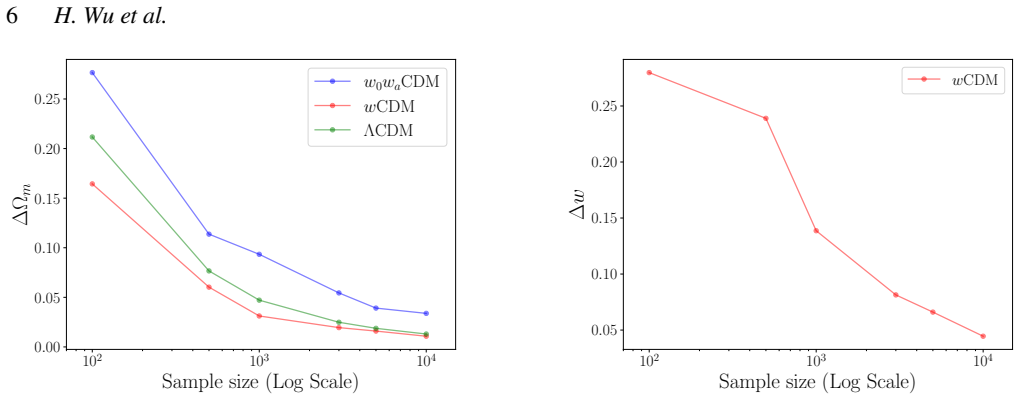
- The claimed precision on Omega_m and w improves by more than an order of magnitude when the sample grows from 100 to 10,000 lenses.
Reading between the lines
- The forecast's precision will degrade if real lens galaxies depart from the single power-law plus constant-anisotropy model, so a natural next test is to inject realistic, non-power-law simulated lenses into the same pipeline and measure the induced bias in Omega_m and w.
- Combining strong-lensing distance ratios with lensing probability statistics or time-delay measurements could break degeneracies and push below the forecasted uncertainties, an avenue the paper mentions but does not quantify.
- A controlled validation on the first few hundred real CSST lenses with spectroscopic redshifts would test whether recovered cosmological parameters agree with independent constraints at the claimed precision.
Editorial analysis
A structured set of objections, weighed in public.
Referee Report
Summary. This paper presents a forecasting study for cosmological constraints from ~10^4 galaxy-galaxy strong lenses expected from the China Space Station Telescope (CSST), using the gravitational-dynamical mass combination method. The authors build a mock lens sample from the Cao et al. (2024) simulation, assign Gaussian scatter to the power-law density slope, and propagate redshift and velocity-dispersion uncertainties in ideal, optimistic, and pessimistic scenarios. They then fit Ω_m in ΛCDM and (Ω_m, w) in wCDM, plus w0waCDM, using both MultiNest nested sampling and a NumPyro-based Bayesian hierarchical model (BHM). The headline results are σ(Ω_m)≈0.01 in ΛCDM and σ(w)≈0.04 in wCDM with 10,000 lenses, with the dark-energy constraint claimed to be about twice as tight as recent DESI BAO results, and with BHM and MultiNest giving comparable cosmological precision while BHM more robustly constrains lens-population scatter. The paper concludes by recommending BHM for population-level inference and MultiNest for speed, and it explicitly acknowledges that several systematic effects remain to be studied.
Significance. If taken at face value, the forecast is a useful demonstration of a scalable pipeline for the upcoming CSST lens sample. The paper has clear strengths: the mock catalogue is publicly available on GitHub, the BHM implementation is modern and reproducible, the three error scenarios are explicitly defined, and the comparison between nested sampling and hierarchical Bayesian inference addresses a practical computational issue for large samples. However, the central precision numbers are conditional on a self-consistency test: the mock data are generated under the same SIE/power-law mass model and the same distance formula that the inference then assumes. With 10^4 systems the statistical errors are tiny, so unmodelled systematics in the mass-dynamical calibration would dominate the quoted errors. Because the abstract and §4.1 present the Ω_m and w uncertainties as expected survey precision without a quantitative systematic-error budget, the significance of the headline claim is currently overstated. The omitted Einstein-radius measurement error and the uncontrolled CPU/GPU timing comparison are additional load-bearing gaps that can be fixed in revision.
major comments (5)
- [§2.1, §3.1.1, §5] The headline precision (σ_Ωm~0.01, σ_w~0.04 with 10^4 lenses) is obtained from a mock catalogue built under the same power-law/Jeans assumptions used in the likelihood: the lenses are generated with γ~N(2,0.16) and an SIE profile, and Eq. (6) is then inverted with priors centred on the same model. This is a self-consistency forecast, not an end-to-end prediction for real data. Because the statistical errors are tiny at N=10^4, deviations such as non-power-law mass profiles, line-of-sight structure, or anisotropy outside the U(-1,0.5) prior will enter through Eq. (6) as a systematic bias. The paper should state explicitly in the abstract and in §4.1 that the quoted constraints are conditional on the assumed mass model, and it should provide a quantitative systematic-error budget. The acknowledgment in §5 that such deviations 'must be studied' is not a substitute for propagating them into
- [§3.1.2, Eq. (6)] The uncertainty model in Eqs. (15)-(17) perturbs only z_l, z_s, and σ_v. The Einstein radius θ_E appears explicitly in Eq. (6) and is inferred from imaging with finite precision, yet no θ_E measurement error is propagated. Since θ_E scales the inferred distance ratio and is correlated with the lens model, omitting its error will systematically tighten the forecast—particularly in the 'pessimistic' scenario where source redshifts are photometric and image quality is lower. The authors should add a θ_E uncertainty (e.g., 2-5%, typical of current lens-modelling analyses) to each scenario and propagate it through Eq. (8).
- [§4.2, Table 1] The running-time comparison is not controlled: MultiNest is listed as running on CPU while BHM is listed as running on GPU. The statement that MultiNest is 'about twice as fast' as BHM is therefore not an intrinsic property of the two sampling algorithms; it may reflect hardware, implementation details, or convergence criteria. To support the computational trade-off recommendation, the authors should measure wall-clock time on the same platform (or provide comparable CPU/GPU costs per effective sample) and state the hardware specifications.
- [§3.2.1, §3.2.2, Table 1] The algorithm comparison is asymmetric: MultiNest is implemented as a population-mean fit with no intrinsic-scatter hyperparameters (σ_γ, σ_β), while BHM explicitly includes them. The claim that both methods 'produce comparable precision' and that BHM is 'more robust' conflates model flexibility with sampling-algorithm choice. For a fair comparison, MultiNest should be applied to the same hierarchical likelihood, or BHM should also be run in a fixed-scatter mode. This matters because the paper's methodological recommendation—BHM for robustness, MultiNest for speed—is based directly on this comparison.
- [§2.1, §3.2.1] The text in §2.1 says that the luminosity-density slope δ is treated as a nuisance parameter and marginalized with a Gaussian prior, but the hierarchical model in §3.2.1 and the parameter list in Table 1 contain only γ, σ_γ, β, and σ_β; δ is absent. If δ is fixed at its mean, then the marginalization is not implemented and the reported uncertainties omit a source of systematic error. If δ is sampled, it should appear in the model description and in Table 1. Please clarify this inconsistency.
minor comments (7)
- [§3.1.1] The paper never states the fiducial cosmological parameter values used to generate the mock catalogue (e.g., Ω_m, w) or the grey dashed lines in Fig. 2. These should be given explicitly to make the forecast reproducible.
- [Fig. 1] The right panel's caption says it shows 'the constraint precision on the dark energy equation of state parameter w', but the legend/label for the curve is missing; specify which model and scenario it corresponds to.
- [§4.1, Abstract] The comparison with 'the latest DESI BAO measurements' is between a mock-based forecast and real data. The claim that GGSL gives constraints 'twice as tight' should be phrased as a forecast under idealized assumptions, and the priors/fiducial inputs used for the GGSL side should be stated alongside the DESI values.
- [§3.1.2] The text says DESI technical parameters motivate the assumption that ~50,000 of 160,000 lenses will have velocity-dispersion data, but DESI is primarily a redshift survey. Clarify what specific DESI capability is being used for σ_v and whether these measurements are actually expected to be available.
- [Eqs. (7)-(8)] There is a notation inconsistency: Eq. (7) defines the correction to a common aperture θ_eff/2 using θ_ap, while Eq. (8) evaluates the model at θ_eff/2 using θ_E. Define θ_ap and θ_eff consistently in both equations.
- [Table 2] In the optimistic ΛCDM case, the recovered Ω_m=0.323^{+0.015}_{-0.020}; if the input is Ω_m=0.3, the mean is more than 1σ from the fiducial. Discuss whether this is a realization effect of the specific mock or a residual systematic from the population-mean approximation or the added noise.
- [Data Availability] The repository URL is broken by a line break in the text; ensure a complete and clickable link is provided.
Circularity Check
No circularity found: the paper is a simulation-based forecast whose precision claims are conditional on its stated model assumptions, and its self-citations are not load-bearing in a circular way.
full rationale
The paper's derivation chain is a mock-recovery exercise: a simulated CSST GGSL catalogue (Cao et al. 2024) is generated using an SIE/power-law mass model with slopes drawn from N(2.0,0.16), and the inference uses the same power-law family (Eq. 3) with Eqs. (1), (2), (4), (6), and (8). This means the recovered cosmological constraints (Ωm~0.01, w~0.04) are conditional on the assumed model, not independent empirical measurements. However, this is a standard forecast—the mock data are not fitted to a subset and then used to 'predict' the same subset; rather, the exercise measures the statistical precision achievable under the stated assumptions. The paper explicitly acknowledges the key limitation: 'potential deviations from the assumptions underlying dynamical mass estimates (e.g., spherical symmetry) ... will be essential for achieving percent-level precision in cosmology' (Section 5). The self-citations (Chen et al. 2019 for Eq. 6 and the δ prior; Cao et al. 2024 for the mock) are not load-bearing in a circular way: Eq. (6) is a standard Jeans-equation result with an independent derivation, and the mock uses externally calibrated empirical relations (e.g., SDSS, SLACS). No fitted parameter is renamed as a prediction, no uniqueness theorem from the authors is invoked to forbid alternatives, and no ansatz is smuggled in via self-citation. The paper's forecast precision follows mathematically from the assumed generative model; that is a feature of forecasts, not a circular reduction.
Assumptions & free parameters
free parameters (5)
- Luminosity density slope prior δ =
2.173 ± 0.085
- Intrinsic scatter σ_γ =
TN(0.16, 0.5, 0, 0.4)
- Intrinsic scatter σ_β =
TN(0.13, 0.5, 0.1, 0.5)
- Velocity dispersion aperture exponent η =
-0.06
- Fiducial cosmology of the mock catalog =
Not stated
assumptions (6)
- domain assumption M_grl^E = M_dyn^E within the Einstein radius (Eq. 1)
- domain assumption Lens galaxy mass and light profiles are power laws with a single orbital anisotropy parameter (Eq. 3)
- standard math Flat universe Ω_k=0
- domain assumption Observational errors are Gaussian with the stated widths (Eqs. 15–17)
- domain assumption The Cao et al. (2024) mock catalogue and the 10,000-lens sub-sample are representative of CSST's real lens population
- standard math Distance-redshift relations in Eqs. (11)–(14)
Cite this review
Pith. "Pith review of CSST Strong Lensing Preparation: Cosmological Constraints Forecast from CSST Galaxy-Scale Strong Lensing." pith.science (2026). https://pith.science/paper/YOFQG4FG
@misc{pith2026251108030,
  author       = {Pith},
  title        = {Pith review of: CSST Strong Lensing Preparation: Cosmological Constraints Forecast from CSST Galaxy-Scale Strong Lensing},
  year         = {2026},
  howpublished = {\url{https://pith.science/paper/YOFQG4FG}},
  note         = {Machine review of arXiv:2511.08030}
}
abstract
Strong gravitational lensing by galaxies is a powerful tool for studying cosmology and galaxy structure. The China Space Station Telescope (CSST) will revolutionize this field by discovering up to $\sim$100,000 galaxy-scale strong lenses, a huge increase over current samples. To harness the statistical power of this vast dataset, we forecast its cosmological constraining power using the gravitational-dynamical mass combination method. We create a realistic simulated lens sample and test how uncertainties in redshift and velocity dispersion measurements affect results under ideal, optimistic, and pessimistic scenarios. We find that increasing the sample size from 100 to 10,000 systems dramatically improves precision: in the $\Lambda$CDM model, the uncertainty on the matter density parameter, $\Omega_m$, drops from 0.2 to 0.01; in the $w$CDM model, the uncertainty on the dark energy equation of state, $w$, decreases from 0.3 to 0.04. With 10,000 lenses, our constraints on dark energy are twice as tight as those from the latest DESI BAO measurements. We also compare two parameter estimation techniques -- MultiNest sampling and Bayesian Hierarchical Modeling (BHM). While both achieve similar precision, BHM provides more robust estimates of intrinsic lens parameters, whereas MultiNest is about twice as fast. This work establishes an efficient and scalable framework for cosmological analysis with next-generation strong lensing surveys.
Figures

Forward citations
Cited by 1 Pith paper
-
Reassessing the Statistical Necessity of Stellar Velocity Anisotropy in Strong-Lensing Cosmology with Lens-by-Lens Photometric Constraints
Analysis of 107 matched strong-lensing and supernova pairs with lens-specific luminosity slopes finds that free stellar anisotropy is statistically required and reveals negative redshift evolution in early-type galaxy...
Reference graph
Works this paper leans on
-
[1]
Abdul Karim M., et al., 2025, Phys. Rev. D, 112, 083515 Albrecht A., et al., 2006, arXiv e-prints, pp astro–ph/0609591 AugerM.W.,TreuT.,BoltonA.S.,GavazziR.,KoopmansL.V.E.,Marshall P. J., Bundy K., Moustakas L. A., 2009, ApJ, 705, 1099 AugerM.W.,TreuT.,BoltonA.S.,GavazziR.,KoopmansL.V.E.,Marshall P. J., Moustakas L. A., Burles S., 2010, ApJ, 724, 511 Bies...
arXiv 2025
Reviewed August 3, 2026 · model on record in the stance chip above.
Discussion (0). Sign in to comment.