Growth-Controlled Twinning and Magnetic Anisotropy in CeSb₂
Pith reviewed 2026-05-17 23:44 UTC · model grok-4.3
The pith
Nearly untwinned CeSb2 crystals reveal intrinsic in-plane magnetic anisotropy with easy axis saturation at 1.8 μB/Ce.
A machine-rendered reading of the paper's core claim, the machinery that carries it, and where it could break.
Core claim
By combining controlled crystal growth with magnetization and rotational magnetometry, we disentangle the effects of twinning in CeSb2. Nearly untwinned high-quality single crystals reveal the intrinsic in-plane anisotropy where the in-plane easy axis saturates at M_easy(4 T) ≈ 1.8 μB/Ce, while the in-plane hard axis magnetization is strongly suppressed, nearly linear, and comparable to the out-of-plane response. These results resolve long-standing discrepancies in reported magnetic measurements.
What carries the argument
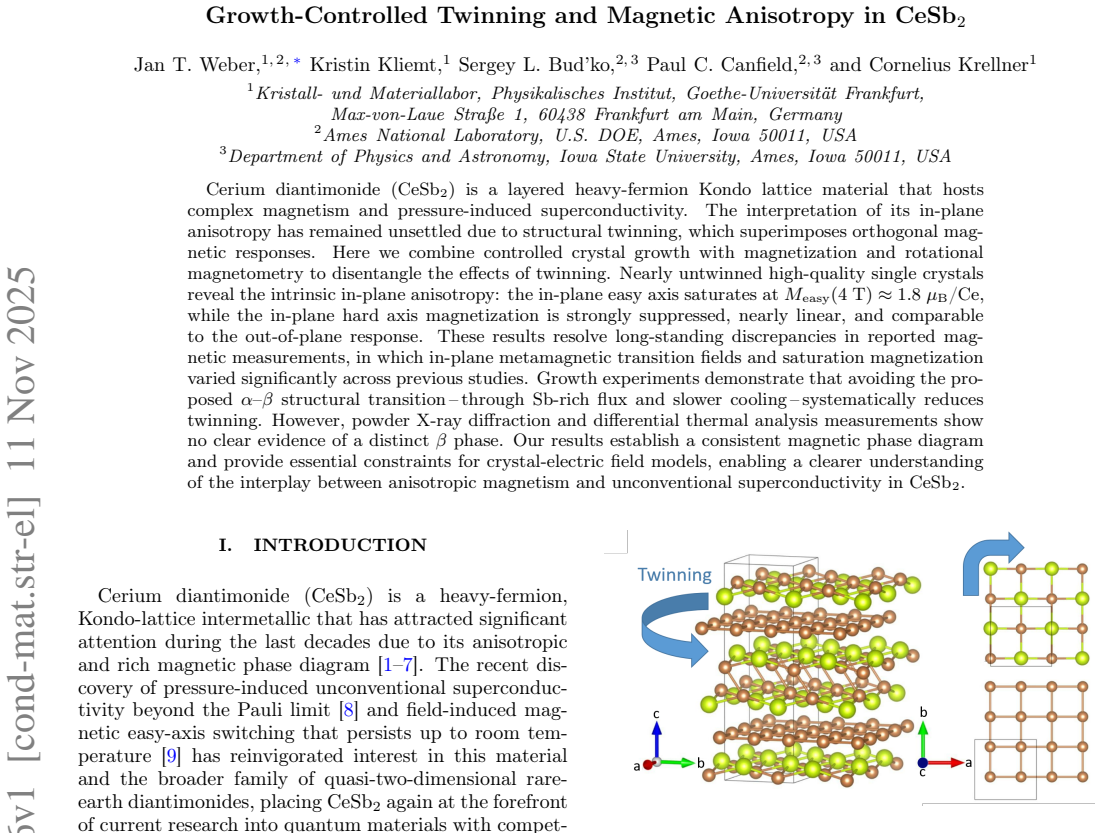
Controlled growth using Sb-rich flux and slower cooling to minimize twinning, allowing rotational magnetometry to measure the directional dependence of magnetization without superposition from orthogonal domains.
If this is right
- Establishes a consistent magnetic phase diagram for CeSb2.
- Provides essential constraints for crystal-electric field models of the material.
- Clarifies the interplay between anisotropic magnetism and unconventional superconductivity under pressure.
- Explains variations in previous magnetization data as due to different levels of twinning.
Where Pith is reading between the lines
- The method of reducing twinning through flux composition and cooling rate could be tested in related cerium-based compounds to check for similar hidden anisotropies.
- The lack of evidence for a distinct beta phase suggests that the twinning reduction may occur through kinetic control of domain formation rather than phase avoidance.
- Measurements on these untwinned crystals could be extended to low temperatures or high pressures to see how the anisotropy affects the superconducting state.
Load-bearing premise
The assumption that Sb-rich flux and slower cooling produce crystals with low enough twinning that the observed magnetization differences reflect the true single-domain anisotropy rather than averaged responses.
What would settle it
If structural characterization such as single-crystal X-ray diffraction on the new crystals reveals multiple orthogonal domains, or if the hard-axis magnetization shows a sudden increase or saturation at higher fields indicating hidden twinning.
Figures


read the original abstract
Cerium diantimonide (CeSb$_2$) is a layered heavy-fermion Kondo lattice material that hosts complex magnetism and pressure-induced superconductivity. The interpretation of its in-plane anisotropy has remained unsettled due to structural twinning, which superimposes orthogonal magnetic responses. Here we combine controlled crystal growth with magnetization and rotational magnetometry to disentangle the effects of twinning. Nearly untwinned high-quality single crystals reveal the intrinsic in-plane anisotropy: The in-plane easy axis saturates at $M_{\text{easy}}(4~\text{T}) \approx 1.8~\mu_{\text{B}}$/Ce, while the in-plane hard axis magnetization is strongly suppressed, nearly linear, and comparable to the out-of-plane response. These results resolve long-standing discrepancies in reported magnetic measurements, in which in-plane metamagnetic transition fields and saturation magnetization varied significantly across previous studies. Growth experiments demonstrate that avoiding the proposed $\alpha$-$\beta$ structural transition $-$ through Sb-rich flux and slower cooling $-$ systematically reduces twinning. However, powder X-ray diffraction and differential thermal analysis measurements show no clear evidence of a distinct $\beta$ phase. Our results establish a consistent magnetic phase diagram and provide essential constraints for crystal-electric field models, enabling a clearer understanding of the interplay between anisotropic magnetism and unconventional superconductivity in CeSb$_2$.
Editorial analysis
A structured set of objections, weighed in public.
Referee Report
Summary. The manuscript reports that controlled growth of CeSb₂ single crystals using Sb-rich flux and slower cooling avoids a proposed α-β structural transition, yielding nearly untwinned samples. Magnetization and rotational magnetometry measurements on these crystals establish the intrinsic in-plane magnetic anisotropy, with the easy axis saturating at M_easy(4 T) ≈ 1.8 μB/Ce while the hard-axis response is strongly suppressed and nearly linear, comparable to the out-of-plane magnetization. These results are presented as resolving prior discrepancies in metamagnetic transition fields and saturation values across the literature, while also providing constraints for crystal-electric-field models.
Significance. If the untwinned character of the crystals is quantitatively established, the work supplies a consistent experimental magnetic phase diagram for CeSb₂ and removes a key ambiguity that has hindered interpretation of its heavy-fermion magnetism and pressure-induced superconductivity. The direct, parameter-free character of the magnetization data (no fitted models or self-referenced parameters) is a clear strength.
major comments (2)
- [Crystal Growth and Characterization] Crystal-growth section: the central claim that the measured hard-axis magnetization is intrinsic and not a superposition from residual twin domains requires a quantitative upper bound on twin volume fraction. The manuscript states that powder XRD and DTA show no clear β-phase signature and that Sb-rich flux plus slower cooling reduces twinning, yet no single-crystal XRD, Laue diffraction, or rocking-curve data are cited to bound the actual twin fraction in the crystals used for magnetometry.
- [Magnetization Measurements] Magnetization results (Fig. 3 and associated text): the headline values M_easy(4 T) ≈ 1.8 μB/Ce and the strongly suppressed hard-axis response are load-bearing for the resolution of prior discrepancies. Without an explicit limit on residual twinning (e.g., <5 % easy-axis volume), a minority twin contribution cannot be excluded as the source of any residual hard-axis signal, weakening the assertion that the anisotropy is fully intrinsic.
minor comments (2)
- [Figure 3] Figure captions and text should explicitly state whether error bars represent standard deviation, standard error, or instrument resolution, and whether data are averaged over multiple crystals.
- [Results] The statement that the hard-axis curve is 'comparable to the out-of-plane response' would benefit from a direct overlay or tabulated ratio at several fields rather than qualitative description.
Simulated Author's Rebuttal
We are grateful to the referee for the positive assessment of our work and for the constructive comments that help strengthen the manuscript. We address each major comment below and commit to revisions that directly respond to the concerns raised.
read point-by-point responses
-
Referee: [Crystal Growth and Characterization] Crystal-growth section: the central claim that the measured hard-axis magnetization is intrinsic and not a superposition from residual twin domains requires a quantitative upper bound on twin volume fraction. The manuscript states that powder XRD and DTA show no clear β-phase signature and that Sb-rich flux plus slower cooling reduces twinning, yet no single-crystal XRD, Laue diffraction, or rocking-curve data are cited to bound the actual twin fraction in the crystals used for magnetometry.
Authors: We agree that a quantitative upper bound on twin volume fraction is required to rigorously establish that the hard-axis response is intrinsic. Powder XRD and DTA on ground material provide supporting but indirect evidence by showing no distinct β-phase signature; these methods are not optimal for quantifying low-level twinning in oriented single crystals. In the revised manuscript we will add single-crystal XRD, Laue diffraction, and rocking-curve data collected on the identical crystals used for the magnetometry measurements. These data will be used to place an explicit upper limit on the twin volume fraction. revision: yes
-
Referee: [Magnetization Measurements] Magnetization results (Fig. 3 and associated text): the headline values M_easy(4 T) ≈ 1.8 μB/Ce and the strongly suppressed hard-axis response are load-bearing for the resolution of prior discrepancies. Without an explicit limit on residual twinning (e.g., <5 % easy-axis volume), a minority twin contribution cannot be excluded as the source of any residual hard-axis signal, weakening the assertion that the anisotropy is fully intrinsic.
Authors: We acknowledge the referee’s point: without a quantified bound, a small twin contribution cannot be formally excluded as the origin of the residual hard-axis signal. The observed near-equivalence of the hard-axis in-plane and out-of-plane magnetizations, together with the systematic suppression of twinning under our optimized growth conditions, already argues against a dominant twin origin. In the revision we will incorporate the new single-crystal characterization results to calculate and state the maximum possible twin-induced contribution to the hard-axis magnetization, thereby confirming that any such contribution lies well below the measured signal. revision: yes
Circularity Check
No significant circularity in experimental claims
full rationale
This is a purely experimental paper reporting controlled crystal growth protocols, powder XRD, DTA, and magnetization measurements on CeSb2. No mathematical derivations, fitted parameters presented as predictions, or load-bearing self-citations appear in the provided text. The central result (intrinsic in-plane anisotropy from nearly untwinned crystals) rests on direct comparison of measured M(H) curves under different growth conditions, which are independently verifiable by replication and do not reduce to any input by construction.
Axiom & Free-Parameter Ledger
axioms (1)
- domain assumption Standard assumptions of single-crystal growth from flux and conventional magnetization/rotational magnetometry measurements hold without significant systematic errors from twinning or sample quality.
Lean theorems connected to this paper
-
IndisputableMonolith/Foundation/RealityFromDistinction.leanreality_from_one_distinction unclear?
unclearRelation between the paper passage and the cited Recognition theorem.
Nearly untwinned high-quality single crystals reveal the intrinsic in-plane anisotropy: The in-plane easy axis saturates at M_easy(4 T) ≈ 1.8 μB/Ce, while the in-plane hard axis magnetization is strongly suppressed, nearly linear...
What do these tags mean?
- matches
- The paper's claim is directly supported by a theorem in the formal canon.
- supports
- The theorem supports part of the paper's argument, but the paper may add assumptions or extra steps.
- extends
- The paper goes beyond the formal theorem; the theorem is a base layer rather than the whole result.
- uses
- The paper appears to rely on the theorem as machinery.
- contradicts
- The paper's claim conflicts with a theorem or certificate in the canon.
- unclear
- Pith found a possible connection, but the passage is too broad, indirect, or ambiguous to say the theorem truly supports the claim.
Reference graph
Works this paper leans on
-
[1]
The data are normalized using the same factors as for theM(H)normalization (M S = M(2.2T))
Magnetic susceptibility Figure A.1.Top:Non-normalized andbottom:normalized molar susceptibilityχof various crystals measured along m1 and m2 atµ 0H= 0.1T. The data are normalized using the same factors as for theM(H)normalization (M S = M(2.2T)). The normalized curves collapse almost perfectly onto one another–except for the hard-axis–dominated ones– demo...
-
[2]
(1), a Gaussian error propagation was per- formed
Error analysis of the lower bound ofx To estimate the uncertainty in the twinning ratioxde- rived from Eq. (1), a Gaussian error propagation was per- formed. A relative measurement uncertainty of 2 % was assumed for both magnetization values, and representa- tive values ofM m1 andM m2 were used. The resulting propagated relative error,∆x/x, is given by: x...
-
[3]
ExtractedM(2.2T)values from all measured crystals at 2.5 K
Measurement accuracy Crystal Mm1 (2.2T) Mm2 (2.2T) Mm1 (2.2T) +M m2 (2.2T) [µB/Ce] 1 1.174 0.633 1.807 2 1.028 0.786 1.814 4 half-1 1.564 0.239 1.803 4 half-2 1.698 0.125 1.823 5 1.721 0.100 1.821 6 1.201 0.635 1.836 7 1.603 0.169 1.772 Table A3. ExtractedM(2.2T)values from all measured crystals at 2.5 K. Together with the corresponding sum Mm1 (2.2T) +M ...
-
[4]
The intrinsicM hard is then obtained by dividing by the twinning ratiox
Deriving the hard-magnetization response Formally,M hard(H)·x=M m2(H)−αM m1(H), with αchosen to suppress metamagnetic steps arising from the easy axis. The intrinsicM hard is then obtained by dividing by the twinning ratiox
-
[5]
Range approximation for the easy- and hard-magnetization axis ForM easy(2.2T), the lower bound is defined by the highest measured raw m1 curve (Crystal 5). The upper 11 bound is obtained by dividing the same curve by its twinning ratiox= 0.935, which itself represents only a lower limit; hence the resulting value is strictly an upper limit. ForM hard(2.2T...
-
[6]
Inverse magnetic susceptibility Figure A.6. Inverse magnetic susceptibility for different crys- tals with highx, measured along m1 and m2 atµ 0H= 1T. Curie–Weiss fits in the range 125–300 K yield similar effec- tive moments but reveal opposite trends in the Curie–Weiss temperatures: negative for the m2 curves (dominated by the hard axis) and positive for ...
-
[7]
Rotational dependence model The field-polarized regime is described by: Mreal,FP =±M S, Mmeasured,FP =M real,FP ·cosθ =±M S ·cosθ =M S · |cosθ|, Mmeasured,FP,total =A· |cosθ|+B· |sinθ|. The paramagnetic regime is described by: Heff =H ext ·cosθ, Mreal,PM =χ easy ·H eff, Mmeasured,PM =M real,FP ·cosθ =χ easy ·H ext ·cos 2 θ, Mmeasured,PM,total =A·cos 2 θ+B...
-
[8]
Powder XRD patterns of as-grown and quenched CeSb2 single crystals
Powder XRD Figure D.1. Powder XRD patterns of as-grown and quenched CeSb2 single crystals. The quenched sample shows one ad- ditional peak (arrow), which may indicate traces of a high- temperatureβphase. Simulated patterns for orthorhombic CeSb2 [10], CeSb2 in the YbSb2-type structure [34], and ele- mental Sb [35] are shown for comparison. 13
-
[9]
P. C. Canfield, J. D. Thompson, and Z. Fisk, Novel Ce magnetism in CeDipnictide and Di-Ce pnictide struc- tures, Journal of Applied Physics70, 5992 (1991)
work page 1991
-
[10]
S. L. Bud’ko, P. C. Canfield, C. H. Mielke, and A. H. Lacerda, Anisotropic magnetic properties of light rare- earth diantimonides, Phys. Rev. B57, 13624 (1998)
work page 1998
-
[11]
T. Pérez-Castañeda, J. Azpeitia, J. Hanko, A. Fente, H. Suderow, and M. A. Ramos, Low-Temperature Spe- cific Heat of Graphite and CeSb2: Validation of a Quasi- adiabatic Continuous Method, Journal of Low Tempera- ture Physics173, 4 (2013)
work page 2013
-
[12]
R. F. Luccas, A. Fente, J. Hanko, A. Correa-Orellana, E. Herrera, E. Climent-Pascual, J. Azpeitia, T. Pérez- Castañeda, M. R. Osorio, E. Salas-Colera, N. M. Nemes, F. J. Mompean, M. García-Hernández, J. G. Rodrigo, M. A. Ramos, I. Guillamón, S. Vieira, and H. Suderow, Charge density wave in layeredLa1−xCexSb2, Phys. Rev. B92, 235153 (2015)
work page 2015
- [13]
-
[14]
B. Liu, L. Wang, I. Radelytskyi, Y. Zhang, M. Meven, H. Deng, F. Zhu, Y. Su, X. Zhu, S. Tan, and A. Schnei- dewind, Neutron scattering study of commensurate mag- netic ordering in single crystal CeSb2, Journal of Physics: Condensed Matter32, 405605 (2020)
work page 2020
-
[15]
C. Trainer, C. Abel, S. L. Bud’ko, P. C. Canfield, and P. Wahl, Phase diagram ofCeSb2 from magnetostriction andmagnetizationmeasurements: Evidenceforferrimag- netic and antiferromagnetic states, Phys. Rev. B104, 205134 (2021)
work page 2021
-
[16]
O. P. Squire, S. A. Hodgson, J. Chen, V. Fedoseev, C. K. de Podesta, T. I. Weinberger, P. L. Alireza, and F. M. Grosche, Superconductivity beyond the Conven- tional Pauli Limit in High-PressureCeSb 2, Phys. Rev. Lett.131, 026001 (2023)
work page 2023
- [17]
-
[18]
R. Wang and H. Steinfink, The Crystal Chemistry of Selected AB2 Rare Earth Compounds with Selenium, Tellurium, and Antimony, Inorganic Chemistry6, 1685 (1967)
work page 1967
-
[19]
N. L. Eatough and H. T. Hall, High-Pressure Synthesis of Rare Earth Diantimonides, Inorganic Chemistry8, 1439 (1969)
work page 1969
-
[20]
J. Charvillat, D. Damien, and A. Wojakowski, Cristal- lochimie des Composes Binaires M Sb2 et Ternaires M Sb Te des Elements Transuraniens, Revue de Chimie Min- erale14, 178 (1977)
work page 1977
-
[21]
K.MommaandF.Izumi,VESTA3forthree-dimensional visualization of crystal, volumetric and morphology data, Journal of Applied Crystallography44, 1272 (2011)
work page 2011
-
[22]
K. F. F. Fischer, N. Roth, and B. B. Iversen, Transport propertiesandcrystalstructureoflayeredLaSb 2,Journal of Applied Physics125, 045110 (2019)
work page 2019
-
[23]
Z. Shan, Y. Jiao, J. Guo, Y. Wang, J. Wu, J. Zhang, Y. Zhang, D. Su, D. T. Adroja, C. Balz, M. Gutmann, Y. Liu, H. Yuan, Z. Wang, Y. Song, and M. Smidman, Emergent Ferromagnetic Ladder Excitations in Heavy Fermion SuperconductorCeSb 2, Phys. Rev. Lett.134, 116704 (2025)
work page 2025
-
[24]
Abulkhaev, Phase diagram of the Ce-Sb system, Rus- sian Journal of Inorganic Chemistry42, 283 (1997)
V. Abulkhaev, Phase diagram of the Ce-Sb system, Rus- sian Journal of Inorganic Chemistry42, 283 (1997)
work page 1997
-
[25]
Okamoto, Ce-Sb (Cerium-Antimony), Journal of Phase Equilibria22, 88 (2001)
H. Okamoto, Ce-Sb (Cerium-Antimony), Journal of Phase Equilibria22, 88 (2001)
work page 2001
-
[26]
J.MurrayandJ.Taylor,Halidevaportransportofbinary rare-earth arsenides, antimonides and tellurides, Journal of the Less Common Metals21, 159 (1970)
work page 1970
- [27]
- [28]
- [29]
-
[30]
J. J. Joyce, A. J. Arko, J. Lawrence, P. C. Can- field, Z. Fisk, R. J. Bartlett, and J. D. Thompson, Temperature-invariant photoelectron spectra in cerium heavy-fermion compounds: Inconsistencies with the Kondo model, Phys. Rev. Lett.68, 236 (1992)
work page 1992
-
[31]
A. J. Arko, J. J. Joyce, A. B. Andrews, J. D. Thomp- son, J. L. Smith, D. Mandrus, M. F. Hundley, A. L. Cornelius, E. Moshopoulou, Z. Fisk, P. C. Canfield, and A. Menovsky, Strongly correlated electron systems: Pho- toemission and the single-impurity model, Phys. Rev. B 56, R7041 (1997)
work page 1997
-
[32]
T. Kagayama, G. Oomi, S. Bud’ko, and P. Canfield, Pres- sure effect on magnetoresistance of CeSb2, Physica B: Condensed Matter281-282, 90 (2000)
work page 2000
-
[33]
T. Kagayama, Y. Uwatoko, S. Bud’ko, and P. Canfield, Pressure-induced collapse of ferromagnetism in CeSb2, Physica B: Condensed Matter359-361, 320 (2005), pro- ceedingsoftheInternationalConferenceonStronglyCor- related Electron Systems
work page 2005
-
[34]
C. K. de Podesta et al., Poster: High Pressure Struc- tural Instability in CeSb2, inSCES conference Amster- dam(2022)
work page 2022
-
[35]
S. Hodgson,Development of High-Pressure Calorimetry Techniques and Calorimetry Study of the Heavy-Fermion Superconductor CeSb2, Ph.D. thesis, Apollo - University of Cambridge Repository (2023)
work page 2023
-
[36]
Squire,High-Pressure Studies of Some Heavy Fermion Materials, Ph.D
O. Squire,High-Pressure Studies of Some Heavy Fermion Materials, Ph.D. thesis, Apollo - University of Cambridge Repository (2024)
work page 2024
-
[37]
P. C. Canfield, T. Kong, U. S. Kaluarachchi, and N. H. Jo, Use of frit-disc crucibles for routine and exploratory solution growth of single crystalline samples, Philosoph- ical Magazine96, 84 (2016)
work page 2016
-
[38]
LSP Industrial Ceramics,https://lspceramics.com/ canfield-crucible-sets-2/. 14
-
[39]
S. B. Wilkins, Qlaue (2007),©Stuart B. Wilkins 2007. All rights reserved. email: stuwilkins@mac.com
work page 2007
-
[40]
J. Laugier, Orientexpress v 3.4 (2000), Laue orientation software, 9, rue Jean-Richard Bloch, F38400 Saint Mar- tin d’Hères, France; email: jean.laugier@free.fr
work page 2000
- [41]
-
[42]
R. Wang, R. Bodnar, and H. Steinfink, The Structure of YbSb2, a ZrSi2 Isotype, Inorganic Chemistry5, 1468 (1966)
work page 1966
-
[43]
C. S. Barrett, P. Cucka, and K. Haefner, The crystal structure of antimony at 4.2, 78 and 298◦ K, Acta Crys- tallographica16, 451 (1963)
work page 1963
discussion (0)
Sign in with ORCID, Apple, or X to comment. Anyone can read and Pith papers without signing in.