Contextual Refinement of Higher-Order Concurrent Probabilistic Programs (Extended Version)
Pith reviewed 2026-05-17 22:24 UTC · model grok-4.3
The pith
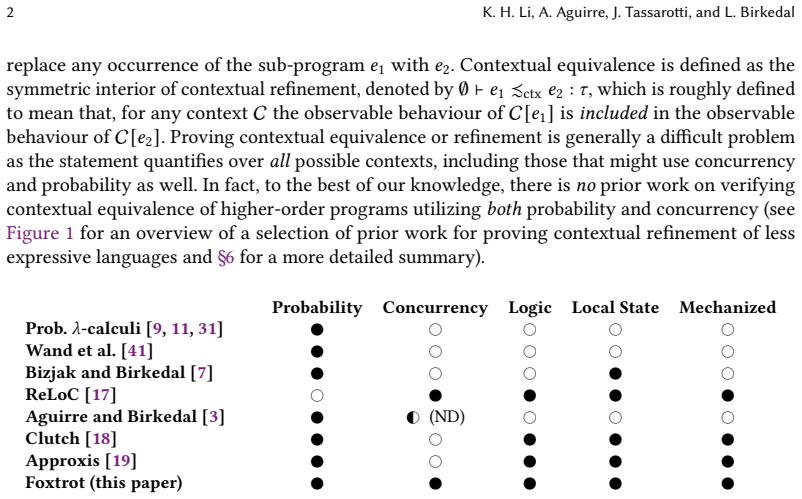
Foxtrot is the first higher-order separation logic for proving contextual refinement of concurrent probabilistic programs with local state.
A machine-rendered reading of the paper's core claim, the machinery that carries it, and where it could break.
Core claim
Foxtrot is the first higher-order separation logic for proving contextual refinement of higher-order concurrent probabilistic programs with higher-order local state. From a high level, Foxtrot inherits various concurrency reasoning principles from standard concurrent separation logic, e.g. invariants and ghost resources, and supports advanced probabilistic reasoning principles for reasoning about complex probability distributions induced by concurrent threads, e.g. tape presampling and induction by error amplification.
What carries the argument
Foxtrot logic, an extension of the Iris separation logic that integrates concurrency invariants with probabilistic tape and error-amplification rules while remaining sound.
If this is right
- Contextual refinement can now be proved for programs that interleave higher-order functions, shared local state, concurrency, and arbitrary probability distributions.
- Adversarial coin-flip protocols and uniform random generation routines from cryptographic libraries become verifiable targets.
- The same logic supplies both invariant-based concurrency reasoning and distribution-sensitive probabilistic reasoning in a single framework.
- All claims, including soundness, have been machine-checked in Rocq using the Iris library.
Where Pith is reading between the lines
- The same machinery may scale to probabilistic distributed systems whose threads communicate over networks rather than shared memory.
- The reliance on an internal axiom of choice raises the question whether weaker choice principles suffice for other effect combinations such as nondeterminism plus probability.
- Mechanized libraries built on Foxtrot could serve as a foundation for verifying larger randomized data structures and protocols.
Load-bearing premise
Soundness of the logic depends on a version of the axiom of choice inside the Iris framework.
What would settle it
A concrete pair of programs that are contextually equivalent yet cannot be proved equivalent inside Foxtrot, or a pair that is not equivalent yet the logic derives a refinement proof, would show the central claim is false.
Figures




read the original abstract
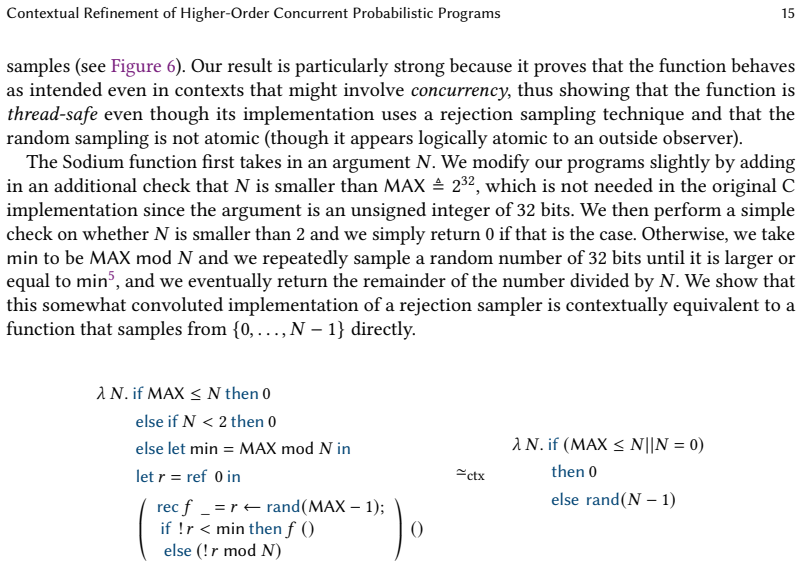
We present Foxtrot, the first higher-order separation logic for proving contextual refinement of higher-order concurrent probabilistic programs with higher-order local state. From a high level, Foxtrot inherits various concurrency reasoning principles from standard concurrent separation logic, e.g. invariants and ghost resources, and supports advanced probabilistic reasoning principles for reasoning about complex probability distributions induced by concurrent threads, e.g. tape presampling and induction by error amplification. The integration of these strong reasoning principles is highly non-trivial due to the combination of probability and concurrency in the language and the complexity of the Foxtrot model; the soundness of the logic relies on a version of the axiom of choice within the Iris logic, which is not used in earlier work on Iris-based logics. We demonstrate the expressiveness of Foxtrot on a wide range of examples, including the adversarial von Neumann coin and the $\mathsf{randombytes\_uniform}$ function of the Sodium cryptography software library. All results have been mechanized in the Rocq proof assistant and the Iris separation logic framework.
Editorial analysis
A structured set of objections, weighed in public.
Referee Report
Summary. The paper presents Foxtrot, the first higher-order separation logic for proving contextual refinement of higher-order concurrent probabilistic programs with higher-order local state. It inherits concurrency reasoning principles such as invariants and ghost resources from standard concurrent separation logic and supports probabilistic reasoning principles including tape presampling and induction by error amplification. The soundness of the logic is established within the Iris framework and the entire development has been mechanized in Rocq, though it relies on a version of the axiom of choice inside Iris that is not used in prior Iris-based logics. The logic is demonstrated on examples including the adversarial von Neumann coin and the randombytes_uniform function from the Sodium cryptography library.
Significance. If the central claims hold, this constitutes a significant advance by enabling formal reasoning about contextual refinement in a setting that combines higher-order features, concurrency, and probability with local state. The mechanization in Rocq and Iris provides strong, reproducible evidence for the soundness of the logic and the validity of the example proofs, which is a notable strength. The practical examples further indicate potential utility for verifying real probabilistic concurrent code.
major comments (1)
- [Soundness] The soundness theorem relies on a version of the axiom of choice within the Iris logic. This step is disclosed in the abstract and introduction but is not used in earlier Iris-based logics; the mechanized development should isolate this axiom application (e.g., in the model construction or adequacy proof) and provide explicit verification or justification that it preserves the independence of the grounding.
minor comments (2)
- [Abstract] The abstract is concise but could mention the mechanization platform (Rocq/Iris) in the opening sentence to foreground the reproducibility of the results.
- [Introduction] Notation for higher-order local state and tape presampling could be introduced with a small illustrative example in the introduction to improve accessibility for readers new to the combination of features.
Simulated Author's Rebuttal
We thank the referee for their careful review and constructive suggestion. We address the single major comment below and will update the mechanized development and paper accordingly.
read point-by-point responses
-
Referee: [Soundness] The soundness theorem relies on a version of the axiom of choice within the Iris logic. This step is disclosed in the abstract and introduction but is not used in earlier Iris-based logics; the mechanized development should isolate this axiom application (e.g., in the model construction or adequacy proof) and provide explicit verification or justification that it preserves the independence of the grounding.
Authors: We appreciate the referee drawing attention to the use of the axiom of choice. As already stated in the abstract and introduction, this axiom is required for the soundness of Foxtrot but was not needed in prior Iris-based logics. We agree that isolating its application will improve clarity. In the revised development we will extract the axiom usage into a dedicated, clearly marked lemma inside the model construction (separate from the main adequacy proof) and add code comments plus a short paragraph in the paper explaining that the axiom is invoked only to select representatives for the probabilistic model and does not affect the independence of the grounding or the validity of the separation-logic rules. This change is feasible within the existing Rocq/Iris infrastructure. revision: yes
Circularity Check
No significant circularity identified
full rationale
The paper defines Foxtrot as a new higher-order separation logic inside the established Iris framework and supplies a complete mechanized soundness proof in Rocq. All reasoning principles (invariants, ghost resources, tape presampling, error-amplification induction) are derived from the Iris model rather than from any self-referential definition or fitted parameter. The explicit disclosure that soundness uses a version of the axiom of choice inside Iris (absent from prior Iris logics) is an external assumption, not a circular reduction. Because the entire development is machine-checked against an independently verified base logic, the derivation chain remains self-contained and does not reduce to its own inputs by construction.
Axiom & Free-Parameter Ledger
axioms (1)
- ad hoc to paper A version of the axiom of choice within the Iris logic
Lean theorems connected to this paper
-
IndisputableMonolith/Foundation/AbsoluteFloorClosure.leanabsolute_floor_iff_bare_distinguishability unclear?
unclearRelation between the paper passage and the cited Recognition theorem.
the soundness of the logic relies on a version of the axiom of choice within the Iris logic, which is not used in earlier work on Iris-based logics
-
IndisputableMonolith/Cost/FunctionalEquation.leanwashburn_uniqueness_aczel unclear?
unclearRelation between the paper passage and the cited Recognition theorem.
Foxtrot uses approximate probabilistic coupling to relate pairs of probabilistic programs
What do these tags mean?
- matches
- The paper's claim is directly supported by a theorem in the formal canon.
- supports
- The theorem supports part of the paper's argument, but the paper may add assumptions or extra steps.
- extends
- The paper goes beyond the formal theorem; the theorem is a base layer rather than the whole result.
- uses
- The paper appears to rely on the theorem as machinery.
- contradicts
- The paper's claim conflicts with a theorem or certificate in the canon.
- unclear
- Pith found a possible connection, but the passage is too broad, indirect, or ambiguous to say the theorem truly supports the claim.
Reference graph
Works this paper leans on
-
[1]
M. Abadi and L. Lamport. 1988. The existence of refinement mappings. In [1988] Proceedings. Third Annual Symposium on Logic in Computer Science . 165–175. doi:10.1109/LICS.1988.5115
-
[2]
Martín Abadi and Leslie Lamport. 1991. The existence of refinement mappings. Theoretical Computer Science 82, 2 (1991), 253–284. doi:10.1016/0304-3975(91)90224-P
-
[3]
Alejandro Aguirre and Lars Birkedal. 2023. Step-Indexed Logical Relations for Countable Nondeterminism and Probabilistic Choice. Proceedings of the ACM on Programming Languages 7 (9 Jan. 2023), 33–60. doi:10.1145/3571195 Publisher Copyright: © 2023 Owner/Author
-
[4]
Alejandro Aguirre, Philipp G. Haselwarter, Markus de Medeiros, Kwing Hei Li, Simon Oddershede Gregersen, Joseph Tassarotti, and Lars Birkedal. 2024. Error Credits: Resourceful Reasoning about Error Bounds for Higher-Order Probabilistic Programs. Proc. ACM Program. Lang. 8, ICFP, Article 246 (Aug. 2024), 33 pages. doi:10.1145/3674635
-
[5]
James Aspnes and Eric Ruppert. 2016. Depth of a Random Binary Search Tree with Concurrent Insertions. InDistributed Computing, Cyril Gavoille and David Ilcinkas (Eds.). Springer Berlin Heidelberg, Berlin, Heidelberg, 371–384
work page 2016
-
[6]
Lars Birkedal, Aleš Bizjak, and Jan Schwinghammer. 2013. Step-Indexed Relational Reasoning for Countable Nonde- terminism. Logical Methods in Computer Science Volume 9, Issue 4 (Oct. 2013). doi:10.2168/lmcs-9(4:4)2013
-
[7]
Aleš Bizjak and Lars Birkedal. 2015. Step-Indexed Logical Relations for Probability. In Foundations of Software Science and Computation Structures, Andrew Pitts (Ed.). Springer Berlin Heidelberg, Berlin, Heidelberg, 279–294
work page 2015
-
[8]
Sylvie Boldo, Catherine Lelay, and Guillaume Melquiond. 2013. Coquelicot: A User-Friendly Library of Real Analysis for Coq. (Sept. 2013). https://inria.hal.science/hal-00860648 working paper or preprint
work page 2013
-
[9]
Raphaëlle Crubillé and Ugo Dal Lago. 2014. On Probabilistic Applicative Bisimulation and Call-by-Value 𝜆-Calculi. In Programming Languages and Systems , Zhong Shao (Ed.). Springer Berlin Heidelberg, Berlin, Heidelberg, 209–228
work page 2014
-
[10]
Ryan Culpepper and Andrew Cobb. 2017. Contextual Equivalence for Probabilistic Programs with Continuous Random Variables and Scoring. In Programming Languages and Systems , Hongseok Yang (Ed.). Springer Berlin Heidelberg, Berlin, Heidelberg, 368–392
work page 2017
-
[11]
Ugo Dal Lago, Davide Sangiorgi, and Michele Alberti. 2014. On coinductive equivalences for higher-order probabilistic functional programs. In Proceedings of the 41st ACM SIGPLAN-SIGACT Symposium on Principles of Programming Languages (San Diego, California, USA) (POPL ’14). Association for Computing Machinery, New York, NY, USA, 297–308. doi:10.1145/25358...
-
[12]
Frank Denis. 2013. The Sodium cryptography library. https://download.libsodium.org/doc/ 22 K. H. Li, A. Aguirre, J. Tassarotti, and L. Birkedal
work page 2013
- [13]
-
[14]
Thomas Ehrhard, Christine Tasson, and Michele Pagani. 2014. Probabilistic coherence spaces are fully abstract for probabilistic PCF. In Proceedings of the 41st ACM SIGPLAN-SIGACT Symposium on Principles of Programming Languages (San Diego, California, USA) (POPL ’14). Association for Computing Machinery, New York, NY, USA, 309–320. doi:10.1145/2535838.2535865
-
[15]
David Evans, Vladimir Kolesnikov, and Mike Rosulek. 2018. . doi:10.1561/3300000019
-
[16]
Ira Fesefeldt, Joost-Pieter Katoen, and Thomas Noll. 2022. Towards Concurrent Quantitative Separation Logic. In 33rd International Conference on Concurrency Theory (CONCUR 2022) (Leibniz International Proceedings in Informatics (LIPIcs), Vol. 243), Bartek Klin, Sławomir Lasota, and Anca Muscholl (Eds.). Schloss Dagstuhl – Leibniz-Zentrum für Informatik, D...
-
[17]
Dan Frumin, Robbert Krebbers, and Lars Birkedal. 2021. ReLoC Reloaded: A Mechanized Relational Logic for Fine- Grained Concurrency and Logical Atomicity. Log. Methods Comput. Sci. 17, 3 (2021). doi:10.46298/LMCS-17(3:9)2021
-
[18]
Haselwarter and Joseph Tassarotti and Lars Birkedal , title =
Simon Oddershede Gregersen, Alejandro Aguirre, Philipp G. Haselwarter, Joseph Tassarotti, and Lars Birkedal. 2024. Asynchronous Probabilistic Couplings in Higher-Order Separation Logic. Proc. ACM Program. Lang. 8, POPL, Article 26 (Jan. 2024), 32 pages. doi:10.1145/3632868
-
[19]
Philipp G. Haselwarter, Kwing Hei Li, Alejandro Aguirre, Simon Oddershede Gregersen, Joseph Tassarotti, and Lars Birkedal. 2025. Approximate Relational Reasoning for Higher-Order Probabilistic Programs. Proc. ACM Program. Lang. 9, POPL, Article 41 (Jan. 2025), 31 pages. doi:10.1145/3704877
-
[20]
Ralf Jung, Robbert Krebbers, Lars Birkedal, and Derek Dreyer. 2016. Higher-order ghost state. In Proceedings of the 21st ACM SIGPLAN International Conference on Functional Programming, ICFP 2016, Nara, Japan, September 18-22, 2016 . 256–269. doi:10.1145/2951913.2951943
-
[21]
Ralf Jung, Robbert Krebbers, Jacques-Henri Jourdan, Ales Bizjak, Lars Birkedal, and Derek Dreyer. 2018. Iris from the ground up: A modular foundation for higher-order concurrent separation logic. J. Funct. Program. 28 (2018), e20. doi:10.1017/S0956796818000151
-
[22]
Ralf Jung, Rodolphe Lepigre, Gaurav Parthasarathy, Marianna Rapoport, Amin Timany, Derek Dreyer, and Bart Jacobs
-
[23]
The future is ours: prophecy variables in separation logic. Proc. ACM Program. Lang. 4, POPL, Article 45 (Dec. 2019), 32 pages. doi:10.1145/3371113
-
[24]
Ralf Jung, David Swasey, Filip Sieczkowski, Kasper Svendsen, Aaron Turon, Lars Birkedal, and Derek Dreyer. 2015. Iris: Monoids and Invariants as an Orthogonal Basis for Concurrent Reasoning. In Proceedings of the 42nd Annual ACM SIGPLAN-SIGACT Symposium on Principles of Programming Languages, POPL 2015, Mumbai, India, January 15-17, 2015 . 637–650. doi:10...
-
[25]
Robbert Krebbers, Ralf Jung, Ales Bizjak, Jacques-Henri Jourdan, Derek Dreyer, and Lars Birkedal. 2017. The Essence of Higher-Order Concurrent Separation Logic. In Programming Languages and Systems - 26th European Symposium on Programming, ESOP 2017, Held as Part of the European Joint Conferences on Theory and Practice of Software, ETAPS 2017, Uppsala, Sw...
-
[26]
Robbert Krebbers, Amin Timany, and Lars Birkedal. 2017. Interactive proofs in higher-order concurrent separation logic. In Proceedings of the 44th ACM SIGPLAN Symposium on Principles of Programming Languages, POPL 2017, Paris, France, January 18-20, 2017, Giuseppe Castagna and Andrew D. Gordon (Eds.). ACM, 205–217. doi:10.1145/3009837.3009855
-
[27]
and Tassarotti, Joseph and Birkedal, Lars , title =
Kwing Hei Li, Alejandro Aguirre, Simon Oddershede Gregersen, Philipp G. Haselwarter, Joseph Tassarotti, and Lars Birkedal. 2025. Modular Reasoning about Error Bounds for Concurrent Probabilistic Programs. Proc. ACM Program. Lang. 9, ICFP, Article 245 (Aug. 2025), 30 pages. doi:10.1145/3747514
- [28]
- [29]
-
[30]
Annabelle McIver, Tahiry Rabehaja, and Georg Struth. 2016. Probabilistic rely-guarantee calculus.Theoretical Computer Science 655 (2016), 120–134. doi:10.1016/j.tcs.2016.01.016 Quantitative Aspects of Programming Languages and Systems (2013-14)
-
[31]
Robert Morris. 1978. Counting large numbers of events in small registers. Commun. ACM 21, 10 (Oct. 1978), 840–842. doi:10.1145/359619.359627
-
[32]
David Sabel, Manfred Schmidt-Schauß, and Luca Maio. 2022. Contextual Equivalence in a Probabilistic Call-by- Need Lambda-Calculus. In Proceedings of the 24th International Symposium on Principles and Practice of Declarative Programming (Tbilisi, Georgia) (PPDP ’22). Association for Computing Machinery, New York, NY, USA, Article 4, 15 pages. doi:10.1145/3...
-
[33]
Tetsuya Sato. 2016. Approximate Relational Hoare Logic for Continuous Random Samplings. In The Thirty-second Conference on the Mathematical Foundations of Programming Semantics, MFPS 2016 . doi:10.1016/J.ENTCS.2016.09.043
-
[34]
Joseph Tassarotti and Robert Harper. 2019. A separation logic for concurrent randomized programs. Proc. ACM Program. Lang. 3, POPL, Article 64 (Jan. 2019), 30 pages. doi:10.1145/3290377 Contextual Refinement of Higher-Order Concurrent Probabilistic Programs 23
-
[35]
The Rocq Development Team. 2024. The Rocq Prover. doi:10.5281/zenodo.11551307
-
[36]
Hermann Thorisson. 2000. Coupling, stationarity, and regeneration. Springer-Verlag, New York. xiv+517 pages
work page 2000
-
[37]
A. Timany. 2018.Contributions in Programming Languages Theory: Logical Relations and Type Theory. Ph. D. Dissertation. , Faculty of Engineering Science, Science, Engineering and Technology Group. https://lirias.kuleuven.be/1838165 Jacobs, B. (supervisor), Piessens, F. (cosupervisor)
-
[38]
Amin Timany, Robbert Krebbers, Derek Dreyer, and Lars Birkedal. 2024. A Logical Approach to Type Soundness. J. ACM 71, 6 (2024), 40:1–75
work page 2024
-
[39]
Turon, Jacob Thamsborg, Amal Ahmed, Lars Birkedal, and Derek Dreyer
Aaron J. Turon, Jacob Thamsborg, Amal Ahmed, Lars Birkedal, and Derek Dreyer. 2013. Logical relations for fine-grained concurrency. In Proceedings of the 40th Annual ACM SIGPLAN-SIGACT Symposium on Principles of Programming Languages (Rome, Italy) (POPL ’13). Association for Computing Machinery, New York, NY, USA, 343–356. doi:10.1145/2429069.2429111
-
[40]
Daniele Varacca and Glynn Winskel. 2006. Distributing probability over non-determinism. Mathematical. Structures in Comp. Sci. 16, 1 (Feb. 2006), 87–113. doi:10.1017/S0960129505005074
-
[41]
John von Neumann. 1961. John von Neumann Collected Works . Vol. 5: Design of Computers, Theory of Automata and Numerical Analysis. Pergamon Press, Oxford, England, Chapter Various Techniques Used in Connection with Random Digits, 768–770. Notes by George E. Forsythe and reproduced from J. Res. Nat. Bus. Stand. Appl. Math. Series, vol. 3, pp. 36–38 (1955)
work page 1961
-
[42]
Mitchell Wand, Ryan Culpepper, Theophilos Giannakopoulos, and Andrew Cobb. 2018. Contextual equivalence for a probabilistic language with continuous random variables and recursion. Proc. ACM Program. Lang. 2, ICFP, Article 87 (July 2018), 30 pages. doi:10.1145/3236782
-
[43]
Noam Zilberstein, Derek Dreyer, and Alexandra Silva. 2023. Outcome Logic: A Unifying Foundation for Correctness and Incorrectness Reasoning. Proc. ACM Program. Lang. 7, OOPSLA1, Article 93 (April 2023), 29 pages. doi:10.1145/3586045
-
[44]
information-theoretically secure
Noam Zilberstein, Alexandra Silva, and Joseph Tassarotti. 2024. Probabilistic Concurrent Reasoning in Outcome Logic: Independence, Conditioning, and Invariants. arXiv:2411.11662 [cs.LO] https://arxiv.org/abs/2411.11662 24 K. H. Li, A. Aguirre, J. Tassarotti, and L. Birkedal A Auxiliary Programs We introduce two auxiliary programs (Figure 8): nondet and di...
discussion (0)
Sign in with ORCID, Apple, or X to comment. Anyone can read and Pith papers without signing in.