Uncertainty-Guided Live Measurement Sequencing for Fast SAR ADC Linearity Testing
Pith reviewed 2026-05-17 21:41 UTC · model grok-4.3
The pith
A real-time adaptive testing method uses an Extended Kalman Filter and uncertainty-based measurement selection to estimate SAR ADC capacitor mismatches without dense data collection.
A machine-rendered reading of the paper's core claim, the machinery that carries it, and where it could break.
Core claim
The central claim is that an iterative behavioral model refined by an Extended Kalman Filter enables direct real-time estimation of capacitor mismatch parameters determining INL, with measurement points adaptively chosen to maximize information gain from uncertainty, thereby removing the need for dense sampling and offline processing.
What carries the argument
The uncertainty-guided live measurement sequencing that uses an Extended Kalman Filter to iteratively refine a behavioral model of capacitor mismatches and selects next points to reduce parameter uncertainty.
If this is right
- Direct real-time estimation of INL behavior becomes possible during testing.
- Total test time and computational overhead decrease substantially compared to offline methods.
- Large-scale data collection and post-measurement analysis are no longer required.
- The approach integrates directly into production testing environments.
Where Pith is reading between the lines
- The sequencing logic could apply to linearity testing of other ADC topologies that depend on similar mismatch parameters.
- Embedding the EKF update in on-chip hardware might enable self-test or field calibration loops.
- Combining the uncertainty metric with known noise statistics could further tighten the number of required measurements.
Load-bearing premise
The iterative behavioral model refined by the Extended Kalman Filter accurately captures the capacitor mismatch parameters that determine INL behavior under real-time measurement conditions.
What would settle it
A side-by-side comparison where the model's final estimated INL curve deviates by more than the target accuracy from a full traditional histogram measurement on the same ADC would falsify the accuracy claim.
Figures


read the original abstract
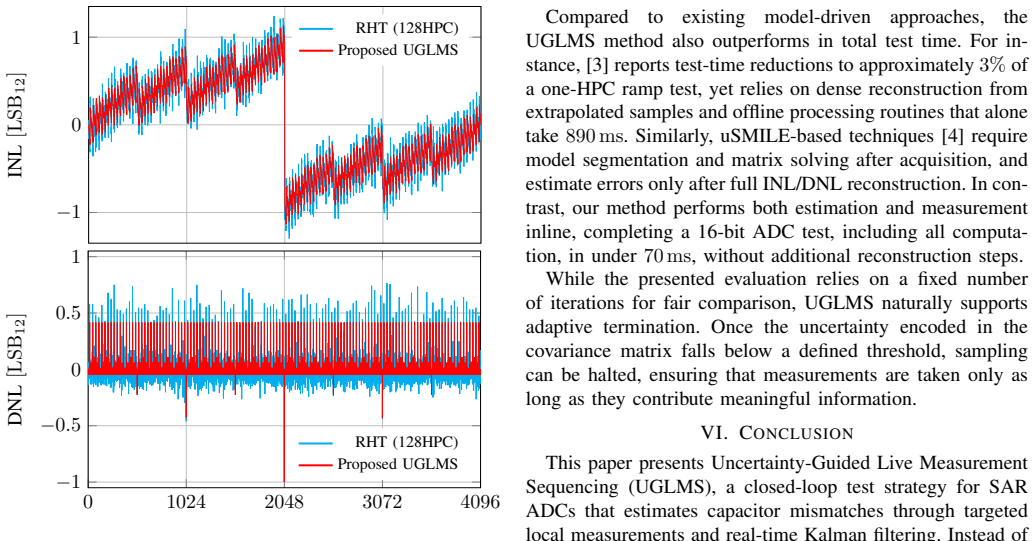
This paper introduces a novel closed-loop testing methodology for efficient linearity testing of high-resolution Successive Approximation Register (SAR) Analog-to-Digital Converters (ADCs). Existing test strategies, including histogram-based approaches, sine wave testing, and model-driven reconstruction, often rely on dense data acquisition followed by offline post-processing, which increases overall test time and complexity. To overcome these limitations, we propose an adaptive approach that utilizes an iterative behavioral model refined by an Extended Kalman Filter (EKF) in real time, enabling direct estimation of capacitor mismatch parameters that determine INL behavior. Our algorithm dynamically selects measurement points based on current model uncertainty, maximizing information gain with respect to parameter confidence and narrowing sampling intervals as estimation progresses. By providing immediate feedback and adaptive targeting, the proposed method eliminates the need for large-scale data collection and post-measurement analysis. Experimental results demonstrate substantial reductions in total test time and computational overhead, highlighting the method's suitability for integration in production environments.
Editorial analysis
A structured set of objections, weighed in public.
Referee Report
Summary. The paper proposes a closed-loop, adaptive methodology for linearity testing of high-resolution SAR ADCs. It employs an iterative behavioral model updated in real time by an Extended Kalman Filter to estimate capacitor mismatch parameters that govern INL, then selects subsequent measurement points dynamically according to current model uncertainty to maximize information gain. This is positioned as an alternative to dense sampling followed by offline post-processing, with the abstract claiming substantial reductions in test time and computational overhead suitable for production environments.
Significance. If the EKF-based estimates prove accurate against dense reference INL measurements on hardware and remain stable under realistic non-idealities, the approach could meaningfully shorten production test times for SAR ADCs by replacing exhaustive data collection with targeted, uncertainty-driven sampling. The real-time feedback loop is a conceptual strength relative to static histogram or sine-wave methods.
major comments (2)
- Abstract and Experimental Results: the central claim of 'substantial reductions in total test time and computational overhead' and suitability for production integration is unsupported by any quantitative data, error bars, number of devices tested, or explicit comparison baselines in the provided text; without these the headline performance gain cannot be evaluated.
- Method description (throughout): no explicit equations, state-transition model, or measurement model for the EKF are shown, preventing assessment of whether the filter remains stable when real ADC effects (voltage-dependent capacitance, settling errors, noise) are present; this directly affects the weakest assumption that the behavioral model accurately captures mismatch parameters under partial adaptive sampling.
Simulated Author's Rebuttal
We thank the referee for the constructive and detailed feedback. The comments have helped us identify areas where the manuscript can be strengthened for clarity and completeness. We address each major comment below and have made corresponding revisions to the manuscript.
read point-by-point responses
-
Referee: Abstract and Experimental Results: the central claim of 'substantial reductions in total test time and computational overhead' and suitability for production integration is unsupported by any quantitative data, error bars, number of devices tested, or explicit comparison baselines in the provided text; without these the headline performance gain cannot be evaluated.
Authors: We agree that the abstract would benefit from explicit quantitative support. The experimental results section of the manuscript reports hardware measurements on multiple fabricated SAR ADC devices, with direct comparisons to dense-sampling baselines, including specific test-time reductions, INL estimation accuracy, and variability across trials. To make these results immediately accessible, we have revised the abstract to include key metrics (e.g., average reduction in measurement points and number of devices evaluated) together with a brief reference to the error characterization. A consolidated performance summary table has also been added to the results section. revision: yes
-
Referee: Method description (throughout): no explicit equations, state-transition model, or measurement model for the EKF are shown, preventing assessment of whether the filter remains stable when real ADC effects (voltage-dependent capacitance, settling errors, noise) are present; this directly affects the weakest assumption that the behavioral model accurately captures mismatch parameters under partial adaptive sampling.
Authors: We appreciate this observation. While the overall EKF-based estimation procedure is outlined in Section III, the explicit state-transition and measurement models were not presented in equation form. In the revised manuscript we now include the full EKF formulation: the state vector of capacitor mismatch parameters, the linear state-transition model, and the nonlinear measurement model that maps mismatches to observed INL values. We have added a dedicated paragraph analyzing filter stability under realistic non-idealities (voltage-dependent capacitance, settling errors, and additive noise) and report supporting Monte Carlo simulation results that confirm convergence behavior under partial sampling. revision: yes
Circularity Check
No circularity: experimental claims rest on measured time savings, not self-referential derivation
full rationale
The paper describes an adaptive SAR ADC testing method that uses an iterative behavioral model updated by EKF to estimate capacitor mismatches and selects subsequent measurements by uncertainty. No equations, parameter-fitting steps, or self-citations appear in the abstract or described content that would reduce the claimed test-time reductions to a fitted input or prior result by construction. The performance gains are presented as outcomes of hardware experiments rather than a closed mathematical chain; the EKF model and uncertainty-driven sequencing are independent engineering choices whose fidelity is asserted via empirical results, not by re-deriving the same quantities from themselves. This is the common case of a self-contained applied method without load-bearing circular steps.
Axiom & Free-Parameter Ledger
Lean theorems connected to this paper
-
IndisputableMonolith/Cost/FunctionalEquation.leanwashburn_uniqueness_aczel unclear?
unclearRelation between the paper passage and the cited Recognition theorem.
Our algorithm dynamically selects measurement points based on current model uncertainty, maximizing information gain with respect to parameter confidence... zk = fc(θ) − fc(θ̂k) + νk
-
IndisputableMonolith/Foundation/RealityFromDistinction.leanreality_from_one_distinction unclear?
unclearRelation between the paper passage and the cited Recognition theorem.
The EKF was chosen... static and only moderately nonlinear... recursive updates with low overhead
What do these tags mean?
- matches
- The paper's claim is directly supported by a theorem in the formal canon.
- supports
- The theorem supports part of the paper's argument, but the paper may add assumptions or extra steps.
- extends
- The paper goes beyond the formal theorem; the theorem is a base layer rather than the whole result.
- uses
- The paper appears to rely on the theorem as machinery.
- contradicts
- The paper's claim conflicts with a theorem or certificate in the canon.
- unclear
- Pith found a possible connection, but the passage is too broad, indirect, or ambiguous to say the theorem truly supports the claim.
Reference graph
Works this paper leans on
-
[1]
S. K. Chaganti, T. Chen, Y . Zhuang, and D. Chen, “Low-cost and accurate dac linearity test with ultrafast segmented model identification of linearity errors and removal of measurement errors (usmile-rome),” in 2018 IEEE International Instrumentation and Measurement Technology Conference (I2MTC). IEEE, 2018, pp. 1–6
work page 2018
-
[2]
Algorithm for dramatically improved efficiency in adc linearity test,
Z. Yu and D. Chen, “Algorithm for dramatically improved efficiency in adc linearity test,” in2012 IEEE International Test Conference. IEEE, 2012, pp. 1–10
work page 2012
-
[3]
New algorithm for fast and accurate linearity testing of high- resolution sar adcs,
R. Aswin, “New algorithm for fast and accurate linearity testing of high- resolution sar adcs,” in2023 IEEE International Test Conference (ITC). IEEE, 2023, pp. 21–29
work page 2023
-
[4]
Fast and accurate linearity test for dacs with various architectures using segmented models,
S. K. Chaganti, A. Sheikh, S. Dubey, F. Ankapong, N. Agarwal, and D. Chen, “Fast and accurate linearity test for dacs with various architectures using segmented models,” in2018 IEEE International Test Conference (ITC). IEEE, 2018, pp. 1–10
work page 2018
-
[5]
Adc parameters and characteristics,
S. Rapuano, P. Daponte, E. Balestrieri, L. De Vito, S. J. Tilden, S. Max, and J. Blair, “Adc parameters and characteristics,”IEEE instrumentation & measurement magazine, vol. 8, no. 5, pp. 44–54, 2005
work page 2005
-
[6]
Adc integral non- linearity testing with low linearity monotonic signals,
B. K. Vasan, D. J. Chen, and R. L. Geiger, “Adc integral non- linearity testing with low linearity monotonic signals,” in2011 IEEE International Instrumentation and Measurement Technology Conference. IEEE, 2011, pp. 1–5
work page 2011
-
[7]
Linearity testing of adcs using low linearity stimulus and kalman filtering,
B. K. Vasan, R. L. Geiger, and D. J. Chen, “Linearity testing of adcs using low linearity stimulus and kalman filtering,” inProceedings of 2010 IEEE International Symposium on Circuits and Systems. IEEE, 2010, pp. 3032–3035
work page 2010
-
[8]
Unified adc nonlinearity error model for sar adc,
L. Michaeli, P. Michalko, and J. ˇSaliga, “Unified adc nonlinearity error model for sar adc,”Measurement, vol. 41, no. 2, pp. 198–204, 2008
work page 2008
-
[9]
Model-based testing of high-resolution adcs,
C. Wegener and M. P. Kennedy, “Model-based testing of high-resolution adcs,” in2000 IEEE International Symposium on Circuits and Systems (ISCAS), vol. 1. IEEE, 2000, pp. 335–338
work page 2000
-
[10]
Analysis of nonideal behaviors based on inl/dnl plots for sar adcs,
C.-P. Huang, H.-W. Ting, and S.-J. Chang, “Analysis of nonideal behaviors based on inl/dnl plots for sar adcs,”IEEE Transactions on Instrumentation and Measurement, vol. 65, no. 8, pp. 1804–1817, 2016
work page 2016
-
[11]
Evaluation of code selective histogram algorithm for adc linearity test,
Y . Zhao, K. Katoh, A. Kuwana, S. Katayama, D. Iimori, Y . Ozawa, T. Nakatani, K. Hatayama, H. Kobayashi, K. Satoet al., “Evaluation of code selective histogram algorithm for adc linearity test,” in2022 IEEE International Conference on Consumer Electronics-Asia (ICCE-Asia). IEEE, 2022, pp. 1–4
work page 2022
-
[12]
A tool for the assisted design of charge redistribution sar adcs,
S. Brenna, A. Bonetti, A. Bonfanti, and A. L. Lacaita, “A tool for the assisted design of charge redistribution sar adcs,” in2015 Design, Automation & Test in Europe Conference & Exhibition (DATE). IEEE, 2015, pp. 1265–1268
work page 2015
-
[13]
Ultrafast stimulus error removal algorithm for adc linearity test,
T. Chen and D. Chen, “Ultrafast stimulus error removal algorithm for adc linearity test,” in2015 IEEE 33rd VLSI Test Symposium (VTS). IEEE, 2015, pp. 1–5
work page 2015
-
[14]
S. Goyal, A. Chatterjee, M. Atia, H. Iglehart, C. Y . Chen, B. Shenouda, N. Khouzam, and H. Haggag, “Test time reduction of successive approximation register a/d converter by selective code measurement,” inIEEE International Conference on Test, 2005.IEEE, 2005, pp. 8– 16
work page 2005
-
[15]
J. Fu, Z. Guan, J. Cheng, H. Xu, and J. Ke, “A stimulus identification method for high-resolution adc linearity testing using low-precision ramp signals,”IEICE Electronics Express, vol. 21, no. 19, 2024
work page 2024
-
[16]
A high-resolution error plotter for analog-to-digital converters,
J. J. Corcoran, T. Hornak, and P. B. Skov, “A high-resolution error plotter for analog-to-digital converters,”IEEE Transactions on Instrumentation and Measurement, vol. 24, no. 4, pp. 370–374, 1975
work page 1975
-
[17]
D. Li, Y . Zhu, L. Wang, S. Liu, and Z. Zhu, “Low-cost linearity testing of high-resolution adcs using segmentation modeling and partial polynomial fitting,” in2024 IEEE International Symposium on Circuits and Systems (ISCAS). IEEE, 2024, pp. 1–4
work page 2024
-
[18]
Linearity test of analog-to-digital converters using kalman filtering,
L. Jin, D. Chen, and R. Geiger, “Linearity test of analog-to-digital converters using kalman filtering,” in2006 IEEE International Test Conference. IEEE, 2006, pp. 1–9
work page 2006
-
[19]
Simon,Optimal state estimation: Kalman, H infinity, and nonlinear approaches
D. Simon,Optimal state estimation: Kalman, H infinity, and nonlinear approaches. John Wiley & Sons, 2006
work page 2006
-
[20]
An ensemble adjustment kalman filter for data assimi- lation,
J. L. Anderson, “An ensemble adjustment kalman filter for data assimi- lation,”Monthly weather review, vol. 129, no. 12, pp. 2884–2903, 2001
work page 2001
discussion (0)
Sign in with ORCID, Apple, or X to comment. Anyone can read and Pith papers without signing in.