Quantum-classical study of charge transport in organic semiconductors with multiple low-frequency vibrational modes
Pith reviewed 2026-05-17 22:43 UTC · model grok-4.3
The pith
Quantum-classical method for organic semiconductor transport preserves accuracy with multiple phonon modes.
A machine-rendered reading of the paper's core claim, the machinery that carries it, and where it could break.
Core claim
Building on earlier validation limited to the single-mode Holstein model, the quantum-classical method yields frequency-dependent mobility spectra for multi-mode Holstein, single-mode Peierls, and multi-mode Peierls cases that match those obtained from the hierarchical equations of motion when rubrene parameters are used, thereby establishing that quantitative accuracy is retained in substantially more complex and material-relevant regimes.
What carries the argument
The quantum-classical method that computes frequency-dependent charge mobility in electron-phonon coupled systems, benchmarked against the hierarchical equations of motion.
If this is right
- The method becomes applicable to realistic electron-phonon Hamiltonians beyond the single-mode Holstein case.
- It supplies a microscopic complement to phenomenological transient-localization theory.
- Quantitative accuracy is preserved when multiple low-frequency vibrational modes are included.
- The approach can be used directly on material-specific parameters drawn from organic semiconductors such as rubrene.
Where Pith is reading between the lines
- The same level of agreement may appear for other organic materials if their vibrational spectra and coupling strengths are inserted.
- The method could be tested on additional observables such as diffusion constants or noise spectra to check breadth of applicability.
- Device-level simulations of organic electronics might become more tractable once the multi-mode reliability is accepted.
Load-bearing premise
Close agreement on frequency-dependent mobility for rubrene parameters in the tested models extends to other organic semiconductors and to transport quantities beyond mobility spectra.
What would settle it
A clear mismatch between the quantum-classical mobility spectrum and the hierarchical-equations-of-motion result for a different organic semiconductor or for a transport property other than mobility would show the claimed generalization does not hold.
Figures


read the original abstract
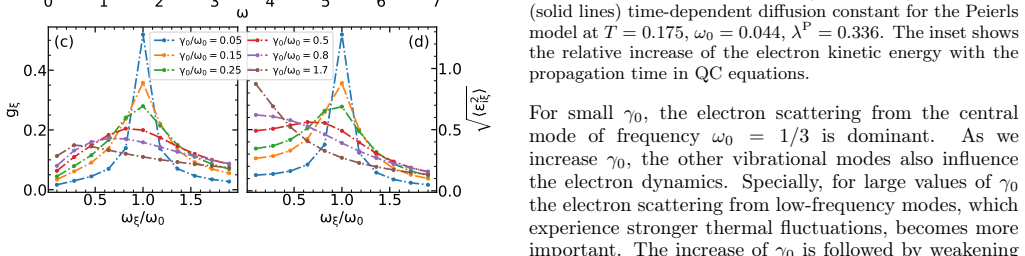
Building on the recent success of a quantum-classical method for computing transport properties in the Holstein model with a single phonon mode [P. Mitri\'c et al., Phys. Rev. B ${\bf 111}$, L161105 (2025)], we now assess its reliability in more realistic scenarios involving multiple phonon modes in the Holstein model, as well as single- and multi-mode Peierls models. For parameters relevant to the prototypical organic semiconductor rubrene, we compute the frequency-dependent charge mobility and find excellent agreement with results from the state-of-the-art hierarchical equations of motion method. These results show that the method, previously validated only for the single-mode Holstein model, preserves quantitative accuracy in substantially more complex and material-relevant regimes. Our microscopic approach complements the phenomenological transient-localization theory and is readily applicable to realistic electron-phonon Hamiltonians.
Editorial analysis
A structured set of objections, weighed in public.
Referee Report
Summary. The paper extends a quantum-classical method, previously validated for the single-mode Holstein model, to multi-mode Holstein and single-/multi-mode Peierls Hamiltonians. Using parameters relevant to the organic semiconductor rubrene, the authors compute frequency-dependent charge mobility and report excellent quantitative agreement with the hierarchical equations of motion (HEOM) method. They conclude that the approach preserves accuracy in more complex, material-relevant regimes and complements phenomenological theories such as transient-localization theory.
Significance. If the validation holds, the work establishes a reliable microscopic quantum-classical framework for charge transport in organic semiconductors with multiple low-frequency vibrational modes. This is significant because it enables direct computation on realistic electron-phonon Hamiltonians without relying solely on phenomenological models, and the direct comparison to HEOM provides a strong external benchmark.
minor comments (2)
- [Abstract] The abstract states 'excellent agreement' with HEOM but supplies no information on error bars, convergence criteria, or parameter sensitivity. Adding a brief statement on these checks would strengthen the presentation of the central validation result.
- The extension of the quantum-classical method to multiple modes and to the Peierls coupling is described only at a high level. A short dedicated subsection outlining the algorithmic changes (e.g., how the multi-mode bath is sampled or how the Peierls term is incorporated into the classical trajectories) would improve clarity and reproducibility.
Simulated Author's Rebuttal
We thank the referee for their positive assessment of our manuscript and for recommending minor revision. The report provides a clear summary of the work and its significance but does not list any specific major comments requiring point-by-point response.
Circularity Check
No significant circularity; validation is externally benchmarked
full rationale
The paper extends a prior quantum-classical method (cited to one overlapping author) but its central claim—that the approach preserves quantitative accuracy for multi-mode Holstein and Peierls models—is supported by direct numerical comparison to the independent HEOM method on rubrene parameters. No load-bearing step reduces the reported frequency-dependent mobility to a fitted parameter, self-defined quantity, or unverified self-citation chain; the agreement with HEOM constitutes external falsifiable evidence outside the present paper's inputs. The derivation chain for the spectra therefore remains self-contained.
Axiom & Free-Parameter Ledger
axioms (1)
- domain assumption The quantum-classical method developed for the single-mode Holstein model remains valid when multiple phonon modes are included.
Lean theorems connected to this paper
-
IndisputableMonolith/Cost/FunctionalEquation.leanwashburn_uniqueness_aczel unclear?
unclearRelation between the paper passage and the cited Recognition theorem.
We now assess its reliability in more realistic scenarios involving multiple phonon modes in the Holstein model, as well as single- and multi-mode Peierls models. ... excellent agreement with results from the state-of-the-art hierarchical equations of motion method.
What do these tags mean?
- matches
- The paper's claim is directly supported by a theorem in the formal canon.
- supports
- The theorem supports part of the paper's argument, but the paper may add assumptions or extra steps.
- extends
- The paper goes beyond the formal theorem; the theorem is a base layer rather than the whole result.
- uses
- The paper appears to rely on the theorem as machinery.
- contradicts
- The paper's claim conflicts with a theorem or certificate in the canon.
- unclear
- Pith found a possible connection, but the passage is too broad, indirect, or ambiguous to say the theorem truly supports the claim.
Reference graph
Works this paper leans on
-
[1]
V.Coropceanu, J.Cornil, D.A.daSilvaFilho, Y.Olivier, R. Silbey, and J.-L. Brédas, Charge transport in organic semiconductors, Chem. Rev.107, 926 (2007)
work page 2007
-
[2]
A. Zhugayevych and S. Tretiak, Theoretical description of structural and electronic properties of organic photovoltaic materials, Annu. Rev. Phys. Chem.66, 305 (2015)
work page 2015
-
[3]
S. Fratini, M. Nikolka, A. Salleo, G. Schweicher, and H. Sirringhaus, Charge transport in high-mobility conjugated polymers and molecular semiconductors, Nat. Mater.19, 491 (2020)
work page 2020
-
[4]
T. Nematiaram and A. Troisi, Modeling charge transport in high-mobility molecular semiconductors: Balancing electronic structure and quantum dynamics methods withthehelpofexperiments,J.Chem.Phys.152,190902 (2020)
work page 2020
-
[5]
S. Fratini, D. Mayou, and S. Ciuchi, The transient localization scenario for charge transport in crystalline organic materials, Adv. Funct. Mater.26, 2292 (2016)
work page 2016
- [6]
-
[7]
S. Fratini, S. Ciuchi, D. Mayou, G. de Laissardière, and A. Troisi, A map of high-mobility molecular semiconductors, Nat. Mater.16, 998 (2017)
work page 2017
-
[8]
A. Troisi and G. Orlandi, Charge-Transport Regime of Crystalline Organic Semiconductors: Diffusion Limited by Thermal Off-Diagonal Electronic Disorder, Phys. Rev. Lett.96, 086601 (2006)
work page 2006
-
[9]
P. V. Parandekar and J. C. Tully, Mixed quantum- classical equilibrium, J. Chem. Phys.122, 094102 (2005)
work page 2005
-
[10]
J. C. Tully, Ehrenfest dynamics with quantum mechanicalnuclei,Chem.Phys.Lett.816,140396(2023)
work page 2023
-
[11]
J. H. Fetherolf, D. Golež, and T. C. Berkelbach, A unification of the Holstein polaron and dynamic disorder pictures of charge transport in organic crystals, Phys. Rev. X10, 021062 (2020)
work page 2020
-
[12]
J. E. Runeson, T. J. G. Drayton, and D. E. Manolopoulos, Charge transport in organic semiconductors from the mapping approach to surface hopping, J. Chem. Phys.161, 144102 (2024)
work page 2024
- [13]
-
[14]
B. M. T. C. Peluzo, R. Meena, L. Catalano, G. Schweicher, and M. T. Ruggiero, Exploring the interplay of lattice dynamics and charge transport in organic semiconductors: Progress toward rational phonon engineering, Angew. Chem. Int. Ed.64, e202507566 (2025)
work page 2025
-
[15]
G.Schweicher, G.D’Avino, M.T.Ruggiero, D.J.Harkin, K. Broch, D. Venkateshvaran, G. Liu, A. Richard, C. Ruzié, J. Armstrong, A. R. Kennedy, K. Shankland, K. Takimiya, Y. H. Geerts, J. A. Zeitler, S. Fratini, and H. Sirringhaus, Chasing the “killer” phonon mode for the rational design of low-disorder, high-mobility molecular semiconductors, Adv. Mater.31, 1...
work page 2019
-
[16]
Janković, Charge transport limited by nonlocal electron-phonon interaction
V. Janković, Charge transport limited by nonlocal electron-phonon interaction. II. Numerically exact quantum dynamics in the slow-phonon regime, Phys. Rev. B112, 035112 (2025)
work page 2025
- [17]
-
[18]
P.Mitrić,Dynamicalquantumtypicality: Simplemethod for investigating transport properties applied to the Holstein model, Phys. Rev. B111, 195140 (2025)
work page 2025
-
[19]
V. Janković, P. Mitrić, D. Tanasković, and N. Vukmirović, Vertex corrections to conductivity in the Holstein model: A numerical-analytical study, Phys. Rev. B109, 214312 (2024)
work page 2024
-
[20]
V. Janković, Holstein polaron transport from numerically "exact" real-time quantum dynamics simulations, J. Chem. Phys.159, 094113 (2023)
work page 2023
-
[21]
Mahan,Many-Particle Physics(Plenum, New York, 1990)
G. Mahan,Many-Particle Physics(Plenum, New York, 1990)
work page 1990
-
[22]
Kubo, Statistical-mechanical theory of irreversible processes
R. Kubo, Statistical-mechanical theory of irreversible processes. I. General theory and simple applications to magnetic and conduction problems, J. Phys. Soc. Jpn. 12, 570 (1957)
work page 1957
-
[23]
S. Fratini and S. Ciuchi, Dynamical localization corrections to band transport, Phys. Rev. Res.2, 013001 (2020)
work page 2020
-
[24]
V. Janković, Numerical investigation of transport properties of the one-dimensional Peierls model based on the hierarchical equations of motion [Data set], Zenodo (2025)
work page 2025
-
[25]
M. Fischer, M. Dressel, B. Gompf, A. K. Tripathi, and J. Pflaum, Infrared spectroscopy on the charge accumulation layer in rubrene single crystals, Appl. Phys. Lett.89, 182103 (2006)
work page 2006
-
[26]
Z. Q. Li, V. Podzorov, N. Sai, M. C. Martin, M. E. Gershenson, M. Di Ventra, and D. N. Basov, Light Quasiparticles Dominate Electronic Transport in Molecular Crystal Field-Effect Transistors, Phys. Rev. Lett.99, 016403 (2007)
work page 2007
discussion (0)
Sign in with ORCID, Apple, or X to comment. Anyone can read and Pith papers without signing in.