Effects of Resolution and Local Stability on Galactic Disks: I. Multiple Spiral Mode Formation via Swing Amplification
Pith reviewed 2026-05-17 04:28 UTC · model grok-4.3
The pith
Live galactic disks with responsive halos develop multiple spiral modes in a cascading sequence from high to low m via swing amplification.
A machine-rendered reading of the paper's core claim, the machinery that carries it, and where it could break.
Core claim
In all sufficiently resolved live-halo models where the dark matter particle mass is at most ten times the stellar mass, the spirals display a cascading sequence: higher-m modes form and decay first, followed by the delayed emergence of lower-m modes, accompanied by an inward drift of the activity's epicenter. This arises from local swing amplification for initial short-wavelength growth combined with interference between long-lived modes causing amplitude modulations. The m=3 mode marks the start of inner-disk angular-momentum transport before bar formation.
What carries the argument
The cascading sequence of spiral modes, driven by swing amplification in live halos, which organizes the growth and decay of Fourier modes m=1 to 6.
If this is right
- Multi-mode spirals can sustain themselves through mode interference even as individual modes decay.
- The transition to bar formation is preceded by m=3 mode activity in the inner disk.
- Fixed-potential models fail to capture the full evolution due to lack of halo response.
- Appropriate mass resolution in the halo is necessary to avoid excessive shot noise and enable coherent cascading.
Where Pith is reading between the lines
- Simulations of disk galaxies should prioritize live halos with mass ratios at or below 10 to model spiral regeneration accurately.
- This cascade may explain recurrent spiral patterns observed in real galaxies without external triggers.
- Varying the local stability parameter could predictably shift the timing of mode emergence in the sequence.
Load-bearing premise
The observed differences in spiral behavior between live-halo and fixed-potential models stem mainly from the halo's gravitational responsiveness rather than from numerical artifacts or specific initial conditions.
What would settle it
Run a high-resolution live-halo simulation with m_DM/m_star = 10 and check if higher-m modes appear and decay before lower-m modes with inward epicenter drift; absence of this sequence would falsify the claim.
Figures
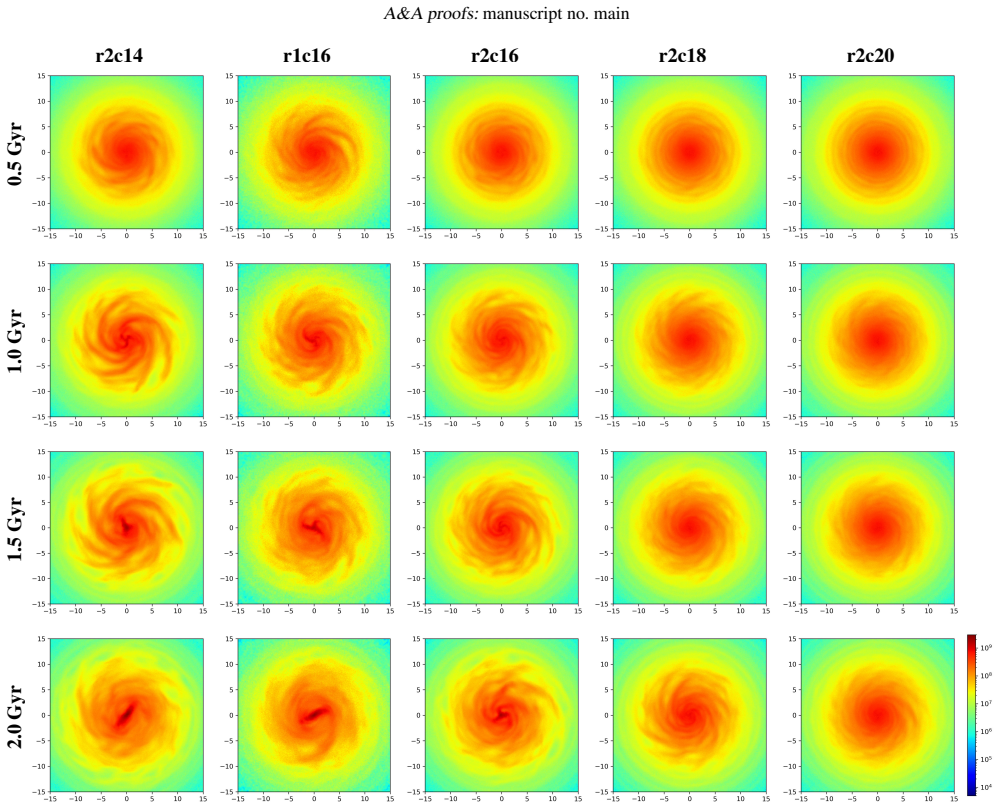


read the original abstract
We investigate the formation of multiple spiral modes in Milky Way-like disk-halo systems without explicitly exciting perturbations. We explore how numerical resolution, the level of local disk stability, and the presence of a live halo influence both the initial appearance and the subsequent evolution of these modes. To characterize spiral structure, we compute Fourier amplitudes for modes $m=1$-$6$. In marginally unstable, lower-resolution disks ($N_\star=5\times10^6$, $N_{\rm DM}=1.14\times10^7$), faint features appear within the first $0.5$ Gyr due to numerical noise, in contrast to high-resolution models where perturbations emerge later. Across all sufficiently resolved, live-halo models with $m_{\rm DM}/m_\star \le 10$, the spirals exhibit a cascading sequence in both mode number and radius: higher-$m$ modes form and decay first, followed by the delayed emergence of lower-$m$ modes, with an inward drift of the activity's epicenter. This behavior reflects a combination of local swing amplification, which explains the initial growth of short-wavelength modes, and interference between coexisting long-lived spiral modes, which accounts for the recurrent short-timescale amplitude modulations. In contrast, models with a fixed halo potential or coarse halo resolution ($N_{\rm DM}=1.14\times10^6$ and $m_{\rm DM}/m_\star=100$) show strong early spirals but lack this coherent cascading behavior, owing to excessive shot noise and insufficient halo responsiveness. The $m=3$ mode plays a transitional role, marking the onset of angular-momentum transport in the inner disk that precedes bar formation, a process absent in fixed-potential models. Our results show that a live halo with appropriate mass resolution provides the gravitational response needed to sustain and regenerate multi-mode spiral structure, even though the total angular-momentum exchange remains small.
Editorial analysis
A structured set of objections, weighed in public.
Referee Report
Summary. The manuscript reports N-body simulations of Milky Way-like disk-halo systems examining spontaneous formation of multiple spiral modes. It finds that sufficiently resolved live-halo models with m_DM/m_star ≤ 10 exhibit a cascading sequence: higher-m modes form and decay first, followed by lower-m modes with inward epicenter drift, attributed to swing amplification plus mode interference enabled by halo responsiveness. Fixed-potential and coarse-halo (N_DM=1.14e6, m_DM/m_star=100) runs instead produce strong early spirals without the cascade due to excessive shot noise and insufficient responsiveness. The m=3 mode is identified as transitional for inner-disk angular-momentum transport preceding bar formation.
Significance. If robust, the results demonstrate that live halos with adequate mass resolution are essential for sustaining realistic multi-mode spiral activity via gravitational response, providing a mechanism linking local stability, swing amplification, and recurrent mode interference. The direct comparative runs across resolutions and halo types offer concrete guidance on numerical requirements for disk simulations and implications for angular-momentum transport and bar precursors.
major comments (2)
- [§3] §3 (live-halo vs. fixed-potential comparisons): The attribution of the higher-m to lower-m cascade and inward drift specifically to halo gravitational responsiveness is load-bearing for the central claim, yet the manuscript does not present a controlled test that suppresses halo response while holding the initial Poisson noise spectrum and particle numbers fixed (e.g., via a fixed potential with matched noise seeding). Without this, differences in timing offset and sequence coherence could arise from unaccounted IC variations rather than responsiveness.
- [Results] Results on Fourier amplitudes (live-halo models with N_star=5e6, N_DM=1.14e7): No error bars, multiple realizations, or explicit convergence tests beyond the two resolution levels are reported for the mode amplitude time series; this weakens quantification of the 'coherent cascading behavior' and the claimed distinction from coarse-halo runs.
minor comments (3)
- [Abstract] Abstract: The qualifier 'sufficiently resolved' should be tied to explicit numerical criteria (e.g., m_DM/m_star threshold and particle counts) rather than left implicit.
- [Methods] Methods: Additional detail on the radial Toomre Q profile initialization and how it evolves across runs would clarify the role of local stability in setting the swing-amplification timescale.
- [Figures] Figure captions and text: Ensure consistent labeling of time intervals and mode numbers when illustrating the sequence and epicenter drift to aid reader interpretation.
Simulated Author's Rebuttal
We thank the referee for the constructive feedback and for recognizing the potential significance of our results on multi-mode spiral formation. We address each major comment below with point-by-point responses, indicating where revisions will be incorporated to strengthen the manuscript.
read point-by-point responses
-
Referee: §3 (live-halo vs. fixed-potential comparisons): The attribution of the higher-m to lower-m cascade and inward drift specifically to halo gravitational responsiveness is load-bearing for the central claim, yet the manuscript does not present a controlled test that suppresses halo response while holding the initial Poisson noise spectrum and particle numbers fixed (e.g., via a fixed potential with matched noise seeding). Without this, differences in timing offset and sequence coherence could arise from unaccounted IC variations rather than responsiveness.
Authors: We agree that isolating halo responsiveness from variations in the initial Poisson noise is important for strengthening the central claim. Our fixed-potential runs use identical disk initial conditions but contain no halo particles, while the coarse-halo runs include halo particles at higher individual mass. To provide the requested controlled test, we will add new simulations in the revised manuscript in which halo particles are initialized with the same number and positions as in the live-halo cases but are not allowed to respond dynamically (i.e., their potential is held fixed after t=0). These runs will match the noise spectrum while suppressing halo response, allowing a direct assessment of whether the cascade requires live halo responsiveness. revision: yes
-
Referee: Results on Fourier amplitudes (live-halo models with N_star=5e6, N_DM=1.14e7): No error bars, multiple realizations, or explicit convergence tests beyond the two resolution levels are reported for the mode amplitude time series; this weakens quantification of the 'coherent cascading behavior' and the claimed distinction from coarse-halo runs.
Authors: We acknowledge that error bars from multiple realizations would improve the quantitative support for the cascading sequence and the distinction from coarse-halo behavior. Performing additional high-resolution realizations is computationally expensive, so we have relied on the two resolution levels to illustrate the resolution dependence. In the revised manuscript we will add shaded uncertainty regions based on short-term temporal variations within each time series, explicitly discuss convergence between the presented resolution levels, and note the single-realization limitation while emphasizing that the qualitative contrast in spiral evolution between live high-resolution, coarse-halo, and fixed-potential models remains consistent. revision: partial
Circularity Check
No circularity: claims rest on direct N-body comparisons without self-referential reduction
full rationale
The paper reports empirical outcomes from suites of N-body simulations that vary particle number, halo responsiveness (live vs fixed potential), and mass resolution. The cascading higher-m to lower-m sequence and inward epicenter drift are presented as observed patterns in the Fourier amplitude time series for sufficiently resolved live-halo runs; these patterns are contrasted against fixed-potential and coarse-halo controls but are not obtained by fitting parameters to the same data or by equations that define the output in terms of the input. Swing amplification is invoked as an explanatory mechanism drawn from prior literature rather than derived within the paper. No load-bearing self-citation, ansatz smuggling, or renaming of known results occurs in the central claims. The derivation chain is therefore self-contained against external simulation benchmarks.
Axiom & Free-Parameter Ledger
free parameters (3)
- Stellar particle number N_star
- DM particle number N_DM
- DM-to-star mass ratio m_DM/m_star
axioms (2)
- domain assumption Local swing amplification governs initial growth of short-wavelength modes
- domain assumption Interference between coexisting long-lived modes produces recurrent amplitude modulations
Lean theorems connected to this paper
-
IndisputableMonolith/Foundation/AlexanderDuality.leanalexander_duality_circle_linking unclear?
unclearRelation between the paper passage and the cited Recognition theorem.
We compute Fourier amplitudes for modes m=1–6... higher-m modes form and decay first, followed by the delayed emergence of lower-m modes, with an inward drift of the activity's epicenter. This behavior reflects a combination of local swing amplification... and interference between coexisting long-lived spiral modes.
-
IndisputableMonolith/Cost/FunctionalEquation.leanwashburn_uniqueness_aczel unclear?
unclearRelation between the paper passage and the cited Recognition theorem.
Q = κ σ_R / (3.36 G Σ_⋆)... swing amplification... live halo with appropriate mass resolution provides the gravitational response needed to sustain and regenerate multi-mode spiral structure
What do these tags mean?
- matches
- The paper's claim is directly supported by a theorem in the formal canon.
- supports
- The theorem supports part of the paper's argument, but the paper may add assumptions or extra steps.
- extends
- The paper goes beyond the formal theorem; the theorem is a base layer rather than the whole result.
- uses
- The paper appears to rely on the theorem as machinery.
- contradicts
- The paper's claim conflicts with a theorem or certificate in the canon.
- unclear
- Pith found a possible connection, but the passage is too broad, indirect, or ambiguous to say the theorem truly supports the claim.
Forward citations
Cited by 1 Pith paper
-
Nexae in caverna: the secular evolution of disks via collectively excited, transient spiral structure
Galactic disks evolve secularly through transient, self-quenching spiral episodes excited non-resonantly by mild gradients (cavernae), with high-multiplicity spirals dominating in cold disks and lower-multiplicity one...
Reference graph
Works this paper leans on
- [1]
- [2]
- [3]
- [4]
- [5]
-
[6]
Bose, S., Eisenstein, D. J., Hernquist, L., et al. 2019, MNRAS, 490, 5693
work page 2019
- [7]
-
[8]
Byrd, G. G. & Howard, S. 1992, AJ, 103, 1089
work page 1992
-
[9]
Comparetta, J. & Quillen, A. C. 2012, arXiv:1207.5753 [arXiv:1207.5753]
work page internal anchor Pith review Pith/arXiv arXiv 2012
-
[10]
Debattista, V . P. & Sellwood, J. A. 2000, ApJ, 543, 704
work page 2000
- [11]
-
[12]
2004, MNRAS, 348, 977 D’Onghia, E
Diemand, J., Moore, B., Stadel, J., & Kazantzidis, S. 2004, MNRAS, 348, 977 D’Onghia, E. 2015, ApJ, 808, L8 D’Onghia, E., V ogelsberger, M., & Hernquist, L. 2013, ApJ, 766, 34
work page 2004
-
[13]
Donner, K. J. & Thomasson, M. 1994, A&A, 290, 785
work page 1994
- [14]
-
[15]
Dubois, Y ., Beckmann, R., Bournaud, F., et al. 2021, A&A, 651, A109
work page 2021
-
[16]
Efthymiopoulos, C., Kyziropoulos, P. E., Páez, R. I., Zouloumi, K., & Gravvanis, G. A. 2019, MNRAS, 484, 1487
work page 2019
-
[17]
Elmegreen, B. G., Elmegreen, D. M., & Montenegro, L. 1992, ApJS, 79, 37
work page 1992
- [18]
-
[19]
Fujii, M. S., Baba, J., Saitoh, T. R., et al. 2011, ApJ, 730, 109
work page 2011
-
[20]
S., Bédorf, J., Baba, J., & Portegies Zwart, S
Fujii, M. S., Bédorf, J., Baba, J., & Portegies Zwart, S. 2018, MNRAS, 477, 1451
work page 2018
-
[21]
Gabbasov, R. F., Rodríguez-Meza, M. A., Klapp, J., & Cervantes-Cota, J. L. 2006, A&A, 449, 1043
work page 2006
- [22]
-
[23]
Gnedin, O. Y ., Goodman, J., & Frei, Z. 1995, AJ, 110, 1105
work page 1995
-
[24]
Goldreich, P. & Lynden-Bell, D. 1965, MNRAS, 130, 125 Gómez, F. A., Minchev, I., Villalobos, Á., O’Shea, B. W., & Williams, M. E. K. 2012, MNRAS, 419, 2163 Grosbøl, P., Patsis, P. A., & Pompei, E. 2004, A&A, 423, 849
work page 1965
-
[25]
Hart, R. E., Bamford, S. P., Keel, W. C., et al. 2018, MNRAS, 478, 932
work page 2018
-
[26]
Hart, R. E., Bamford, S. P., Willett, K. W., et al. 2016, MNRAS, 461, 3663
work page 2016
- [27]
- [28]
- [29]
- [30]
- [31]
- [32]
-
[33]
Julian, W. H. & Toomre, A. 1966, ApJ, 146, 810
work page 1966
-
[34]
Khoperskov, S., Minchev, I., Steinmetz, M., et al. 2024, MNRAS, 533, 3975
work page 2024
- [35]
-
[36]
Kwak, S., Kim, W.-T., Rey, S.-C., & Quinn, T. R. 2019, ApJ, 887, 139
work page 2019
-
[37]
2011, MNRAS, 410, 166 Łokas, E
Lintott, C., Schawinski, K., Bamford, S., et al. 2011, MNRAS, 410, 166 Łokas, E. L., Athanassoula, E., Debattista, V . P., et al. 2014, MNRAS, 445, 1339
work page 2011
-
[38]
Ludlow, A. D., Fall, S. M., Schaye, J., & Obreschkow, D. 2021, MNRAS, 508, 5114
work page 2021
-
[39]
V ., V ogelsberger, M., Torrey, P., & Springel, V
Marinacci, F., Sales, L. V ., V ogelsberger, M., Torrey, P., & Springel, V . 2019, MNRAS, 489, 4233
work page 2019
-
[40]
Marques, L., Minchev, I., Ratcliffe, B., et al. 2025, A&A, 701, A88
work page 2025
- [41]
-
[42]
Meidt, S. E., Rand, R. J., & Merrifield, M. R. 2009, ApJ, 702, 277 Article number, page 17 A&A proofs:manuscript no. main
work page 2009
-
[43]
Meidt, S. E., Rand, R. J., Merrifield, M. R., Shetty, R., & V ogel, S. N. 2008, ApJ, 688, 224
work page 2008
- [44]
- [45]
-
[46]
Minchev, I., Famaey, B., Combes, F., et al. 2011, A&A, 527, A147
work page 2011
- [47]
- [48]
-
[49]
Minchev, I., Quillen, A. C., Williams, M., et al. 2009, MNRAS, 396, L56
work page 2009
- [50]
-
[51]
Moore, B., Katz, N., Lake, G., Dressler, A., & Oemler, A. 1996, Nature, 379, 613
work page 1996
- [52]
-
[53]
Mueller, M. W. & Arnett, W. D. 1976, ApJ, 210, 670
work page 1976
- [54]
-
[55]
Oh, S. H., Kim, W.-T., Lee, H. M., & Kim, J. 2008, ApJ, 683, 94
work page 2008
- [56]
-
[57]
Quillen, A. C., Dougherty, J., Bagley, M. B., Minchev, I., & Comparetta, J. 2011, MNRAS, 417, 762
work page 2011
- [58]
- [59]
- [60]
- [61]
- [62]
-
[63]
Sellwood, J. A. 2012, ApJ, 751, 44
work page 2012
-
[64]
Sellwood, J. A. 2016, ApJ, 819, 92
work page 2016
-
[65]
Sellwood, J. A. 2020, MNRAS, 492, 3103
work page 2020
-
[66]
Sellwood, J. A. 2021, MNRAS, 506, 3018
work page 2021
-
[67]
Sellwood, J. A. & Binney, J. J. 2002, MNRAS, 336, 785
work page 2002
-
[68]
Sellwood, J. A. & Carlberg, R. G. 2014, ApJ, 785, 137
work page 2014
-
[69]
Sellwood, J. A. & Carlberg, R. G. 2019, MNRAS, 489, 116
work page 2019
- [70]
- [71]
-
[72]
Springel, V ., Di Matteo, T., & Hernquist, L. 2005, MNRAS, 361, 776
work page 2005
-
[73]
Springel, V ., Wang, J., V ogelsberger, M., et al. 2008, MNRAS, 391, 1685
work page 2008
-
[74]
F., Athanassoula, E., & Pellat, R
Tagger, M., Sygnet, J. F., Athanassoula, E., & Pellat, R. 1987, ApJ, 318, L43
work page 1987
- [75]
-
[76]
1981, in Structure and Evolution of Normal Galaxies, ed
Toomre, A. 1981, in Structure and Evolution of Normal Galaxies, ed. S. M. Fall & D. Lynden-Bell, 111–136
work page 1981
-
[77]
Vislosky, E., Minchev, I., Khoperskov, S., et al. 2024, MNRAS, 528, 3576
work page 2024
- [78]
- [79]
- [80]
discussion (0)
Sign in with ORCID, Apple, or X to comment. Anyone can read and Pith papers without signing in.