MatBase algorithm for translating (E)MDM schemes into E-R data models
Pith reviewed 2026-05-17 02:43 UTC · model grok-4.3
The pith
A pseudocode algorithm translates (Elementary) Mathematical Data Model schemes into equivalent Entity-Relationship models.
A machine-rendered reading of the paper's core claim, the machinery that carries it, and where it could break.
Core claim
The algorithm maps any valid (E)MDM scheme to an equivalent E-R model through a fixed set of mechanical rules that preserve all semantic information, and the authors prove this procedure is linear in time, sound, complete, and semi-optimal.
What carries the argument
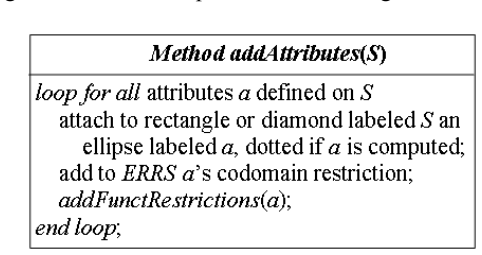
The translation algorithm that applies fixed mapping rules from (E)MDM elements such as entities, relationships, and attributes to corresponding E-R constructs.
If this is right
- Database designers can generate E-R diagrams from any valid (E)MDM scheme without manual intervention.
- Semantic information remains intact during conversion, so no meaning is lost in the process.
- The linear time bound makes the translation feasible even for large schemes.
- The MatBase implementation supplies extra reverse-engineering features that build on this mapping.
Where Pith is reading between the lines
- The approach could support automated migration of database designs between modeling styles.
- Similar mechanical translations might be developed for other pairs of data models.
- Integration into broader design tools could reduce manual steps in creating and updating database schemas.
Load-bearing premise
Any valid (E)MDM scheme can be mechanically translated into an equivalent E-R model without loss of semantic information or need for additional human judgment.
What would settle it
A valid (E)MDM scheme on which the algorithm either fails to produce a fully equivalent E-R model, runs in more than linear time, or requires human intervention to resolve semantics would falsify the claims.
Figures




read the original abstract
This paper presents a pseudocode algorithm for translating (Elementary) Mathematical Data Model ((E)MDM) schemes into Entity-Relationship data models. We prove that this algorithm is linear, sound, complete, and semi-optimal. As an example, we apply this algorithm to an (E)MDM scheme for a genealogical tree sub-universe. We also provide the main additional features added to the implementation of this data science reverse engineering algorithm in MatBase, our intelligent knowledge and database management system prototype based on both the Entity-Relationship, (E)MDM, and Relational Data Models.
Editorial analysis
A structured set of objections, weighed in public.
Referee Report
Summary. The paper presents a pseudocode algorithm for translating (Elementary) Mathematical Data Model ((E)MDM) schemes into Entity-Relationship (E-R) data models. It claims to prove that this algorithm is linear, sound, complete, and semi-optimal. The algorithm is illustrated via application to an (E)MDM scheme for a genealogical tree sub-universe, and the paper describes additional features implemented in the MatBase prototype system.
Significance. If the claimed properties hold with rigorous support, the work would provide a practical automated translation method between mathematical and E-R modeling paradigms, aiding reverse engineering tasks in database design and knowledge management systems. The integration with the MatBase implementation adds applied value, though the current lack of detailed proof support limits immediate significance.
major comments (2)
- [Abstract and algorithm properties section] Abstract and claims of algorithm properties: The paper asserts proofs of linearity, soundness, completeness, and semi-optimality but supplies no derivation details, lemmas, error analysis, or edge-case handling. Completeness in particular requires exhaustive case analysis showing every (E)MDM construct (e.g., elementary functions, constraints, higher-order relations) maps losslessly to E-R without external judgment; the single genealogical-tree example does not discharge this.
- [Example and completeness discussion] Completeness argument: The central claim that any valid (E)MDM scheme translates mechanically to an equivalent E-R model rests on an unstated assumption that all constructs have direct, canonical E-R equivalents. Without formal semantics for both models and a full case analysis, the completeness result cannot be verified from the provided material.
minor comments (2)
- [Implementation section] The description of MatBase implementation features would benefit from concrete examples of how the translation algorithm is embedded and any performance metrics observed.
- [Introduction and notation] Notation for (E)MDM elements should be defined more explicitly at first use to aid readers unfamiliar with the model.
Simulated Author's Rebuttal
We thank the referee for the careful reading and constructive feedback on our manuscript. We address each major comment below, indicating where we will revise the paper to improve clarity and rigor.
read point-by-point responses
-
Referee: [Abstract and algorithm properties section] Abstract and claims of algorithm properties: The paper asserts proofs of linearity, soundness, completeness, and semi-optimality but supplies no derivation details, lemmas, error analysis, or edge-case handling. Completeness in particular requires exhaustive case analysis showing every (E)MDM construct (e.g., elementary functions, constraints, higher-order relations) maps losslessly to E-R without external judgment; the single genealogical-tree example does not discharge this.
Authors: We agree that the current manuscript states the four properties in the abstract and properties section without including full derivation details, lemmas, or explicit edge-case analysis. Linearity is established by counting the constant-time operations performed on each input construct. Soundness follows from the direct mapping rules that preserve (E)MDM semantics in the resulting E-R diagram. Completeness and semi-optimality rest on the claim that the rule set covers all standard (E)MDM constructs. The genealogical-tree example serves only as illustration. To address the concern, we will add a dedicated subsection with lemmas for each property, a brief error analysis, and an explicit enumeration of how elementary functions, constraints, and higher-order relations are translated. revision: yes
-
Referee: [Example and completeness discussion] Completeness argument: The central claim that any valid (E)MDM scheme translates mechanically to an equivalent E-R model rests on an unstated assumption that all constructs have direct, canonical E-R equivalents. Without formal semantics for both models and a full case analysis, the completeness result cannot be verified from the provided material.
Authors: The manuscript relies on the established correspondence between (E)MDM and E-R constructs documented in prior literature on both models, which is why a self-contained formal semantics section was omitted. The algorithm encodes this correspondence as a fixed set of translation rules. We acknowledge that a reader unfamiliar with those equivalences cannot verify completeness from the given material alone. In the revision we will insert a short subsection that recalls the relevant semantic mappings and supplies a more systematic case analysis covering the main construct categories. revision: yes
Circularity Check
No significant circularity detected
full rationale
The paper presents a pseudocode algorithm for translating (E)MDM schemes into E-R models, claims proofs of linearity/soundness/completeness/semi-optimality, and illustrates with a genealogical tree example. No quoted derivation step reduces by construction to a self-definition, a fitted input renamed as prediction, or a load-bearing self-citation chain. The central claims rest on the algorithm design and case analysis rather than re-deriving inputs from outputs or importing uniqueness via prior self-work as an unverified axiom. The presentation is self-contained against external benchmarks.
Axiom & Free-Parameter Ledger
axioms (1)
- domain assumption Any valid (E)MDM scheme has a corresponding E-R representation that can be derived algorithmically without additional semantic input.
Reference graph
Works this paper leans on
-
[1]
Mancas, C. (2024). The (Elementary) Mathematical Data Model revisited. Primera Scientific Engineering, 5(4), 78–91. https://doi.org/10.48550/arXiv.2408.08367
-
[2]
Chen, P.P. (1976). The entity -relationship model. Toward a unified view of data. ACM TODS, 1(1), 9–36. 10.1145/320434.320440
-
[3]
Thalheim, B. (2000). Entity-Relationship Modeling: Foundations of Database Technology. Springer-Verlag
work page 2000
-
[4]
Mancas, C. (2015). Conceptual Data Modeling and Database Design: A Completely Algorithmic Approach. Volume 1: The Shortest Advisable Path. Apple Academic Press
work page 2015
-
[5]
Codd, E.F. (1970). A relational model for large shared data banks. CACM 13(6), 377–387. 10.1145/362384.362685
-
[6]
Abiteboul, S., Hull, R., & Vianu, V . (1995). Foundation of Databases. Addison-Wesley
work page 1995
-
[7]
MatBase – a tool for transparent programming while modeling data at conceptual levels
Mancas, C. MatBase – a tool for transparent programming while modeling data at conceptual levels. Proc. Int. Conf. on Comp. Sci. & Inf. Techn. CSITEC 2019, Vienna, Austria, (2019), 15–27. . https://aircconline.com/csit/papers/vol9/csit91102.pdf
work page 2019
-
[8]
Mancas, C. (2020). MatBase metadata catalog management. Acta Scientific Computer Sciences, 2(4), 25–29. https://doi.org/10.48550/arXiv.2504.07243
-
[9]
Mancas, C. & Mancas, D.C. (2025). MatBase Algorithm for Translating Entity - Relationship Data Models into (Elementary) Mathematical Data Model Schemes. Primera Scientific Engineering 7(6), 04–11. https://10.56831/PSEN-07-237 24
-
[10]
Mancas, D.C. (2023). Design and development of a database software application for managing genealogical trees [M.Sc. dissertation, Ovidius University at Constanta, Romania, Mathematics and Informatics Department]
work page 2023
-
[11]
Mancas, C., Serban, C., and Mancas, D.C. (2023). On Software Application Database Constraint-driven Design and Development. J. of Comp. Sci. Res. 5(1), 31 –45. https://doi.org/10.30564/jcsr.v5i1.5476
-
[12]
Quest. (2025, November 19). erwin Data Modeler by Quest. https://www.quest.com/documents/erwin-data-modeler-datasheet-147769.pdf
work page 2025
-
[13]
Microsoft SQL Documentation. (2025, November 19). SQL Server Management Studio. https://learn.microsoft.com/pdf?url=https%3A%2F%2Flearn.microsoft.com%2Fen- us%2Fssms%2Ftoc.json
work page 2025
-
[14]
Mancas, C. & Dragomir, S. On the Equivalence between Entity -Relationship and Functional Data Modeling. Proc. IASTED Software Eng. & App. SEA 2003 , Marina del Rey, U.S.A., (2003), 335–340. https://www.actapress.com/Abstract.aspx?paperId=14533
work page 2003
-
[15]
Oracle Corp. (2025, November 19). Oracle SQL Developer Data Modeler User’s Guide. https://docs.oracle.com/en/database/oracle/sql-developer-data- modeler/24.3/dmdug/data-modeler-concepts-usage.html#GUID-69B12E47-6075-4471- A205-BBB04113EE24
work page 2025
-
[16]
IBM Software Hub. (2025, November 19). IBM Db2 Data Management Console. https://www.ibm.com/docs/en/software-hub/5.2.x?topic=services-db2-data- management-console
work page 2025
-
[17]
Dataedo. (2025, November 19). Create diagram for IBM Db2 database. https://dataedo.com/tutorials/create-diagram-for-ibm-db2-database
work page 2025
-
[18]
von Halle, B. & Goldberg, L. (2006). The Business Rule Revolution. Running Businesses the Right Way. Happy About. 25
work page 2006
-
[19]
Taylor, J. (2019). Decision Management Systems: A Practical Guide to Using Business Rules and Predictive Analytics. IBM Press
work page 2019
-
[20]
IBM Corp. (2025, November 19). IBM Business Automation Manager Open Editions. https://www.ibm.com/docs/en/ibamoe/9.3.0
work page 2025
-
[21]
Red Hat Documentation. (2025, November 19). Designing your decision management architecture with Red Hat Decision Manager. https://docs.redhat.com/en/documentation/red_hat_decision_manager/7.13/html/designi ng_your_decision_management_architecture_for_red_hat_decision_manager/index
work page 2025
-
[22]
DecisionRules.io. (2025, November 19). DecisionRules Documentation. https://docs.decisionrules.io/doc/
work page 2025
-
[23]
Mancas, C. (2025). On Enforcing Satisfiable, Coherent, and Minimal Sets of Self -map Constraints in MatBase. Primera Scientific Engineering 6(2), 31 –49. https://10.56831/PSEN-06-179
discussion (0)
Sign in with ORCID, Apple, or X to comment. Anyone can read and Pith papers without signing in.