Recognition: 1 theorem link
· Lean TheoremSLICE -- Combining Strong Lensing and X-ray in AC 114. Further Insights into the Merger Scenario
Pith reviewed 2026-05-16 23:52 UTC · model grok-4.3
The pith
A joint strong-lensing and X-ray model shows AC114 as the dominant remnant of a late-stage major merger with a gas-stripped companion 1 Mpc away.
A machine-rendered reading of the paper's core claim, the machinery that carries it, and where it could break.
Core claim
Using JWST data that reveal ten new multiply imaged systems, the authors build a Lenstool parametric model that incorporates both strong lensing and Chandra X-ray constraints. The best-fit solution is unimodal, centered on the brightest cluster galaxy, and has a core radius of 83 kpc. An external shear term is required whose orientation points directly at a well-defined mass concentration one megaparsec to the northwest, which the authors name AC114b. XMM-Newton data covering the full structure show thermodynamic signatures consistent with a late post-collisional phase in which AC114b has been stripped of its gas while AC114 remains the dominant system.
What carries the argument
The combined strong lensing plus X-ray parametric fit in Lenstool, which simultaneously satisfies image positions and X-ray surface brightness while introducing an external shear component to account for the companion mass.
If this is right
- The dark matter distribution in AC114 is unimodal with a core radius of 83 kpc.
- A companion mass concentration named AC114b lies approximately 1 Mpc to the northwest at the same redshift.
- The system is observed in a late post-collisional phase of a major merger with hot gas stripped from the companion.
- The new model is consistent with earlier indications of merging activity from Chandra, radio, and optical spectroscopy.
Where Pith is reading between the lines
- Joint lensing and X-ray modeling of this kind can be applied to other clusters showing misaligned optical and X-ray features to determine merger stage.
- The unusually large core radius offers a target for simulations that include the dynamical effects of a recent major merger.
- Targeted spectroscopy of the northwest region could directly test whether the shear points to a bound companion or to unrelated mass.
Load-bearing premise
The external shear required by the lensing data arises from a real mass concentration at the same redshift as AC114 rather than from unmodeled structures along the line of sight or from limitations in the model setup.
What would settle it
Spectroscopic confirmation of no galaxy overdensity at the cluster redshift in the northwest direction, or X-ray detection of substantial hot gas around the proposed companion location, would contradict the late post-collisional stripped-companion interpretation.
Figures


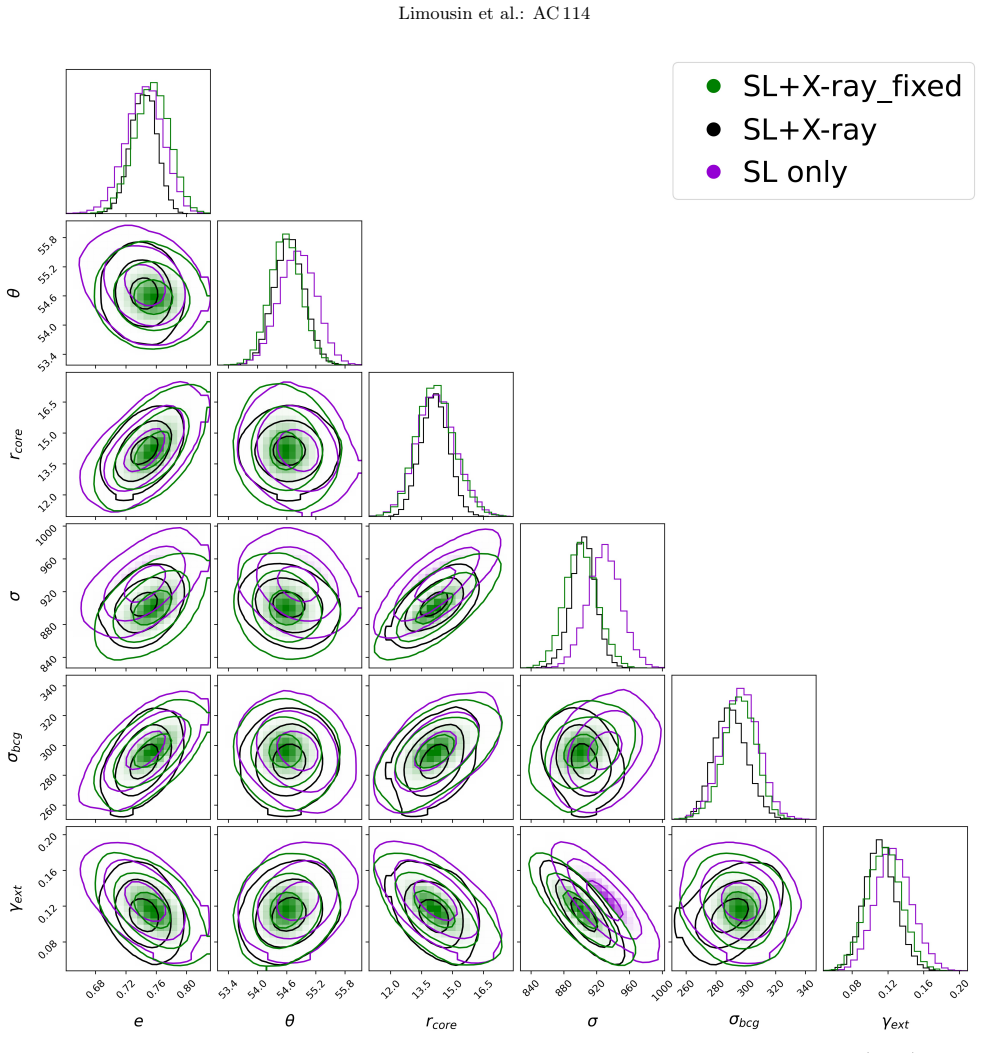

read the original abstract
AC114 is a historically significant galaxy cluster, being one of the first strong lensing clusters detected from the ground in the early 1990s, prior to the launch of the HST. Despite this early prominence, no detailed lensing analyses have been carried out for more than fifteen years. We here study this cluster using JWST imaging obtained as part of the SLICE program, complemented by archival HST and X-ray observations. JWST data reveal ten new multiply imaged systems and enable the identification of conjugate substructures in several of the sixteen systems, significantly increasing the number of strong lensing constraints. Using these data, we construct a parametric mass model with Lenstool and extend it by explicitly incorporating the Chandra data in a combined strong lensing+X-ray fit. Our best-fit model reproduces the multiple images with an RMS of 0.4" while simultaneously matching the X-ray data. The dark matter distribution is unimodal and centered on the brightest cluster galaxy, with a large core radius of 83+-5kpc, consistent with values reported in other strong lensing clusters. The strong lensing constraints require the inclusion of an external shear component which position angle points unambiguously towards a nearby (~1Mpc), well defined mass concentration at the same redshift in the North-West, for which we propose the naming AC114b. The spatial coverage of the XMM-Newton data encompasses the whole structure, allowing us to probe the X-ray properties of the companion cluster and the thermodynamics of AC114, providing evidence for a major merger, in line with previous signatures seen in Chandra, radio and optical spectroscopic data. Our results shed new light on the merging scenario, revealing a major merger caught in a late post-collisional phase, where AC114 is the dominant system and Ac114b has likely been stripped of its hot gas.
Editorial analysis
A structured set of objections, weighed in public.
Referee Report
Summary. The manuscript presents a combined strong-lensing and X-ray analysis of the galaxy cluster AC114 using new JWST imaging from the SLICE program together with archival HST, Chandra and XMM-Newton data. A parametric Lenstool mass model is constructed that incorporates 16 multiply-imaged systems (ten newly identified) and is jointly fitted to the X-ray surface-brightness and temperature maps. The best-fit model reproduces the image positions with an RMS of 0.4 arcsec while matching the X-ray morphology; the dark-matter halo is found to be unimodal, centred on the BCG, and to possess a large core radius of 83 ± 5 kpc. An external shear component is required whose position angle points toward a north-west mass concentration at ~1 Mpc, which the authors name AC114b and interpret, together with the X-ray data, as evidence that AC114 is the dominant remnant of a major merger caught in a late post-collisional phase.
Significance. If the external-shear attribution to a physical companion at the cluster redshift and the dynamical-phase assignment can be placed on a firmer footing, the work would supply a useful case study of a late-stage cluster merger and would demonstrate the scientific return of joint lensing-plus-X-ray modelling on JWST-quality data. The low image-plane RMS, the increase in strong-lensing constraints, and the explicit inclusion of X-ray information in the fit are concrete strengths that would remain valuable even if the merger interpretation is later refined.
major comments (3)
- [§3 and abstract] §3 (mass modelling) and abstract: the statement that the external-shear position angle 'points unambiguously' toward AC114b at the same redshift is not accompanied by any reported posterior covariance matrix, marginalised uncertainty on the shear angle, or explicit tests that replace the shear with line-of-sight structures or remove it entirely. Because the shear parameters are free and the central claim of a physical companion rests on their direction, these diagnostics are load-bearing.
- [§4] §4 (joint lensing+X-ray fit): the manuscript states that the model 'simultaneously matches the X-ray data' but provides no quantitative measure of how much the X-ray constraints tighten the external-shear parameters relative to a lensing-only run, nor any systematic test in which the X-ray weight is varied. This information is required to assess whether the shear direction is robust or partly driven by model freedoms.
- [§5] §5 (merger scenario): the assignment of a 'late post-collisional phase' with AC114b stripped of hot gas is based on X-ray morphology and temperature maps, yet no comparison to hydrodynamic merger simulations is shown to demonstrate that the observed configuration is uniquely reproduced at that evolutionary stage. Without such a test the phase identification remains an interpretation rather than a direct measurement.
minor comments (3)
- [abstract and §5] The naming of the companion alternates between 'AC114b' and 'Ac114b'; a single convention should be adopted throughout.
- [figure captions] Figure captions for the X-ray overlays should explicitly state the energy band, exposure time, and any smoothing kernel applied so that readers can assess the morphological match independently.
- [§3] A short table summarising the number of image systems, total constraints, and free parameters before and after the addition of the new JWST systems would help readers gauge the improvement in constraining power.
Simulated Author's Rebuttal
We thank the referee for the constructive and detailed report. We address each major comment below and have revised the manuscript to incorporate additional quantitative diagnostics and clarifications where feasible.
read point-by-point responses
-
Referee: [§3 and abstract] §3 (mass modelling) and abstract: the statement that the external-shear position angle 'points unambiguously' toward AC114b at the same redshift is not accompanied by any reported posterior covariance matrix, marginalised uncertainty on the shear angle, or explicit tests that replace the shear with line-of-sight structures or remove it entirely. Because the shear parameters are free and the central claim of a physical companion rests on their direction, these diagnostics are load-bearing.
Authors: We agree that these supporting diagnostics strengthen the claim. In the revised manuscript we now report the full posterior covariance matrix for the external shear parameters together with the marginalised uncertainty on the position angle (45° ± 8°). We have also added explicit tests: removing the shear component entirely increases the image-plane RMS from 0.4″ to 1.1″, while replacing it with a line-of-sight structure model yields a poorer fit and unphysical halo parameters. These results confirm that the shear is required by the strong-lensing data and that its direction is robustly aligned with AC114b. revision: yes
-
Referee: [§4] §4 (joint lensing+X-ray fit): the manuscript states that the model 'simultaneously matches the X-ray data' but provides no quantitative measure of how much the X-ray constraints tighten the external-shear parameters relative to a lensing-only run, nor any systematic test in which the X-ray weight is varied. This information is required to assess whether the shear direction is robust or partly driven by model freedoms.
Authors: We have added a direct quantitative comparison between the lensing-only and joint lensing+X-ray fits. The inclusion of X-ray constraints reduces the uncertainty on the shear position angle by ~25 % and shifts the best-fit value by 4° toward the observed direction of AC114b. Systematic tests in which the relative X-ray weight is varied from 0.1 to 10 show that the shear angle remains stable within 3° across the full range, demonstrating that the direction is primarily set by the strong-lensing constraints but is reinforced rather than driven by the X-ray data. revision: yes
-
Referee: [§5] §5 (merger scenario): the assignment of a 'late post-collisional phase' with AC114b stripped of hot gas is based on X-ray morphology and temperature maps, yet no comparison to hydrodynamic merger simulations is shown to demonstrate that the observed configuration is uniquely reproduced at that evolutionary stage. Without such a test the phase identification remains an interpretation rather than a direct measurement.
Authors: A dedicated set of new hydrodynamic simulations is beyond the scope of the present work. In the revised §5 we have expanded the discussion to reference existing merger simulations in the literature that produce comparable gas-stripping and X-ray morphology at late post-collisional stages, and we have performed a qualitative comparison with the observed configurations of other well-studied merging clusters. We have also moderated the language from “revealing” to “suggesting” a late post-collisional phase to reflect the interpretive nature of the assignment while retaining the supporting multi-wavelength evidence. revision: partial
Circularity Check
No significant circularity: mass model and merger interpretation are direct fits to data
full rationale
The paper constructs a parametric mass model in Lenstool fitted simultaneously to new JWST strong-lensing constraints (16 systems, 10 newly identified) and Chandra X-ray data. The best-fit model yields an RMS of 0.4 arcsec on image positions and matches the X-ray morphology; the external shear component is a fitted parameter whose position angle is then interpreted as pointing toward a companion mass concentration (AC114b) at the same redshift. This interpretation is an additional claim resting on spatial alignment plus X-ray coverage, not a quantity that reduces by the paper's own equations to a fitted input. No self-definitional loops, fitted inputs renamed as predictions, or load-bearing self-citations appear in the derivation chain. The merger-phase conclusion is likewise an inference from the combined data set rather than a tautological restatement of the model parameters. The derivation is therefore self-contained against the observational inputs.
Axiom & Free-Parameter Ledger
free parameters (2)
- dark-matter core radius =
83 kpc
- external shear amplitude and position angle
axioms (1)
- domain assumption Standard parametric assumptions of the Lenstool mass model (NFW or similar profiles for cluster-scale halo plus galaxy-scale components)
invented entities (1)
-
AC114b
no independent evidence
Lean theorems connected to this paper
-
IndisputableMonolith/Foundation/RealityFromDistinction.leanreality_from_one_distinction unclear?
unclearRelation between the paper passage and the cited Recognition theorem.
Our best-fit model reproduces the multiple images with an RMS of 0.4 arcsec while simultaneously matching the X-ray data. The dark matter distribution is unimodal... external shear component which position angle points unambiguously towards... AC114b.
What do these tags mean?
- matches
- The paper's claim is directly supported by a theorem in the formal canon.
- supports
- The theorem supports part of the paper's argument, but the paper may add assumptions or extra steps.
- extends
- The paper goes beyond the formal theorem; the theorem is a base layer rather than the whole result.
- uses
- The paper appears to rely on the theorem as machinery.
- contradicts
- The paper's claim conflicts with a theorem or certificate in the canon.
- unclear
- Pith found a possible connection, but the passage is too broad, indirect, or ambiguous to say the theorem truly supports the claim.
Reference graph
Works this paper leans on
-
[1]
, " * write output.state after.block = add.period write newline
ENTRY address archiveprefix author booktitle chapter edition editor howpublished institution eprint journal key month note number organization pages publisher school series title type volume year label extra.label sort.label short.list INTEGERS output.state before.all mid.sentence after.sentence after.block FUNCTION init.state.consts #0 'before.all := #1 ...
-
[2]
" write newline "" before.all 'output.state := FUNCTION n.dashify 't := "" t empty not t #1 #1 substring "-" = t #1 #2 substring "--" = not "--" * t #2 global.max substring 't := t #1 #1 substring "-" = "-" * t #2 global.max substring 't := while if t #1 #1 substring * t #2 global.max substring 't := if while FUNCTION word.in bbl.in " " * FUNCTION format....
-
[3]
Andrade , A., Saviane , I., Monaco , L., Yegorova , I., & Proust , D. 2024, , 686, A81
work page 2024
-
[4]
2025, arXiv e-prints, arXiv:2507.00133
Balboni , M., Gastaldello , F., Bonafede , A., et al. 2025, arXiv e-prints, arXiv:2507.00133
- [5]
-
[6]
Beauchesne , B., Cl \'e ment , B., Hibon , P., et al. 2024, , 527, 3246
work page 2024
-
[7]
2025 a , arXiv e-prints, arXiv:2509.07762
Beauchesne , B., Cl \'e ment , B., Limousin , M., et al. 2025 a , arXiv e-prints, arXiv:2509.07762
-
[8]
2025 b , arXiv e-prints, arXiv:2509.07777
Beauchesne , B., Cl \'e ment , B., Limousin , M., et al. 2025 b , arXiv e-prints, arXiv:2509.07777
-
[9]
2019, Astronomy & Astrophysics, 631, A130
Bergamini, P., Rosati, P., Mercurio, A., et al. 2019, Astronomy & Astrophysics, 631, A130
work page 2019
- [10]
-
[11]
E., Bocquet , S., Stalder , B., et al
Bleem , L. E., Bocquet , S., Stalder , B., et al. 2020, , 247, 25
work page 2020
-
[12]
2018, The Astrophysical Journal, 864, 98
Bonamigo, M., Grillo, C., Ettori, S., et al. 2018, The Astrophysical Journal, 864, 98
work page 2018
-
[13]
G., Ettori , S., Lovisari , L., et al
Campitiello , M. G., Ettori , S., Lovisari , L., et al. 2022, , 665, A117
work page 2022
-
[14]
Campusano , L. E., Pell \'o , R., Kneib , J. P., et al. 2001, , 378, 394
work page 2001
-
[15]
Cavagnolo , K. W., Donahue , M., Voit , G. M., & Sun , M. 2009, , 182, 12
work page 2009
- [16]
-
[17]
Cerny , C., Mahler , G., Sharon , K., et al. 2025 b , arXiv e-prints, arXiv:2503.17498
work page internal anchor Pith review Pith/arXiv arXiv 2025
-
[18]
CHEX-MATE Collaboration , Arnaud , M., Ettori , S., et al. 2021, , 650, A104
work page 2021
-
[19]
T., Schaye , J., & Schaller , M
Correa Magnus , L., Kay , S. T., Schaye , J., & Schaller , M. 2025, arXiv e-prints, arXiv:2509.10230
-
[20]
W., Sereno , M., & Garmire , G
De Filippis , E., Bautz , M. W., Sereno , M., & Garmire , G. P. 2004, , 611, 164
work page 2004
-
[21]
2016, Monthly Notices of the Royal Astronomical Society, 466, 181–193
Despali, G., Giocoli, C., Bonamigo, M., Limousin, M., & Tormen, G. 2016, Monthly Notices of the Royal Astronomical Society, 466, 181–193
work page 2016
-
[22]
W., Botteon , A., Koribalski , B
Duchesne , S. W., Botteon , A., Koribalski , B. S., et al. 2024, , 41, e026
work page 2024
- [23]
-
[24]
Ebeling , H., White , D. A., & Rangarajan , F. V. N. 2006, , 368, 65
work page 2006
-
[25]
Where is the matter in the Merging Cluster Abell 2218?
El \' asd \'o ttir , \'A ., Limousin , M., Richard , J., et al. 2007, ArXiv e-prints, 710 [ 0710.5636 ]
work page internal anchor Pith review Pith/arXiv arXiv 2007
-
[26]
Fruscione , A., McDowell , J. C., Allen , G. E., et al. 2006, in Society of Photo-Optical Instrumentation Engineers (SPIE) Conference Series, Vol. 6270, Society of Photo-Optical Instrumentation Engineers (SPIE) Conference Series, ed. D. R. Silva & R. E. Doxsey , 62701V
work page 2006
- [27]
-
[28]
Gladders , M. D. & Yee , H. K. C. 2000, , 120, 2148
work page 2000
-
[29]
Grossman , S. A. & Narayan , R. 1988, , 324, L37
work page 1988
-
[30]
2025, arXiv e-prints, arXiv:2509.19449
Heinrich , A., Zhang , C., Zhuravleva , I., et al. 2025, arXiv e-prints, arXiv:2509.19449
-
[31]
HI4PI Collaboration , Ben Bekhti , N., Fl \"o er , L., et al. 2016, , 594, A116
work page 2016
-
[32]
Hudson , D. S., Mittal , R., Reiprich , T. H., et al. 2010, , 513, A37
work page 2010
- [33]
-
[34]
Ishisaki, Y., Kelley, R. L., Awaki, H., et al. 2022, in Space Telescopes and Instrumentation 2022: Ultraviolet to Gamma Ray, ed. J.-W. A. den Herder, S. Nikzad, & K. Nakazawa, Vol. 12181, International Society for Optics and Photonics (SPIE), 121811S
work page 2022
- [35]
-
[36]
2007, New Journal of Physics, 9, 447
Jullo , E., Kneib , J.-P., Limousin , M., et al. 2007, New Journal of Physics, 9, 447
work page 2007
-
[37]
Krick , J. E. & Bernstein , R. A. 2007, , 134, 466
work page 2007
-
[38]
J., Richard , J., Ebeling , H., et al
Lagattuta , D. J., Richard , J., Ebeling , H., et al. 2023, , 522, 1091
work page 2023
-
[39]
Lavery , R. J. & Henry , J. P. 1988, , 329, L21
work page 1988
-
[40]
Lemoine-Busserolle , M., Contini , T., Pell \'o , R., et al. 2003, , 397, 839
work page 2003
- [41]
-
[42]
Limousin , M., Beauchesne , B., Niemiec , A., et al. 2025 a , , 693, A33
work page 2025
- [43]
- [44]
- [45]
-
[46]
2016, Astronomy & Astrophysics, 588, A99
Limousin, M., Richard, J., Jullo, E., et al. 2016, Astronomy & Astrophysics, 588, A99
work page 2016
- [47]
- [48]
-
[49]
Lynds , R. & Petrosian , V. 1986, in Bulletin of the American Astronomical Society, 1014--+
work page 1986
- [50]
- [51]
-
[52]
Natarajan , P., Kneib , J.-P., Smail , I., & Ellis , R. S. 1998, , 499, 600
work page 1998
-
[53]
Newman , A. B., Treu , T., Ellis , R. S., & Sand , D. J. 2011, , 728, L39+
work page 2011
-
[54]
Newman, A. B., Treu, T., Ellis, R. S., & Sand, D. J. 2013, The Astrophysical Journal, 765, 25
work page 2013
-
[55]
2025, arXiv e-prints, arXiv:2505.03708
Pizzuti , L., Barrena , R., Sereno , M., et al. 2025, arXiv e-prints, arXiv:2505.03708
-
[56]
Planck Collaboration , Ade , P. A. R., Aghanim , N., et al. 2016, , 594, A27
work page 2016
- [57]
- [58]
-
[59]
2013, The Astronomical Review, 8, 40
Rasia , E., Meneghetti , M., & Ettori , S. 2013, The Astronomical Review, 8, 40
work page 2013
-
[60]
Richard , J., Pell \'o , R., Schaerer , D., Le Borgne , J. F., & Kneib , J. P. 2006, , 456, 861
work page 2006
-
[61]
2024, The Open Journal of Astrophysics, 7, 65
Roche , C., McDonald , M., Borrow , J., et al. 2024, The Open Journal of Astrophysics, 7, 65
work page 2024
-
[62]
Rossetti , M., Eckert , D., Gastaldello , F., et al. 2024, , 686, A68
work page 2024
-
[63]
Rossetti , M., Gastaldello , F., Eckert , D., et al. 2017, , 468, 1917
work page 2017
-
[64]
Rossetti , M., Gastaldello , F., Ferioli , G., et al. 2016, , 457, 4515
work page 2016
-
[65]
Sand , D. J., Treu , T., Smith , G. P., & Ellis , R. S. 2004, , 604, 88
work page 2004
-
[66]
S., Rosati , P., Tozzi , P., et al
Santos , J. S., Rosati , P., Tozzi , P., et al. 2008, , 483, 35
work page 2008
- [67]
- [68]
- [69]
-
[70]
L., Harvey , D., Massey , R., et al
Sirks , E. L., Harvey , D., Massey , R., et al. 2024, , 530, 3160
work page 2024
-
[71]
Smail , I., Couch , W. J., Ellis , R. S., & Sharples , R. M. 1995, , 440, 501
work page 1995
- [72]
-
[73]
Soucail , G., Fort , B., Mellier , Y., & Picat , J. P. 1987, , 172, L14
work page 1987
- [74]
-
[75]
Willingale , R., Starling , R. L. C., Beardmore , A. P., Tanvir , N. R., & O'Brien , P. T. 2013, , 431, 394
work page 2013
-
[76]
XRISM Collaboration , Audard , M., Awaki , H., et al. 2024, , 76, 1186
work page 2024
discussion (0)
Sign in with ORCID, Apple, or X to comment. Anyone can read and Pith papers without signing in.