Recognition: 2 theorem links
· Lean TheoremTracking Protostellar Variability in Massive Protoclusters with ALMA: I. Insights from QUARKS and MaMMOtH
Pith reviewed 2026-05-16 23:45 UTC · model grok-4.3
The pith
ALMA observations of 22 massive protoclusters detect millimeter variability in five of 383 condensations, including a 68% intensity increase in one source over one year.
A machine-rendered reading of the paper's core claim, the machinery that carries it, and where it could break.
Core claim
Multi-epoch ALMA Band 6 continuum imaging at 0.3 arcsec resolution of 22 massive protoclusters yields 383 tracked condensations, of which five exhibit statistically significant variability; the standout source I13111-6228 shows a 68 percent rise in continuum peak intensity over one year.
What carries the argument
Custom data-reduction pipeline for image alignment and relative flux calibration, combined with the astrodendro algorithm to identify and monitor condensations across epochs.
If this is right
- Millimeter variability occurs in high-mass protoclusters but at a lower rate than reported for low-mass regions.
- Hypercompact H II regions can produce large, rapid continuum changes on yearly timescales.
- Interferometric multi-epoch surveys can deliver statistical samples of protostellar variability beyond nearby clouds.
- The detected changes are consistent with dynamical accretion events that also operate in more massive systems.
Where Pith is reading between the lines
- Longer time baselines or additional epochs could reveal whether the variability is periodic, episodic, or tied to specific accretion bursts.
- Cross-matching the variable sources with infrared or radio data would test whether the millimeter changes correlate with other accretion tracers.
- The 1.3 percent lower limit implies that larger surveys of massive clusters are needed to build a robust sample of variable objects.
Load-bearing premise
The measured intensity changes are produced by intrinsic protostellar processes rather than residual calibration or alignment errors that survive the custom processing.
What would settle it
A fresh ALMA Band 6 observation of I13111-6228 at matching resolution and frequency that shows the peak intensity has returned to the pre-increase value would falsify the reported 68 percent change.
Figures




read the original abstract
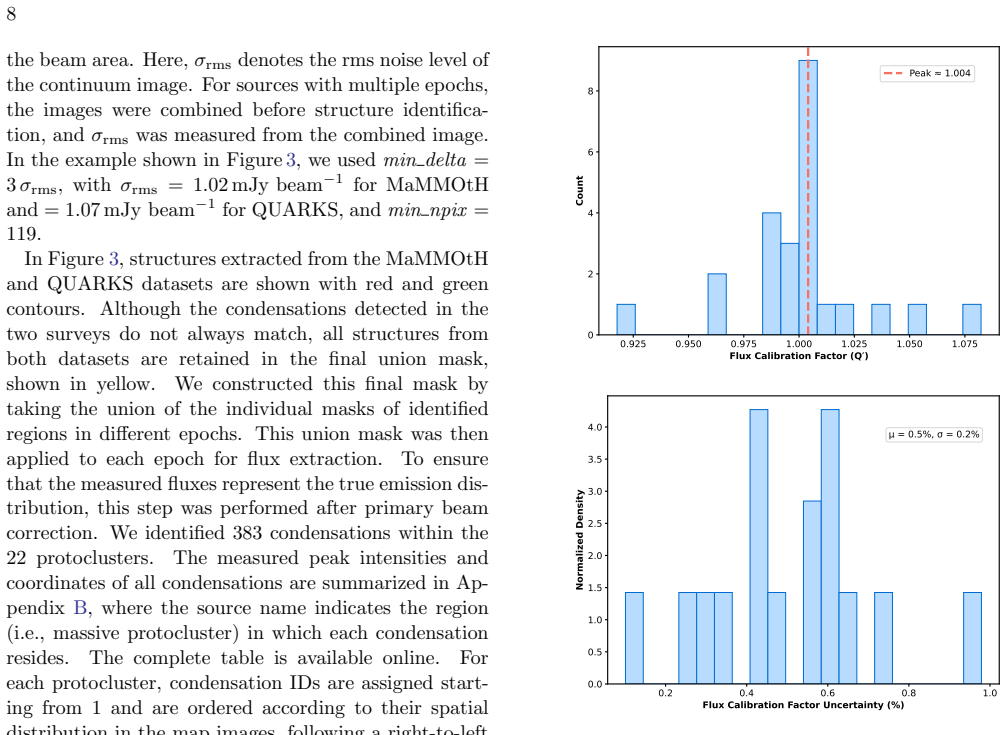
Millimeter/submillimeter variability is often attributed to dynamical disk-mediated accretion, yet detection is limited to low-mass protostars in nearby clouds. Recent observations have also revealed significant (sub)millimeter variability in high-mass protostars, but the confirmed cases are scarce and lack systematic monitoring. In this work, we analyzed multi-epoch Atacama Large Millimeter/submillimeter Array (ALMA) Band 6 (1.3 mm) continuum observations of 22 massive protoclusters, with epoch separations ranging from a few hours to more than two years, while achieving a consistent angular resolution of approximately 0.3 arcsec. These data allow us to track variability of protostars across a broader mass range and in an environment markedly different from nearby clouds. Using a custom processing pipeline for data reduction, image alignment, and relative flux calibration, we achieve high-precision flux measurements and, for the first time, investigate millimeter variability in massive protoclusters based on interferometric data in a statistical manner. Applying the astrodendro algorithm, we identified 383 condensations and tracked their variations in peak intensities. Standard deviation analysis and difference maps reveal five variable sources, corresponding to a lower limit of 1.3% on the variable fraction. Among these, I13111-6228 stands out as it hosts a hypercompact H II region that exhibits a 68% increase in continuum peak intensity over one year, with an uncertainty of 2%.
Editorial analysis
A structured set of objections, weighed in public.
Referee Report
Summary. The paper analyzes multi-epoch ALMA Band 6 (1.3 mm) continuum data for 22 massive protoclusters at ~0.3 arcsec resolution. Using a custom pipeline for reduction, alignment, and relative calibration, the authors apply astrodendro to extract 383 condensations and identify five variable sources via standard-deviation cuts and difference maps, yielding a 1.3% lower limit on the variable fraction. The standout case is source I13111-6228, whose hypercompact H II region shows a 68% rise in peak intensity over one year (quoted uncertainty 2%).
Significance. If the variability detections hold after rigorous validation, the work supplies the first statistical millimeter-variability census in massive protoclusters, extending earlier low-mass results to a higher-mass regime and different environment. The large sample size (383 sources) and the dramatic 68% change in I13111-6228 are concrete observational anchors that could constrain accretion-disk models for high-mass star formation.
major comments (2)
- [Methods (custom processing pipeline)] Methods / custom pipeline description: no error budget, no injected-signal simulations, and no control-sample statistics are presented to demonstrate that residual phase/amplitude errors after alignment and relative calibration remain below the quoted 2% level; this directly affects the reliability of the 68% intensity change reported for I13111-6228 and the overall 1.3% variable fraction.
- [Results (standard deviation analysis and difference maps)] Results / variability detection: the standard-deviation analysis and difference-map criteria that flag the five variable sources lack a quantitative false-positive rate or Monte-Carlo validation against the noise properties of the aligned images; without this, it is unclear whether the reported lower limit of 1.3% is robust.
minor comments (2)
- [Abstract] Abstract: the 2% uncertainty on the 68% change should explicitly state whether it is statistical only or includes systematic contributions from the pipeline.
- [Figure 1 / text] Figure captions and text: epoch time baselines are described only qualitatively; a compact table listing the exact time separations for each cluster would improve clarity.
Simulated Author's Rebuttal
We thank the referee for their constructive and detailed comments, which help improve the rigor of our analysis. We address each major comment below and will revise the manuscript to incorporate the requested validations.
read point-by-point responses
-
Referee: Methods / custom pipeline description: no error budget, no injected-signal simulations, and no control-sample statistics are presented to demonstrate that residual phase/amplitude errors after alignment and relative calibration remain below the quoted 2% level; this directly affects the reliability of the 68% intensity change reported for I13111-6228 and the overall 1.3% variable fraction.
Authors: We agree that the current manuscript does not include a full error budget or quantitative validation of residual calibration errors. In the revised version we will add an explicit error budget for the alignment and relative-calibration steps, perform injected-signal Monte-Carlo simulations to measure residual phase/amplitude errors, and analyze a control sample of non-variable condensations to demonstrate that the achieved precision is at or below the quoted 2% level. These additions will directly support the reliability of the 68% intensity change in I13111-6228 and the overall variable fraction. revision: yes
-
Referee: Results / variability detection: the standard-deviation analysis and difference-map criteria that flag the five variable sources lack a quantitative false-positive rate or Monte-Carlo validation against the noise properties of the aligned images; without this, it is unclear whether the reported lower limit of 1.3% is robust.
Authors: We acknowledge that a quantitative false-positive assessment is required. We will add Monte-Carlo simulations that generate noise realizations matching the observed image properties, apply the identical standard-deviation and difference-map criteria to non-variable sources, and report the resulting false-positive rate. This will allow us to evaluate and, if necessary, adjust the 1.3% lower limit in the revised manuscript. revision: yes
Circularity Check
No circularity: purely observational flux measurements
full rationale
The paper reports direct ALMA continuum observations of 383 condensations across multiple epochs. Variability is identified by applying standard deviation analysis and difference maps to measured peak intensities after a custom data-reduction pipeline. No equations, predictions, or derivations are present that reduce to fitted parameters, self-definitions, or self-citations. The central results (5 variable sources, 1.3% lower limit, 68% change in I13111-6228) are empirical counts and ratios computed from the observed data values themselves. The pipeline is described as a processing step, not a theoretical model whose outputs are then re-derived as inputs.
Axiom & Free-Parameter Ledger
Lean theorems connected to this paper
-
IndisputableMonolith/Foundation/RealityFromDistinction.leanreality_from_one_distinction unclear?
unclearRelation between the paper passage and the cited Recognition theorem.
Applying the astrodendro algorithm, we identified 383 condensations
What do these tags mean?
- matches
- The paper's claim is directly supported by a theorem in the formal canon.
- supports
- The theorem supports part of the paper's argument, but the paper may add assumptions or extra steps.
- extends
- The paper goes beyond the formal theorem; the theorem is a base layer rather than the whole result.
- uses
- The paper appears to rely on the theorem as machinery.
- contradicts
- The paper's claim conflicts with a theorem or certificate in the canon.
- unclear
- Pith found a possible connection, but the passage is too broad, indirect, or ambiguous to say the theorem truly supports the claim.
Reference graph
Works this paper leans on
-
[1]
, " * write output.state after.block = add.period write newline
ENTRY address archivePrefix author booktitle chapter doi edition editor eprint howpublished institution journal key month number organization pages publisher school series title misctitle type volume year version url label extra.label sort.label short.list INTEGERS output.state before.all mid.sentence after.sentence after.block FUNCTION init.state.consts ...
-
[2]
" write newline "" before.all 'output.state := FUNCTION format.url url empty "" new.block "" url * "" * if FUNCTION format.eprint eprint empty "" archivePrefix empty "" archivePrefix "arXiv" = new.block " " eprint * " " * new.block " " eprint * " " * if if if FUNCTION format.doi doi empty "" " " doi * " " * if FUNCTION format.pid doi empty eprint empty ur...
-
[3]
l N؟ /4'5տȯ w_ ?՟ òJ0MN M<?d>_ ?i왳?#NQH뺕#n ӵ AÌ(nkYC<fx>DA- ^*Xk ͥ͟ki j G\ /f ͦYĪCXԈlr3
thebibliography [1] 20pt to REFERENCES 6pt =0pt \@twocolumntrue 12pt -12pt 10pt plus 3pt =0pt =0pt =1pt plus 1pt =0pt =0pt -12pt =13pt plus 1pt =20pt =13pt plus 1pt \@M =10000 =-1.0em =0pt =0pt 0pt =0pt =1.0em @enumiv\@empty 10000 10000 `\.\@m \@noitemerr \@latex@warning Empty `thebibliography' environment \@ifnextchar \@reference \@latexerr Missing key o...
discussion (0)
Sign in with ORCID, Apple, or X to comment. Anyone can read and Pith papers without signing in.