Experimental and Monte Carlo Simulation Studies to Investigate the Working Principle of Compact Nanodosimeters
Pith reviewed 2026-05-16 22:31 UTC · model grok-4.3
The pith
Experiments confirm ion-impact ionizations as primary signal mechanism in compact nanodosimeters
A machine-rendered reading of the paper's core claim, the machinery that carries it, and where it could break.
Core claim
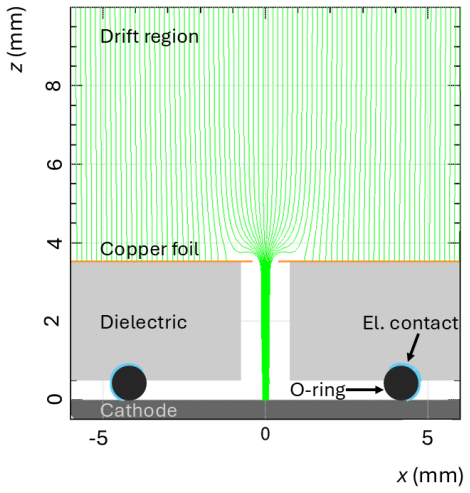
By covering the 1.5 mm cell hole with a grounded readout electrode containing a 0.8 mm hole, the setup prevents collected ions from interacting with the dielectric walls. High signal yields at low propane pressures show that ion-impact ionizations of gas molecules dominate signal formation, while ion-induced secondary electron emission from the cathode may also contribute. The Geant4-DNA and Garfield++ models reproduce the observed ion collection and multiplication behavior.
What carries the argument
Isolated single cell hole with 0.8 mm grounded readout electrode that separates ion-gas ionization from wall interactions.
Load-bearing premise
The grounded readout electrode with its 0.8 mm hole fully prevents collected ions from interacting with the cell hole walls.
What would settle it
A large drop in signal yield when the readout hole is enlarged or removed to allow ions to reach the cell walls would show that wall effects contribute substantially.
Figures




read the original abstract
In recent years, compact nanodosimetric detectors based on ion multiplication in low-pressure gas have been developed and gained attention in the scientific community. These detectors use strong electric fields to collect and multiply positive ions produced by the incident radiation in mm-sized cell holes in dielectric materials, achieving a nm-equivalent spatial resolution of the localization of ionization events, when scaled to liquid water at unit density. Their design assumes that ion-impact ionizations of gas molecules within the cell holes dominate signal formation, yet this assumption has lacked direct physical verification. Electron emission from the cell hole walls or the cathode due to ion-impact could also contribute, requiring alternative designs to optimize efficiency. To investigate the relative importance of the possible mechanisms, a nanodosimetric detector featuring a single cell hole with a diameter of 1.5 mm in a dielectric plate was developed. Ion collection and multiplication were achieved by applying a negative high voltage to the glass cathode 0.5 mm below the cell hole, assisted by a low drift field above the plate. A grounded readout electrode with a 0.8 mm hole covers the cell hole to prevent interactions of collected ions with the hole walls. High signal yields in 1 mbar and 2 mbar propane gas were observed and indicated that ion-impact ionizations of the gas molecules could indeed be the primary mechanism for signal induction. Ion-induced secondary electron emission from the cathode was identified as another potential contribution. The compact nanodosimeter setup was further modeled with Geant4-DNA and Garfield++ for deeper insight. The results of these studies are important for understanding and developing a new class of nanodosimeters with potential applications in particle therapy, radiation protection, space dosimetry, and particle physics.
Editorial analysis
A structured set of objections, weighed in public.
Referee Report
Summary. The manuscript describes the design, experimental testing, and Monte Carlo modeling of a compact nanodosimeter with a single 1.5 mm diameter cell hole in a dielectric plate. Using propane at 1 mbar and 2 mbar, high signal yields were measured with a negative high voltage on the glass cathode 0.5 mm below the hole and a low drift field above, assisted by a grounded readout electrode with a 0.8 mm hole intended to isolate collected ions from wall interactions. The authors conclude that ion-impact ionizations of gas molecules are the primary signal mechanism, with possible additional contribution from ion-induced secondary electron emission from the cathode. The setup is simulated with Geant4-DNA and Garfield++.
Significance. If the experimental isolation holds, the work provides direct verification of the dominant signal-formation mechanism assumed in compact nanodosimeter designs, which is relevant for applications in particle therapy, radiation protection, space dosimetry, and particle physics. The combination of measurements at two pressures with two standard Monte Carlo packages offers moderate support for the primary-mechanism claim, though the absence of quantitative yields and error bars weakens the evidential weight.
major comments (1)
- [Abstract and Experimental Setup] The central claim that high signal yields demonstrate ion-impact ionization of gas molecules as the primary mechanism rests on the assumption that the grounded readout electrode with its 0.8 mm hole fully prevents collected ions from interacting with the cell hole walls (Abstract and Experimental Setup). The manuscript does not quantify the wall-hit fraction in the Garfield++ simulations under the operating voltages, 1.5 mm hole geometry, and 1–2 mbar propane pressures, where transverse diffusion or field fringing could allow ions to reach the dielectric walls and induce secondary electrons. This quantification is required to isolate the gas-ionization contribution.
minor comments (1)
- [Abstract] The abstract refers to 'high signal yields' without reporting numerical values, uncertainties, or the criteria used to attribute yields to gas ionization versus cathode emission.
Simulated Author's Rebuttal
We thank the referee for the detailed review and constructive feedback on our manuscript. We address the single major comment below and will revise the manuscript to incorporate the requested quantification.
read point-by-point responses
-
Referee: [Abstract and Experimental Setup] The central claim that high signal yields demonstrate ion-impact ionization of gas molecules as the primary mechanism rests on the assumption that the grounded readout electrode with its 0.8 mm hole fully prevents collected ions from interacting with the cell hole walls (Abstract and Experimental Setup). The manuscript does not quantify the wall-hit fraction in the Garfield++ simulations under the operating voltages, 1.5 mm hole geometry, and 1–2 mbar propane pressures, where transverse diffusion or field fringing could allow ions to reach the dielectric walls and induce secondary electrons. This quantification is required to isolate the gas-ionization contribution.
Authors: We agree that an explicit quantification of the wall-hit fraction is needed to strengthen the isolation of the gas-phase ion-impact ionization mechanism. The original manuscript describes the grounded readout electrode design as intended to minimize wall interactions but does not report the simulated fraction. In the revised version we will add Garfield++ results that calculate the wall-hit fraction for the 1.5 mm hole geometry, operating voltages, and 1–2 mbar propane pressures, including the effects of transverse diffusion and field fringing. This will allow a direct assessment of the contribution from gas-molecule ionizations versus possible wall-induced secondary electrons. revision: yes
Circularity Check
No significant circularity; claims rest on direct experiment and standard external simulations
full rationale
The paper reports experimental signal yields in 1-2 mbar propane and attributes them to ion-impact ionization based on the observed data and modeling with the independent, publicly available packages Geant4-DNA and Garfield++. No derivation chain, fitted parameter, or self-citation is used to generate the central claim; the 0.8 mm hole design is presented as an engineering choice whose effectiveness is tested by the measurements themselves rather than assumed by construction. The result is therefore self-contained against external benchmarks and does not reduce to its inputs.
Axiom & Free-Parameter Ledger
Lean theorems connected to this paper
-
IndisputableMonolith/Foundation/AlexanderDuality.leanalexander_duality_circle_linking unclear?
unclearRelation between the paper passage and the cited Recognition theorem.
A grounded readout electrode with a 0.8 mm hole covers the cell hole to prevent interactions of collected ions with the hole walls.
What do these tags mean?
- matches
- The paper's claim is directly supported by a theorem in the formal canon.
- supports
- The theorem supports part of the paper's argument, but the paper may add assumptions or extra steps.
- extends
- The paper goes beyond the formal theorem; the theorem is a base layer rather than the whole result.
- uses
- The paper appears to rely on the theorem as machinery.
- contradicts
- The paper's claim conflicts with a theorem or certificate in the canon.
- unclear
- Pith found a possible connection, but the passage is too broad, indirect, or ambiguous to say the theorem truly supports the claim.
Reference graph
Works this paper leans on
-
[1]
Conte, V., Bianchi, A., Selva, A., 2023
URL:https://doi.org/10.1093/rpd/ncv139, doi:10.1093/rpd/ncv139, arXiv:https://academic.oup.com/rpd/article-pdf/166/1-4/223/4565335/ncv139.pdf. Conte, V., Bianchi, A., Selva, A., 2023. Track structure of light ions: The link to radiobiology. International Journal of Molecular Sciences 24. URL:https: //www.mdpi.com/1422-0067/24/6/5826, doi:10.3390/ijms24065...
-
[2]
van Elsbergen, V., Bachmann, P.K., Juestel, T., 2000
URL:https://doi.org/10.1093/rpd/ncx175, doi:10.1093/rpd/ncx175, arXiv:https://academic.oup.com/rpd/article-pdf/180/1-4/150/25409814/ncx175.pdf. van Elsbergen, V., Bachmann, P.K., Juestel, T., 2000. 16.3: Ion-induced sec- ondary electron emission: A comparative study. SID Symposium Digest of Technical Papers 31, 220–223. URL:https://sid.onlinelibrary.wiley...
-
[3]
Ion-induced secondary electron emission coefficient (γ) of bulk mgo-single crystals. Jpn. J. Appl. Phys. 39, 1890–1891. URL:https://iopscience.iop. org/article/10.1143/JJAP.39.1890/pdf. Malinen, M., Råback, P., 2013. Elmer finite element solver for multiphysics and multiscale problems. In book: Multiscale Modelling Methods for Applications in Material Sci...
-
[4]
Radiation and Environmental Bio- physics 41, 235–256
Ionization-cluster distributions ofα-particles in nanometric volumes of propane: measurement and calculation. Radiation and Environmental Bio- physics 41, 235–256. URL:https://doi.org/10.1007/s00411-002-0171-6, doi:10.1007/s00411-002-0171-6. Pietrzak, M., Pszona, S., Bantsar, A., 2018. Measurements of spatial correlations of ionisation clusters in the tra...
-
[5]
URL:https://link.aps.org/doi/10.1103/PhysRev.169.263, doi:10. 1103/PhysRev.169.263. Vasi, F., Kempf, I., Besserer, J., Schneider, U., 2021. Fire: A compact nanodosime- ter detector based on ion amplification in gas. Nuclear Instruments and Meth- ods in Physics Research Section A: Accelerators, Spectrometers, Detectors and Associated Equipment 999, 165116....
discussion (0)
Sign in with ORCID, Apple, or X to comment. Anyone can read and Pith papers without signing in.