R\'ecurrence ou non minimalit\'e des adh\'erences des d'orbites irr\'eguli\'eres du flot horocyclique de finesse infinie
Pith reviewed 2026-05-16 22:02 UTC · model grok-4.3
The pith
On geometrically infinite hyperbolic surfaces, irregular orbits of the horocyclic flow are recurrent or their closures are non-minimal.
A machine-rendered reading of the paper's core claim, the machinery that carries it, and where it could break.
Core claim
We show that such an orbit is recurrent, or its closure is non-h_R minimal. This would allow us to almost complete the description of h_R-minimal sets.
What carries the argument
The irregular orbit of the horocyclic flow h_R on the unit tangent bundle, whose closure is analyzed for recurrence and minimality.
Load-bearing premise
The surface is geometrically infinite with the horocyclic flow of infinite fineness and the orbit is irregular.
What would settle it
Finding an irregular orbit that is not recurrent but has a minimal closure would falsify the result.
Figures
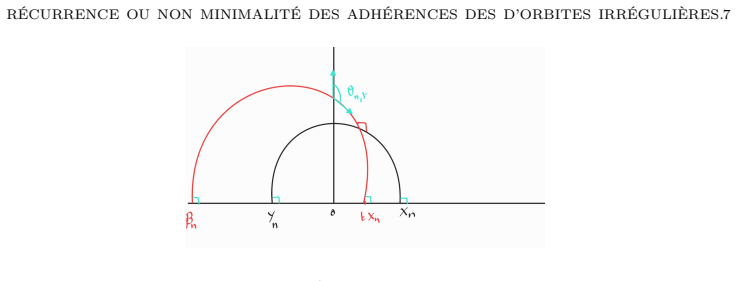
read the original abstract
The topological dynamics of the horocyclic flow $h_{\mathbb{R}}$ on the unit tangent bundle of a geometrically finite hyperbolic surface is well known. In particular, on such a surface, the flow $h_{\mathbb{R}}$ is minimal, or the minimal sets are the periodic orbits. When the surface is geometrically infinite, the situation is more complex, and the presence of possible non-closed and non-dense orbits, called irregular orbits, complicates the description of minimal sets. In this text, we will show that such an orbit is recurrent, or its closure is non-$h_{\mathbb{R}}$ minimal. This would allow us to almost complete the description of $h_{\mathbb{R}}$-minimal sets.
Editorial analysis
A structured set of objections, weighed in public.
Referee Report
Summary. The manuscript proves that an irregular orbit (neither closed nor dense) of the horocyclic flow h_R on the unit tangent bundle of a geometrically infinite hyperbolic surface with infinite fineness is either recurrent or has non-h_R-minimal closure. The argument proceeds by case analysis on the orbit's accumulation behavior, using the infinite-fineness hypothesis to control possible limit sets, with the goal of nearly completing the classification of h_R-minimal sets.
Significance. If the result holds, it is a meaningful contribution to the topological dynamics of horocyclic flows. It extends the classical dichotomy for geometrically finite surfaces (minimal or periodic minimal sets) to the geometrically infinite setting by ruling out minimal closures for non-recurrent irregular orbits. The case analysis under the infinite-fineness assumption supplies a concrete mechanism for restricting limit sets and thereby reduces the possible forms of minimal sets.
minor comments (3)
- [Abstract] Abstract: the statement of the main theorem is clear, but a one-sentence indication of the proof method (case analysis on accumulation points controlled by infinite fineness) would help readers anticipate the logical structure.
- [§1] §1 (Introduction): the definition of 'finesse infinie' and the precise meaning of 'irrégulières' should be recalled explicitly before the case division, even if they appear in the background literature cited.
- [Notation] Notation: the symbol h_R is used consistently for the flow, but the distinction between the orbit closure and the minimal subsets of the closure should be emphasized in the statement of the dichotomy to avoid any ambiguity in later sections.
Simulated Author's Rebuttal
We thank the referee for their positive summary and significance assessment of our manuscript. We appreciate the recommendation for minor revision and note that no specific major comments were raised in the report.
Circularity Check
No significant circularity in the claimed derivation
full rationale
The manuscript claims to prove that irregular orbits of the horocyclic flow are either recurrent or have non-minimal closures on geometrically infinite surfaces with infinite fineness. This is presented as a direct result via case analysis on accumulation behavior, without any self-definitional loops, fitted predictions, or load-bearing self-citations that reduce the theorem to its assumptions. The argument builds on standard background in hyperbolic geometry and flows, making the derivation self-contained against external benchmarks.
Axiom & Free-Parameter Ledger
axioms (1)
- domain assumption The horocyclic flow h_R is defined on the unit tangent bundle of a geometrically infinite hyperbolic surface of infinite fineness.
Lean theorems connected to this paper
-
IndisputableMonolith/Foundation/AlexanderDuality.leanalexander_duality_circle_linking unclear?
unclearRelation between the paper passage and the cited Recognition theorem.
Théorème 1.1: irregular orbit recurrent or closure non-hR-minimal; uses Inj(u(R+))=+∞ and limit-point partition Λirr
What do these tags mean?
- matches
- The paper's claim is directly supported by a theorem in the formal canon.
- supports
- The theorem supports part of the paper's argument, but the paper may add assumptions or extra steps.
- extends
- The paper goes beyond the formal theorem; the theorem is a base layer rather than the whole result.
- uses
- The paper appears to rely on the theorem as machinery.
- contradicts
- The paper's claim conflicts with a theorem or certificate in the canon.
- unclear
- Pith found a possible connection, but the passage is too broad, indirect, or ambiguous to say the theorem truly supports the claim.
Reference graph
Works this paper leans on
-
[1]
A. F. Beardon,The geometry of discrete groups, Springer-Verlag, New York, 1983
work page 1983
-
[2]
A.Bellis,Étude topologique du flot horocyclique: le cas des surfaces géométriquement infinies, Thèse/Université de Rennes1
-
[3]
A. Bellis,On the links between horocyclic and geodesic orbits on geometrically infinite sur- feces, Journal de l’École polytechnique Mathématiques, Tome5(2018), 443-454
work page 2018
-
[4]
Dal’Bo,Trajectoires géodésiques et horocycliques, Savoirs Actuels: EDPS-CNRS 2007
F. Dal’Bo,Trajectoires géodésiques et horocycliques, Savoirs Actuels: EDPS-CNRS 2007
work page 2007
-
[5]
F. Dal’Bo - J. Farre, O . Landesberg, and Y. Minsky,Weaving geodesic and new phenomena in horocyclic dynamics, arXiv : 2510.202609v1 [math.DS] 28 Oct 2025
-
[6]
F. Dal’Bo - A.N. Starkov,On a classification of limit points of infinitely generated Schottky groups, Journal of Dynamical and control Systems, Vol 6,n4, 2000, 561-578
work page 2000
-
[7]
Confluentes Math9(2017), no.1, 95-104
M.Gaye - C.Lo,Sur l’inexistance d’ensembles minimaux pour le flot horocyclique. Confluentes Math9(2017), no.1, 95-104
work page 2017
-
[8]
E. Ghys,Dynamique des flots unipotents sur les espaces homogénes, Séminaire Bourbaki (1991-1992), Volume:34, pages 93-136
work page 1991
-
[9]
G. A. Hedlund,Fuchsian groups and transitive horocycles, Duke Math.J. Volume2, Number 3 (1936), 530-542
work page 1936
-
[10]
Kulikov,The horocycle flow without minimal sets, Elsevier Edition C.R
M. Kulikov,The horocycle flow without minimal sets, Elsevier Edition C.R. Acad. Sci. Paris, Ser. 1338 (2004) 477-480
work page 2004
-
[11]
Labourie,Géométrie hyperbolique,https://math.univ-cotedazur.fr, 10 mars 2010
F. Labourie,Géométrie hyperbolique,https://math.univ-cotedazur.fr, 10 mars 2010
work page 2010
-
[12]
Matsumoto,Horocycle flow without minimal sets, J
S. Matsumoto,Horocycle flow without minimal sets, J. Math. Sci. Univ. Tokyo23(2016), no. 3, 661-673
work page 2016
-
[13]
A. N. Starkov,Fuchsian groups from the dynamical viewpoint, Journal of Dynamical and control Systems, Vol 1,n3, 1995, 427-445. Laboratoire Géométrie et Application (LGA), Département Mathématique et Infor- matique, UCAD-DAKAR, Senegal. Email address:masseye.gaye@ucad.edu.sn Email address:amadou22.sy@ucad.edu.sn
work page 1995
discussion (0)
Sign in with ORCID, Apple, or X to comment. Anyone can read and Pith papers without signing in.