From flocking to jamming in collective cell dynamics: a Vicsek-like model including contact forces
Pith reviewed 2026-05-16 21:57 UTC · model grok-4.3
The pith
An agent-based model merging Vicsek polarity alignment with contact forces recovers both flocking transitions and jamming at high cell densities.
A machine-rendered reading of the paper's core claim, the machinery that carries it, and where it could break.
Core claim
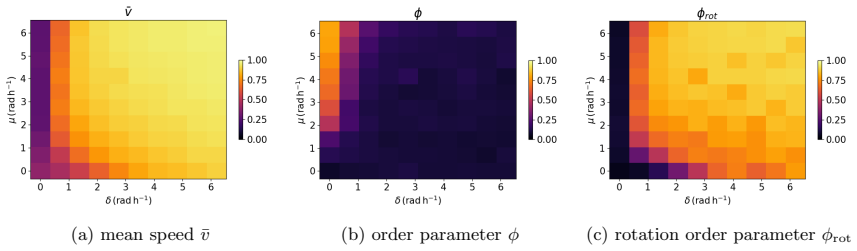
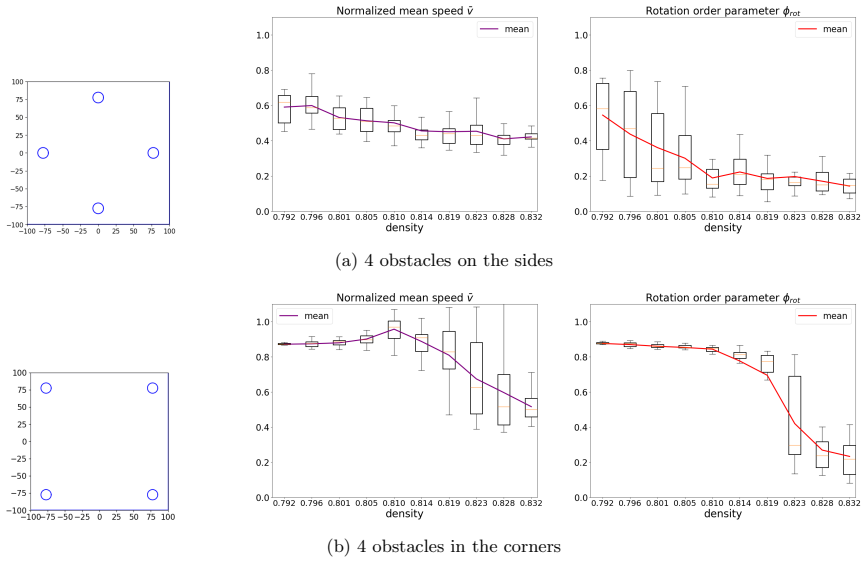
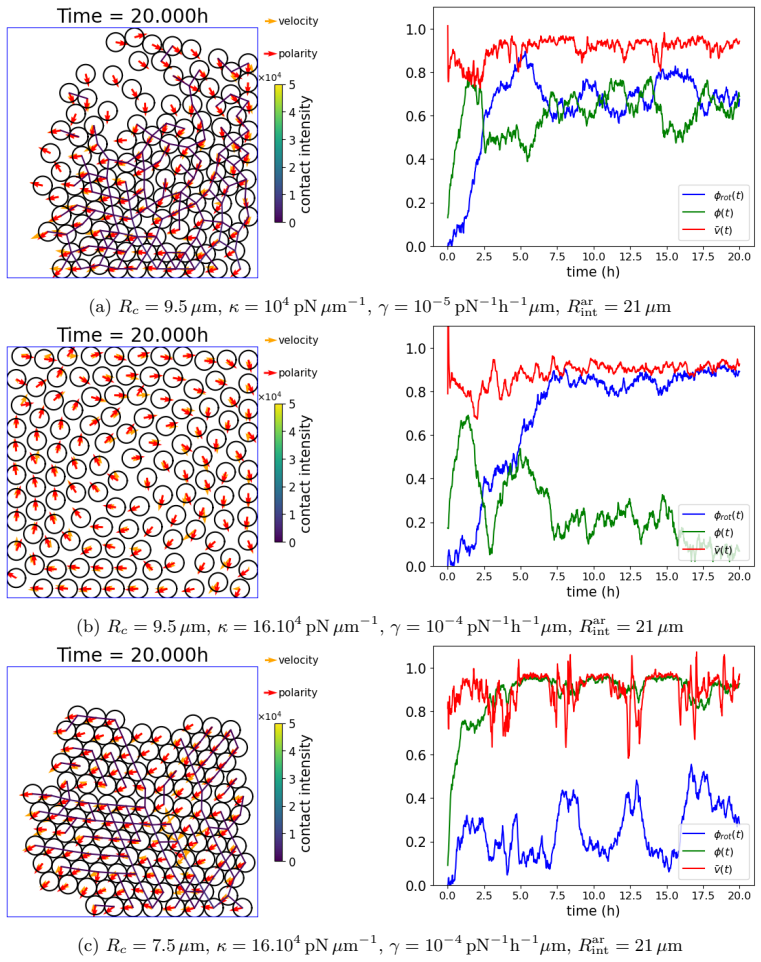
The dynamical system is capable of recovering the order-disorder phase transition of the flock, as well as the jamming effect in high density regimes.
What carries the argument
Agent-based model that combines Vicsek-like polarity alignments with Maury-Venel contact forces, augmented by velocity feedback on polarity and soft attraction-repulsion interactions.
If this is right
- The model produces the expected order-disorder transition when polarity alignment strength is varied.
- Jamming emerges naturally once cell density exceeds a threshold set by the contact forces.
- The discretization permits quantitative exploration of how interaction parameters control collective motion.
- The framework supplies a simulation platform for studying emerging tissue flows driven by cell collectives.
Where Pith is reading between the lines
- The same numerical setup could be used to test how boundary geometry or external flows alter the jamming threshold.
- Varying the relative strength of contact forces versus polarity alignment might map out regimes where flocking persists or collapses in confined domains.
- The well-posedness analysis provides a starting point for adding further biological ingredients such as cell division or adhesion maturation.
Load-bearing premise
The chosen velocity feedback on polarity together with the soft attraction-repulsion interactions produce a well-posed dynamical system that admits an effective numerical discretization.
What would settle it
Numerical runs in which the order-disorder phase transition disappears or in which jamming fails to appear at high densities would refute the central claim.
Figures





read the original abstract
The goal of the present work is to propose an agent-based model that originally combines classical Vicsek-like polarity alignments and contact forces, as implemented in the framework developed by Maury and Venel in [Maury, Venel, 2011]. The description additionally incorporates velocity feedback on polarity and soft attraction-repulsion interactions. After carefully studying the well posedness of the model, we introduce a suitable discretization and perform an extensive range of numerical experiments to assess the impact of different modeling ingredients. The dynamical system is capable of recovering the order-disorder phase transition of the flock, as well as the jamming effect in high density regimes. As such, the developed framework can be seen as a promising theoretical tool that could contribute to improving the understanding of complex collective cell dynamics and emerging tissue flows.
Editorial analysis
A structured set of objections, weighed in public.
Referee Report
Summary. The manuscript proposes an agent-based model for collective cell dynamics that integrates Vicsek-like polarity alignment with contact forces from Maury and Venel (2011), augmented by velocity feedback on polarity and soft attraction-repulsion interactions. After establishing well-posedness, a discretization scheme is introduced and numerical experiments are performed to demonstrate recovery of the order-disorder phase transition of flocking as well as jamming at high densities.
Significance. If the well-posedness result and the numerical recovery of both transitions hold under the stated modeling assumptions, the framework provides a coherent agent-based bridge between flocking and jamming regimes that could inform models of tissue-level flows. The reuse of the Maury-Venel contact-force formulation is a strength that anchors the new ingredients in an existing, validated setting.
major comments (2)
- [Well-posedness analysis] Well-posedness section: the manuscript states that well-posedness was carefully studied prior to discretization, yet no theorem statement, function-space setting, or key a-priori estimates (e.g., on the Lipschitz constants of the combined alignment and contact terms) are supplied; this information is load-bearing for the subsequent claim that the discrete scheme is consistent with a well-defined continuous dynamics.
- [Numerical experiments] Numerical experiments section: the recovery of the Vicsek order-disorder transition and the jamming transition is asserted, but the text gives no quantitative diagnostics (order-parameter curves versus noise strength, density thresholds at which jamming onset is observed, or comparison against the pure Vicsek or pure Maury-Venel baselines), making it impossible to judge how much the added velocity-feedback term contributes to the reported behaviors.
minor comments (2)
- [Abstract] Abstract: the phrase 'originally combines' is ambiguous; replace with 'combines' or 'novelty combines' to clarify the intended contribution.
- [References] References: the citation [Maury, Venel, 2011] must be expanded to a complete bibliographic entry (journal, volume, pages, DOI) in the reference list.
Simulated Author's Rebuttal
We thank the referee for the careful reading and constructive feedback on our manuscript. We address each major comment below and outline the revisions we will implement to strengthen the presentation.
read point-by-point responses
-
Referee: Well-posedness section: the manuscript states that well-posedness was carefully studied prior to discretization, yet no theorem statement, function-space setting, or key a-priori estimates (e.g., on the Lipschitz constants of the combined alignment and contact terms) are supplied; this information is load-bearing for the subsequent claim that the discrete scheme is consistent with a well-defined continuous dynamics.
Authors: We agree that the well-posedness analysis requires a more explicit presentation. Although the continuous model was analyzed in detail before discretization, the manuscript condenses this material. In the revised version we will insert a dedicated theorem stating existence and uniqueness in an appropriate function-space setting (e.g., measures with bounded variation for positions and continuous functions for polarities), together with the principal a-priori estimates, including uniform Lipschitz bounds on the combined alignment, contact-force, and velocity-feedback operators. These additions will directly support the consistency claim for the discrete scheme. revision: yes
-
Referee: Numerical experiments section: the recovery of the Vicsek order-disorder transition and the jamming transition is asserted, but the text gives no quantitative diagnostics (order-parameter curves versus noise strength, density thresholds at which jamming onset is observed, or comparison against the pure Vicsek or pure Maury-Venel baselines), making it impossible to judge how much the added velocity-feedback term contributes to the reported behaviors.
Authors: We acknowledge the need for quantitative diagnostics. The revised manuscript will include (i) plots of the global order parameter versus noise amplitude, (ii) explicit density values at which jamming onset is observed, and (iii) side-by-side comparisons with the pure Vicsek model and the pure Maury-Venel contact-force model. These additions will quantify the incremental effect of the velocity-feedback term and allow readers to assess its role in bridging the two regimes. revision: yes
Circularity Check
No significant circularity; derivation is self-contained
full rationale
The paper constructs an agent-based model by combining the established Vicsek polarity alignment rule with contact forces from the independent Maury-Venel 2011 framework, then augments it with velocity feedback on polarity and soft attraction-repulsion potentials. It first proves well-posedness of the resulting dynamical system, introduces a discretization scheme, and performs numerical experiments whose outcomes (order-disorder transition and high-density jamming) emerge from the integrated dynamics rather than being imposed by construction or fitted parameters. No equation reduces to a self-definition, no prediction is a renamed fit, and the sole external citation is to non-overlapping prior work. The logical chain (model definition → well-posedness → discretization → targeted numerics) therefore remains independent of its target behaviors.
Axiom & Free-Parameter Ledger
Lean theorems connected to this paper
-
IndisputableMonolith/Cost/FunctionalEquation.leanwashburn_uniqueness_aczel unclear?
unclearRelation between the paper passage and the cited Recognition theorem.
V = Proj_CX (cP + γF(X)) ... dθk/dt = μ sin(¯θk−θk) + δ sin(ψk−θk) ... well-posedness via proximal normal cone of Q×RN
-
IndisputableMonolith/Foundation/BranchSelection.leanbranch_selection unclear?
unclearRelation between the paper passage and the cited Recognition theorem.
numerical experiments recover order-disorder phase transition and jamming at high density
What do these tags mean?
- matches
- The paper's claim is directly supported by a theorem in the formal canon.
- supports
- The theorem supports part of the paper's argument, but the paper may add assumptions or extra steps.
- extends
- The paper goes beyond the formal theorem; the theorem is a base layer rather than the whole result.
- uses
- The paper appears to rely on the theorem as machinery.
- contradicts
- The paper's claim conflicts with a theorem or certificate in the canon.
- unclear
- Pith found a possible connection, but the passage is too broad, indirect, or ambiguous to say the theorem truly supports the claim.
Reference graph
Works this paper leans on
-
[1]
F. Al Reda, S. Faure, B. Maury, and E. Pinsard. Faster is slower effect for evacuation processes: a granular standpoint. J. Comput. Phys. , page 112861, 2024
work page 2024
- [2]
- [3]
- [4]
-
[5]
C. Beatrici, C. Kirch, S. Henkes, F. Graner, and L. Brunnet. Comparing individual-based models of collective cell motion in a benchmark flow geometry. Soft Matter , 19(29):5583--5601, 2023
work page 2023
-
[6]
H. Bloch and A. Lefebvre-Lepot. On convex numerical schemes for inelastic contacts with friction. ESAIM Proc. Surveys , 75:24--59, 2023
work page 2023
-
[7]
Differential inclusions with proximal normal cones in banach spaces
Fr \'e d \'e ric Bernicot and Juliette Venel. Differential inclusions with proximal normal cones in banach spaces. J. Convex Anal , 17(2):451--484, 2010
work page 2010
-
[8]
H. Chat \'e , F. Ginelli, G. Gr \'e goire, F. Peruani, and F. Raynaud. Modeling collective motion: variations on the vicsek model. Eur. Phys. J. B , 64:451--456, 2008
work page 2008
- [9]
-
[10]
J.A. Carrillo, Y. Huang, and S. Martin. Explicit flock solutions for quasi-morse potentials. Eur. J. Appl. Math. , 25(5):553--578, 2014
work page 2014
-
[11]
P.G. Ciarlet. Introduction \`a l'analyse num \'e rique matricielle et \`a l'optimisation . Dunod, 2007
work page 2007
-
[12]
M.R. D’Orsogna, Y.-L. Chuang, A.L. Bertozzi, and L.S. Chayes. Self-propelled particles with soft-core interactions: patterns, stability, and collapse. Phys. Rev. Lett. , 96(10):104302, 2006
work page 2006
- [13]
- [14]
- [15]
- [16]
-
[17]
P. Degond, M.A. Ferreira, and S. Motsch. Damped Arrow–Hurwicz algorithm for sphere packing . J. Comput. Phys. , 332:47–65, March 2017
work page 2017
-
[18]
A. Deutsch, P. Friedl, L. Preziosi, and G. Theraulaz. Multi-scale analysis and modelling of collective migration in biological systems. Philos. Trans. R. Soc. B-Biol. Sc. , 375(1807):20190377, 2020
work page 2020
-
[19]
P. Degond and S. Motsch. Continuum limit of self-driven particles with orientation interaction. Math. Models Methods Appl. Sci. , 18(supp01):1193--1215, 2008
work page 2008
-
[20]
L.C. Evans. An introduction to stochastic differential equations , volume 82. American Mathematical Soc., 2012
work page 2012
-
[21]
P. Friedl and D. Gilmour. Collective cell migration in morphogenesis, regeneration and cancer. Nat. Rev. Mol. Cell Biol. , 10(7):445--457, 2009
work page 2009
-
[22]
S. Faure and B. Maury. Crowd motion from the granular standpoint. Math. Models Methods Appl. Sci. , 25(03):463--493, 2015
work page 2015
-
[23]
C. Feliciani, Ke. Shimura, and K. Nishinari. Introduction to crowd management: Managing crowds in the digital era: Theory and Practice . Springer Nature, 2022
work page 2022
-
[24]
D. Helbing, L. Buzna, A. Johansson, and T. Werner. Self-organized pedestrian crowd dynamics: Experiments, simulations, and design solutions. Transportation science , 39(1):1--24, 2005
work page 2005
-
[25]
V. Hakim and P. Silberzan. Collective cell migration: a physics perspective. Rep. Prog. Phys. , 80(7):076601, 2017
work page 2017
-
[26]
D.L. Koch and G. Subramanian. Collective hydrodynamics of swimming microorganisms: living fluids. Annu. Rev. Fluid Mech. , 43(1):637--659, 2011
work page 2011
-
[27]
S. Lo Vecchio, O. Pertz, M. Szopos, L. Navoret, and D. Riveline. Spontaneous rotations in epithelia as an interplay between cell polarity and boundaries. Nat. Phys. , pages 1--10, 2024
work page 2024
-
[28]
B. Maury. A time-stepping scheme for inelastic collisions. Numer. Math. , 102:649--679, 2006
work page 2006
-
[29]
B. Maury. Defective laplacians and paradoxical phenomena in crowd motion modeling. C. R. M \'e ca. , 351(S1):1--32, 2023
work page 2023
-
[30]
M.C. Marchetti, J.-F. Joanny, S. Ramaswamy, T.B. Liverpool, J. Prost, M. Rao, and R.A. Simha. Hydrodynamics of soft active matter. Rev. Modern Phys. , 85(3):1143, 2013
work page 2013
-
[31]
S. Motsch and L. Navoret. Numerical simulations of a nonconservative hyperbolic system with geometric constraints describing swarming behavior. Multiscale Model. Simul. , 9(3):1253--1275, 2011
work page 2011
-
[32]
B. Maury and J. Venel. A discrete contact model for crowd motion. ESAIM Math. Model. Numer. Anal. , 45(1):145--168, 2011
work page 2011
-
[33]
S. Shankar, M.J. Bowick, and M.C. Marchetti. Topological sound and flocking on curved surfaces. Phys. Rev. X , 7(3), September 2017
work page 2017
-
[34]
B. Szab\'o, G. J. Sz\"oll\"osi, B. G\"onci, Zs. Jur\'anyi, D. Selmeczi, and T. Vicsek. Phase transition in the collective migration of tissue cells: Experiment and model. Phys. Rev. E , 74:061908, Dec 2006
work page 2006
- [35]
- [36]
-
[37]
J. Venel. Mod \'e lisation math \'e matique et num \'e rique de mouvements de foule . PhD thesis, Universit \'e Paris Sud-Paris XI, 2008
work page 2008
-
[38]
T. Vicsek and A. Zafeiris. Collective motion. Phys. Rep. , 517(3):71--140, 2012
work page 2012
discussion (0)
Sign in with ORCID, Apple, or X to comment. Anyone can read and Pith papers without signing in.