Structure of the mean-field yrast spectrum of a two-component Bose gas in a ring: role of interaction asymmetry
Pith reviewed 2026-05-16 21:13 UTC · model grok-4.3
The pith
Interaction asymmetry in a two-component Bose gas on a ring changes how plane-wave states become the yrast states.
A machine-rendered reading of the paper's core claim, the machinery that carries it, and where it could break.
Core claim
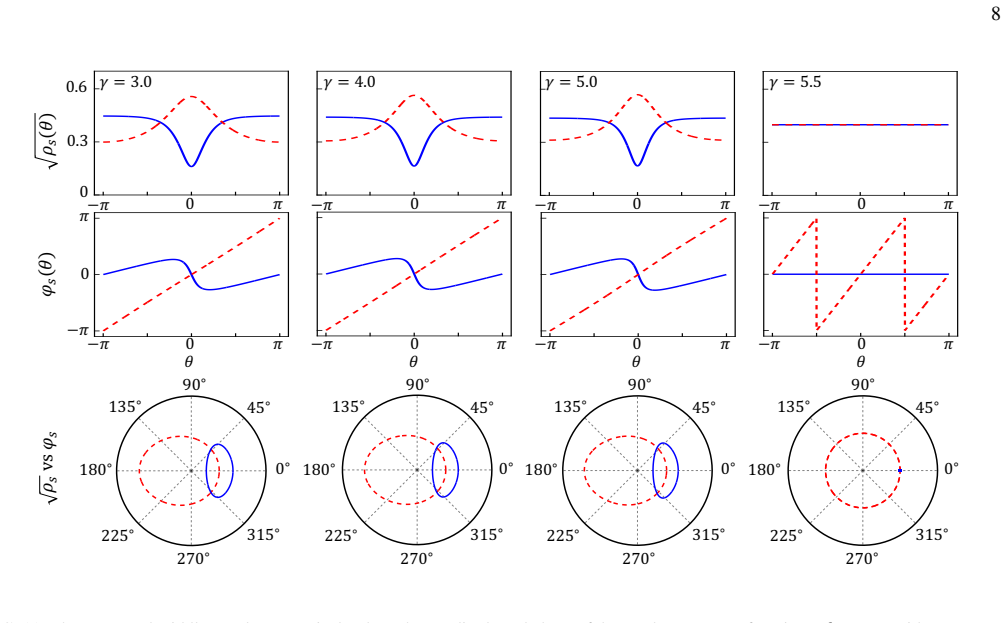
Numerical solutions of the coupled Gross-Pitaevskii equations show that plane-wave yrast states emerge either by continuous replacement of soliton branches when the intra-component interaction strength is smaller than the inter-component strength, or by discrete branch crossings when the intra-component strength is larger; in the latter regime the plane-wave states acquire significantly enhanced stability.
What carries the argument
Coupled Gross-Pitaevskii equations solved numerically for propagating soliton states, from which the energy versus angular-momentum curves and the critical interaction-asymmetry values separating different yrast regimes are extracted.
If this is right
- Plane-wave yrast states exist only for more restricted ranges of angular momentum when intra-component interactions are weaker.
- Branch crossings allow plane-wave states to appear at fractional angular momenta even when soliton states would otherwise remain lower in energy.
- Persistent-current stability is markedly higher when intra-component interactions exceed inter-component interactions.
- The non-analytic features of the yrast spectrum survive asymmetry but change their locations and character.
Where Pith is reading between the lines
- The enhanced stability in the stronger-intra-component regime may allow persistent currents to survive at higher temperatures or larger particle numbers than in the symmetric case.
- The same asymmetry dependence should appear in the spectrum of collective modes around the yrast states.
- Pushing the asymmetry to extreme values recovers the single-component limit, providing a continuous connection between the two known cases.
Load-bearing premise
The mean-field Gross-Pitaevskii equations remain accurate across the full range of interaction asymmetries examined.
What would settle it
A measurement of the yrast energy spectrum in a ring-trapped two-component Bose gas as the ratio of intra- to inter-component scattering lengths is varied, checking for the predicted shift from continuous replacement to branch-crossing transitions at the calculated critical asymmetry values.
Figures



read the original abstract
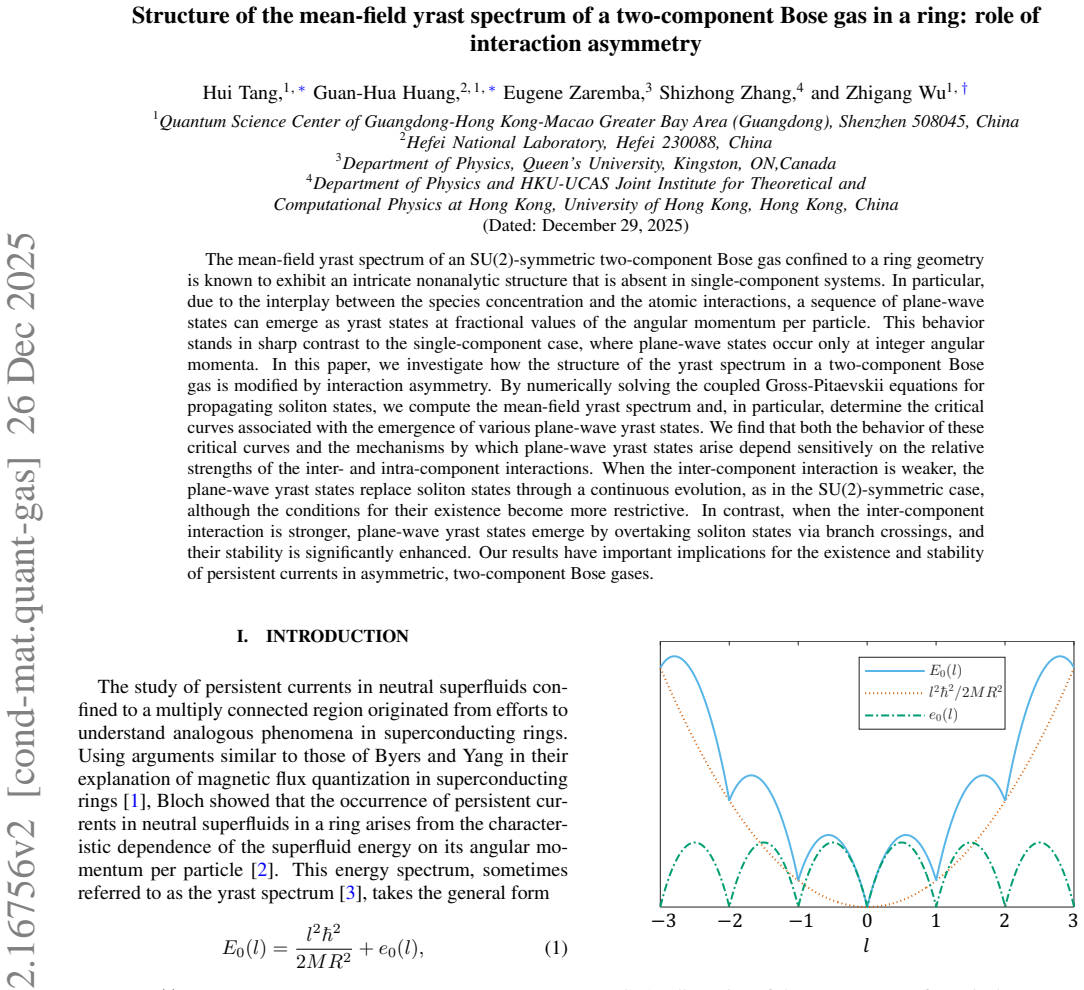
The mean-field yrast spectrum of an SU(2)-symmetric two-component Bose gas confined to a ring geometry is known to exhibit an intricate nonanalytic structure that is absent in single-component systems. In particular, due to the interplay between the species concentration and the atomic interactions, a sequence of plane-wave states can emerge as yrast states at fractional values of the angular momentum per particle. This behavior stands in sharp contrast to the single-component case, where plane-wave states occur only at integer angular momenta. In this paper, we investigate how the structure of the yrast spectrum in a two-component Bose gas is modified by interaction asymmetry. By numerically solving the coupled Gross-Pitaevskii equations for propagating soliton states, we compute the mean-field yrast spectrum and, in particular, determine the critical curves associated with the emergence of various plane-wave yrast states. We find that both the behavior of these critical curves and the mechanisms by which plane-wave yrast states arise depend sensitively on the relative strengths of the inter- and intra-component interactions. When the intra-component interaction is weaker, the plane-wave yrast states replace soliton states through a continuous evolution, as in the SU(2)-symmetric case, although the conditions for their existence become more restrictive. In contrast, when the intra-component interaction is stronger, plane-wave yrast states may emerge by overtaking soliton states via branch crossings, and their stability is significantly enhanced. Our results have important implications for the existence and stability of persistent currents in asymmetric, two-component Bose gases.
Editorial analysis
A structured set of objections, weighed in public.
Referee Report
Summary. The paper examines the mean-field yrast spectrum of a two-component Bose gas in a ring geometry when the intra- and inter-component interaction strengths are asymmetric. By numerically propagating soliton initial conditions in the coupled Gross-Pitaevskii equations, the authors compute the lowest-energy curves E(L) and identify critical curves separating regions where plane-wave states appear as yrast states at fractional angular momenta. They report that the topology of these curves and the mechanism of plane-wave emergence (continuous replacement of solitons versus overtaking via branch crossings) depend sensitively on whether the intra-component interaction is weaker or stronger than the inter-component interaction, with the latter case also yielding enhanced stability.
Significance. If the numerical results hold under convergence checks, the work extends the known SU(2)-symmetric yrast structure to the asymmetric regime and supplies concrete predictions for the stability of persistent currents in two-component ring condensates. The distinction between continuous evolution and branch-crossing mechanisms is a clear, falsifiable outcome of the mean-field model.
major comments (2)
- [Numerical methods / Results] The central distinction between continuous replacement and branch-crossing mechanisms (abstract and results section) rests on the precise topology of the numerically obtained E(L) branches. No spatial discretization (grid points per ring), time-step size, or convergence tests with respect to these parameters are reported, so it is not possible to assess whether small numerical errors could convert an avoided crossing into an apparent crossing or vice versa.
- [Results on critical curves] The claim of 'significantly enhanced' stability when intra-component interactions are stronger is stated without quantitative support such as the magnitude of the energy gap at the crossing point or a linear-stability analysis of the plane-wave states (e.g., Bogoliubov-de Gennes spectrum).
minor comments (1)
- [Abstract] The abstract refers to 'the range of interaction asymmetries studied' but does not quote the specific ratios g11/g12 and g22/g12 that were scanned; adding these values would help readers reproduce the critical curves.
Simulated Author's Rebuttal
We are grateful to the referee for their thorough review and valuable suggestions, which have helped us improve the clarity and rigor of our manuscript. Below, we provide detailed responses to each major comment and outline the revisions we will make.
read point-by-point responses
-
Referee: [Numerical methods / Results] The central distinction between continuous replacement and branch-crossing mechanisms (abstract and results section) rests on the precise topology of the numerically obtained E(L) branches. No spatial discretization (grid points per ring), time-step size, or convergence tests with respect to these parameters are reported, so it is not possible to assess whether small numerical errors could convert an avoided crossing into an apparent crossing or vice versa.
Authors: We fully agree that providing the numerical discretization parameters and convergence tests is crucial to substantiate the reported topologies of the E(L) branches. In the revised version of the manuscript, we will include these details: we use a spatial grid with 1024 points around the ring, a time step of 0.0001 in the imaginary-time propagation, and we have performed convergence checks by doubling the grid size and halving the time step, confirming that the locations of branch crossings and the continuous replacement mechanisms are unchanged within numerical precision. This ensures that the distinction between the mechanisms is not affected by discretization errors. revision: yes
-
Referee: [Results on critical curves] The claim of 'significantly enhanced' stability when intra-component interactions are stronger is stated without quantitative support such as the magnitude of the energy gap at the crossing point or a linear-stability analysis of the plane-wave states (e.g., Bogoliubov-de Gennes spectrum).
Authors: We appreciate this comment and recognize that a quantitative assessment would better support our statement on enhanced stability. In the revised manuscript, we will add quantitative data on the energy gaps at the relevant crossing points for different interaction asymmetries. Additionally, we will include results from a Bogoliubov-de Gennes linear stability analysis applied to the plane-wave states, demonstrating that the lowest excitation frequencies are higher (indicating greater stability) in the regime where intra-component interactions exceed inter-component ones. These additions will provide the requested quantitative support. revision: yes
Circularity Check
No circularity in numerical yrast spectrum computation
full rationale
The paper derives its central claims about critical curves and plane-wave yrast emergence mechanisms solely from direct numerical propagation of soliton initial conditions in the coupled Gross-Pitaevskii equations on a ring. No load-bearing step reduces to a self-definition, a fitted parameter renamed as a prediction, or a self-citation chain; the SU(2)-symmetric reference supplies background only and is not invoked to force the asymmetric results. The derivation chain is therefore self-contained against external numerical benchmarks.
Axiom & Free-Parameter Ledger
free parameters (1)
- relative intra- versus inter-component interaction strengths
axioms (1)
- domain assumption Mean-field Gross-Pitaevskii equations accurately describe the two-component Bose gas in a ring
Lean theorems connected to this paper
-
IndisputableMonolith/Cost/FunctionalEquation.leanwashburn_uniqueness_aczel unclear?
unclearRelation between the paper passage and the cited Recognition theorem.
By numerically solving the coupled Gross-Pitaevskii equations for propagating soliton states, we compute the mean-field yrast spectrum and, in particular, determine the critical curves associated with the emergence of various plane-wave yrast states.
What do these tags mean?
- matches
- The paper's claim is directly supported by a theorem in the formal canon.
- supports
- The theorem supports part of the paper's argument, but the paper may add assumptions or extra steps.
- extends
- The paper goes beyond the formal theorem; the theorem is a base layer rather than the whole result.
- uses
- The paper appears to rely on the theorem as machinery.
- contradicts
- The paper's claim conflicts with a theorem or certificate in the canon.
- unclear
- Pith found a possible connection, but the passage is too broad, indirect, or ambiguous to say the theorem truly supports the claim.
Reference graph
Works this paper leans on
-
[1]
N. Byers and C. N. Yang, Theoretical considerations concern- ing quantized magnetic flux in superconducting cylinders, Phys. Rev. Lett.7, 46 (1961)
work page 1961
-
[2]
Bloch, Superfluidity in a ring, Phys
F. Bloch, Superfluidity in a ring, Phys. Rev. A7, 2187 (1973)
work page 1973
-
[3]
Mottelson, Yrast spectra of weakly interacting bose-einstein condensates, Phys
B. Mottelson, Yrast spectra of weakly interacting bose-einstein condensates, Phys. Rev. Lett.83, 2695 (1999)
work page 1999
-
[4]
B. S. Deaver and W. M. Fairbank, Experimental evidence for quantized flux in superconducting cylinders, Phys. Rev. Lett.7, 43 (1961)
work page 1961
-
[5]
R. Doll and M. N ¨abauer, Experimental proof of magnetic flux quantization in a superconducting ring, Phys. Rev. Lett.7, 51 (1961)
work page 1961
-
[6]
C. Ryu, M. F. Andersen, P. Clad ´e, V . Natarajan, K. Helmer- son, and W. D. Phillips, Observation of persistent flow of a bose-einstein condensate in a toroidal trap, Phys. Rev. Lett.99, 260401 (2007)
work page 2007
-
[7]
A. Ramanathan, K. C. Wright, S. R. Muniz, M. Zelan, W. T. Hill, C. J. Lobb, K. Helmerson, W. D. Phillips, and G. K. Camp- bell, Superflow in a toroidal bose-einstein condensate: An atom circuit with a tunable weak link, Phys. Rev. Lett.106, 130401 (2011)
work page 2011
-
[8]
S. Moulder, S. Beattie, R. P. Smith, N. Tammuz, and Z. Hadz- ibabic, Quantized supercurrent decay in an annular bose- einstein condensate, Phys. Rev. A86, 013629 (2012)
work page 2012
-
[9]
S. Beattie, S. Moulder, R. J. Fletcher, and Z. Hadzibabic, Per- sistent currents in spinor condensates, Phys. Rev. Lett.110, 025301 (2013)
work page 2013
-
[10]
K. C. Wright, R. B. Blakestad, C. J. Lobb, W. D. Phillips, and G. K. Campbell, Driving phase slips in a superfluid atom circuit with a rotating weak link, Phys. Rev. Lett.110, 025302 (2013)
work page 2013
-
[11]
Y . Cai, D. G. Allman, P. Sabharwal, and K. C. Wright, Persis- tent currents in rings of ultracold fermionic atoms, Phys. Rev. Lett.128, 150401 (2022)
work page 2022
-
[12]
G. Del Pace, K. Xhani, A. Muzi Falconi, M. Fedrizzi, N. Grani, D. Hernandez Rajkov, M. Inguscio, F. Scazza, W. J. Kwon, and G. Roati, Imprinting persistent currents in tunable fermionic rings, Phys. Rev. X12, 041037 (2022)
work page 2022
-
[13]
J. Polo, W. Chetcuti, T. Haug, A. Minguzzi, K. Wright, and L. Amico, Persistent currents in ultracold gases, Physics Re- ports1137, 1 (2025), persistent currents in ultracold gases
work page 2025
-
[14]
Y . Kawaguchi and M. Ueda, Spinor bose–einstein condensates, Physics Reports520, 253 (2012), spinor Bose–Einstein conden- sates
work page 2012
- [15]
-
[16]
J. Smyrnakis, S. Bargi, G. M. Kavoulakis, M. Magiropou- los, K. K ¨arkk¨ainen, and S. M. Reimann, Mixtures of bose gases confined in a ring potential, Phys. Rev. Lett.103, 100404 (2009)
work page 2009
-
[17]
K. Anoshkin, Z. Wu, and E. Zaremba, Persistent currents in a bosonic mixture in the ring geometry, Phys. Rev. A88, 013609 10 (2013)
work page 2013
- [18]
-
[19]
M. Abad, A. Sartori, S. Finazzi, and A. Recati, Persistent cur- rents in two-component condensates in a toroidal trap, Phys. Rev. A89, 053602 (2014)
work page 2014
-
[20]
Z. Wu, E. Zaremba, J. Smyrnakis, M. Magiropoulos, N. K. Efremidis, and G. M. Kavoulakis, Mean-field yrast spectrum and persistent currents in a two-component bose gas with inter- action asymmetry, Phys. Rev. A92, 033630 (2015)
work page 2015
- [21]
-
[22]
J. Smyrnakis, M. Magiropoulos, N. K. Efremidis, and G. M. Kavoulakis, Persistent currents in a two-component bose–einstein condensate confined in a ring potential, Journal of Physics B: Atomic, Molecular and Optical Physics47, 215302 (2014)
work page 2014
- [23]
-
[24]
E. T. D. Matsushita and E. J. V . de Passos, Mixture of two ultra cold bosonic atoms confined in a ring: stability and persistent currents, Journal of Physics Communications2, 035023 (2018)
work page 2018
-
[25]
A. Roussou, J. Smyrnakis, M. Magiropoulos, N. K. Efremidis, G. M. Kavoulakis, P. Sandin, M. ¨Ogren, and M. Gulliksson, Excitation spectrum of a mixture of two bose gases confined in a ring potential with interaction asymmetry, New Journal of Physics20, 045006 (2018)
work page 2018
discussion (0)
Sign in with ORCID, Apple, or X to comment. Anyone can read and Pith papers without signing in.