MCPlas, a MATLAB toolbox for reproducible plasma modelling with COMSOL
Pith reviewed 2026-05-16 20:38 UTC · model grok-4.3
The pith
MCPlas toolbox generates transparent fluid-Poisson plasma models in COMSOL from JSON data.
A machine-rendered reading of the paper's core claim, the machinery that carries it, and where it could break.
Core claim
MCPlas supplies MATLAB functions that translate structured JSON plasma kinetic data into COMSOL equation-based fluid-Poisson models, incorporating flexible electron transport and boundary conditions across one- and two-dimensional Cartesian, polar, and cylindrical geometries. When applied to low-pressure DC and RF argon discharges, the resulting simulations match outputs from COMSOL's Plasma Module, confirming implementation reliability and illustrating the impact of the chosen transport treatment.
What carries the argument
The MCPlas toolbox of editable MATLAB functions that convert JSON-formatted plasma data into COMSOL equation-based fluid-Poisson simulations.
If this is right
- Complex reaction sets can be managed by direct editing of the JSON input files.
- Input data remain reusable across different simulation platforms through the shared JSON schema.
- The transparent MATLAB code lets users inspect and alter every equation and boundary condition.
- Verification against the Plasma Module establishes baseline reliability for low-pressure argon cases.
Where Pith is reading between the lines
- Adoption of the same JSON format could simplify data exchange between plasma codes written in different environments.
- The explicit code structure may reduce hidden implementation errors when users extend models to new gases or pressures.
- Similar automation layers could be built for other multiphysics solvers once the JSON schema is fixed.
- Extensions to three-dimensional geometries would follow directly from the existing coordinate handling.
Load-bearing premise
The fluid-Poisson approximation with the selected electron transport description and boundary conditions sufficiently represents the physics of the tested low-pressure glow discharges.
What would settle it
A clear mismatch between MCPlas-generated results and either the Plasma Module or measured data on a well-documented argon discharge would show the model fails to capture the intended physics.
Figures




read the original abstract
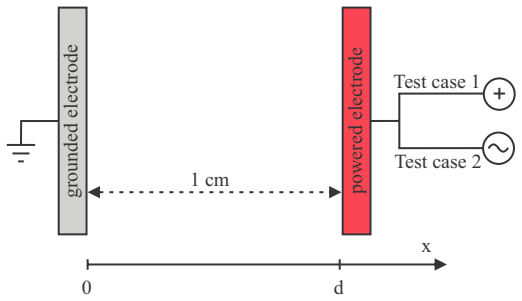
The MCPlas toolbox represents a collection of MATLAB functions for the automated generation of an equation-based fluid-Poisson model for non-thermal plasmas in the multiphysics simulation software COMSOL. Following the development of the new generation of the LXCat platform, all input data are prepared in a structured and interoperable JSON format and can be supplied and validated using existing JSON schemas. The toolbox includes fully transparent, editable MATLAB source code and offers an advanced description of electron transport in addition to commonly used approaches in the plasma modelling community. It supports one-dimensional and two-dimensional modelling geometries employing Cartesian, polar and cylindrical coordinate systems. MCPlas is tested on two reference cases: DC- and RF-driven low-pressure glow discharges in argon. Comparison of MCPlas results with results obtained by employing COMSOL's Plasma Module verifies the reliability of the plasma model implemented by MCPlas and demonstrates the significance of electron transport treatment and boundary conditions applied in the toolbox. Using the same examples, the easy handling of complex reaction kinetic models in MCPlas and the reusability of its JSON input data across different modelling platforms are illustrated. This demonstrates that MCPlas provides a transparent and reproducible workflow for the simulation of non-thermal plasmas using COMSOL.
Editorial analysis
A structured set of objections, weighed in public.
Referee Report
Summary. The paper presents MCPlas, a MATLAB toolbox that automates generation of equation-based fluid-Poisson models for non-thermal plasmas inside COMSOL. Input data are supplied in structured JSON format from the LXCat platform; the toolbox supports advanced electron transport closures, 1D/2D geometries in Cartesian/polar/cylindrical coordinates, and is demonstrated on DC- and RF-driven low-pressure argon glow discharges. Results are compared to COMSOL's Plasma Module to verify reliability of the implemented model and to illustrate the role of transport treatment and boundary conditions; reusability of the JSON kinetics data across platforms is also shown.
Significance. A transparent, editable MATLAB implementation with reusable JSON reaction data could improve reproducibility and ease of modification in the plasma-modeling community, particularly for users who prefer equation-based COMSOL workflows over the built-in Plasma Module. The provision of an advanced electron-transport description is potentially useful, but its practical advantage remains to be quantified.
major comments (3)
- [Abstract] Abstract and verification section: the statement that comparison with COMSOL's Plasma Module 'verifies the reliability of the plasma model implemented by MCPlas' is circular. Because MCPlas constructs equation-based models inside the identical COMSOL environment and draws from the same LXCat JSON data, agreement on the DC and RF argon cases primarily confirms consistent equation setup and boundary-condition implementation rather than independent validation of the fluid-Poisson closure or chosen transport coefficients.
- [Verification] Verification section: no quantitative discrepancy metrics (L2 norms, maximum relative errors, or point-wise differences on ne, Te, or E profiles) are reported for the two reference cases. Only qualitative agreement is stated, which prevents readers from judging the numerical fidelity of the generated models.
- [Electron transport] Electron-transport discussion: the claim that the toolbox 'demonstrates the significance of electron transport treatment' is not supported by explicit side-by-side comparisons (e.g., figures or tables) showing how the advanced description alters discharge characteristics relative to the standard mobility/diffusion approach on the same DC/RF cases.
minor comments (2)
- [Abstract] The abstract states that 'fully transparent, editable MATLAB source code' is included, yet no repository URL, supplementary-material link, or licensing statement is provided.
- [Figures] All comparison figures should include quantitative axis scales, error bars or difference plots, and clear legends distinguishing MCPlas from Plasma Module results.
Simulated Author's Rebuttal
We thank the referee for the constructive and detailed comments on our manuscript. We have addressed each major point below and will revise the paper accordingly to improve clarity and rigor.
read point-by-point responses
-
Referee: [Abstract] Abstract and verification section: the statement that comparison with COMSOL's Plasma Module 'verifies the reliability of the plasma model implemented by MCPlas' is circular. Because MCPlas constructs equation-based models inside the identical COMSOL environment and draws from the same LXCat JSON data, agreement on the DC and RF argon cases primarily confirms consistent equation setup and boundary-condition implementation rather than independent validation of the fluid-Poisson closure or chosen transport coefficients.
Authors: We agree that the comparison primarily confirms consistent implementation of equations and boundary conditions within the same COMSOL framework rather than providing independent validation of the fluid-Poisson model. In the revised manuscript we will rephrase the abstract and verification section to state that the agreement demonstrates correct setup of the generated models and boundary conditions, without claiming independent verification of the underlying physics or transport coefficients. revision: yes
-
Referee: [Verification] Verification section: no quantitative discrepancy metrics (L2 norms, maximum relative errors, or point-wise differences on ne, Te, or E profiles) are reported for the two reference cases. Only qualitative agreement is stated, which prevents readers from judging the numerical fidelity of the generated models.
Authors: We acknowledge the absence of quantitative metrics. The revised version will include L2 norms and maximum relative errors for electron density, electron temperature, and electric field profiles for both DC and RF cases. These metrics will be added to the verification section, accompanied by a table summarizing the discrepancies to allow readers to assess numerical fidelity. revision: yes
-
Referee: [Electron transport] Electron-transport discussion: the claim that the toolbox 'demonstrates the significance of electron transport treatment' is not supported by explicit side-by-side comparisons (e.g., figures or tables) showing how the advanced description alters discharge characteristics relative to the standard mobility/diffusion approach on the same DC/RF cases.
Authors: We agree that explicit side-by-side comparisons are required to substantiate the claim. The revised manuscript will add dedicated figures and/or tables directly comparing results obtained with the advanced electron transport description versus the standard mobility/diffusion approach for the same DC and RF argon cases, quantifying the differences in key discharge parameters such as density and temperature profiles. revision: yes
Circularity Check
No circularity: software verification against external COMSOL module
full rationale
The paper describes a MATLAB toolbox (MCPlas) that generates equation-based fluid-Poisson models inside COMSOL and verifies correctness by direct numerical comparison against COMSOL's built-in Plasma Module on reference DC and RF argon cases. No derivation chain, first-principles predictions, parameter fitting presented as prediction, or self-citation load-bearing steps exist. The comparison serves as an external benchmark within the shared platform, and the central claim of providing a transparent, reusable workflow is self-contained against that benchmark without reducing to its own inputs by construction.
Axiom & Free-Parameter Ledger
axioms (1)
- domain assumption Fluid approximation remains valid for the low-pressure argon glow discharges considered
Lean theorems connected to this paper
-
IndisputableMonolith/Foundation/AbsoluteFloorClosure.leanreality_from_one_distinction unclear?
unclearRelation between the paper passage and the cited Recognition theorem.
MCPlas ... automated generation of an equation-based fluid-Poisson model ... JSON format ... comparison with COMSOL's Plasma Module verifies the reliability
-
IndisputableMonolith/Cost/FunctionalEquation.leanwashburn_uniqueness_aczel unclear?
unclearRelation between the paper passage and the cited Recognition theorem.
three different drift-diffusion approximations ... novel DDAn ... J-cost not mentioned
What do these tags mean?
- matches
- The paper's claim is directly supported by a theorem in the formal canon.
- supports
- The theorem supports part of the paper's argument, but the paper may add assumptions or extra steps.
- extends
- The paper goes beyond the formal theorem; the theorem is a base layer rather than the whole result.
- uses
- The paper appears to rely on the theorem as machinery.
- contradicts
- The paper's claim conflicts with a theorem or certificate in the canon.
- unclear
- Pith found a possible connection, but the passage is too broad, indirect, or ambiguous to say the theorem truly supports the claim.
Reference graph
Works this paper leans on
-
[1]
G. Colonna, A. D’Angola, Plasma Modeling (Second Edition), IOP Publishing, UK, Bristol, 2022.doi:10.1088/978-0-7503-3559-1. URLhttps://store.ioppublishing.org/page/detail/ Plasma-Modeling-Second-Edition/?K=9780750335577
-
[2]
L. L. Alves, L. Marques, Fluid modelling of capacitively coupled radio- frequency discharges: a review, Plasma Phys. Control. Fusion 54 (12) (2012) 124012.doi:10.1088/0741-3335/54/12/124012. URLhttps://dx.doi.org/10.1088/0741-3335/54/12/124012
-
[3]
M. M. Becker, T. Hoder, R. Brandenburg, D. Loffhagen, Analysis of microdischarges in asymmetric dielectric barrier discharges in argon, J. Phys. D: Appl. Phys. 46 (35) (2013) 355203.doi:10.1088/0022-3727/ 46/35/355203. URLhttps://doi.org/10.1088/0022-3727/46/35/355203
-
[4]
A. H. Markosyan, J. Teunissen, S. Dujko, U. Ebert, Comparing plasma fluid models of different order for 1D streamer ionization fronts, Plasma Sources Sci. Technol. 24 (6) (2015) 065002.doi:10.1088/0963-0252/ 24/6/065002. URLhttps://dx.doi.org/10.1088/0963-0252/24/6/065002
-
[5]
L. L. Alves, A. Bogaerts, V. Guerra, M. M. Turner, Foundations of modelling of nonequilibrium low-temperature plasmas, Plasma Sources Sci. Technol. 27 (2) (2018) 023002.doi:10.1088/1361-6595/aaa86d. URLhttps://dx.doi.org/10.1088/1361-6595/aaa86d
-
[6]
M. Stankov, M. M. Becker, R. Bansemer, K.-D. Weltmann, D. Loffha- gen, Influence of surface parameters on dielectric-barrier discharges in argon at subatmospheric pressure, Plasma Sources Sci. Technol. 29 (12) (2020) 125009.doi:10.1088/1361-6595/abc5a3. URLhttps://dx.doi.org/10.1088/1361-6595/abc5a3
-
[7]
W. Wang, T. Butterworth, A. Bogaerts, Plasma propagation in a single bead DBD reactor at different dielectric constants: insights from fluid modelling, J. Phys. D: Appl. Phys. 54 (21) (2021) 214004.doi:10. 1088/1361-6463/abe8ff. URLhttps://dx.doi.org/10.1088/1361-6463/abe8ff 33
-
[8]
M. Stankov, M. M. Becker, T. Hoder, D. Loffhagen, Extended reaction kinetics model for non-thermal argon plasmas and its test against ex- perimental data, Plasma Sources Sci. Technol. 31 (12) (2022) 125002. doi:10.1088/1361-6595/ac9332. URLhttps://dx.doi.org/10.1088/1361-6595/ac9332
-
[9]
D. Levko, L. L. Raja, Computational analysis of electrical breakdown of SF6/N2 mixtures, J. Appl. Phys. 133 (5) (2023) 053301.doi:10.1063/ 5.0131780. URLhttps://doi.org/10.1063/5.0131780
-
[10]
A. Bogaerts, R. Gijbels, J. Vlcek, Collisional-radiative model for an argon glow discharge, J. Appl. Phys. 84 (1) (1998) 121.doi:10.1063/ 1.368009. URLhttps://doi.org/10.1063/1.368009
-
[11]
PLASIMOPlasmaSimulation&Modelling, PlasmaMattersB.V., Eind- hoven, The Netherlands,https://plasma-matters.nl/(2025)
work page 2025
-
[12]
J. van Dijk, K. Peerenboom, M. Jimenez, D. Mihailova, J. van der Mullen, The plasma modelling toolkit plasimo, J. Phys. D: Appl. Phys. 42 (19) (2009) 4012.doi:10.1088/0022-3727/42/19/194012. URLhttps://doi.org/10.1088/0022-3727/42/19/194012
-
[13]
COMSOL Multiphysics ® v.6.2 COMSOL AB, Stockholm, Sweden, https://www.comsol.com/(2023)
work page 2023
- [14]
-
[15]
OverViz TM, Fremont, California, USA,https://www.lamresearch. com/products/overviz/(2025)
work page 2025
-
[16]
I. Rafatov, E. A. Bogdanov, A. A. Kudryavtsev, On the accuracy and reliability of different fluid models of the direct current glow discharge, Phys. Plasmas 19 (3) (2012) 033502.doi:10.1063/1.3688875. URLhttps://doi.org/10.1063/1.3688875
-
[17]
H. Li, Y. Liu, Y.-R. Zhang, F. Gao, Y.-N. Wang, Nonlocal electron ki- netics and spatial transport in radio-frequency two-chamber inductively coupled plasmas with argon discharges, J. Appl. Phys 121 (23) (2017) 34 233302.doi:10.1063/1.4986495. URLhttps://doi.org/10.1063/1.4986495
-
[18]
M. Baeva, F. Hempel, H. Baierl, T. Trautvetter, R. Foest, D. Loffhagen, Two- and three-dimensional simulation analysis of microwave excited plasma for deposition applications: operation with argon at atmospheric pressure, J. Phys. D: Appl. Phys. 51 (38) (2018) 385202.doi:10.1088/ 1361-6463/aad537. URLhttps://dx.doi.org/10.1088/1361-6463/aad537
-
[19]
T. Murakami, O. Sakai, Rescaling the complex network of low- temperature plasma chemistry through graph-theoretical analysis, Plasma Sources Sci. Technol. 29 (11) (2020) 115018.doi:10.1088/ 1361-6595/abbdca. URLhttps://dx.doi.org/10.1088/1361-6595/abbdca
-
[20]
T. N. Terentev, A. Y. Shemakhin, E. S. Samsonova, V. S. Zheltukhin, Frequency dependencies of the characteristics of an inductively coupled radiofrequency discharge at reduced pressure, Plasma Sources Sci. Tech- nol. 31 (9) (2022) 094005.doi:10.1088/1361-6595/ac8dba. URLhttps://dx.doi.org/10.1088/1361-6595/ac8dba
-
[21]
A. K. Bose, D. Maddipatla, M. Z. Atashbar, 2-d finite-element modeling of surface dielectric barrier plasma discharge devices to understand the influence of design parameters on sterilization applications, IEEE Trans. Plasma Sci. 50 (4) (2022) 841.doi:10.1109/TPS.2022.3156031. URLhttps://ieeexplore.ieee.org/document/9737727
-
[22]
S. Datta, J. G. Han, R. Kumar, B. B. Sahu, Experimental studies and COMSOL 1-D simulation in Ar capacitively coupled plasmas, AIP Adv. 14 (1) (2024) 015046.doi:10.1063/5.0174990. URLhttps://doi.org/10.1063/5.0174990
-
[23]
M. M. Becker, H. Kählert, A. Sun, M. Bonitz, D. Loffhagen, Ad- vanced fluid modeling and PIC/MCC simulations of low-pressure ccrf discharges, Plasma Sources Sci. Technol. 26 (4) (2017) 044001. doi:10.1088/1361-6595/aa5cce. URLhttps://iopscience.iop.org/article/10.1088/1361-6595/ aa5cce 35
-
[24]
I. L. Semenov, Moment fluid equations for ions in weakly ionized plasma, Phys. Rev. E 95 (2017) 043208.doi:10.1103/PhysRevE.95.043208. URLhttps://link.aps.org/doi/10.1103/PhysRevE.95.043208
-
[25]
MATLAB™ R2023b Natick, MA, USA,https://www.mathworks.com/ (2023)
work page 2023
-
[26]
A.P.Jovanović, M.N.Stankov, D.Loffhagen, M.M.Becker, Automated fluid model generation and numerical analysis of dielectric barrier dis- charges using comsol, IEEE Trans. Plasma Sci. 49 (11) (2021) 3710. doi:10.1109/TPS.2021.3120507. URLhttps://doi.org/10.1109/TPS.2021.3120507
-
[27]
B. Bagheri, J. Teunissen, U. Ebert, M. M. Becker, S. Chen, O. Ducasse, O. Eichwald, D. Loffhagen, A. Luque, D. Mihailova, J. M. Plewa, J. van Dijk, M. Yousfi, Comparison of six simulation codes for positive streamers in air, Plasma Sources Sci. Technol. 27 (9) (2018) 095002. doi:10.1088/1361-6595/aad768. URLhttps://iopscience.iop.org/article/10.1088/1361-...
-
[28]
L. L. Alves, M. M. Becker, J. van Dijk, T. Gans, D. B. Go, K. Stapel- mann, J. Tennyson, M. M. Turner, M. J. Kushner, Foundations of plasma standards, Plasma Sources Science and Technology 32 (2) (2023) 023001.doi:10.1088/1361-6595/acb810. URLhttps://doi.org/10.1088/1361-6595/acb810
-
[29]
E. Carbone, W. Graef, G. Hagelaar, D. Boer, M. M. Hopkins, J. C. Stephens, B. T. Yee, S. Pancheshnyi, J. van Dijk, L. Pitchford, Data needs for modeling low-temperature non-equilibrium plasmas: The LX- Cat project, history, perspectives and a tutorial, Atoms 9 (1) (2021) 1. doi:10.3390/atoms9010016. URLhttps://www.mdpi.com/2218-2004/9/1/16
-
[30]
"Introducing JSON",https://www.json.org, last accessed 16 April 2024
work page 2024
-
[31]
Ben, Beginning JSON, Apress, USA, New York, 2015
S. Ben, Beginning JSON, Apress, USA, New York, 2015. URLhttps://link.springer.com/book/10.1007/ 978-1-4842-0202-9 36
work page 2015
-
[32]
D. Boer, S. Verhoeven, S. Ali, W. Graef, J. Dijk, LXCat (2024).doi: 10.5281/zenodo.13771593. URLhttps://doi.org/10.5281/zenodo.13771593
-
[33]
D. Boer, S. Verhoeven, S. Ali, W. Graef, J. van Dijk, LXCat,https: //github.com/LXCat-project/LXCat, accessed 12-2025 (2025)
work page 2025
-
[34]
M. D. Wilkinson, M. Dumontier, I. J. Aalbersberg, G. Appleton, M. Axton, A. Baak, N. Blomberg, J.-W. Boiten, L. B. da Silva San- tos, P. E. Bourne, J. Bouwman, A. J. Brookes, T. Clark, M. Crosas, I. Dillo, O. Dumon, S. Edmunds, C. T. Evelo, R. Finkers, A. Gonzalez- Beltran, A. J. G. Gray, P. Groth, C. Goble, J. S. Grethe, J. Heringa, P. A. C. ’T Hoen, R. ...
-
[35]
D. P. Lymberopoulos, D. J. Economou, Fluid simulations of glow dis- charges: Effectofmetastable atoms inargon, J.Appl.Phys73(8)(1993) 3668.doi:10.1063/1.352926. URLhttps://doi.org/10.1063/1.352926
-
[36]
F. Sigeneger, R. Winkler, Nonlocal transport and dissipation properties of electrons in inhomogeneous plasmas, IEEE Trans. Plasma Sci. 27 (5) (1999) 1254.doi:10.1109/27.799801. URLhttps://ieeexplore.ieee.org/document/799801
-
[37]
G. K. Grubert, M. M. Becker, D. Loffhagen, Why the local-mean-energy approximation should be used in hydrodynamic plasma descriptions in- stead of the local-field approximation, Phys. Rev. E 80 (2009) 036405. doi:10.1103/PhysRevE.80.036405. URLhttps://doi.org/10.1103/PhysRevE.80.036405
-
[38]
M. M. Becker, D. Loffhagen, Enhanced reliability of drift-diffusion ap- proximation for electrons in fluid models for nonthermal plasmas, AIP 37 Adv. 3 (1) (2013) 012108.doi:10.1063/1.4775771. URLhttp://dx.doi.org/10.1063/1.4775771
-
[39]
M. M. Becker, D. Loffhagen, Derivation of moment equations for the theoretical description of electrons in nonthermal plasmas, Adv. Pure Math. 3 (3) (2013) 343.doi:10.4236/apm.2013.33049. URLhttps://dx.doi.org/10.4236/apm.2013.33049
-
[40]
M. Baeva, D. Loffhagen, M. M. Becker, D. Uhrlandt, Fluid mod- elling of DC argon microplasmas: Effects of the electron transport description, Plasma Chem. Plasma Process. 39 (4) (2019) 949. doi:10.1007/s11090-019-09994-5. URLhttps://link.springer.com/article/10.1007/ s11090-019-09994-5
-
[41]
G. J. M. Hagelaar, F. J. de Hoog, G. M. W. Kroesen, Boundary condi- tions in fluid models of gas discharges, Phys. Rev. E 62 (1) (2000) 1452. doi:10.1103/PhysRevE.62.1452. URLhttp://adsabs.harvard.edu/abs/2000PhRvE..62.1452H
-
[42]
Plasma Module User’s Guide,https://doc.comsol.com/6.2/doc/ com.comsol.help.plasma/PlasmaModuleUsersGuide.pdf(2023)
work page 2023
-
[43]
The CSL schema repository,https://github.com/ citation-style-language/schema, accessed 05-2024
work page 2024
-
[44]
D. Boer, A Novel Data Platform for Low-Temperature Plasma Physics, Master’s thesis, Eindhoven University of Technology, Eindhoven, Netherlands (2021). URLhttps://research.tue.nl/nl/studentTheses/ a-novel-data-platform-for-low-temperature-plasma-physics
work page 2021
-
[45]
I. Chaerony Siffa, J. Schäfer, M. M. Becker, Adamant: a json schema- based metadata editor for research data management workflows [version 2; peer review: 3 approved], F1000Research 11 (475) (2022).doi:10. 12688/f1000research.110875.2. URLhttps://f1000research.com/articles/11-475
work page 2022
- [46]
-
[47]
A. P. Jovanović, D. Loffhagen, M. M. Becker, Introduction and verification of FEDM, an open-source FEniCS-based discharge mod- elling code, Plasma Sources Sci. Technol. 32 (4) (2023) 044003. doi:10.1088/1361-6595/acc54b. URLhttps://iopscience.iop.org/article/10.1088/1361-6595/ acc54b
-
[48]
A. Jovanović, L. Pattinson, R. Pile, Finite Element Discharge Modelling (FEDM), accessed 12-2025. URLhttps://github.com/INP-PM/FEDM
work page 2025
-
[49]
M. M. Becker, D. Loffhagen, W. Schmidt, A stabilized finite element method for modeling of gas discharges, Comput. Phys. Commun. 180 (8) (2009) 1230.doi:https://doi.org/10.1016/j.cpc.2009.02.001. URLhttps://www.sciencedirect.com/science/article/pii/ S0010465509000447
-
[50]
Y. P. Raizer, Gas Discharge Physics, Springer, Berlin, Heidelberg, New York, 1991
work page 1991
-
[51]
D. Loffhagen, M. M. Becker, A. K. Czerny, C.-P. Klages, Modeling of atmospheric-pressure dielectric barrier discharges in argon with small admixtures of tetramethylsilane, Plasma Chem. Plasma Process. 41 (2020) 289.doi:10.1007/s11090-020-10121-y. URLhttps://link.springer.com/content/pdf/10.1007/ s11090-020-10121-y.pdf
-
[52]
A. Hartgers, J. A. M. van der Mullen, Modelling an Ar-Hg fluorescent lamp plasma using a 3 electron-temperature approximation, J. Phys. D: Appl. Phys. 34 (12) (2001) 1907.doi:10.1088/0022-3727/34/12/322. URLhttps://dx.doi.org/10.1088/0022-3727/34/12/322
-
[53]
D. Hayashi, G. Heusler, G. Hagelaar, G. Kroesen, Discharge efficiency in high-Xe-content plasma display panels, J. Appl. Phys. 95 (4) (2004) 1656.doi:10.1063/1.1641961. URLhttps://doi.org/10.1063/1.1641961 39
-
[54]
D. Mihailova, M. Grozeva, G. J. M. Hagelaar, J. van Dijk, W. J. M. Brok, J. J. A. M. van der Mullen, A flexible platform for simulations of sputtering hollow cathode discharges for laser applications, J. Phys. D: Appl. Phys. 41 (24) (2008) 245202.doi:10.1088/0022-3727/41/24/ 245202. URLhttps://dx.doi.org/10.1088/0022-3727/41/24/245202
-
[55]
P.-A. Maitre, M. S. Bieniek, P. N. Kechagiopoulos, Plasma-catalysis of nonoxidative methane coupling: A dynamic investigation of plasma and surface microkinetics over Ni(111), J. Phys. Chem. C 126 (47) (2022) 19987.doi:10.1021/acs.jpcc.2c03503. URLhttps://doi.org/10.1021/acs.jpcc.2c03503
-
[56]
FEniCS project team,https://fenicsproject.org/, accessed 12-2025 (2019). 40
work page 2025
discussion (0)
Sign in with ORCID, Apple, or X to comment. Anyone can read and Pith papers without signing in.