Positivity and long-term behaviour of a diffusion model with measure-valued nonlocal reaction term
Pith reviewed 2026-05-21 15:50 UTC · model grok-4.3
The pith
For symmetric and monotonic positive initial conditions in a suitable parameter regime, the diffusion equation with nonlocal Dirac reaction preserves positivity and converges to a constant steady state outside the origin.
A machine-rendered reading of the paper's core claim, the machinery that carries it, and where it could break.
Core claim
In the identified parameter regime and for initial conditions that are positive, symmetric about the origin, and monotonic in the appropriate sense, the solution to the diffusion equation with the measure-valued nonlocal reaction term remains positive for all times and converges pointwise to a constant steady state outside the region of observation, as established using Laplace transform arguments.
What carries the argument
Laplace transform arguments applied to the diffusion equation with a Dirac delta reaction term at the origin, to derive bounds and asymptotic behavior.
If this is right
- The positivity result allows the model to be used for representing control systems without unphysical negative concentrations.
- Convergence to a constant state provides long-term predictability for the system away from the intervention point.
- The conditions on symmetry and monotonicity delineate when the nonlocal singular term does not induce negativity.
- Pointwise convergence outside the origin supports analysis of steady-state behavior in simplified nonlocal models.
Where Pith is reading between the lines
- Similar techniques could be tested on related models with different nonlocal kernels or in higher dimensions.
- The parameter regime might be expanded by incorporating other analytical tools beyond Laplace transforms.
- These positivity conditions could inform the design of numerical schemes that preserve positivity in such systems.
Load-bearing premise
The initial condition is positive, symmetric about the origin, and monotonic, while the parameters are in the regime permitting Laplace transform proofs of positivity and convergence.
What would settle it
A counterexample or numerical computation where, for an initial condition that is positive, symmetric, and monotonic, the solution becomes negative at some time and location within the claimed parameter regime.
Figures



read the original abstract
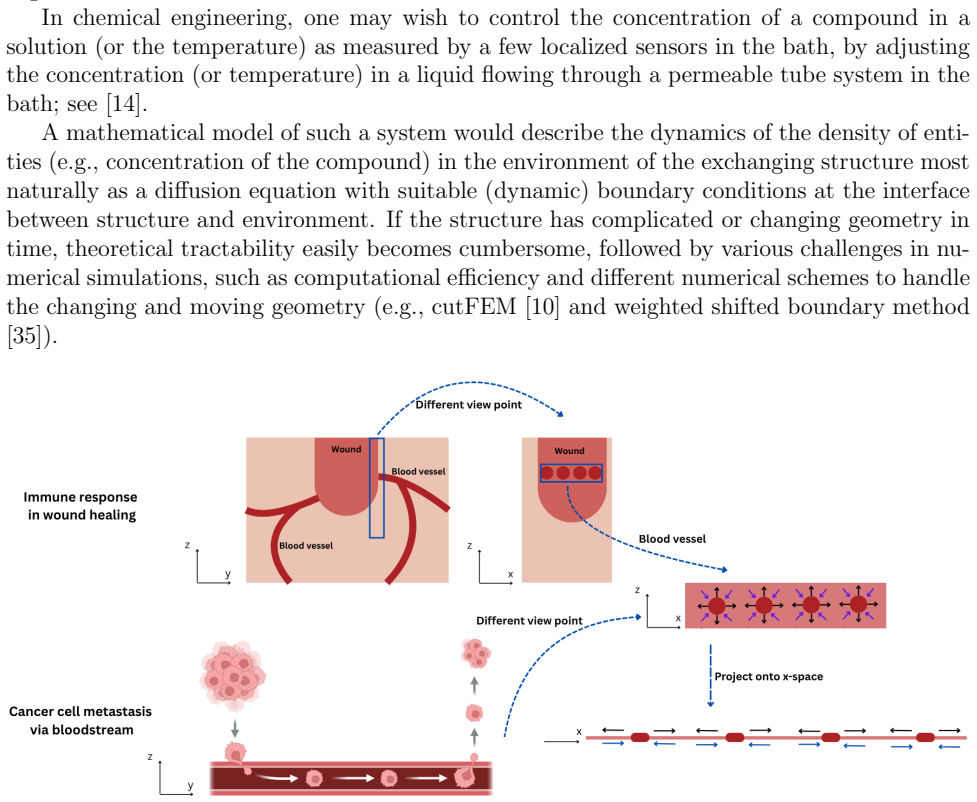
The behaviour is investigated of solutions to a diffusion equation on the real line with nonlocal and singular reaction term, i.e., given by a Dirac source or sink at the origin. It gives a simplified representation of for example a control system that senses concentration at a distance, but "intervenes" at the origin. Positivity of solutions (for positive initial conditions) cannot be guaranteed for all parameter settings in the model. We determine a parameter regime and conditions on the positive initial condition in terms of monotonicity and symmetry, that do allow us to conclude the positivity of the solution for all time. In addition, we provide conditions that ensure convergence of the system to a constant steady state (pointwise), outside the region of observation. Technically, we extensively use Laplace transform arguments to achieve these results.
Editorial analysis
A structured set of objections, weighed in public.
Referee Report
Summary. The manuscript analyzes positivity and long-term behavior for a diffusion equation on the real line with a singular nonlocal reaction term given by a Dirac measure at the origin. Under a specified parameter regime together with symmetry about the origin and suitable monotonicity of positive initial data, Laplace-transform arguments are used to establish that solutions remain positive for all time. Additional conditions are given that guarantee pointwise convergence to a constant steady state outside the observation region.
Significance. If the claims are verified, the work provides explicit, checkable conditions for positivity preservation in a diffusion model with a measure-valued nonlocal term, which is relevant to simplified control or sensing systems. The reliance on standard Laplace-transform techniques applied distributionally is a methodological strength, and the restriction of the results to a clearly stated regime on parameters and initial data avoids overclaiming. Reproducible verification of the transformed ODE positivity would strengthen the contribution.
minor comments (2)
- [Abstract / Introduction] The abstract and introduction would benefit from a brief statement of the precise functional setting (e.g., the space in which the Dirac term is interpreted and the notion of solution) to make the Laplace-transform step immediately accessible.
- [Section 2 or 3 (model and assumptions)] Notation for the monotonicity and symmetry assumptions on the initial datum should be introduced once and used consistently; a short remark clarifying how these properties are preserved by the evolution would help readers follow the sign-control argument.
Simulated Author's Rebuttal
We thank the referee for their careful reading of the manuscript, positive assessment of the results, and recommendation for minor revision. We have incorporated the feedback to improve the clarity and reproducibility of the arguments.
read point-by-point responses
-
Referee: Reproducible verification of the transformed ODE positivity would strengthen the contribution.
Authors: We agree that explicit verification steps for the positivity of the transformed ODE would enhance reproducibility. In the revised version we have added a short appendix with the explicit ODE system obtained after the Laplace transform together with a brief numerical check confirming positivity preservation under the stated parameter regime and initial-data assumptions. revision: yes
Circularity Check
No significant circularity in derivation chain
full rationale
The paper establishes positivity and long-time convergence for the diffusion PDE with Dirac nonlocal reaction via Laplace transform methods applied to the transformed system, under explicitly stated hypotheses on parameters and on symmetry/monotonicity of positive initial data. These steps rely on standard properties of the Laplace transform and distributional handling of the source term, without any reduction of outputs to fitted parameters, self-definitional relations, or load-bearing self-citations. The central claims are conditional on the regime where the arguments close and do not rename or smuggle in prior results by construction. The derivation is therefore self-contained against external mathematical benchmarks.
Axiom & Free-Parameter Ledger
axioms (1)
- domain assumption The diffusion equation with the given measure-valued nonlocal reaction term admits solutions that can be analyzed via Laplace transforms.
Lean theorems connected to this paper
-
IndisputableMonolith/Cost/FunctionalEquation.leanwashburn_uniqueness_aczel unclear?
unclearRelation between the paper passage and the cited Recognition theorem.
Theorem 2.2 (Positivity under monotonicity condition) … If â = aR/D ∈ [0, e⁻¹] and if u₀ is increasing on (−∞,0) while decreasing on R⁺ …
-
IndisputableMonolith/Foundation/AlphaCoordinateFixation.leanalpha_pin_under_high_calibration unclear?
unclearRelation between the paper passage and the cited Recognition theorem.
Proposition 4.7 … If a ≤ e⁻¹, then ˜p_a(t,β) ≥ 0 … (via DDE y′(t) = −a y(t−1))
What do these tags mean?
- matches
- The paper's claim is directly supported by a theorem in the formal canon.
- supports
- The theorem supports part of the paper's argument, but the paper may add assumptions or extra steps.
- extends
- The paper goes beyond the formal theorem; the theorem is a base layer rather than the whole result.
- uses
- The paper appears to rely on the theorem as machinery.
- contradicts
- The paper's claim conflicts with a theorem or certificate in the canon.
- unclear
- Pith found a possible connection, but the passage is too broad, indirect, or ambiguous to say the theorem truly supports the claim.
Reference graph
Works this paper leans on
-
[1]
R. A. Adams and J. J. Fournier.Sobolev Spaces. Elsevier Science: Oxford, 2nd edition, 2003
work page 2003
-
[2]
Amann.Linear and Quasilinear Parabolic Problems, volume 1
H. Amann.Linear and Quasilinear Parabolic Problems, volume 1. Birkh¨ auser Verlag, 1995
work page 1995
-
[3]
H. Amann. Linear parabolic problems involving measures.Real Academia de Ciencias Exactas, Fisicas y Naturales. Revista. Serie A, Matematicas, 95(1):85–119, 2001
work page 2001
-
[4]
H. Amann and P. Quittner. Semilinear parabolic equations involving measures and low regularity data.Transactions of the American Mathematical Society, 356(3):1045–1119, 2004
work page 2004
-
[5]
W. Arendt, C. J. Batty, M. Hieber, and F. Neubrander.Vector-valued Laplace Transforms and Cauchy Problems. Birkh¨ auser Basel, 2011. doi: 10.1007/978-3-0348-0087-7
- [6]
-
[7]
M. Ashyraliyev, J. Blom, and J. Verwer. On the numerical solution of diffusion-reaction equations with singular source terms.Journal of Computational and Applied Mathematics, 216(1):20–38, June 2008. ISSN 0377-0427. doi: 10.1016/j.cam.2007.04.017. URLhttp: //dx.doi.org/10.1016/j.cam.2007.04.017
-
[8]
M. Banerjee, ,Department of Mathematics & Statistics, Indian Institute of Technology Kanpur, Kanpur - 208016, India, N. Mukherjee, V. Volpert, ,Institut Camille Jordan, UMR 5208 CNRS, University Lyon 1, 69622 Villeurbanne, France, ,INRIA, Universit´ e de Lyon, Universit´ e Lyon 1, Institut Camille Jordan, 43 Bd. du 11 Novembre 1918, 69200 Villeurbanne Ced...
work page 1918
-
[9]
M. Banerjee, M. Kuznetsov, O. Udovenko, and V. Volpert. Nonlocal reaction-diffusion equations in biomedical applications.Acta Biotheoretica, 70(2), Mar. 2022. ISSN 1572-
work page 2022
-
[10]
doi: 10.1007/s10441-022-09436-4
-
[11]
E. Burman, S. Claus, P. Hansbo, M. G. Larson, and A. Massing. Cutfem: Discretizing geometry and partial differential equations.International Journal for Numerical Methods in Engineering, 104(7):472–501, Dec. 2014. ISSN 1097-0207. doi: 10.1002/nme.4823
-
[12]
J. Ca˜ nizo, J. Carillo, and S. Cuadrado. Measure solutions for some models in population dynamics.Acta Appl. Math., 123:141–156, 2013. doi: 10.1007/s10440-012-9758-3. URL https://doi.org/10.1007/s10440-012-9758-3
-
[13]
H. S. Carslaw.Introduction to the mathematical theory of the conduction of heat in solids. The Macmillan Co. of Canada, Ltd., 1921. 48
work page 1921
-
[14]
R. M. Corless1, G. H. Gonnet, D. E. G. Hare, D. J. Jeffrey1, and D. E. Knuth. On the lambert W function.Advances in Computational Mathematics, Vol, 5, 1996
work page 1996
-
[15]
A. de Diego, A. Usobiaga, L. A. Fern´ andez, and J. M. Madariaga.Application of the electrical conductivity of concentrated electrolyte solutions to industrial process control and design: from experimental measurement towards prediction through modelling, volume 20
-
[16]
doi: https://doi.org/10.1016/S0165-9936(00)00081-9
-
[17]
S. Di Russo, F. R. Liberati, A. Riva, F. Di Fonzo, A. Macone, G. Giardina, M. Arese, S. Ri- naldo, F. Cutruzzol` a, and A. Paone. Beyond the barrier: the immune-inspired pathways of tumor extravasation.Cell Commun. Signal., 22(1):104, Feb. 2024
work page 2024
-
[18]
J. Dibl` ık. Asymptotic representation of solutions of equation ˙y(t) =β(t)[y(t)−y(t−τ(t))]. Journal of Mathematical Analysis and Applications, 217(1):200–215, 1998. ISSN 0022- 247X. doi: 10.1006/jmaa.1997.5709
-
[19]
O. Diekmann, S. A. van Gils, S. M. Verduyn Lunel, and H. O. Walter.Delay Equations; Functional-, Complex- and Nonlinear Analysis. Springer-Verlag, 1995
work page 1995
-
[20]
D. B. Finlay, S. B. Duffull, and M. Glass. 100 years of modelling ligand-receptor binding and response: A focus on gpcrs.British Journal of Pharmacology, 177(7):1472–1484, Feb
- [21]
-
[22]
G. B. Folland.Real Analysis: Modern Techniques and Their Applications. John Wiley & Sons, 2nd edition, 1999. ISBN 0-471-31716-0
work page 1999
-
[23]
I. G. Gjerde, K. Kumar, and J. M. Nordbotten. A singularity removal method for coupled 1d-3d flow models.Computational Geosciences, 24(2):443–457, Dec. 2019. ISSN 1573-1499. doi: 10.1007/s10596-019-09899-4
-
[24]
I. Gy¨ ori and G. Ladas.Oscillation theory of delay differential equations: with applications. Oxford University Press, 1991
work page 1991
-
[25]
S. C. Hille, R. Lyons, and A. Muntean. Invariance properties of the solution for measure-valued semilinear transport equations.Analysis and Mathematical Physics, 15:93, 2025. doi: 10.1007/s13324-025-01093-3. URLhttps://doi.org/10.1007/ s13324-025-01093-3
-
[26]
I. M. Klotz and D. L. Hunston. Mathematical models for ligand-receptor binding. real sites, ghost sites.Journal of Biological Chemistry, 259(16):10060–10062, Aug. 1984. ISSN 0021-9258. doi: 10.1016/s0021-9258(18)90927-0
-
[27]
T. K¨ oppl and B. Wohlmuth. Optimal a priori error estimates for an elliptic problem with dirac right-hand side.SIAM J. Numer. Anal., 52(4):1753–1769, January 2014. ISSN 1095-7170. doi: 10.1137/130927619. URLhttp://dx.doi.org/10.1137/130927619
-
[28]
T. Naito, J. S. Shin, S. Murakami, and P. H. A. Ngoc. Characterizations of linear volterra integral equations with nonnegative kernels.Journal of Mathematical Analysis and Appli- cations, 335(1):298–313, 2007. ISSN 0022-247X. doi: 10.1016/j.jmaa.2007.01.070. 49
-
[29]
F. Oberhettinger and L. Badii.Tables of Laplace Transforms. Springer-Verlag, 1973. ISBN 978-1-4419-7645-1. doi: 10.1007/978-3-642-65645-3
-
[30]
O. A. Pe˜ na and P. Martin. Cellular and molecular mechanisms of skin wound healing. Nature Reviews Molecular Cell Biology, 25(8):599–616, 2024
work page 2024
-
[31]
Q. Peng and S. C. Hille. Quality of approximating a mass-emitting object by a point source in a diffusion model.Computers & Mathematics with Applications, 151:491–507, Dec. 2023. doi: 10.1016/j.camwa.2023.10.034
-
[32]
Q. Peng and S. C. Hille. Using multiple dirac delta points to describe inhomogeneous flux density over a cell boundary in a single-cell diffusion model. 2024. URLhttps: //arxiv.org/abs/2401.16261
-
[33]
L. Qiu, Z. Wang, H. Yu, and S. Yu. Traceability of water pollution: An inversion scheme via dynamic complex geometrical optics solutions.SIAM Journal on Mathematical Analysis, 57(1):286–305, Jan. 2025. ISSN 1095-7154. doi: 10.1137/23m1619605
-
[34]
S. Salsa and G. Verzini.Partial Differential Equations in Action; From Modelling to Theory. Springer, 2nd edition, 2022
work page 2022
-
[35]
M. K. Sznurkowska and N. Aceto. The gate to metastasis: key players in cancer cell intravasation.FEBS J., 289(15):4336–4354, Aug. 2022
work page 2022
- [36]
-
[37]
G. N. Watson.A Treatise on the Theory of Bessel Functions. Cambridge University Press, Cambridge, 2nd edition, 1966
work page 1966
-
[38]
D. Xu, O. Colom´ es, A. Main, K. Li, N. M. Atallah, N. Abboud, and G. Scovazzi. A weighted shifted boundary method for immersed moving boundary simulations of stokes’ flow.Journal of Computational Physics, 510:113095, Aug. 2024. ISSN 0021-9991. doi: 10.1016/j.jcp.2024.113095
-
[39]
X. Yang, Q. Peng, and S. C. Hille. Approximation of a compound-exchanging cell by a dirac point.IFAC-PapersOnLine, 59(1):73–78, 2025. ISSN 2405-8963. doi: 10.1016/j. ifacol.2025.03.014. 50
work page doi:10.1016/j 2025
discussion (0)
Sign in with ORCID, Apple, or X to comment. Anyone can read and Pith papers without signing in.