CascadeInfer: Length-Aware Scheduling of LLM Serving with Low Latency and Load Balancing
Pith reviewed 2026-05-21 17:19 UTC · model grok-4.3
The pith
CascadeInfer partitions LLM serving instances into length-specialized groups to cut end-to-end latency and raise throughput.
A machine-rendered reading of the paper's core claim, the machinery that carries it, and where it could break.
Core claim
CascadeInfer is a runtime system that dynamically reschedules requests across multiple instances serving the same LLM to mitigate per-instance length heterogeneity. It partitions these instances into length-specialized groups, each handling requests within a designated length range, naturally forming a pipeline as requests flow through them. CascadeInfer devises a dynamic programming algorithm to efficiently find the stage partition with the best QoE, employs runtime range refinement together with decentralized load rebalance both across and within groups, achieving a balanced and efficient multi-instance service.
What carries the argument
length-range partitions of instances that form a request pipeline, with boundaries chosen by dynamic programming to minimize heterogeneity within each batch
If this is right
- End-to-end latency falls by up to 67 percent under identical hardware and model settings.
- Tail latency falls by up to 69 percent.
- System throughput rises by up to 2.89 times relative to prior multi-instance schedulers.
- Decentralized load rebalancing keeps utilization high both within each length group and across the pipeline.
Where Pith is reading between the lines
- The same grouping principle could be tested on other batch-sensitive GPU kernels beyond attention, such as certain matrix-multiplication patterns.
- Placing the length-range decisions inside the front-end load balancer might reduce the frequency of runtime rescheduling.
- The dynamic-programming step itself may need approximation or caching when the cluster contains hundreds of instances.
Load-bearing premise
Rescheduling a request from one instance to another adds almost no extra delay compared with the time saved by keeping batch lengths more uniform, and the chosen length ranges stay useful long enough that the dynamic-programming solution does not need constant re-solving.
What would settle it
Run CascadeInfer on a workload whose request lengths shift rapidly every few seconds and measure whether the claimed 67 percent latency reduction still appears or whether the cost of frequent rescheduling cancels the gains.
Figures


read the original abstract
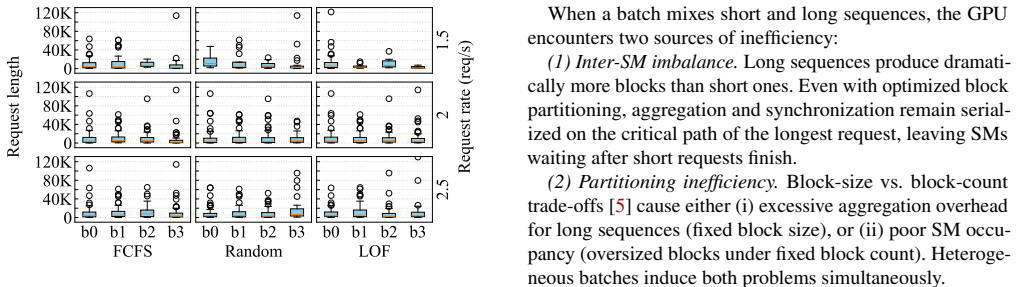
Efficiently harnessing GPU compute is critical to improving user experience and reducing operational costs in large language model (LLM) services. However, current inference engine schedulers overlook the attention backend's sensitivity to request-length heterogeneity within a batch. As state-of-the-art models now support context windows exceeding 128K tokens, this once-tolerable inefficiency has escalated into a primary system bottleneck, causing severe performance degradation through GPU underutilization and increased latency. We present CascadeInfer, a runtime system that dynamically reschedules requests across multiple instances serving the same LLM to mitigate per-instance length heterogeneity. CascadeInfer partitions these instances into length-specialized groups, each handling requests within a designated length range, naturally forming a pipeline as requests flow through them. CascadeInfer devises a dynamic programming algorithm to efficiently find the stage partition with the best QoE, employs runtime range refinement together with decentralized load (re)balance both across and within groups, achieving a balanced and efficient multi-instance service. Our evaluation shows that, under the same configuration, CascadeInfer reduces end-to-end latency by up to 67% and tail latency by up to 69%, while improving overall system throughput by up to 2.89 times compared to the state-of-the-art multi-instance scheduling systems.
Editorial analysis
A structured set of objections, weighed in public.
Referee Report
Summary. The paper proposes CascadeInfer, a runtime system for efficient LLM serving that partitions multiple instances into length-specialized groups, uses a dynamic programming algorithm to select optimal stage partitions for best QoE, and applies runtime range refinement plus decentralized load rebalancing to mitigate per-instance length heterogeneity. It reports concrete gains of up to 67% lower end-to-end latency, 69% lower tail latency, and 2.89x higher throughput versus state-of-the-art multi-instance schedulers under the same configuration, targeting long-context models (>128K tokens).
Significance. If the empirical gains prove robust, the work addresses a growing systems bottleneck in LLM inference by turning length heterogeneity from a liability into a structured pipeline, with potential for substantial improvements in GPU utilization, latency, and cost in production serving clusters. The dynamic-programming partitioner and decentralized balancer represent practical engineering contributions that could influence future schedulers.
major comments (1)
- The central latency and throughput claims rest on the premise that KV-cache migration during dynamic rescheduling incurs negligible overhead relative to the heterogeneity penalty eliminated. However, for contexts exceeding 128K tokens the transfer size is large; no section quantifies or bounds this cost (e.g., PCIe/RDMA latency) under the evaluated hardware, leaving open the possibility that migration overhead erodes or reverses the reported 67% and 69% reductions.
minor comments (1)
- The abstract states gains occur 'under the same configuration' without enumerating the exact baseline scheduler, model sizes, or arrival patterns; adding this detail would strengthen the comparison.
Simulated Author's Rebuttal
We thank the referee for the constructive comment on KV-cache migration overhead. We address the concern directly below and have revised the manuscript to incorporate supporting analysis and measurements.
read point-by-point responses
-
Referee: The central latency and throughput claims rest on the premise that KV-cache migration during dynamic rescheduling incurs negligible overhead relative to the heterogeneity penalty eliminated. However, for contexts exceeding 128K tokens the transfer size is large; no section quantifies or bounds this cost (e.g., PCIe/RDMA latency) under the evaluated hardware, leaving open the possibility that migration overhead erodes or reverses the reported 67% and 69% reductions.
Authors: We agree that the original manuscript does not provide explicit quantification or bounds on KV-cache migration cost for contexts exceeding 128K tokens. In the revised manuscript we have added a new subsection (Section 5.4) together with Appendix D that reports both analytical bounds and empirical measurements of PCIe and RDMA transfer latency on the same A100-based testbed used for the main evaluation. The measurements show that a 128K-token KV-cache transfer (approximately 1.8–2.2 GB depending on model) completes in 35–55 ms over RDMA, which is amortized across the request lifetime and remains well below the per-request latency reductions obtained from length-specialized batching. We further demonstrate that the runtime range refinement and decentralized balancer trigger migrations only when the expected heterogeneity penalty exceeds this measured cost, thereby preserving the reported end-to-end and tail-latency gains. revision: yes
Circularity Check
No circularity: empirical system results rest on independent measurements
full rationale
The paper describes a runtime scheduling system whose central claims are measured end-to-end latency, tail latency, and throughput improvements obtained from an implemented prototype running on real hardware and workloads. The dynamic-programming partitioner and decentralized rebalancer are algorithmic procedures whose correctness and performance are validated externally by experiment rather than by any equation that reduces to its own fitted parameters or to a self-citation chain. No derivation step equates a claimed prediction to an input by construction; the reported gains are falsifiable observations outside the algorithm itself.
Axiom & Free-Parameter Ledger
Lean theorems connected to this paper
-
IndisputableMonolith/Cost/FunctionalEquation.leanwashburn_uniqueness_aczel unclear?
unclearRelation between the paper passage and the cited Recognition theorem.
CascadeInfer partitions these instances into length-specialized groups... dynamic programming algorithm to efficiently find the stage partition with the best QoE
-
IndisputableMonolith/Foundation/AlexanderDuality.leanalexander_duality_circle_linking unclear?
unclearRelation between the paper passage and the cited Recognition theorem.
decentralized bid-ask scheduling... KV cache transfer
What do these tags mean?
- matches
- The paper's claim is directly supported by a theorem in the formal canon.
- supports
- The theorem supports part of the paper's argument, but the paper may add assumptions or extra steps.
- extends
- The paper goes beyond the formal theorem; the theorem is a base layer rather than the whole result.
- uses
- The paper appears to rely on the theorem as machinery.
- contradicts
- The paper's claim conflicts with a theorem or certificate in the canon.
- unclear
- Pith found a possible connection, but the passage is too broad, indirect, or ambiguous to say the theorem truly supports the claim.
Reference graph
Works this paper leans on
-
[1]
https://huggingface.co/d atasets/RyokoAI/ShareGPT52K, 2023
ShareGPT Datasets. https://huggingface.co/d atasets/RyokoAI/ShareGPT52K, 2023
work page 2023
-
[2]
Marah Abdin, Jyoti Aneja, Hany Awadalla, Ahmed Awadallah, Ammar Ahmad Awan, Nguyen Bach, Amit Bahree, Arash Bakhtiari, Jianmin Bao, Harkirat Behl, Alon Benhaim, Misha Bilenko, Johan Bjorck, Sébastien Bubeck, Martin Cai, Qin Cai, Vishrav Chaudhary, Dong 12 Chen, Dongdong Chen, Weizhu Chen, Yen-Chun Chen, Yi-Ling Chen, Hao Cheng, Parul Chopra, Xiyang Dai, M...
work page internal anchor Pith review Pith/arXiv arXiv 2024
-
[3]
Locality-aware fair scheduling in llm serving
Shiyi Cao, Yichuan Wang, Ziming Mao, Pin-Lun Hsu, Liangsheng Yin, Tian Xia, Dacheng Li, Shu Liu, Yineng Zhang, Yang Zhou, Ying Sheng, Joseph Gonzalez, and Ion Stoica. Locality-aware fair scheduling in llm serving. arXiv preprint arXiv:2501.14312, 2025
-
[4]
Tri Dao, Dan Fu, Stefano Ermon, Atri Rudra, and Christopher Ré. Flashattention: Fast and memory- efficient exact attention with io-awareness.Advances in neural information processing systems, 35:16344– 16359, 2022
work page 2022
-
[5]
Flash-decoding for long-context inference
Tri Dao, Daniel Haziza, Francisco Massa, and Grigory Sizov. Flash-decoding for long-context inference. 2023
work page 2023
-
[6]
DeepSeek-AI, Aixin Liu, Bei Feng, Bing Xue, Bingx- uan Wang, Bochao Wu, Chengda Lu, Chenggang Zhao, Chengqi Deng, Chenyu Zhang, Chong Ruan, Damai Dai, Daya Guo, Dejian Yang, Deli Chen, Dongjie Ji, Erhang Li, Fangyun Lin, Fucong Dai, Fuli Luo, Guangbo Hao, Guanting Chen, Guowei Li, H. Zhang, Han Bao, Han- wei Xu, Haocheng Wang, Haowei Zhang, Honghui Ding, ...
work page internal anchor Pith review Pith/arXiv arXiv 2024
-
[7]
Serverlessllm: Low-latency serverless inference for large language models
Yao Fu, Leyang Xue, Yeqi Huang, Andrei-Octavian Brabete, Dmitrii Ustiugov, Yuvraj Patel, and Luo Mai. Serverlessllm: Low-latency serverless inference for large language models. In18th USENIX Symposium on Operating Systems Design and Implementation (OSDI 24), pages 135–153. USENIX Association, 2024
work page 2024
-
[8]
Yichao Fu, Siqi Zhu, Runlong Su, Aurick Qiao, Ion Sto- ica, and Hao Zhang. Efficient llm scheduling by learning to rank.Advances in Neural Information Processing Systems, 37:59006–59029, 2024. 13
work page 2024
-
[9]
Lawrence R Glosten and Paul R Milgrom. Bid, ask and transaction prices in a specialist market with het- erogeneously informed traders.Journal of financial economics, 14(1):71–100, 1985
work page 1985
-
[10]
Accelerating llm serving for multi-turn dialogues with efficient resource management
Jinwoo Jeong and Jeongseob Ahn. Accelerating llm serving for multi-turn dialogues with efficient resource management. InProceedings of the 30th ACM Inter- national Conference on Architectural Support for Pro- gramming Languages and Operating Systems, Volume 2, pages 1–15, 2025
work page 2025
-
[11]
Efficient memory man- agement for large language model serving with page- dattention
Woosuk Kwon, Zhuohan Li, Siyuan Zhuang, Ying Sheng, Lianmin Zheng, Cody Hao Yu, Joseph Gonzalez, Hao Zhang, and Ion Stoica. Efficient memory man- agement for large language model serving with page- dattention. InProceedings of the 29th Symposium on Operating Systems Principles, pages 611–626, 2023
work page 2023
-
[12]
xformers: A modular and hackable transformer modelling library
Benjamin Lefaudeux, Francisco Massa, Diana Liskovich, Wenhan Xiong, Vittorio Caggiano, Sean Naren, Min Xu, Jieru Hu, Marta Tintore, Susan Zhang, Patrick Labatut, Daniel Haziza, Luca Wehrstedt, Jeremy Reizenstein, and Grigory Sizov. xformers: A modular and hackable transformer modelling library. https: //github.com/facebookresearch/xformers , 2022
work page 2022
-
[13]
A proof for the queuing formula: L= λ w.Operations research, 9(3):383–387, 1961
John DC Little. A proof for the queuing formula: L= λ w.Operations research, 9(3):383–387, 1961
work page 1961
-
[14]
Introducing llama 3.1: Our most capable models to date, 2024
Meta. Introducing llama 3.1: Our most capable models to date, 2024
work page 2024
-
[15]
Llama 3.2: Revolutionizing edge ai and vision with open, customizable models, 2024
Meta. Llama 3.2: Revolutionizing edge ai and vision with open, customizable models, 2024
work page 2024
- [16]
- [17]
-
[18]
NVIDIA. Fastertransformer, 2025. https://github .com/NVIDIA/FasterTransformer
work page 2025
-
[19]
NVIDIA. Nvidia dynamo, 2025. https://github.c om/ai-dynamo/dynamo
work page 2025
-
[20]
OpenAI. Chatgpt application, 2025. https://chat .openai.com/
work page 2025
-
[21]
Haoran Qiu, Weichao Mao, Archit Patke, Shengkun Cui, Saurabh Jha, Chen Wang, Hubertus Franke, Zbig- niew T Kalbarczyk, Tamer Ba¸ sar, and Ravishankar K Iyer. Efficient interactive llm serving with proxy model-based sequence length prediction.arXiv preprint arXiv:2404.08509, 2024
-
[22]
The AIBrix Team: Jiaxin Shan, Varun Gupta, Le Xu, Haiyang Shi, Jingyuan Zhang, Ning Wang, Linhui Xu, Rong Kang, Tongping Liu, Yifei Zhang, Yiqing Zhu, Shuowei Jin, Gangmuk Lim, Binbin Chen, Zuzhi Chen, Xiao Liu, Xin Chen, Kante Yin, Chak-Pong Chung, Chenyu Jiang, Yicheng Lu, Jianjun Chen, Caixue Lin, Wu Xiang, Rui Shi, and Liguang Xie. Aibrix: Towards sca...
- [23]
-
[24]
Llumnix: Dynamic scheduling for large language model serving
Biao Sun, Ziming Huang, Hanyu Zhao, Wencong Xiao, Xinyi Zhang, Yong Li, and Wei Lin. Llumnix: Dynamic scheduling for large language model serving. In18th USENIX Symposium on Operating Systems Design and Implementation (OSDI 24), pages 173–191, Santa Clara, CA, July 2024. USENIX Association
work page 2024
-
[25]
QwQ: Reflect deeply on the boundaries of the unknown
Qwen Team. QwQ: Reflect deeply on the boundaries of the unknown. https://qwenlm.github.io/blog/ qwq-32b-preview/, 2024
work page 2024
-
[26]
Triton: an intermediate language and compiler for tiled neural network computations
Philippe Tillet, Hsiang-Tsung Kung, and David Cox. Triton: an intermediate language and compiler for tiled neural network computations. InProceedings of the 3rd ACM SIGPLAN International Workshop on Machine Learning and Programming Languages, pages 10–19, 2019
work page 2019
-
[27]
Attention is all you need.Advances in neural information processing systems, 30, 2017
Ashish Vaswani, Noam Shazeer, Niki Parmar, Jakob Uszkoreit, Llion Jones, Aidan N Gomez, Łukasz Kaiser, and Illia Polosukhin. Attention is all you need.Advances in neural information processing systems, 30, 2017
work page 2017
-
[28]
Fast Distributed Inference Serving for Large Language Models
Bingyang Wu, Yinmin Zhong, Zili Zhang, Shengyu Liu, Fangyue Liu, Yuanhang Sun, Gang Huang, Xuanzhe Liu, and Xin Jin. Fast distributed inference serving for large language models.arXiv preprint arXiv:2305.05920, 2023
work page internal anchor Pith review Pith/arXiv arXiv 2023
- [29]
-
[30]
Qwen2.5 technical report, 2025
Qwen: An Yang, Baosong Yang, Beichen Zhang, Binyuan Hui, Bo Zheng, Bowen Yu, Chengyuan Li, Day- iheng Liu, Fei Huang, Haoran Wei, Huan Lin, Jian Yang, Jianhong Tu, Jianwei Zhang, Jianxin Yang, Jiaxi Yang, Jingren Zhou, Junyang Lin, Kai Dang, Keming Lu, Ke- qin Bao, Kexin Yang, Le Yu, Mei Li, Mingfeng Xue, Pei Zhang, Qin Zhu, Rui Men, Runji Lin, Tianhao Li...
work page 2025
-
[31]
FlashInfer: Efficient and Customizable Attention Engine for LLM Inference Serving
Zihao Ye, Lequn Chen, Ruihang Lai, Wuwei Lin, Yineng Zhang, Stephanie Wang, Tianqi Chen, Baris Kasikci, Vinod Grover, Arvind Krishnamurthy, and Luis Ceze. Flashinfer: Efficient and customizable atten- tion engine for llm inference serving.arXiv preprint arXiv:2501.01005, 2025
work page internal anchor Pith review Pith/arXiv arXiv 2025
-
[32]
Orca: A distributed serving system for transformer-based generative mod- els
Gyeong-In Yu, Joo Seong Jeong, Geon-Woo Kim, Soo- jeong Kim, and Byung-Gon Chun. Orca: A distributed serving system for transformer-based generative mod- els. In16th USENIX Symposium on Operating Systems Design and Implementation (OSDI 22), pages 521–538, 2022
work page 2022
-
[33]
Jingyang Yuan, Huazuo Gao, Damai Dai, Junyu Luo, Liang Zhao, Zhengyan Zhang, Zhenda Xie, Y . X. Wei, Lean Wang, Zhiping Xiao, Yuqing Wang, Chong Ruan, Ming Zhang, Wenfeng Liang, and Wangding Zeng. Native sparse attention: Hardware-aligned and natively trainable sparse attention.arXiv preprint arXiv:2502.11089, 2025
work page internal anchor Pith review Pith/arXiv arXiv 2025
-
[34]
ChatGLM: A Family of Large Language Models from GLM-130B to GLM-4 All Tools
Team GLM: Aohan Zeng, Bin Xu, Bowen Wang, Chen- hui Zhang, Da Yin, Dan Zhang, Diego Rojas, Guanyu Feng, Hanlin Zhao, Hanyu Lai, Hao Yu, Hongning Wang, Jiadai Sun, Jiajie Zhang, Jiale Cheng, Jiayi Gui, Jie Tang, Jing Zhang, Jingyu Sun, Juanzi Li, Lei Zhao, Lindong Wu, Lucen Zhong, Mingdao Liu, Minlie Huang, Peng Zhang, Qinkai Zheng, Rui Lu, Shuaiqi Duan, S...
work page internal anchor Pith review Pith/arXiv arXiv 2024
-
[35]
Gonzalez, Clark Bar- rett, and Ying Sheng
Lianmin Zheng, Liangsheng Yin, Zhiqiang Xie, Chuyue Sun, Jeff Huang, Cody Hao Yu, Shiyi Cao, Christos Kozyrakis, Ion Stoica, Joseph E. Gonzalez, Clark Bar- rett, and Ying Sheng. Sglang: Efficient execution of structured language model programs. In A. Globerson, L. Mackey, D. Belgrave, A. Fan, U. Paquet, J. Tomczak, and C. Zhang, editors,Advances in Neural...
work page 2024
-
[36]
Zangwei Zheng, Xiaozhe Ren, Fuzhao Xue, Yang Luo, Xin Jiang, and Yang You. Response length perception and sequence scheduling: An llm-empowered llm infer- ence pipeline.Advances in Neural Information Process- ing Systems, 36:65517–65530, 2023
work page 2023
-
[37]
Dist- serve: Disaggregating prefill and decoding for goodput- optimized large language model serving
Yinmin Zhong, Shengyu Liu, Junda Chen, Jianbo Hu, Yibo Zhu, Xuanzhe Liu, Xin Jin, and Hao Zhang. Dist- serve: Disaggregating prefill and decoding for goodput- optimized large language model serving. In18th USENIX Symposium on Operating Systems Design and Implementation (OSDI 24), pages 193–210, Santa Clara, CA, July 2024. USENIX Association
work page 2024
-
[38]
Ruidong Zhu, Ziheng Jiang, Chao Jin, Peng Wu, Cesar A. Stuardo, Dongyang Wang, Xinlei Zhang, Huaping Zhou, Haoran Wei, Yang Cheng, Jianzhe Xiao, Xinyi Zhang, Lingjun Liu, Haibin Lin, Li-Wen Chang, Jianxi Ye, Xiao Yu, Xuanzhe Liu, Xin Jin, and Xin Liu. Megascale-infer: Serving mixture-of-experts at scale with disaggregated expert parallelism.arXiv preprint...
discussion (0)
Sign in with ORCID, Apple, or X to comment. Anyone can read and Pith papers without signing in.