pith. sign in

arxiv: 2512.20575 · v2 · submitted 2025-12-23 · 🧮 math.CO

Framing Lattices and Flow Polytopes

Pith reviewed 2026-05-16 20:08 UTC · model grok-4.3

classification 🧮 math.CO
keywords framing latticeflow polytopeTamari latticesemidistributive latticecongruence uniformCambrian latticenoncrossing partitionsM-move
0
0 comments X

The pith

Framing lattices unify the Tamari lattice, Boolean lattice, and weak order on permutations as duals to framed triangulations of flow polytopes.

A machine-rendered reading of the paper's core claim, the machinery that carries it, and where it could break.

The paper defines framing lattices for framed graphs so that the Hasse diagram of the lattice is exactly the dual graph of a framed triangulation of the associated flow polytope. This single construction recovers the Boolean lattice, the Tamari lattice, the weak order on permutations, all type-A Cambrian lattices, the Grassmann-Tamari lattices, permutree lattices, and several others. The lattices that arise are shown to be semidistributive and congruence-uniform, and to be polygonal with only squares, pentagons, and hexagons as faces. A reader cares because the geometric origin supplies uniform proofs of these shared properties and explicit descriptions of their join-irreducible elements, congruences, and quotients via a graph operation called an M-move.

Core claim

Framing lattices are defined from framed graphs so that their Hasse diagrams are dual to framed triangulations of the corresponding flow polytopes. They form a semidistributive, congruence-uniform class of polygonal lattices whose polygons are squares, pentagons, and hexagons. The construction subsumes the Boolean lattice, Tamari lattice, weak order, all type-A Cambrian lattices, Grassmann and grid-Tamari lattices, alt-nu-Tamari and cross-Tamari lattices, permutree lattices, and tau-tilting posets of certain gentle algebras, while also yielding connections to noncrossing partitions through Reading's core label orders and to lattice congruences induced by M-moves.

What carries the argument

The framing lattice of a framed graph, whose Hasse diagram is defined to be dual to a framed triangulation of the flow polytope.

If this is right

  • All listed classical lattices inherit semidistributivity, congruence uniformity, and the restricted polygon types from the single geometric source.
  • Join- and meet-irreducible elements admit simple combinatorial descriptions in terms of the underlying framed graph.
  • Lattice congruences and quotients correspond to M-moves on the graph, giving explicit maps between different framing lattices.
  • Connections to noncrossing partitions become uniform via core label orders on the framing lattices.

Where Pith is reading between the lines

These are editorial extensions of the paper, not claims the author makes directly.

  • Volume computations for flow polytopes could be rephrased as enumeration problems inside the corresponding framing lattices.
  • The restriction to three polygon types may extend to other families of polytopes whose triangulations admit similar dual-lattice constructions.
  • M-moves could supply a rewriting system for moving between different lattice quotients, potentially simplifying algorithms for lattice-theoretic operations.

Load-bearing premise

Every framed triangulation of a flow polytope has a dual graph that forms a lattice satisfying the semidistributivity and polygonal-face conditions.

What would settle it

A single framed graph whose framed triangulation produces a dual graph that is not a semidistributive lattice or that contains a face with more or fewer than four, five, or six sides.

Figures
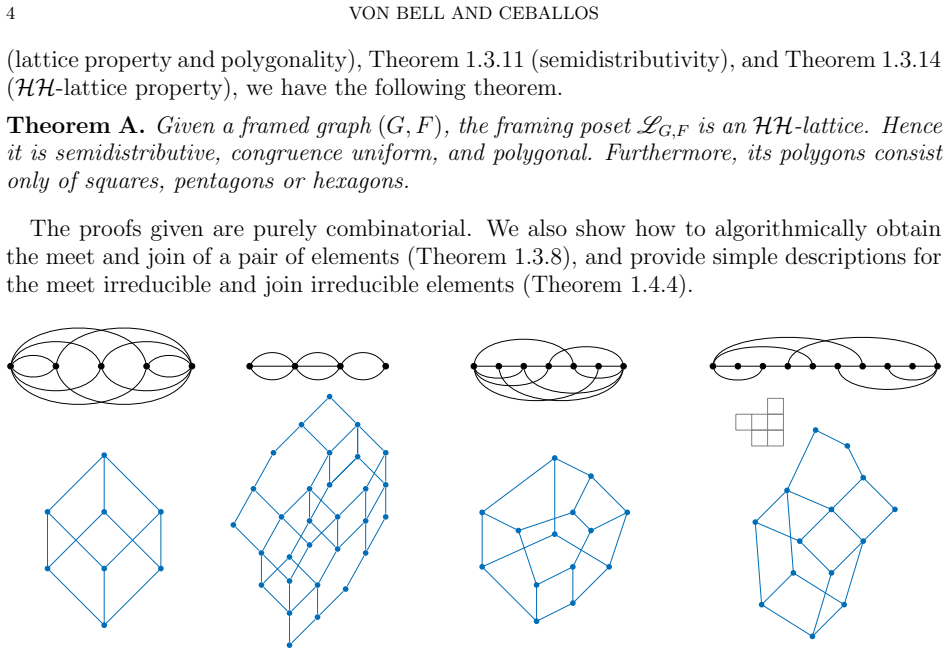
Figures reproduced from arXiv: 2512.20575 by Cesar Ceballos, Matias von Bell.
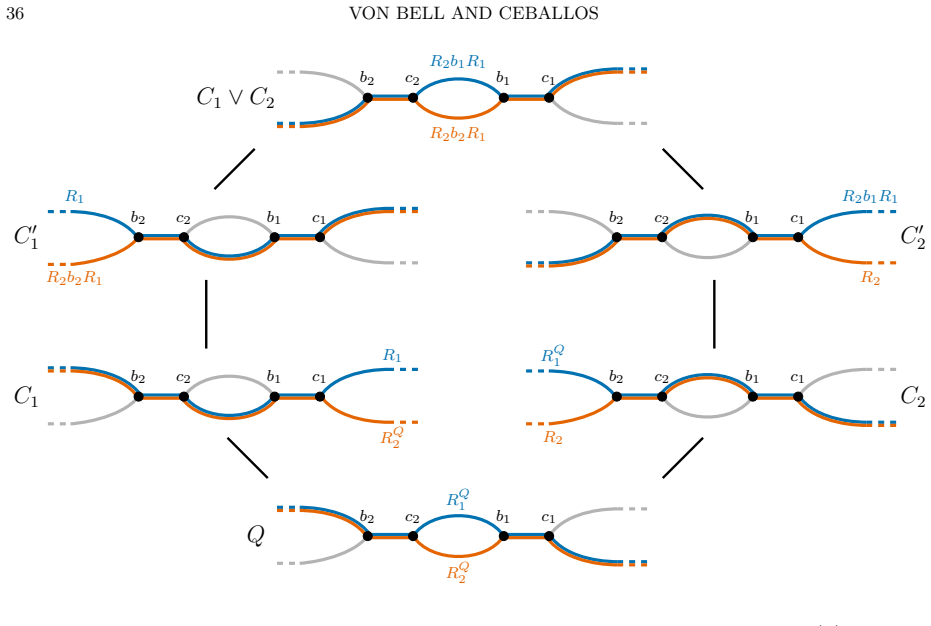
Figure 1
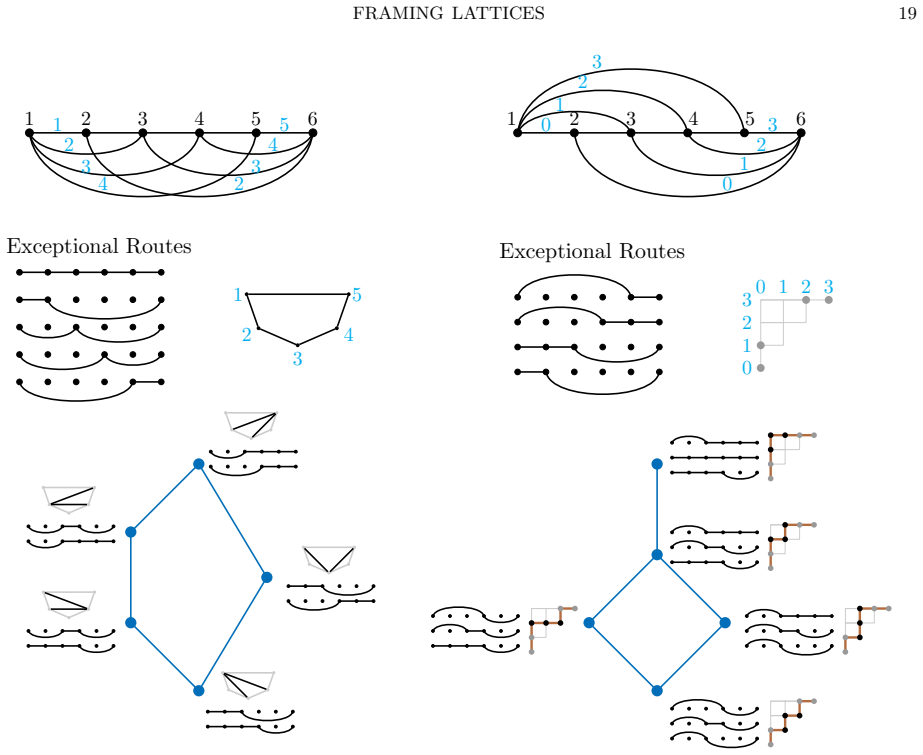
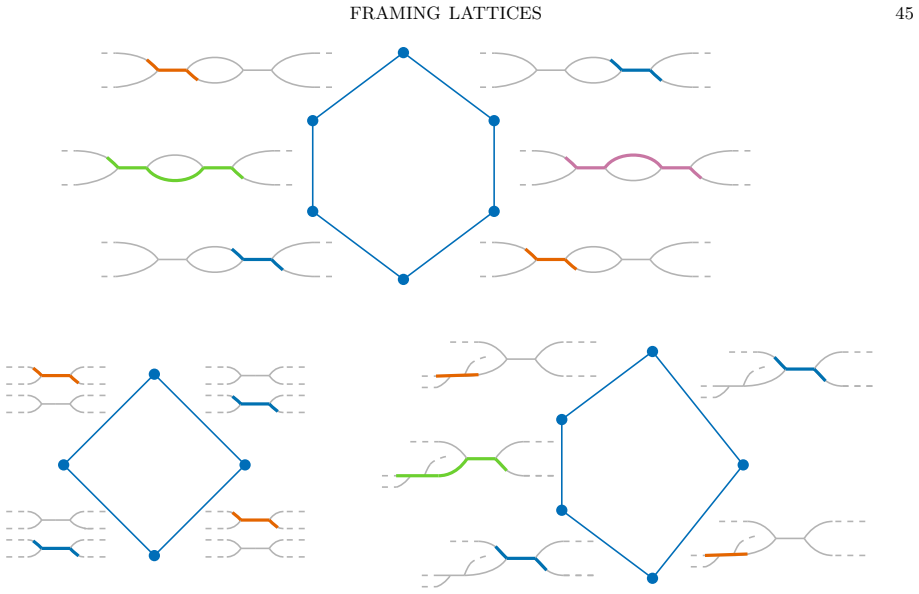
Figure 1. Figure 1: Four framed graphs and the Hasse diagrams of their framing lat￾tices. The first is the Boolean lattice B3. The second is the lattice of multiper￾mutations of 122 23. The third is the ε-cambrian lattice with ε = (−, −, +, −). The fourth is a cross-Tamari lattice of the cross-shaped grid shown below the right-most graph. Next, we introduce the core label order of a framing lattice, which serves as the natura… view at source ↗
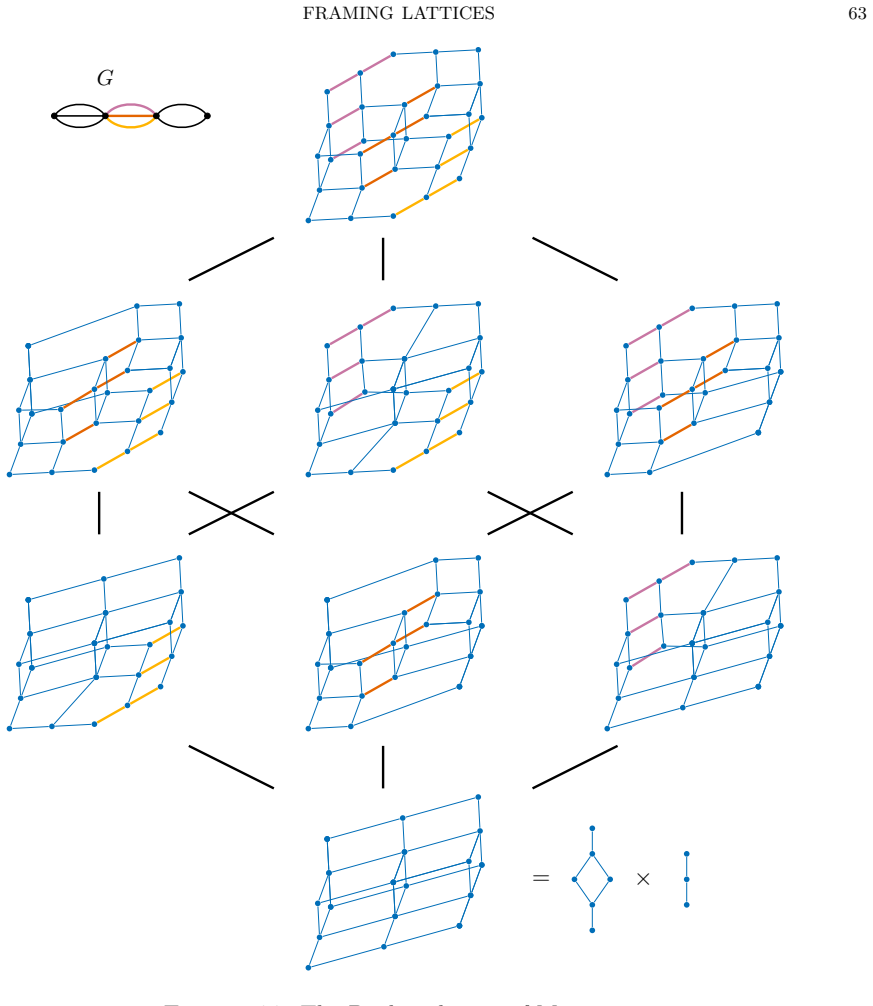
Figure 2
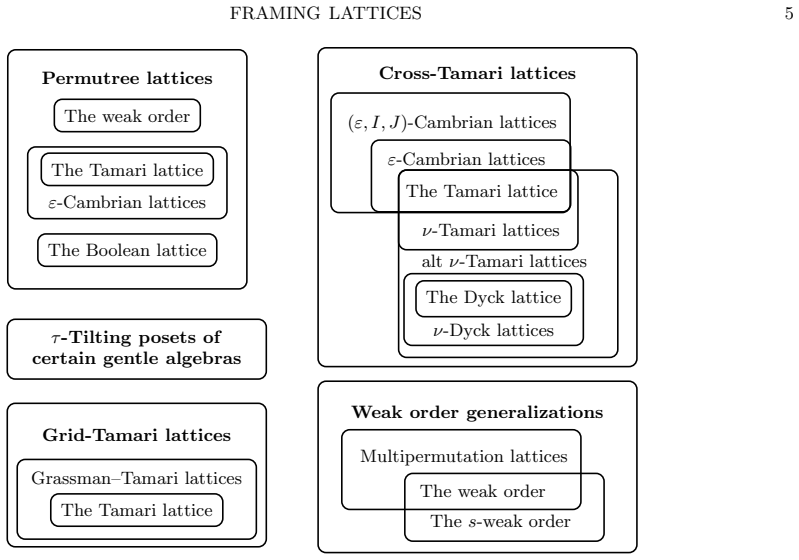
Figure 2. Figure 2: Some popular exhibitions at the zoo of framing lattices. In Part II of the article, we give a tour of the zoo of framing lattices, highlighting various interesting species. At the time of writing, we know of the following species of framing lattices: • the Tamari lattice (Example 1.2.6); • ν-Tamari lattices of Pr´eville-Ratelle and Viennot [34]; • alt ν-Tamari lattices of Ceballos and Chenevi`ere [11]; • t… view at source ↗
Figure 3
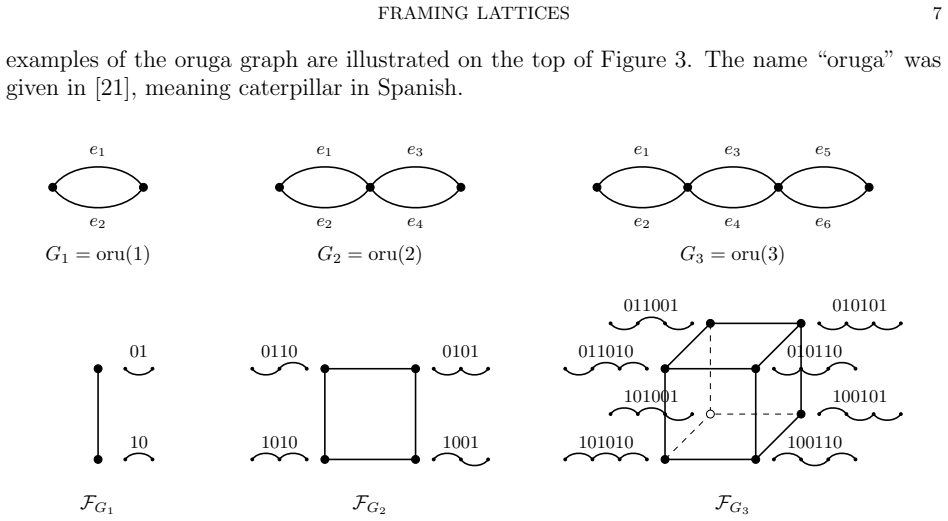
Figure 3. Figure 3: Some examples of the oruga graph and their flow polytopes. The flow polytope FGn is the set of points (x1, . . . , x2n) ∈ R 2n ≥0 (that is xi ≥ 0 for all i) such that x2i−1 + x2i = 1 for every i ∈ [n]. Combinatorially, this flow polytope is a cube of dimension n in R 2n . Its vertices are of the form ei1 + · · · + ein , where ei ∈ R 2n denote the standard basis vectors and ik has two possibilities, ik = 2k… view at source ↗
Figure 4
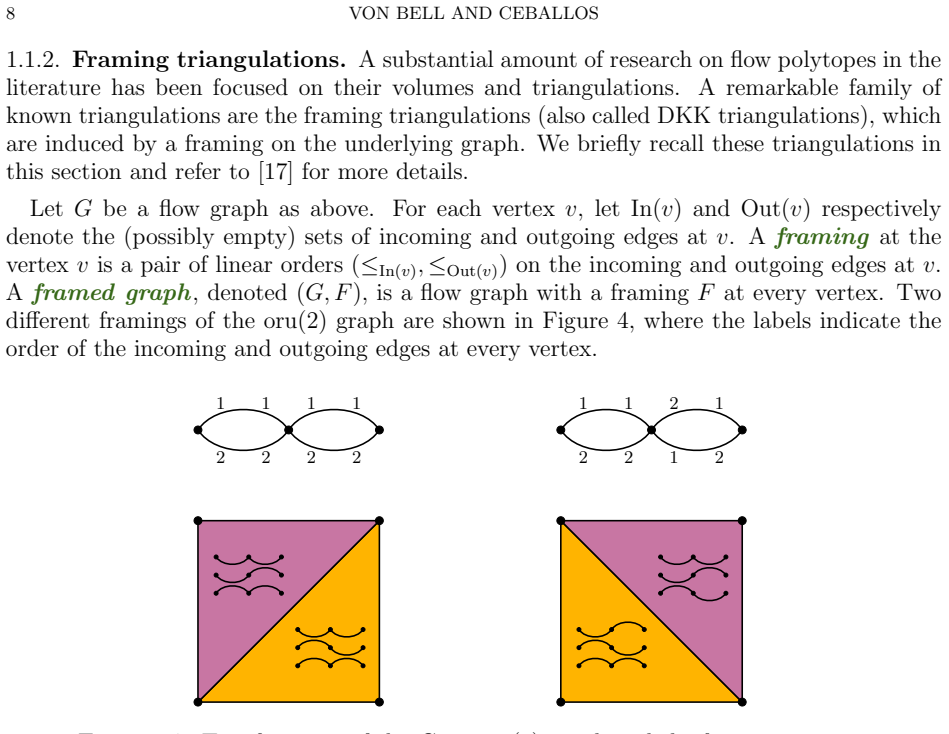
Figure 4. Figure 4: Two framings of the G2 = oru(2) graph and the framing triangu￾lations of the corresponding flow polytope FG2 . For a path P containing a vertex v, let P v (resp. vP) denote the maximal subpath of P ending (resp. beginning) at v. Furthermore, let I (v) (resp. O(v)) denote the set of paths in G ending (resp. beginning) at v. Our notation I stands for Incoming and O for Outgoing. We consider I (s) as containi… view at source ↗
Figure 5
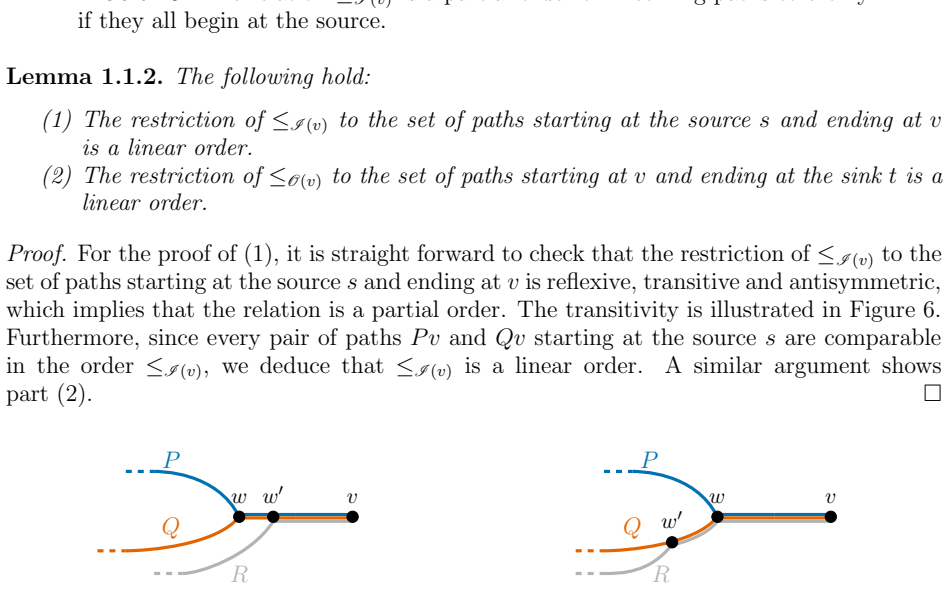
Figure 5. Figure 5: The relation ≤I (v) is a partial order on incoming paths to v only if they all begin at the source. Lemma 1.1.2. The following hold: (1) The restriction of ≤I (v) to the set of paths starting at the source s and ending at v is a linear order. (2) The restriction of ≤O(v) to the set of paths starting at v and ending at the sink t is a linear order. Proof. For the proof of (1), it is straight forward to chec… view at source ↗
Figure 6
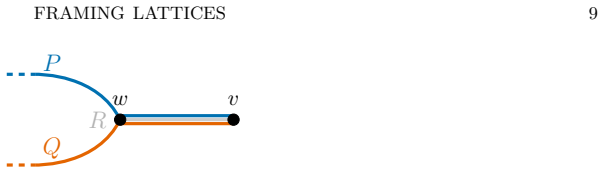
Figure 6. Figure 6: Two cases in the proof of the transitivity of ≤I (v) in Lemma 1.1.2. We say that a vertex v of a path P is an inner vertex if v is not the first or last vertex of the path. If v is an inner vertex of paths P and Q, we say that P and Q are incoherent at v if P v <I (v) Qv and vQ <O(v) vP, or if Qv <I (v) P v and vP <O(v) vQ, and we say that they are coherent at v otherwise. Paths P and Q are then said to be… view at source ↗
Figure 7
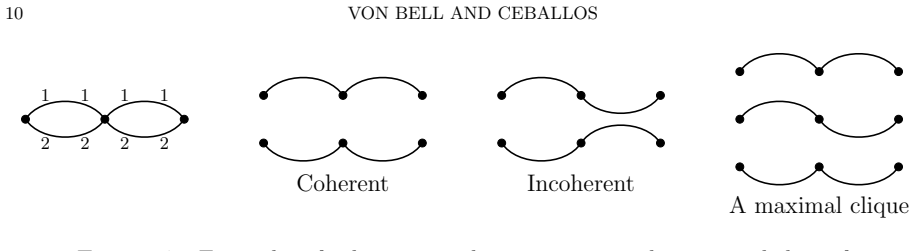
Figure 7. Figure 7: Examples of coherent, incoherent routes, and a maximal clique for the given framing of the oru(2) graph. give a nice triangulation of the flow polytope FG. This is stated in the following proposition, where ∆C denotes the convex hull of the indicator vectors of the routes in a maximal clique C. Proposition 1.1.3 (Danilov et al. [17]). Let (G, F) be a framed graph. The set {∆C | C ∈ C} is the set of the top… view at source ↗
Figure 8
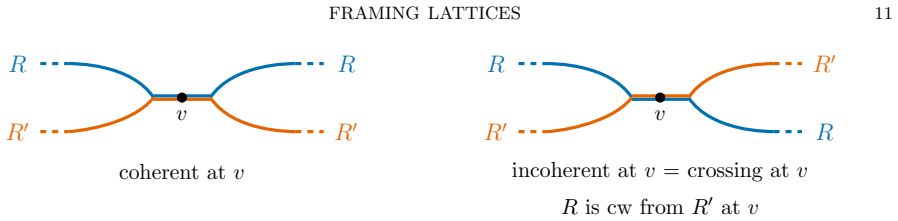
Figure 8. Figure 8: The coherent relation coincides with non-crossing relation when the framing of incoming and outgoing edges increases from top to bottom at every vertex. If two routes R, R′ are incoherent at v as shown on the right, we say that R is clockwise (cw) from R′ at v. edges of Gn from top to bottom. The maximal cliques of (G, F) are in correspondence with permutations of [n] as follows. Given a permutation [i1, .… view at source ↗
Figure 9
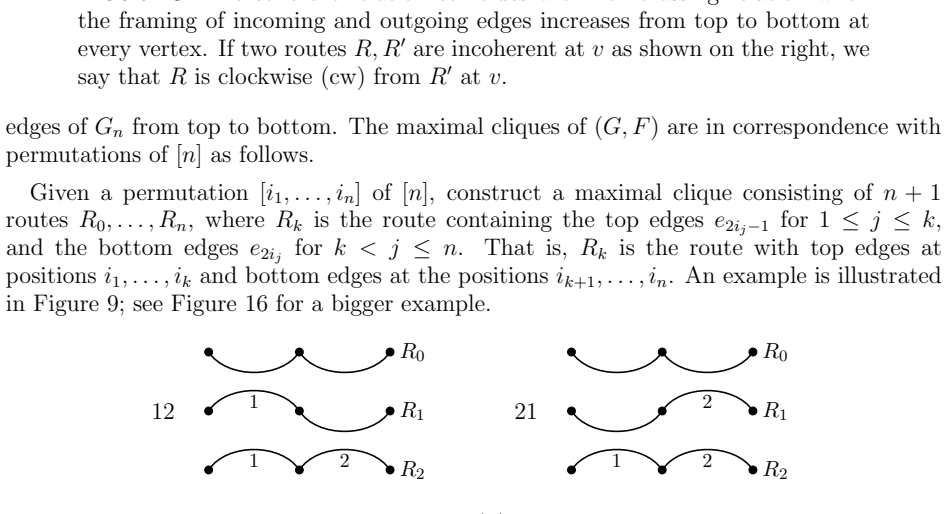
Figure 9. Figure 9: Maximal cliques of the oru(n) graph are in bijection with permu￾tations of [n]. It is not hard to see that the resulting set of routes is a maximal clique, and that all the maximal cliques are of this form. Therefore, the maximal simplices of the framing triangulation of FGn induced by the framing F are naturally labeled by permutations of [n]. Moreover, two facets are adjacent if and only if the correspon… view at source ↗
Figure 10
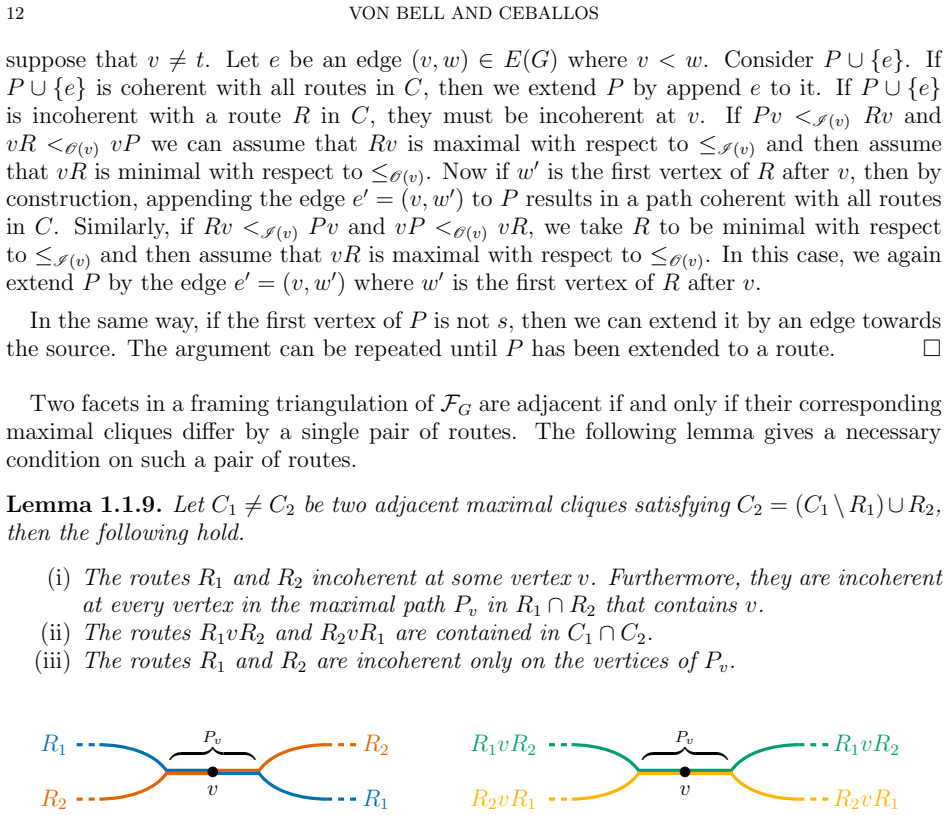
Figure 10. Figure 10: The routes R1, R2, R1vR2, and R2vR1 of Lemma 1.1.9. Proof. We first prove (i). If the routes R1 and R2 are coherent, then since R2 is coherent with all the routes in C1 ∩ C2, we have that C1 ∪ R2 is a clique larger than C1. However, this contradicts the maximality of C1, and so R1 and R2 must be incoherent at some v. It follows from the definition of incoherent routes that R1 and R2 are also incoherent at… view at source ↗
Figure 11
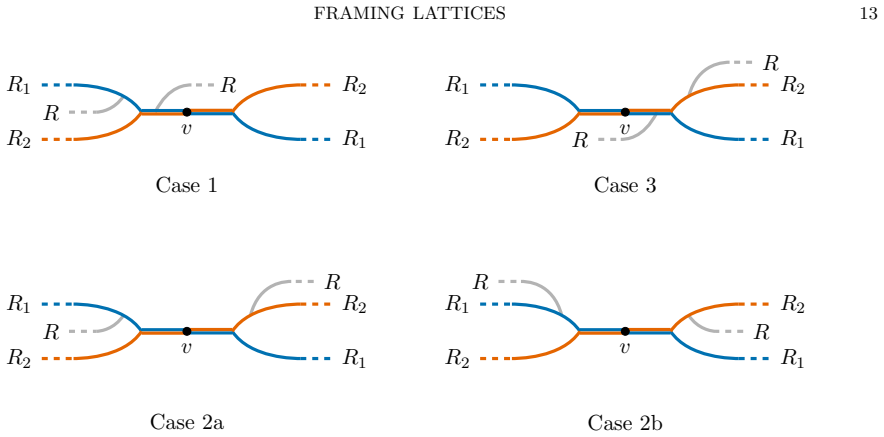
Figure 11. Figure 11: Examples of the three cases in the proof of Lemma 1.1.9. For (iii), we let y ∈ R1 ∩ R2 such that y /∈ Pv. Note that R1 and R2 must be coherent at y, as otherwise R1vR2 and R2vR1 would be incoherent at y, which is not possible by (ii). Hence we have (iii). □ The following proposition characterizes precisely the condition under which a route in a maximal clique can be replaced by another route to form an ad… view at source ↗
Figure 12
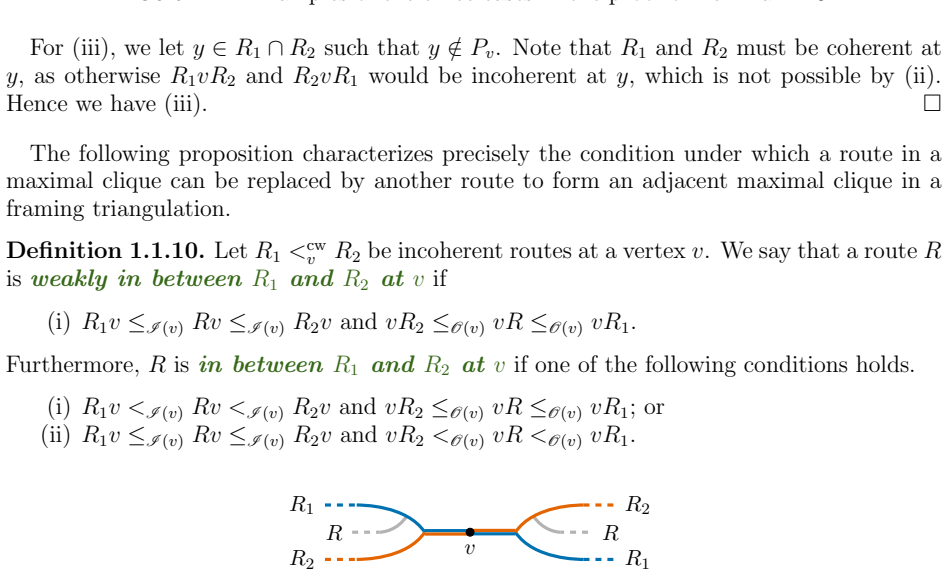
Figure 12. Figure 12: The route R is in between R1 and R2 at v. The same is true for routes RvR1, RvR2, R1vR, and R2vR. Proposition 1.1.11. Let R1 be a route in a maximal clique C1, and let R2 be a route such that R1 <cw v R2 for some v. Then C2 = (C1 \ R1) ∪ R2 is a maximal clique if and only if the following statements hold. (i) (The “Top-Bottom Property”) The routes Top(R1, R2) := R1vR2 and Bot(R1, R2) := R2vR1 are containe… view at source ↗
Figure 13
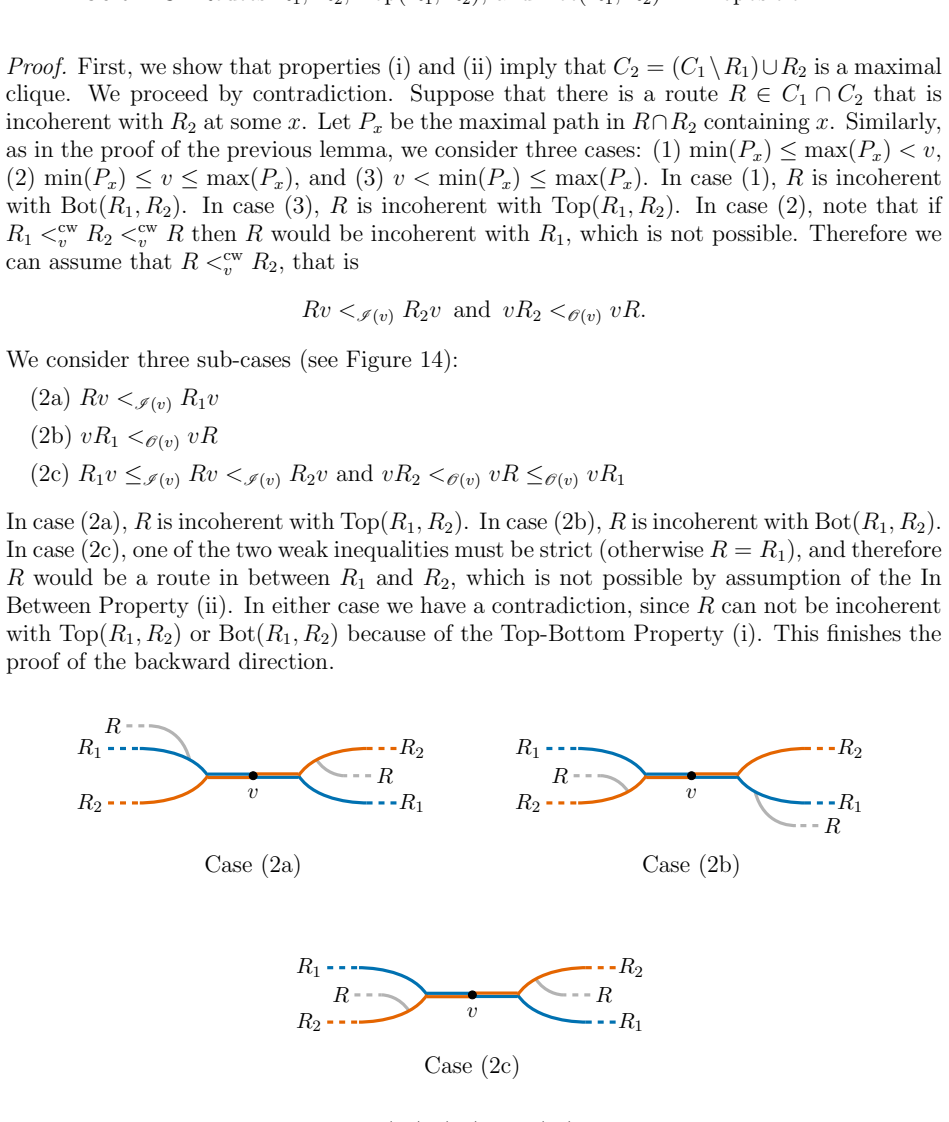
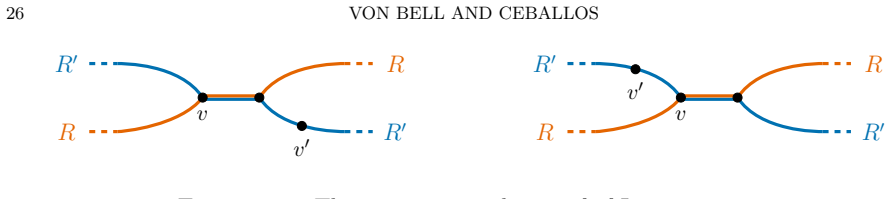
Figure 13. Figure 13: Routes R1, R2, Top(R1, R2), and Bot(R1, R2) in Proposition 1.1.11. Proof. First, we show that properties (i) and (ii) imply that C2 = (C1 \R1)∪R2 is a maximal clique. We proceed by contradiction. Suppose that there is a route R ∈ C1 ∩ C2 that is incoherent with R2 at some x. Let Px be the maximal path in R∩R2 containing x. Similarly, as in the proof of the previous lemma, we consider three cases: (1) min(… view at source ↗
Figure 14
Figure 14. Figure 14: Examples of the cases (2a), (2b) and (2c) in the proof of Proposition 1.1.11 [PITH_FULL_IMAGE:figures/full_fig_p014_14.png] view at source ↗
Figure 15
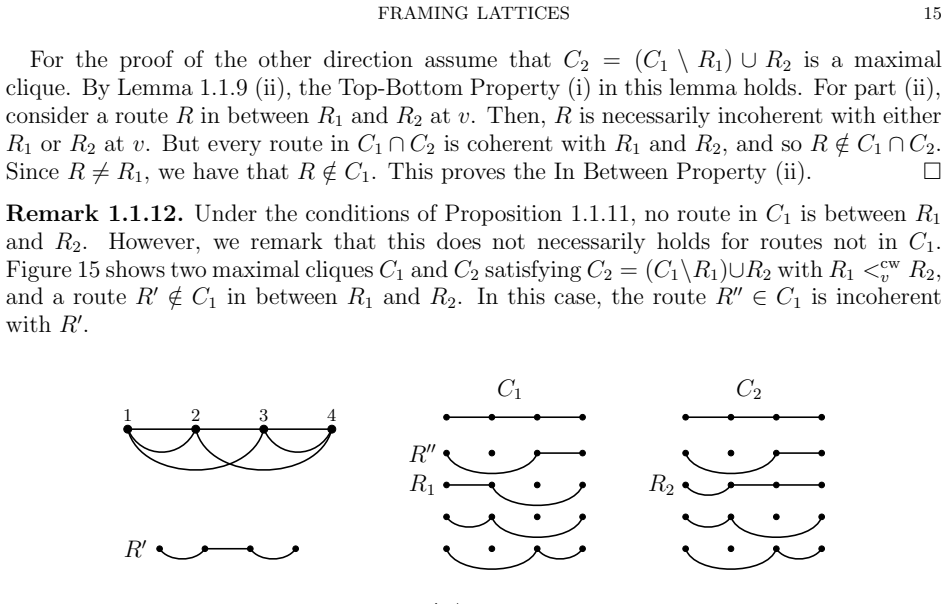
Figure 15. Figure 15: shows two maximal cliques C1 and C2 satisfying C2 = (C1\R1)∪R2 with R1 <cw v R2, and a route R′ ∈/ C1 in between R1 and R2. In this case, the route R′′ ∈ C1 is incoherent with R′ . 1 2 3 4 R′ C1 R1 R′′ C2 R2 [PITH_FULL_IMAGE:figures/full_fig_p015_15.png] view at source ↗
Figure 16
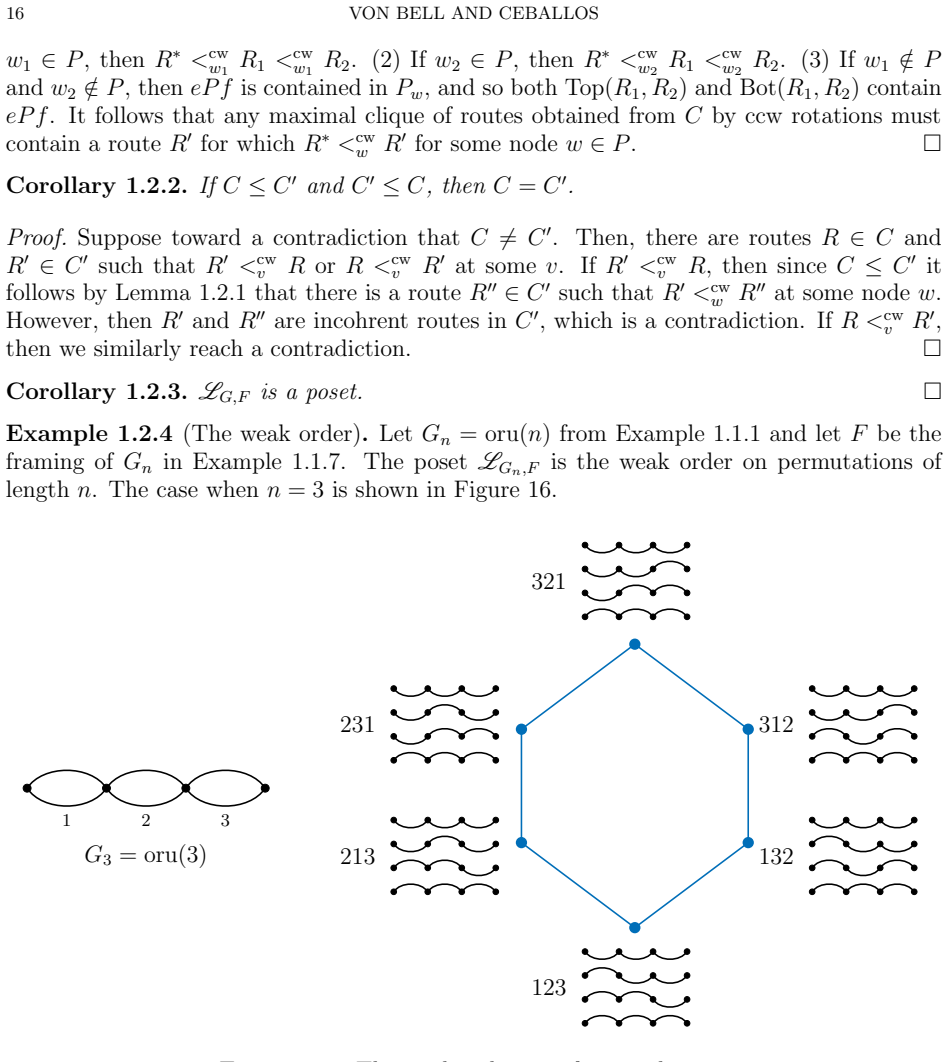
Figure 16. Figure 16: The weak order as a framing lattice. Example 1.2.5. Let G be the graph oru(3) but with the added edge (1, 3). Let the framing F be induced by the drawing in [PITH_FULL_IMAGE:figures/full_fig_p016_16.png] view at source ↗
Figure 17
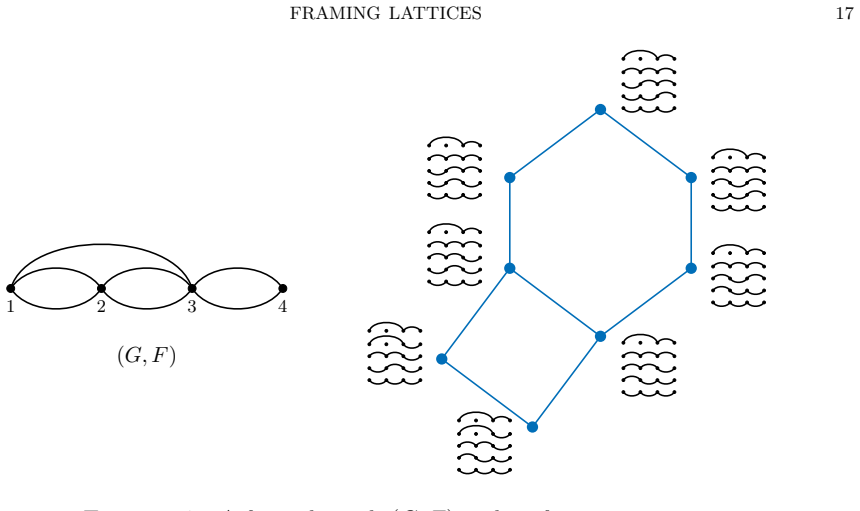
Figure 17. Figure 17: A framed graph (G, F) and its framing poset. the length framing of car(n), as drawn on the left of [PITH_FULL_IMAGE:figures/full_fig_p017_17.png] view at source ↗
Figure 18
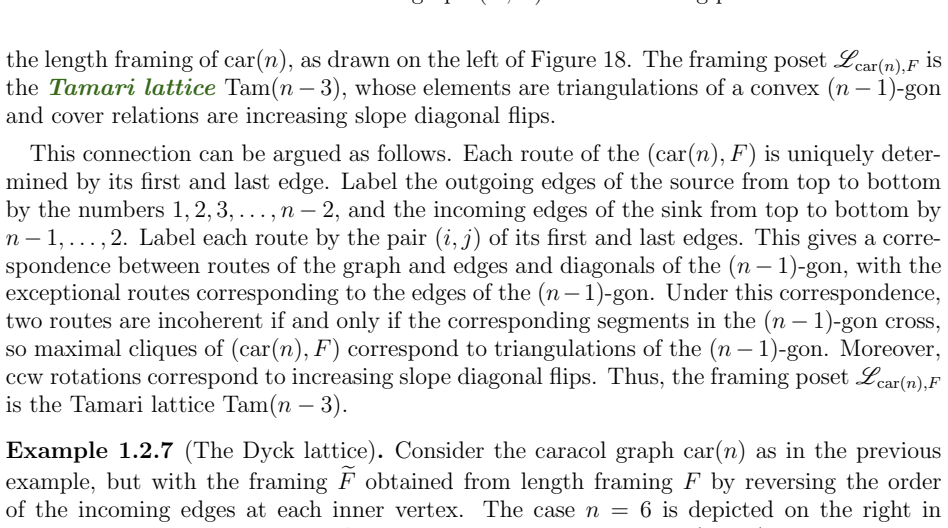
Figure 18. Figure 18: The framing poset Lcar(n),Fe is the Dyck lattice Dyck(n − 3), whose elements are lattice paths in an (n − 3) × (n − 3) grid using north and east steps from the left-bottom corner to the top-right corner that stay weakly above the main diagonal, i.e. Dyck paths in an (n − 3) × (n − 3) square. A path π2 covers π1 in the Dyck lattice if π2 can be obtained from π1 by adding one box. The bijection between maxi… view at source ↗
Figure 18
Figure 18. Figure 18: The Tamari lattice and the Dyck lattice as framing lattices of the caracol graph car(6) (with two different framings). and FG′ are integrally equivalent, meaning they are affinely equivalent and have the same Ehrhart polynomial [27, Lemma 2.2]. Contracting idle edges in G also preserves the framing poset, along with the operations mentioned in the following lemma. Lemma 1.2.12. The following operations of… view at source ↗
Figure 19
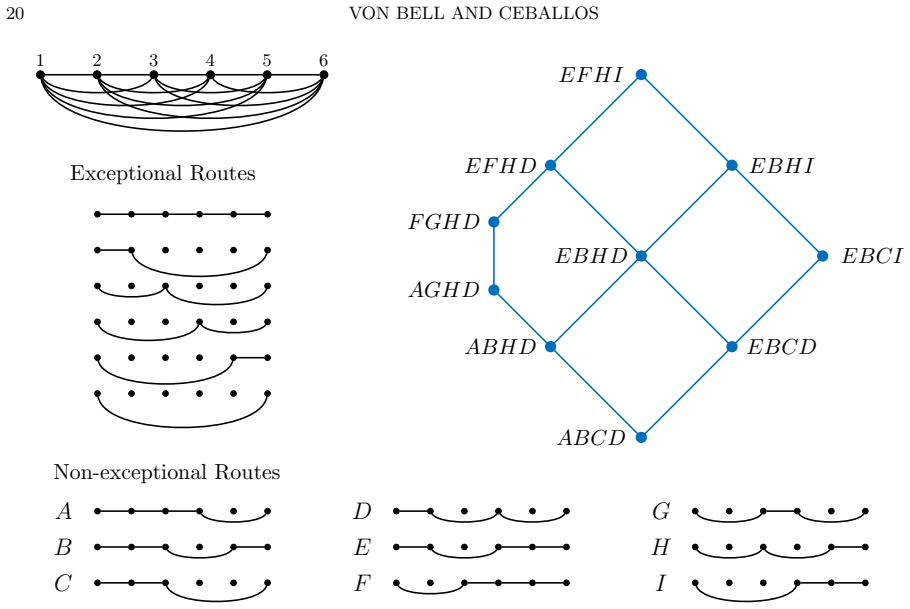
Figure 19. Figure 19: The graph K6 drawn with the length framing, its six exceptional routes, nine non-exceptional routes, and framing poset. (G, F) LG,F (Grev, F) LGrev,F (G, Frev) LG,Frev (Grev, Frev) LGrev,Frev [PITH_FULL_IMAGE:figures/full_fig_p020_19.png] view at source ↗
Figure 20
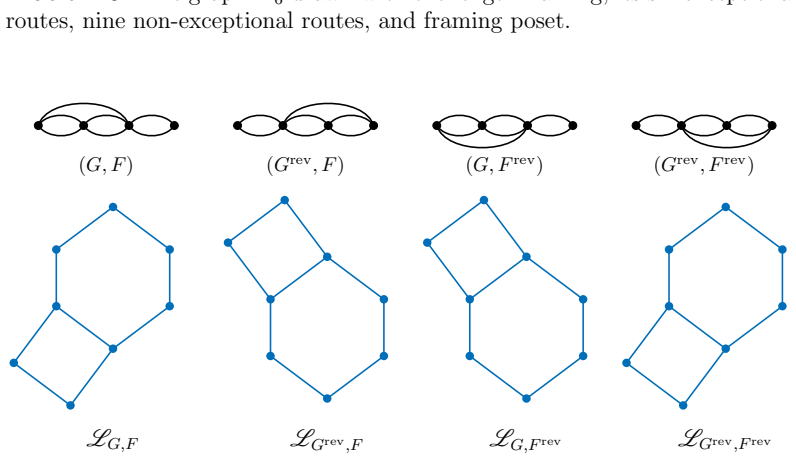
Figure 20. Figure 20: An example of the graph operations in Lemma 1.2.11 and the corresponding framing lattices. at v under F1 if and only if their images under φ are coherent at v under F2. Thus φ extends to a bijection Φ between maximal cliques. Furthermore, it is easy to verify that Φ is order-preserving. □ [PITH_FULL_IMAGE:figures/full_fig_p020_20.png] view at source ↗
Figure 21
Figure 21. Figure 21: Cases (1) and (2) in the proof of Lemma 1.2.13 [PITH_FULL_IMAGE:figures/full_fig_p022_21.png] view at source ↗
Figure 22
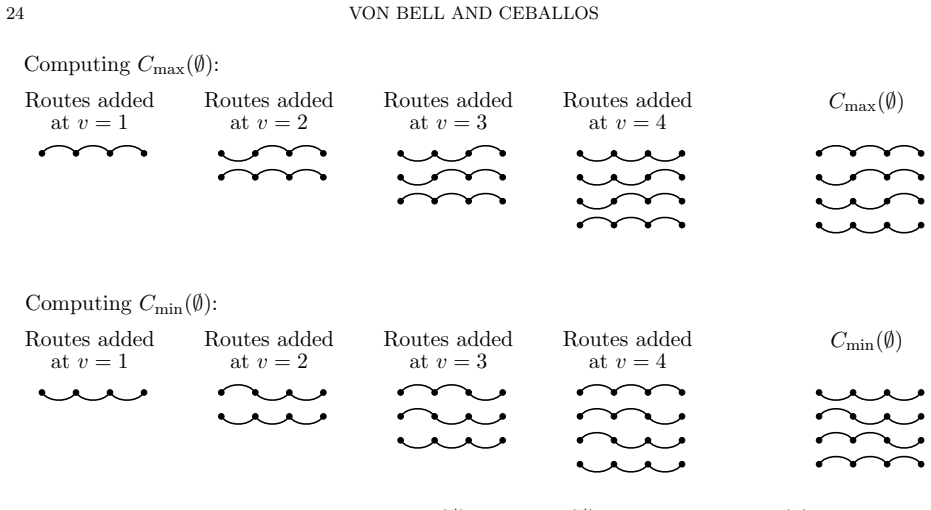
Figure 22. Figure 22: Computing Cmax(∅) and Cmin(∅) for the graph oru(3). Cmax(S) is e1e3e5. We have considered all paths incoming to 1, so we proceed to vertex 2. The path e2e3e5 is considered first and added to Cmax(S). The next path to be considered is the path e1e3e5, which is already contained in Cmax(S). Nevertheless, it is added again and the innermost loop in the algorithm terminates, and we proceed to vertex 3. The fi… view at source ↗
Figure 23
Figure 23. Figure 23: The two cases in the proof of Lemma 1.2.18. When S = ∅, the next lemma implies that the framing poset LG,F has a unique minimal element b0 and a unique maximal element b1. Lemma 1.2.19. Let S be a set of pairwise coherent paths and C be a maximal clique whose routes are coherent with the paths in S. The following hold: (1) If C ̸= Cmax(S) then there is a maximal clique C ′ whose routes are coherent with t… view at source ↗
Figure 24
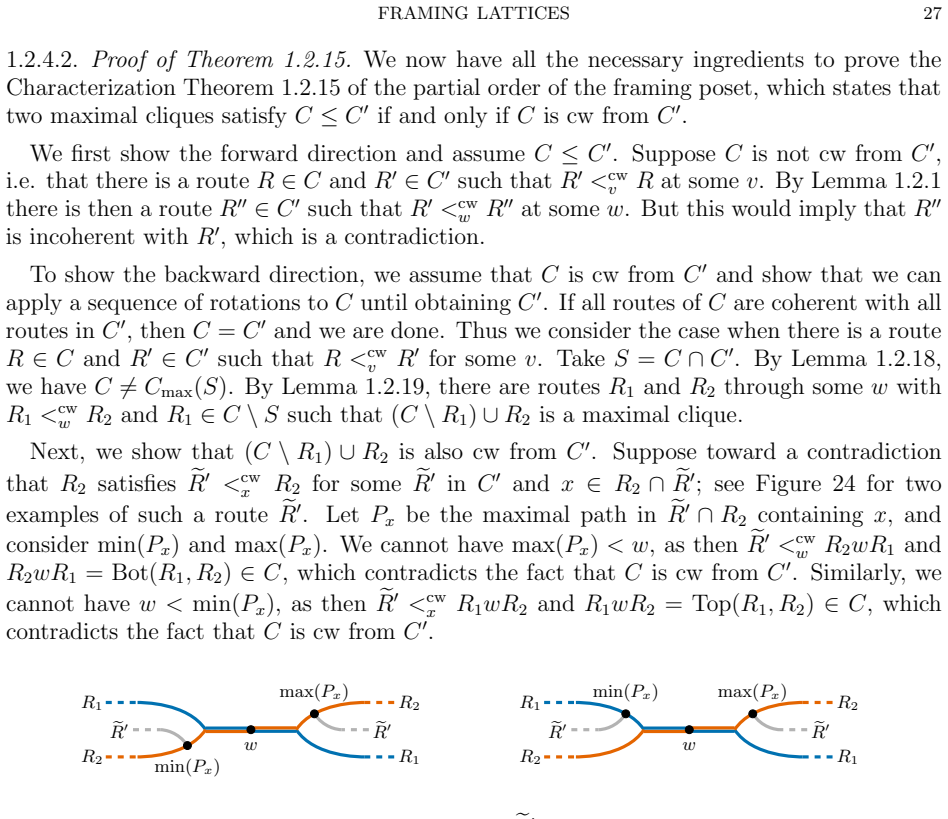
Figure 24. Figure 24: Two examples for the route Re′ in the proof of Theorem 1.2.15. If min(Px) ≤ w ≤ max(Px), observe that that since C is cw from C ′ we cannot have Re′ be cw from R1wR2, R2wR1, or R1 as they are all routes in C. Thus R1w ≤I (w) Re′w <I (w) R2w and wR2 <O(w) wRe′ ≤O(w) wR1. Consider the case when R1w <I (w) Re′w. Let q be the largest vertex after which R1w and Re′w coincide. Let Q denote the path formed by th… view at source ↗
Figure 25
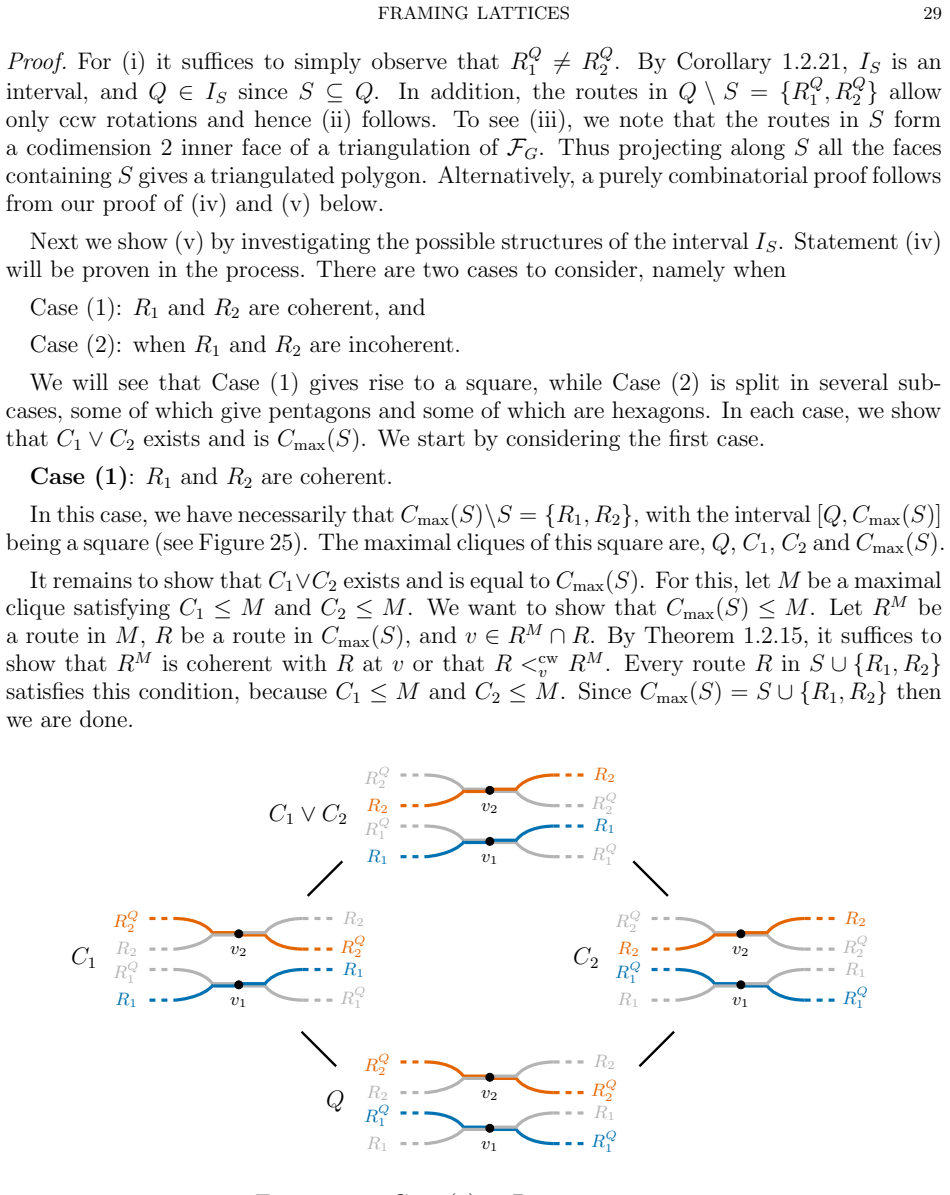
Figure 25. Figure 25: Case (1) in Proposition 1.3.3. Case (2): R1 and R2 are incoherent. Suppose that R1 and R2 are incoherent at a vertex x. Without lost of generality, we can assume that R1 <cw x R2. Let Px denote the maximal path containing x in R1 ∩ R2 at [PITH_FULL_IMAGE:figures/full_fig_p029_25.png] view at source ↗
Figure 26
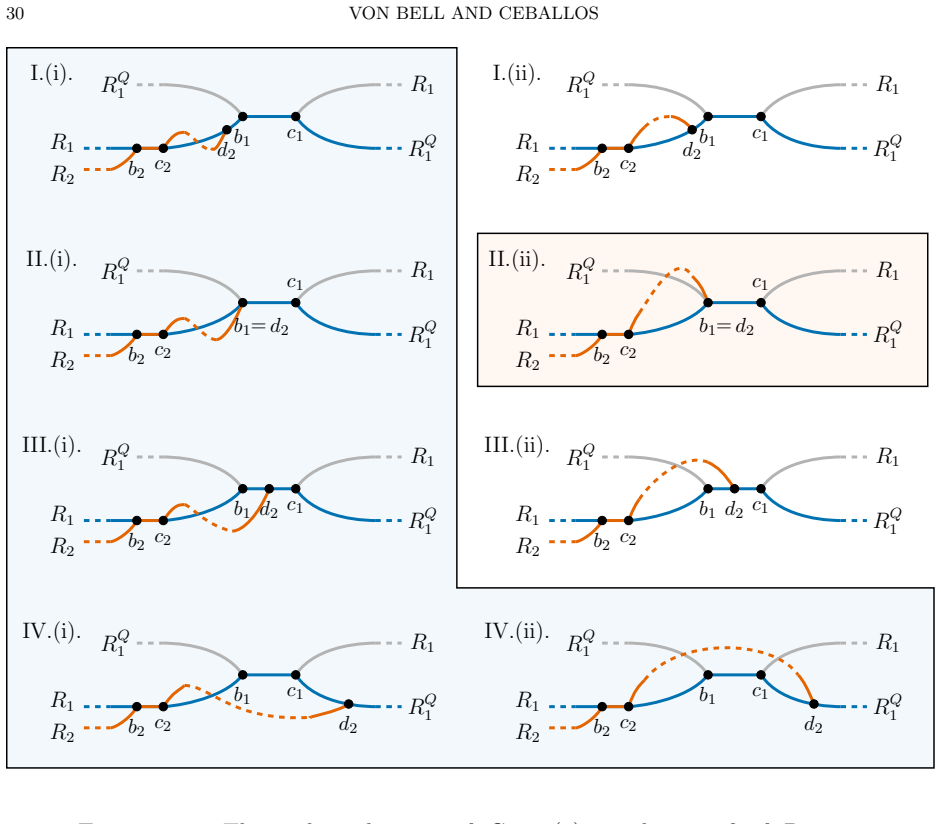
Figure 26. Figure 26: The eight sub-cases of Case (2) in the proof of Proposi￾tion 1.3.3(v). The five cases in the light-blue region give rise to pentagons, the case in the light-orange region gives rise to the hexagon, and the remaining two cases are impossible. which R1 and R2 are incoherent. Let w1 be a vertex at which R Q 1 and R1 are incoherent, and let Pw1 be the path at which they are incoherent. We assume that x < w1 (… view at source ↗
Figure 27
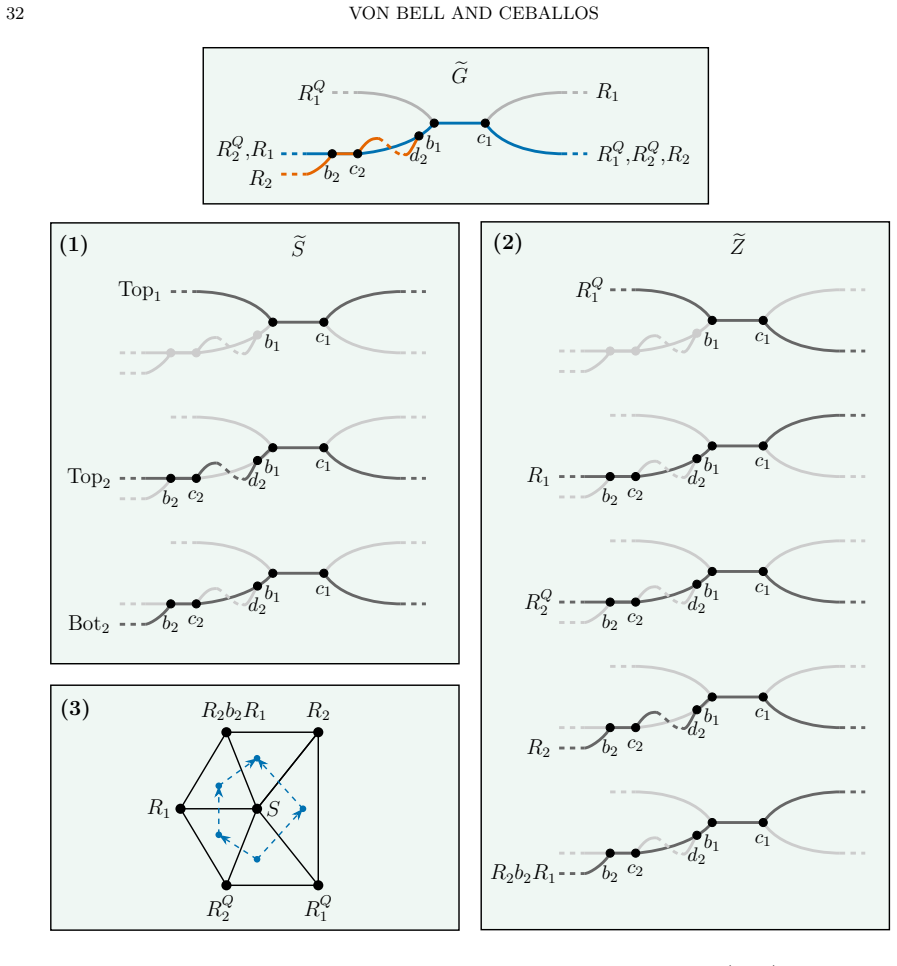
Figure 27. Figure 27: Steps 1-3 in the strategy applied to Case (2.I.i). Next, we consider Case I.(i). The outcome of the steps throughout our strategy are illustrated in [PITH_FULL_IMAGE:figures/full_fig_p032_27.png] view at source ↗
Figure 28
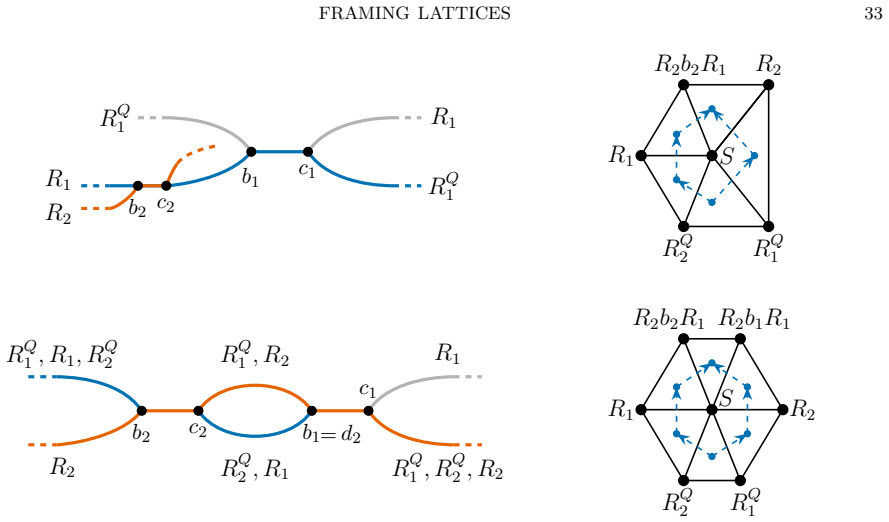
Figure 28. Figure 28: The pentagonal and hexagonal sub-cases and their respective coherence graphs. which is a contradiction. In the second case, R1 <cw b2 R because R1b2 <I (b2) R2b2 <I (b2) Rb2 and b2R <O(b2) b2R1. This implies that R and R1 are incoherent, which is a contradiction. In Step 3, we find the coherence graph between the routes in Ze∪S, which is a triangulated pentagon, with a point in the middle representing the… view at source ↗
Figure 29
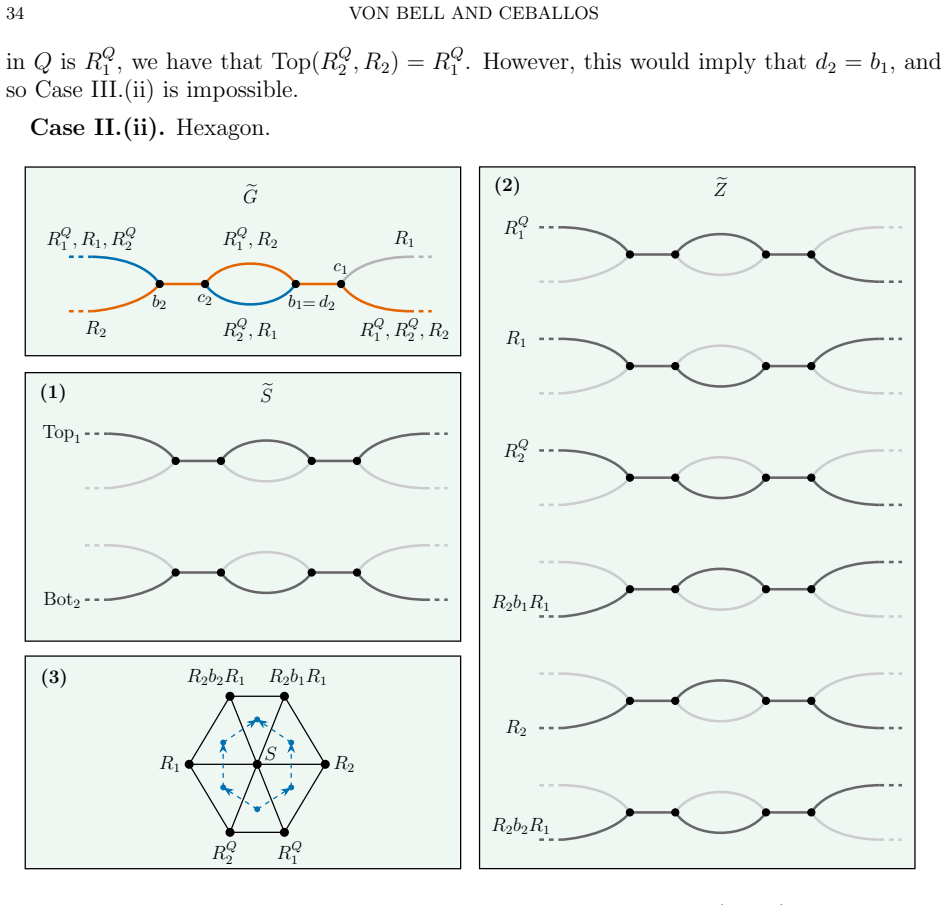
Figure 29. Figure 29: Steps 1-3 in the strategy applied to Case (2.II.ii). It remains to consider Case II.(ii). Similarly as in the previous case, since Top(R Q 2 , R2) ∈ Q is incoherent with R1, we have that Top(R Q 2 , R2) = R Q 1 . This case is depicted in Fig￾ure 28 (bottom). The outcomes of the steps throughout our strategy are illustrated in [PITH_FULL_IMAGE:figures/full_fig_p034_29.png] view at source ↗
Figure 30
Figure 30. Figure 30: The pentagonal sub-cases in the proof of Proposition 1.3.3(v). there exists a route R ∈ S that is incoherent with either R2b1R1 or R2b2R1. Using similar arguments as in Step 2a for the pentagonal Case I.(i), one can deduce that R is incoherent with R1 or R2, which is a contradiction. In Step 3, we find the coherence graph between the routes in Ze∪S, which is a triangulated hexagon, with a point in the mid… view at source ↗
Figure 31
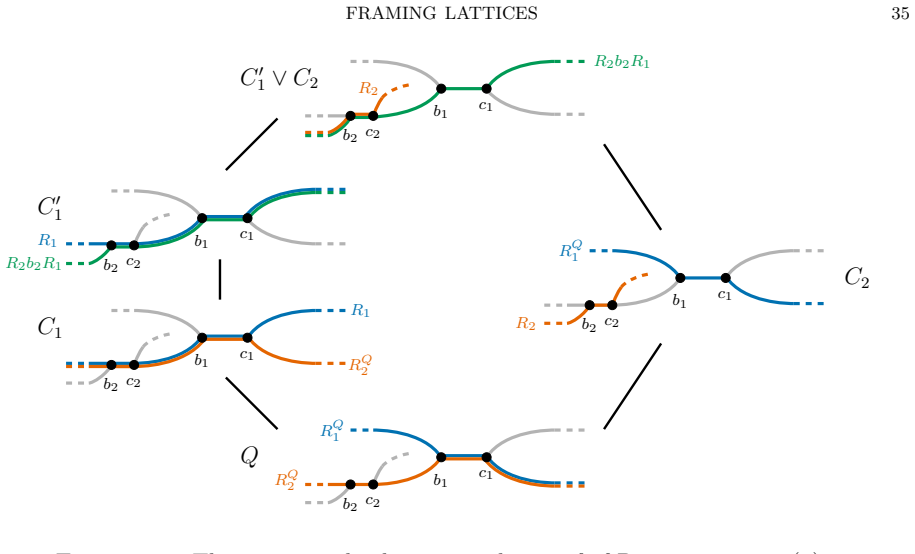
Figure 31. Figure 31: The hexagonal sub-case in the proof of Proposition 1.3.3(v). Theorem 1.3.4. The framing poset LG,F is a polygonal lattice. The polygons are squares, pentagons or hexagons. Proof. The fact that LG,F is a lattice follows from the BEZ Lemma 1.3.1 and Proposi￾tion 1.3.3(v). Polygonality also follows from Proposition 1.3.3(iv) and (v). □ 1.3.2. Meets and joins. In the previous section, the join (resp. meet) of… view at source ↗
Figure 32
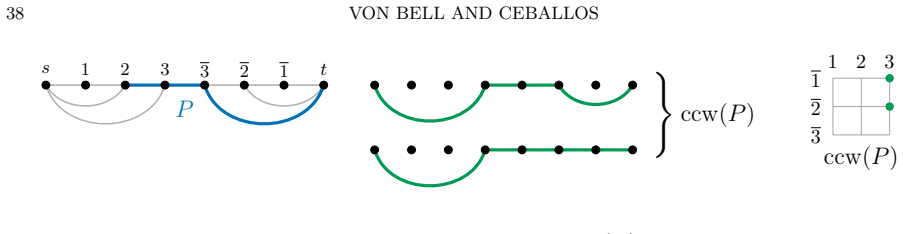
Figure 32. Figure 32: Two maximal cliques satisfying C ∨ C ′ ̸= Cmax(C ∩ C ′ ). Similarly, let cw(P) denote the set of routes clockwise from P, i.e. cw(P) := {R | R <cw v P for some v ∈ G}. Note that if P is of length less than 2, then ccw(P) and cw(P) are necessarily empty. An example is shown in [PITH_FULL_IMAGE:figures/full_fig_p037_32.png] view at source ↗
Figure 33
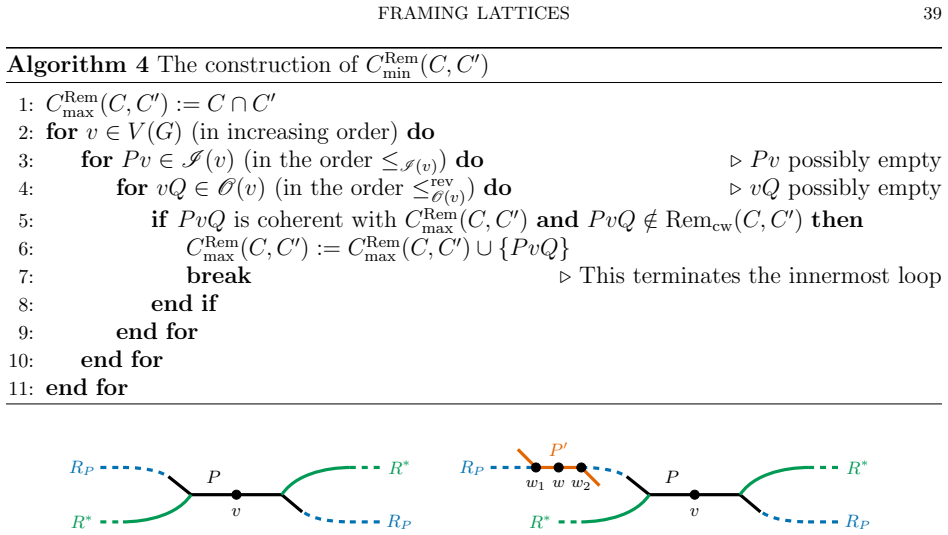
Figure 33. Figure 33: Example of ccw(P). For two maximal cliques C and C ′ , we define the following sets of routes: Remccw(C, C′ ) := [ P is a path ccw(P)∩(C∪C′ )=∅ ccw(P), and Remcw(C, C′ ) := [ P is a path cw(P)∩(C∪C′ )=∅ cw(P). Here Rem stands for “removed”, as the routes in Remccw(C, C′ ) and Remcw(C, C′ ) will be removed from consideration in the construction of the join and meet. For the join, we construct the clique C … view at source ↗
Figure 34
Figure 34. Figure 34: Some routes and paths involved in the proof of Lemma 1.3.5. Lemma 1.3.5. The cliques C Rem max (C, C′ ) and C Rem min (C, C′ ) are maximal. Proof. We prove only the statement for C Rem max (C, C′ ) as the proof for C Rem max (C, C′ ) is sym￾metric. Suppose toward a contradiction that C Rem max (C, C′ ) is not maximal. Then, there is a route R∗ that is coherent with all routes in C Rem max (C, C′ ), but no… view at source ↗
Figure 35
Figure 35. Figure 35: The path P, and the extended paths Pe1 and Pf2. (2) the cw-extended path labeling ℓe1(C1, C2) := Pe1, and (3) the ccw-extended path labeling ℓe2(C1, C2) := Pe2. Since we will be mainly using ℓe1 instead of ℓe2, we often call ℓe1 the extended path labeling for simplicity, and make a distinction adding cw or ccw when necessary. As we observed already in the proofs of semidistributivity and of the HH-lattice… view at source ↗
Figure 36
Figure 36. Figure 36: Opposite edges containing the minimal or maximal element of a polygon have the same path and extended path labelings. for this reason. Examples are illustrated in [PITH_FULL_IMAGE:figures/full_fig_p045_36.png] view at source ↗
Figure 37
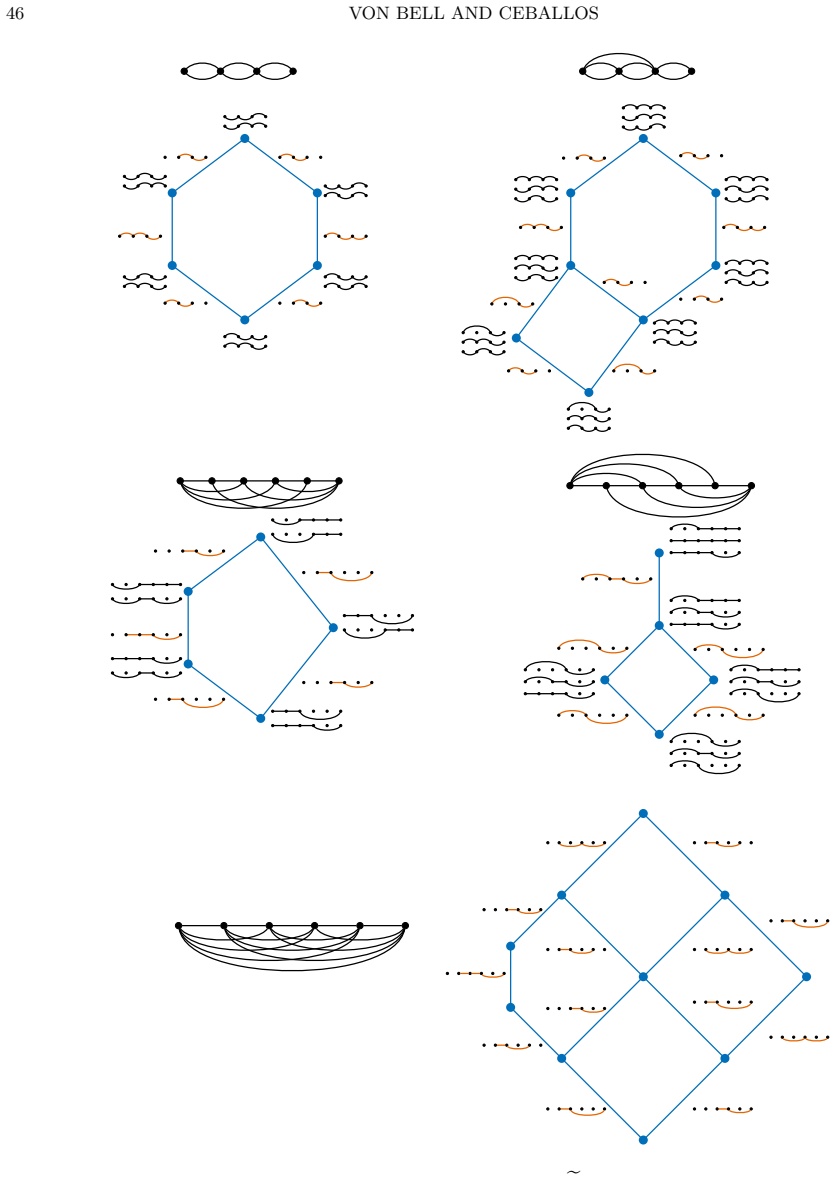
Figure 37. Figure 37: The cw-extended path labeling ℓe1 for the running examples in Figures 16 to 18. The exceptional routes in each maximal clique have been suppressed for clarity [PITH_FULL_IMAGE:figures/full_fig_p046_37.png] view at source ↗
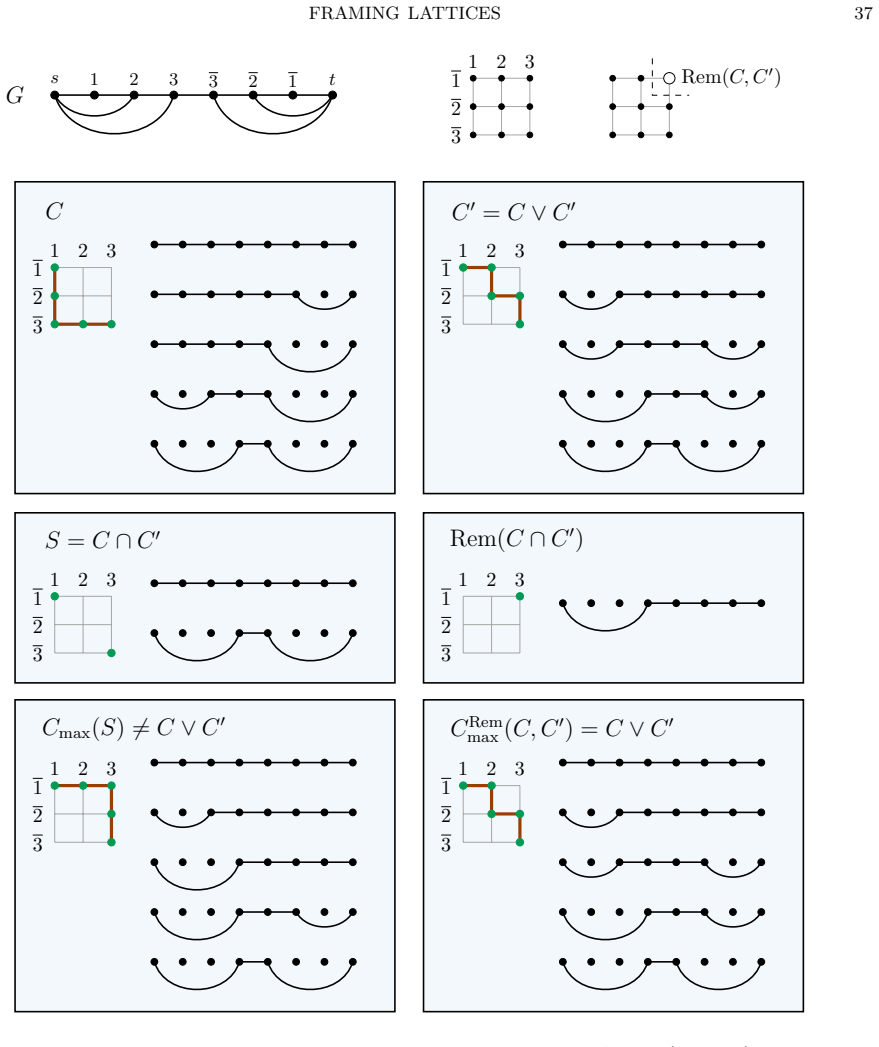
Figure 38
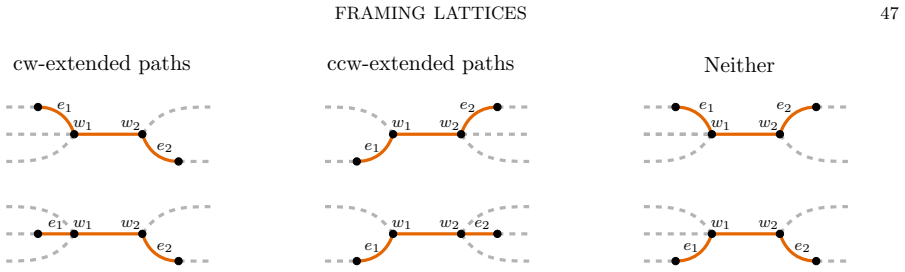
Figure 38. Figure 38: Visual representations of cw-extended paths and ccw-extended paths obtained from a path from w1 to w2. Moreover, φ ccw and φ cw are inverses of each other. We call φ cw the cw-map and φ ccw the ccw-map. 1.4.2. Join irreducibles and meet irreducibles. Now that we have introduced the pre￾liminary concepts, we are ready to give a complete and very simple understanding of the join irreducible and meet irreduc… view at source ↗
Figure 39
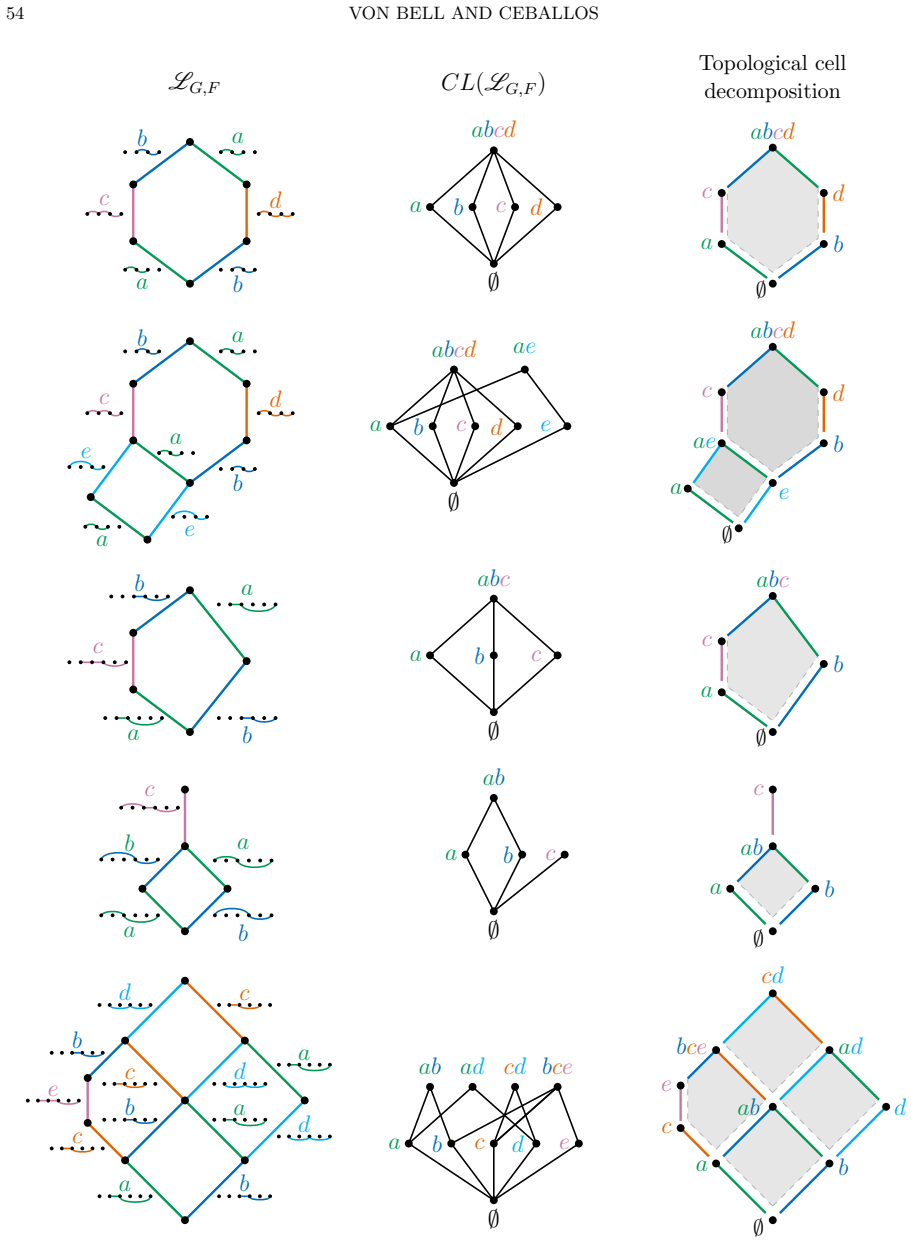
Figure 39. Figure 39: Examples of the core label order of the framing lattices in [PITH_FULL_IMAGE:figures/full_fig_p054_39.png] view at source ↗
Figure 40
Figure 40. Figure 40: Some lattice quotients obtained via M-moves. 1.5.1. An equivalence relation via M-moves. We say that an edge e = (i, j) is an inner edge of G if i and j are inner vertices, i.e. when e is not incident to the source or sink of G. Given an inner edge e = (i, j) of G, define the graph M(G, e) as the graph obtained from G by replacing e with the edges (s, j) and (i, t). In other words, M(G, e) is obtained fro… view at source ↗
Figure 41
Figure 41. Figure 41 [PITH_FULL_IMAGE:figures/full_fig_p055_41.png] view at source ↗
Figure 42
Figure 42. Figure 42: The split map applied to two maximal cliques. Lemma 1.5.1. For an inner edge e = (i, j) of G, the split map Φe is a surjection from the set of maximal cliques in (G, F) to the set of maximal cliques in (M(G, e), Fe). Proof. Given a maximal clique C in (G, F), it is clear from the construction that the routes in Φe(C) are pairwise coherent in (M(G, e), Fe). Let R be a route in M(G, e) that is coherent with… view at source ↗
Figure 43
Figure 43. Figure 43: Two examples of the distributive lattice LGv Alternatively, the elements of LGv can be described as lattice paths in the plane from (0, 0) to (a, b) using unit East steps and unit North steps. Each mutlipermutation of 1a2 b can be transformed in such a lattice path by replacing each 1 by an E step and each 2 by a N step. The covering relation can be then described as adding a box to the path. This resulti… view at source ↗
Figure 44
Figure 44. Figure 44: The Boolean lattice of M-moves. (but only 20 up to horizontal and vertical symmetry) [31]. As we have shown, every lattice quotient obtained from M-moves is itself a framing lattice. But we do not know if every lattice quotient is a framing lattice as well. We leave this as an open question, which is interesting even in the simple case of the oruga graph. Question 1.6.1. Is every lattice quotient of a fra… view at source ↗
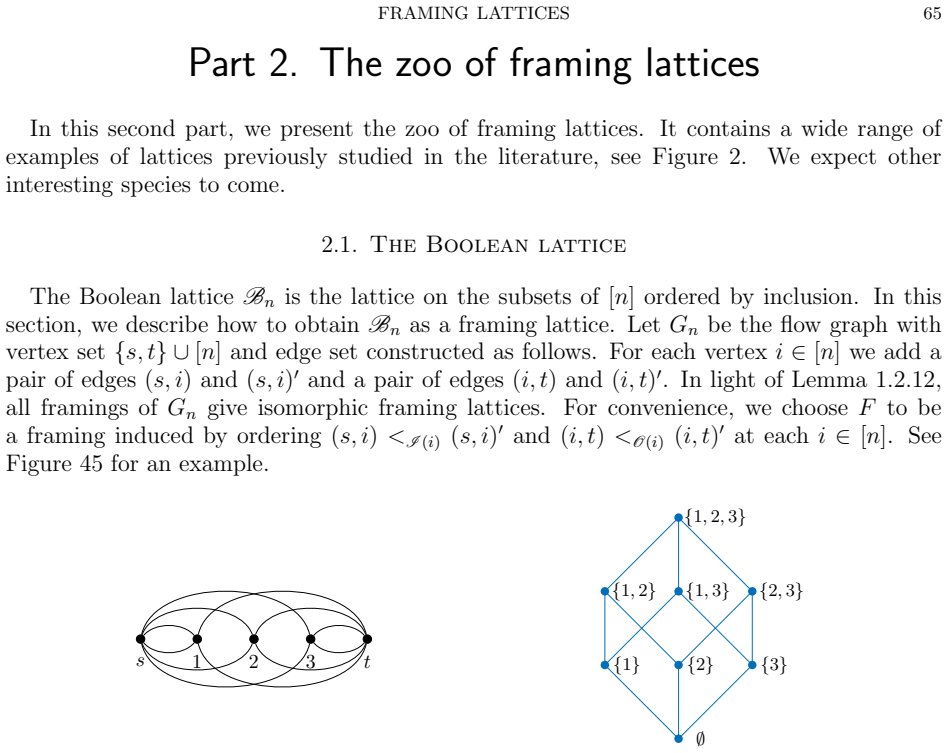
Figure 45
Figure 45. Figure 45: for an example. s 1 2 3 t ∅ {1} {2} {3} {1, 2} {1, 3} {2, 3} {1, 2, 3} [PITH_FULL_IMAGE:figures/full_fig_p065_45.png] view at source ↗
Figure 46
Figure 46. Figure 46: The polygon Pε(3) and the Cambrian caracol graph Gε for the parameter ε = (−, +, −). • horizontal edges (s, 0),(0, 1),(1, 2), . . . ,(n − 1, n),(n, t), • positive edges (s, a) +,(a − 1, t) + when ε(a) = + (above the horizontal line), and • negative edges (s, a) −,(a − 1, t) − when ε(a) = − (below the horizontal line). The graph Gε is independent of ε, and coincides with the caracol graph car(n + 3) from E… view at source ↗
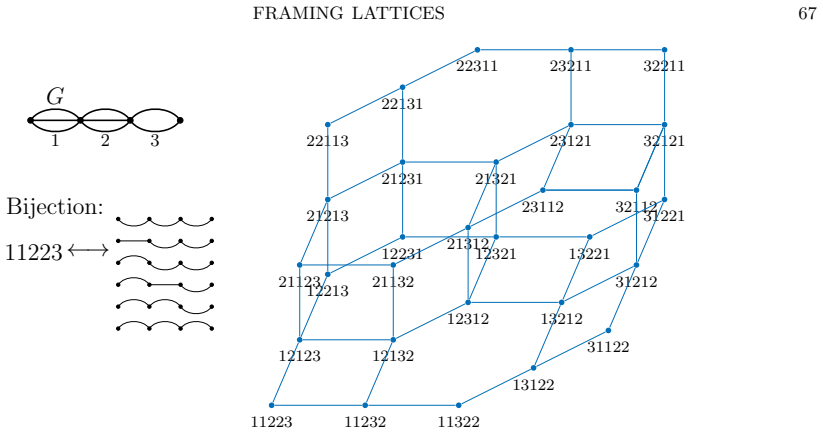
Figure 47
Figure 47. Figure 47: The lattice of multipermutations. transposition of two adjacent numbers. Note that when choosing s = (1, . . . , 1) with length n, the lattice of multipermutations Ms is the classical weak order on Sn. For s = (s1, s2, . . . , sn), let oru(s) be the graph on vertex set [n + 1] with si + 1 edges between i and i+1 for each i ∈ [n]. Its flow polytope is a product of n simplices, ∆s1×. . . ∆sn . Let F be the … view at source ↗
Figure 48
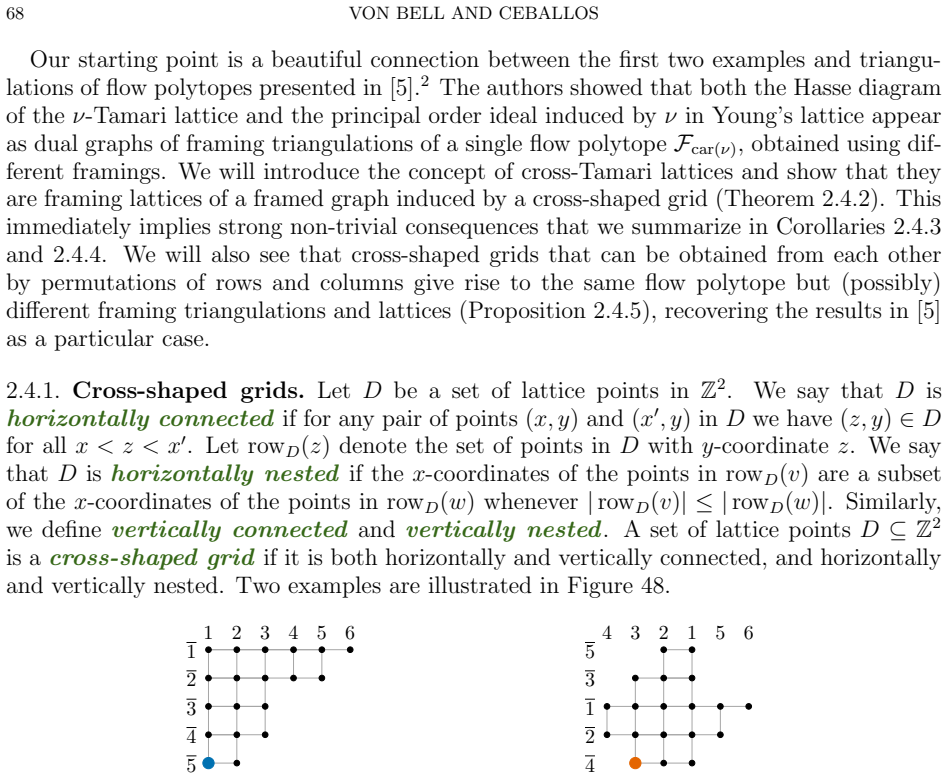
Figure 48. Figure 48: Two cross-shaped grids with proper labelings. Note that they are related by a sequence of row and column commutations that preserve the cross-shaped property. Remark 2.4.1. Replacing lattice points by unit boxes, cross-shaped grids coincide with the moon polyominos already used in the literature, see i.e. [39, 41]. We keep the terms “cross-shaped grid” and “cross-Tamari” for simplicity. 2.4.2. The cross-T… view at source ↗
Figure 49
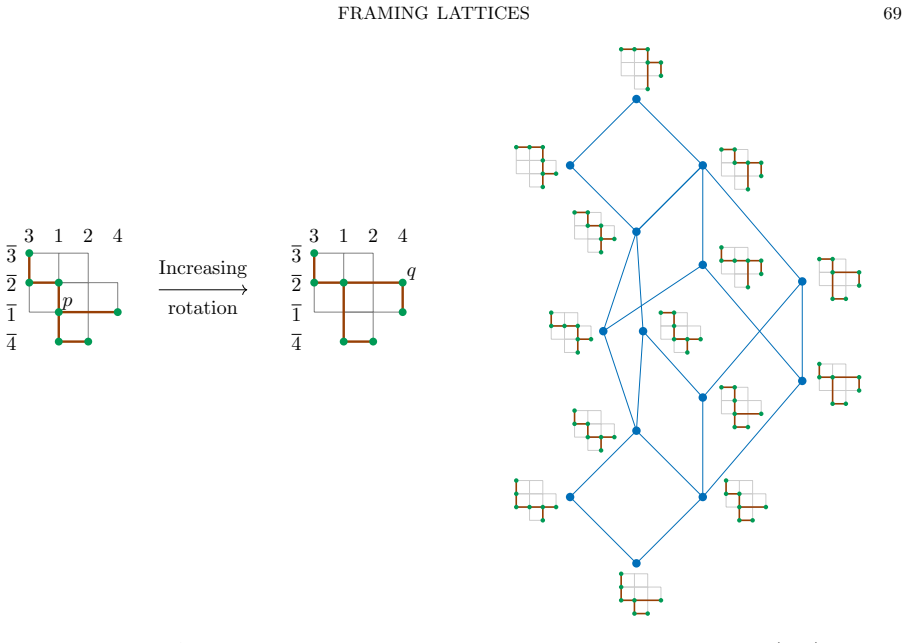
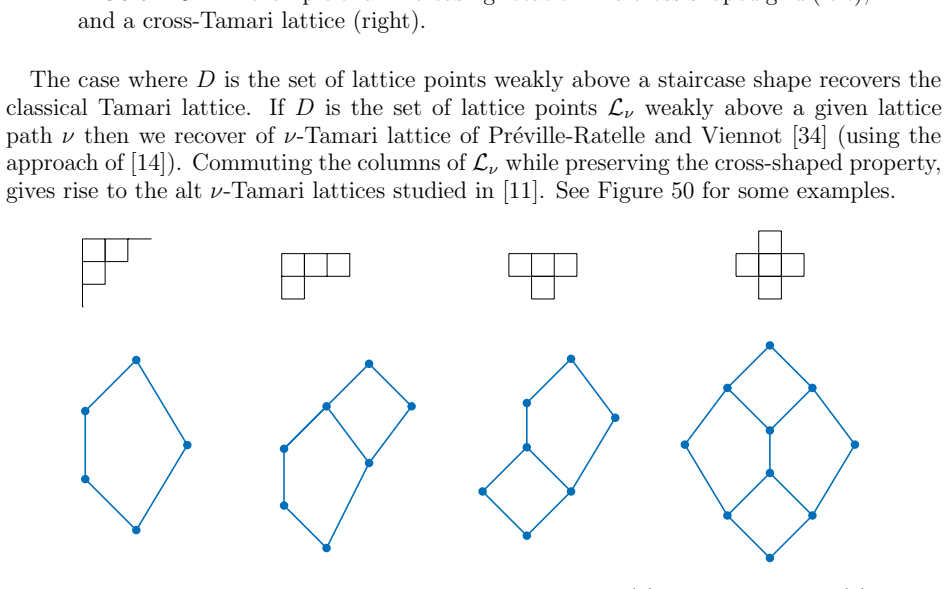
Figure 49. Figure 49: An example of an increasing rotation in a cross-shaped grid (left), and a cross-Tamari lattice (right). The case where D is the set of lattice points weakly above a staircase shape recovers the classical Tamari lattice. If D is the set of lattice points Lν weakly above a given lattice path ν then we recover of ν-Tamari lattice of Pr´eville-Ratelle and Viennot [34] (using the approach of [14]). Commuting t… view at source ↗
Figure 50
Figure 50. Figure 50: Some examples of cross-Tamari lattices: (1) a Tamari lattice, (2) a ν-Tamari lattice, (3) an alt ν-Tamari lattice, (4) the cross-Tamari lattice of the “minimal cross-shaped grid” [PITH_FULL_IMAGE:figures/full_fig_p069_50.png] view at source ↗
Figure 51
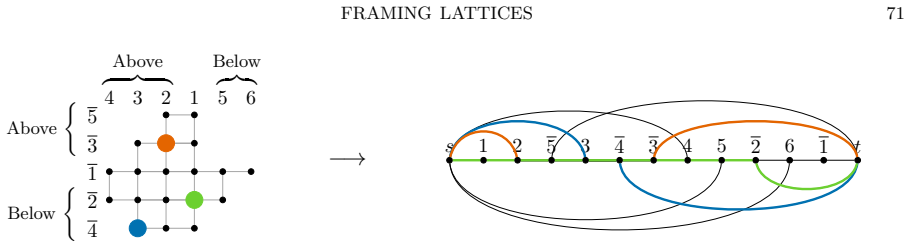
Figure 51. Figure 51: A cross-shaped grid D with a proper labeling L of its rows and columns (left). The (D, L)-caracol graph GD,L with the routes corresponding to the marked points in D highlighted (right). Proof. An important feature of GD,L is that its routes can be characterized by two edges, namely the edges of the route incident to the source and sink. We can then express the unique route that uses edges (s, i) and (j, t… view at source ↗
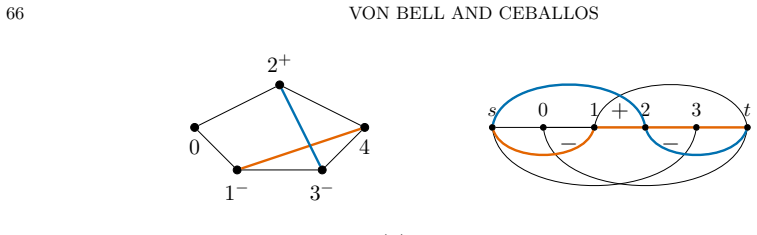
Figure 52
Figure 52. Figure 52: ε-Cambrian lattices are cross-Tamari lattices (Remark 2.4.7): ex￾ample of a Cambrian caracol graph Gε and its corresponding (D, L)-caracol graph GD,L (with the order of labels in [b] reversed). In order to get the (ε, I, J)-Cambrian lattices from [29], one just needs to restrict the cross-shaped grid corresponding to Gε to a subset of columns and a subset of rows. The restricted cross-shaped grid gives a … view at source ↗
read the original abstract

Flow polytopes of acyclic oriented graphs arise naturally in combinatorial optimization, and the study of their volumes and triangulations has revealed intriguing connections across combinatorics, geometry, algebra, and representation theory. In this work, we introduce the framing lattice associated with a framed graph, whose Hasse diagram is dual to a framed triangulation of the corresponding flow polytope. Framing lattices are remarkable in that they provide a unifying framework encompassing many classical and well-studied lattice structures, including the Boolean lattice, the Tamari lattice, and the weak order on permutations. They further subsume a broad array of examples such as all type-A Cambrian lattices, the Grassmann and grid-Tamari lattices, the alt-$\nu$-Tamari and cross-Tamari lattices, the permutree lattices, and the $\tau$-tilting posets of certain gentle algebras. We show, among several foundational structural properties, that the framing lattice is a semidistributive, congruence uniform, and polygonal lattice, with its polygons consisting of squares, pentagons, and hexagons. We study its connections to noncrossing partitions via Reading's core label orders, simple representations of its join and meet irreducible elements, and several of its lattice congruences and quotients induced by a graph operation called an M-move.

Editorial analysis

A structured set of objections, weighed in public.

Desk editor's note, referee report, simulated authors' rebuttal, and a circularity audit. Tearing a paper down is the easy half of reading it; the pith above is the substance, this is the friction.

Referee Report

2 major / 2 minor

Summary. The manuscript introduces framing lattices for framed graphs, defined such that their Hasse diagram is the dual of a framed triangulation of the flow polytope of the graph. It asserts that this construction unifies numerous classical lattices including the Boolean lattice, Tamari lattice, weak order on permutations, type-A Cambrian lattices, Grassmann and grid-Tamari lattices, alt-ν-Tamari and cross-Tamari lattices, permutree lattices, and τ-tilting posets of certain gentle algebras. The paper establishes that framing lattices are semidistributive, congruence uniform, and polygonal lattices whose polygons are squares, pentagons, and hexagons. It further investigates connections to noncrossing partitions via core label orders, join and meet irreducibles, and lattice congruences induced by M-moves.

Significance. If the central duality holds and the structural theorems are verified, this work offers a significant unifying framework connecting geometric objects (flow polytopes and triangulations) with algebraic and combinatorial structures (various lattices and posets). It could provide new geometric interpretations and proofs for properties of these lattices, advancing understanding of their relationships in combinatorial geometry and lattice theory.

major comments (2)
  1. [§2] §2 (Definition): The framing lattice is defined by declaring its Hasse diagram to be dual to a framed triangulation of the flow polytope, but the manuscript supplies no independent combinatorial description of the covering relations and no explicit base-case verification that this recovers the known Hasse diagrams of the Tamari lattice or Boolean lattice. This is load-bearing for the unification claims in the abstract and all subsequent structural results.
  2. [§4] §4 (Polygonal structure): The claim that all polygons are squares, pentagons, or hexagons is asserted from the triangulation, but the derivation does not include a concrete enumeration or small-graph example showing how the framed triangulation restricts polygon types; without this, the polygonal property remains unverified for the claimed examples.
minor comments (2)
  1. [Introduction] Notation for alt-ν-Tamari and cross-Tamari lattices should be defined explicitly on first use with a reference to prior work.
  2. [Figures] Figure captions for triangulations should label vertices or edges corresponding to lattice elements to aid readability.

Simulated Author's Rebuttal

2 responses · 0 unresolved

We thank the referee for their thoughtful and constructive report. The two major comments identify places where the manuscript would benefit from additional explicit verifications and small examples. We agree with both points and will revise the paper to address them directly.

read point-by-point responses
  1. Referee: [§2] §2 (Definition): The framing lattice is defined by declaring its Hasse diagram to be dual to a framed triangulation of the flow polytope, but the manuscript supplies no independent combinatorial description of the covering relations and no explicit base-case verification that this recovers the known Hasse diagrams of the Tamari lattice or Boolean lattice. This is load-bearing for the unification claims in the abstract and all subsequent structural results.

    Authors: We acknowledge that the current definition is primarily geometric and that an independent combinatorial description of the covering relations, together with explicit base-case checks, would make the unification claims more self-contained. In the revised version we will add a direct combinatorial characterization of the covering relations in terms of the framed graph (using the M-moves and local flips already present in §3). We will also insert explicit verifications for the Boolean lattice (the case of the empty framing on a complete graph) and the Tamari lattice (the path graph with the standard framing), confirming that the resulting Hasse diagrams coincide with the classical ones. These additions will be placed immediately after the definition in §2. revision: yes

  2. Referee: [§4] §4 (Polygonal structure): The claim that all polygons are squares, pentagons, or hexagons is asserted from the triangulation, but the derivation does not include a concrete enumeration or small-graph example showing how the framed triangulation restricts polygon types; without this, the polygonal property remains unverified for the claimed examples.

    Authors: The referee correctly notes the absence of a concrete small example. We will add a fully worked example in the revised §4 using the flow polytope of a 4-vertex acyclic graph with a simple framing. We will list all maximal simplices of the framed triangulation, compute the dual 2-faces, and enumerate the resulting polygons, verifying that only squares, pentagons, and hexagons appear. This explicit enumeration will illustrate the restriction imposed by the framing and support the general claim. revision: yes

Circularity Check

0 steps flagged

No significant circularity: framing lattice defined geometrically and shown to recover classical examples by explicit correspondence.

full rationale

The paper introduces the framing lattice by definition as the poset whose Hasse diagram is dual to a framed triangulation of the flow polytope of a framed graph. All subsequent structural results (semidistributivity, congruence uniformity, polygonal structure) and unification claims (recovering Boolean, Tamari, Cambrian, permutree lattices, etc.) follow from this geometric construction and from exhibiting specific framed graphs whose triangulations reproduce the known covering relations of the classical lattices. No equation reduces a derived quantity to a fitted parameter or to the target result by construction; no self-citation chain is invoked to justify the central definition; the unification is obtained by direct comparison rather than by renaming or self-reference. The derivation is therefore self-contained against the external combinatorial benchmarks it claims to unify.

Axiom & Free-Parameter Ledger

0 free parameters · 1 axioms · 1 invented entities

The central claim rests on the new definition of framed graphs and the duality between their framing lattices and triangulations of flow polytopes. No free parameters are introduced. The main axiom is the duality itself.

axioms (1)
  • domain assumption Hasse diagram of framing lattice is dual to a framed triangulation of the flow polytope
    This duality is the defining property stated in the abstract.
invented entities (1)
  • framing lattice no independent evidence
    purpose: Unifying poset whose Hasse diagram is dual to framed triangulations
    Newly introduced construction that subsumes multiple known lattices.

pith-pipeline@v0.9.0 · 5523 in / 1236 out tokens · 27611 ms · 2026-05-16T20:08:13.351054+00:00 · methodology

discussion (0)

Sign in with ORCID, Apple, or X to comment. Anyone can read and Pith papers without signing in.

Lean theorems connected to this paper

Citations machine-checked in the Pith Canon. Every link opens the source theorem in the public Lean library.

What do these tags mean?
matches
The paper's claim is directly supported by a theorem in the formal canon.
supports
The theorem supports part of the paper's argument, but the paper may add assumptions or extra steps.
extends
The paper goes beyond the formal theorem; the theorem is a base layer rather than the whole result.
uses
The paper appears to rely on the theorem as machinery.
contradicts
The paper's claim conflicts with a theorem or certificate in the canon.
unclear
Pith found a possible connection, but the passage is too broad, indirect, or ambiguous to say the theorem truly supports the claim.

Reference graph

Works this paper leans on

42 extracted references · 42 canonical work pages

  1. [1]

    Kostant partitions functions and flow poly- topes

    Welleda Baldoni and Mich` ele Vergne. “Kostant partitions functions and flow poly- topes”. In:Transform. Groups13.3-4 (2008), pp. 447–469

  2. [2]

    On flow polytopes, nu-associahedra, and the subdivision algebra

    Matias von Bell. “On flow polytopes, nu-associahedra, and the subdivision algebra”. In:Theses and Dissertations–Mathematics. 90(2022).url:https://uknowledge. uky.edu/math_etds/90

  3. [3]

    Framing lattices and flow polytopes

    Matias von Bell and Cesar Ceballos. “Framing lattices and flow polytopes”. In:S´ em. Lothar. Combin.91 (2024), p. 9812

  4. [4]

    Unpublished work in progress

    Matias von Bell, Cesar Ceballos, and Sergio Fernandez de soto Guerrero.Framingtopes. Unpublished work in progress. In preparation. 2025. 74 REFERENCES

  5. [5]

    A Unifying Framework for thenu-Tamari Lattice and Principal Order Ideals in Young’s Lattice

    Matias von Bell et al. “A Unifying Framework for thenu-Tamari Lattice and Principal Order Ideals in Young’s Lattice”. In:Combinatorica(2023), pp. 1–26

  6. [6]

    Triangulations of flow polytopes, ample framings, and gentle algebras

    Matias von Bell et al. “Triangulations of flow polytopes, ample framings, and gentle algebras”. In:Selecta Mathematica30.3 (2024), p. 55

  7. [7]

    A combinatorial model for computing volumes of flow poly- topes

    Carolina Benedetti et al. “A combinatorial model for computing volumes of flow poly- topes”. In:Trans. Amer. Math. Soc.372.5 (2019), pp. 3369–3404

  8. [8]

    Two families of Newman lattices

    Mary K Bennett and Garrett Birkhoff. “Two families of Newman lattices”. In:Algebra Universalis32 (1994), pp. 115–144

  9. [9]

    Wilting theory of flow polytopes

    Jonah Berggren and Khrystyna Serhiyenko. “Wilting theory of flow polytopes”. In: S´ em. Lothar. Combin.91 (2024)

  10. [10]

    Cayley lat- tices of finite Coxeter groups are bounded

    Nathalie Caspard, Claude Le Conte de Poly-Barbut, and Michel Morvan. “Cayley lat- tices of finite Coxeter groups are bounded”. In:Advances in Applied Mathematics33.1 (2004), pp. 71–94

  11. [11]

    On linear intervals in the altν-Tamari lat- tices

    Cesar Ceballos and Cl´ ement Chenevi` ere. “On linear intervals in the altν-Tamari lat- tices”. In:Combinatorial Theory4.2 (2024)

  12. [12]

    Dyck path triangulations and extendability

    Cesar Ceballos, Arnau Padrol, and Camilo Sarmiento. “Dyck path triangulations and extendability”. In:J. Combin. Theory Ser. A131 (2015), pp. 187–208.issn: 0097- 3165,1096-0899

  13. [13]

    Geometry ofν-Tamari lattices in typesAandB

    Cesar Ceballos, Arnau Padrol, and Camilo Sarmiento. “Geometry ofν-Tamari lattices in typesAandB”. In:Trans. Amer. Math. Soc.371.4 (2019), pp. 2575–2622

  14. [14]

    Theν-Tamari lattice viaν- trees,ν-bracket vectors, and subword complexes

    Cesar Ceballos, Arnau Padrol, and Camilo Sarmiento. “Theν-Tamari lattice viaν- trees,ν-bracket vectors, and subword complexes”. In:Electron. J. Comb27 (2020)

  15. [15]

    Thes-weak order ands-permutahedra I: combina- torics and lattice structure

    Cesar Ceballos and Viviane Pons. “Thes-weak order ands-permutahedra I: combina- torics and lattice structure”. In:arXiv preprint arXiv:2212.11556(2022)

  16. [16]

    On the volume of a certain polytope

    Clara S Chan, David P Robbins, and David S Yuen. “On the volume of a certain polytope”. In:Experimental Mathematics9.1 (2000), pp. 91–99

  17. [17]

    Coherent fans in the space of flows in framed graphs

    Vladimir I. Danilov, Alexander V. Karzanov, and Gleb A. Koshevoy. “Coherent fans in the space of flows in framed graphs”. In:24th International Conference on For- mal Power Series and Algebraic Combinatorics (FPSAC 2012). Discrete Math. Theor. Comput. Sci. Proc., AR. 2012, pp. 481–490

  18. [18]

    Splitting lattices generate all lattices

    Alan Day. “Splitting lattices generate all lattices”. In:Algebra Universalis7 (1977), pp. 163–169

  19. [19]

    De Loera, J¨ org Rambau, and Francisco Santos.Triangulations

    Jes´ us A. De Loera, J¨ org Rambau, and Francisco Santos.Triangulations. Vol. 25. Algo- rithms and Computation in Mathematics. Structures for algorithms and applications. Springer-Verlag, Berlin, 2010, pp. xiv+535.isbn: 978-3-642-12970-4
  20. [20]

    Oriented flip graphs of polygonal subdi- visions and noncrossing tree partitions

    Alexander Garver and Thomas McConville. “Oriented flip graphs of polygonal subdi- visions and noncrossing tree partitions”. In:J. Combin. Theory Ser. A158 (), pp. 126– 175.issn: 0097-3165,1096-0899

  21. [21]

    Realizing thes-permutahedron via flow polytopes
    Rafael Gonz´ alez D’Le´ on et al. “Realizing thes-permutahedron via flow polytopes”. In: Transactions of the American Mathematical Society378.11 (2025), pp. 7625–7666
  22. [22]

    Quivers, cones and polytopes

    Lutz Hille. “Quivers, cones and polytopes”. In:Linear algebra and its applications365 (2003), pp. 215–237

  23. [23]

    Gelfand–Tsetlin Polytopes: A Story of Flow and Order Polytopes

    Ricky I Liu, Karola M´ esz´ aros, and Avery St Dizier. “Gelfand–Tsetlin Polytopes: A Story of Flow and Order Polytopes”. In:SIAM Journal on Discrete Mathematics33.4 (2019), pp. 2394–2415. REFERENCES 75

  24. [24]

    Lattice structure of Grid–Tamari orders

    Thomas McConville. “Lattice structure of Grid–Tamari orders”. In:Journal of Com- binatorial Theory, Series A148 (2017), pp. 27–56

  25. [25]

    Volumes and Ehrhart polynomials of flow polytopes

    Karola M´ esz´ aros and Alejandro H. Morales. “Volumes and Ehrhart polynomials of flow polytopes”. In:Math. Z.293.3-4 (2019), pp. 1369–1401

  26. [26]

    The polytope of Tesler matrices

    Karola M´ esz´ aros, Alejandro H Morales, and Brendon Rhoades. “The polytope of Tesler matrices”. In:Selecta Mathematica23.1 (2017), pp. 425–454

  27. [27]

    From generalized permutahedra to Grothendieck polynomials via flow polytopes

    Karola M´ esz´ aros and Avery St Dizier. “From generalized permutahedra to Grothendieck polynomials via flow polytopes”. In:Algebraic Combinatorics3.5 (2020), pp. 1197– 1229

  28. [28]

    The core label order of a congruence-uniform lattice

    Henri M¨ uhle. “The core label order of a congruence-uniform lattice”. In:Algebra Uni- versalis80.1 (2019), Paper No. 10, 22.issn: 0002-5240,1420-8911

  29. [29]

    Cambrian triangulations and their tropical realizations

    Vincent Pilaud. “Cambrian triangulations and their tropical realizations”. In:European Journal of Combinatorics83 (2020), p. 102997

  30. [30]

    Permutrees

    Vincent Pilaud and Viviane Pons. “Permutrees”. In:Algebraic Combinatorics1.2 (2018), pp. 173–224

  31. [31]

    Quotientopes

    Vincent Pilaud and Francisco Santos. “Quotientopes”. In:Bulletin of the London Math- ematical Society51.3 (2019), pp. 406–420

  32. [32]

    Celebrating Loday’s associ- ahedron

    Vincent Pilaud, Francisco Santos, and G¨ unter M Ziegler. “Celebrating Loday’s associ- ahedron”. In:Archiv der Mathematik121.5 (2023), pp. 559–601

  33. [33]

    A polytope related to empirical distributions, plane trees, parking functions, and the associahedron

    Jim Pitman and Richard P. Stanley. “A polytope related to empirical distributions, plane trees, parking functions, and the associahedron”. In:Discrete Comput. Geom. 27.4 (2002), pp. 603–634

  34. [34]

    The enumeration of generalized Tamari intervals

    Louis-Fran¸ cois Pr´ eville-Ratelle and Xavier Viennot. “The enumeration of generalized Tamari intervals”. In:Trans. Amer. Math. Soc.369.7 (2017), pp. 5219–5239

  35. [35]

    Cambrian lattices

    Nathan Reading. “Cambrian lattices”. In:Advances in Mathematics205.2 (2006), pp. 313–353

  36. [36]

    Lattice and order properties of the poset of regions in a hyperplane arrangement

    Nathan Reading. “Lattice and order properties of the poset of regions in a hyperplane arrangement”. In:Algebra Universalis50 (2003), pp. 179–205

  37. [37]

    Lattice theory of the poset of regions

    Nathan Reading. “Lattice theory of the poset of regions”. In:Lattice Theory: Special Topics and Applications: Volume 2. Ed. by George Gr¨ atzer and Wehrung Friedrich. Springer, 2016, pp. 399–487

  38. [38]

    Noncrossing partitions and the shard intersection order

    Nathan Reading. “Noncrossing partitions and the shard intersection order”. In:J. Algebraic Combin.33.4 (2011), pp. 483–530.issn: 0925-9899,1572-9192

  39. [39]

    Maximal 0-1-fillings of moon polyominoes with restricted chain lengths and rc-graphs

    Martin Rubey. “Maximal 0-1-fillings of moon polyominoes with restricted chain lengths and rc-graphs”. In:Adv. in Appl. Math.48.2 (2012), pp. 290–305.issn: 0196-8858,1090- 2074

  40. [40]

    Noncrossing sets and a Grassmann associahedron

    Francisco Santos, Christian Stump, and Volkmar Welker. “Noncrossing sets and a Grassmann associahedron”. In:Forum of Mathematics, Sigma. Vol. 5. Cambridge Uni- versity Press. 2017, e5

  41. [41]

    Maximal fillings of moon polyominoes, simplicial complexes, and Schubert polynomials

    Luis Serrano and Christian Stump. “Maximal fillings of moon polyominoes, simplicial complexes, and Schubert polynomials”. In:Electron. J. Combin.19.1 (2012), Paper 16, 18.issn: 1077-8926

  42. [42]

    Combinatorics of Permutreehedra and Geometry ofs-Permutahedra

    Daniel Tamayo Jim´ enez. “Combinatorics of Permutreehedra and Geometry ofs-Permutahedra”. In:arXiv preprint arXiv:2310.19732(2023). 76 REFERENCES (von Bell)Institute of Geometry, Graz University of Technology, Email address:matias.vonbell@gmail.com (Ceballos)Institute of Geometry, Graz University of Technology, Email address:cesar.ceballos@tugraz.at