ESCHER: Efficient and Scalable Hypergraph Evolution Representation with Application to Triad Counting
Pith reviewed 2026-05-16 19:58 UTC · model grok-4.3
The pith
ESCHER is a GPU-centric parallel data structure that supports efficient dynamic updates and triad counting in large hypergraphs.
A machine-rendered reading of the paper's core claim, the machinery that carries it, and where it could break.
Core claim
ESCHER is a GPU-centric parallel data structure for Efficient and Scalable Hypergraph Evolution Representation designed to manage large-scale hypergraph dynamics efficiently. A companion hypergraph triad-count update framework minimizes redundant computation while fully leveraging the data structure for dynamic operations. The approach is validated on hyperedge-based, incident-vertex-based, and temporal triad counting tasks.
What carries the argument
The ESCHER GPU-centric parallel data structure, which stores and updates hypergraph elements to enable fast dynamic operations and triad maintenance.
Load-bearing premise
The GPU implementation correctly preserves hypergraph invariants and adjacency information during every dynamic insertion or deletion.
What would settle it
Running the same sequence of hypergraph updates on both ESCHER and a verified sequential reference implementation and checking whether the final triad counts match exactly while the reported speedups fail to appear.
Figures







read the original abstract
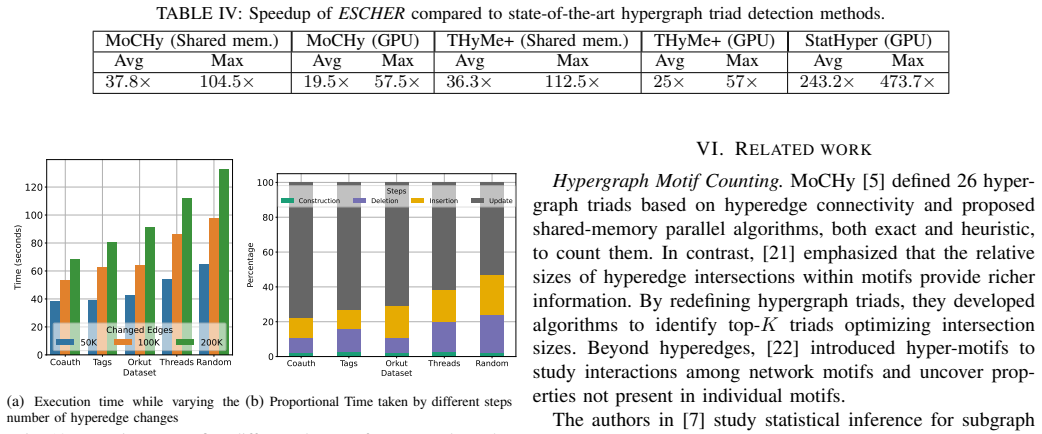
Higher-order interactions beyond pairwise relationships in large complex networks are often modeled as hypergraphs. Analyzing hypergraph properties such as triad counts is essential, as hypergraphs can reveal intricate group interaction patterns that conventional graphs fail to capture. In real-world scenarios, these networks are often large and dynamic, introducing significant computational challenges. Due to the absence of specialized software packages and data structures, the analysis of large dynamic hypergraphs remains largely unexplored. Motivated by this gap, we propose ESCHER, a GPU-centric parallel data structure for Efficient and Scalable Hypergraph Evolution Representation, designed to manage large scale hypergraph dynamics efficiently. We also design a hypergraph triad-count update framework that minimizes redundant computation while fully leveraging the capabilities of ESCHER for dynamic operations. We validate the efficacy of our approach across multiple categories of hypergraph triad counting, including hyperedge-based, incident-vertex-based, and temporal triads. Empirical results on both large real-world and synthetic datasets demonstrate that our proposed method outperforms existing state-of-the-art methods, achieving speedups of up to 104.5x, 473.7x, and 112.5x for hyperedge-based, incident-vertex-based, and temporal triad types, respectively.
Editorial analysis
A structured set of objections, weighed in public.
Referee Report
Summary. The paper proposes ESCHER, a GPU-centric parallel data structure for efficient and scalable representation of large dynamic hypergraphs, together with a triad-count update framework that minimizes redundant computation. It reports empirical speedups of up to 104.5x, 473.7x, and 112.5x over existing methods for hyperedge-based, incident-vertex-based, and temporal triad counting, respectively, on both real-world and synthetic datasets.
Significance. If the GPU implementation is shown to preserve hypergraph invariants exactly and the performance numbers are reproducible, the work would address a genuine gap in dynamic higher-order network analysis tools. The concrete speedups across multiple triad categories indicate potential practical utility for large-scale applications.
major comments (2)
- [ESCHER data structure and update framework] The abstract and experimental claims rest on the assertion that parallel GPU operations maintain exact hypergraph structure during insertions and deletions, yet no pseudocode, invariant statements, or small-scale verification (e.g., comparison against a sequential reference on a toy hypergraph) is provided to rule out race conditions or stale incidence updates.
- [Empirical evaluation] Reported speedups (104.5x–473.7x) are presented without error bars, full experimental protocol details, or hardware specifications, making it impossible to assess whether the numbers reflect stable performance or depend on particular dataset characteristics or implementation tuning.
minor comments (1)
- [Introduction] Notation for the three triad categories could be introduced more explicitly early in the paper to aid readers unfamiliar with hypergraph-specific counting variants.
Simulated Author's Rebuttal
We thank the referee for the constructive feedback and for recognizing the potential utility of ESCHER for large-scale dynamic hypergraph analysis. We address each major comment below and will incorporate revisions to improve clarity and reproducibility.
read point-by-point responses
-
Referee: [ESCHER data structure and update framework] The abstract and experimental claims rest on the assertion that parallel GPU operations maintain exact hypergraph structure during insertions and deletions, yet no pseudocode, invariant statements, or small-scale verification (e.g., comparison against a sequential reference on a toy hypergraph) is provided to rule out race conditions or stale incidence updates.
Authors: We agree that explicit documentation of the parallel operations would strengthen the presentation. In the revised manuscript we will add (i) pseudocode for the core insertion and deletion kernels, (ii) formal statements of the hypergraph invariants preserved by the GPU implementation, and (iii) results of small-scale verification experiments that compare the GPU output against a sequential reference implementation on toy hypergraphs, thereby confirming the absence of race conditions or stale updates. revision: yes
-
Referee: [Empirical evaluation] Reported speedups (104.5x–473.7x) are presented without error bars, full experimental protocol details, or hardware specifications, making it impossible to assess whether the numbers reflect stable performance or depend on particular dataset characteristics or implementation tuning.
Authors: We acknowledge that additional reporting is required for reproducibility. In the revised version we will (i) report error bars computed over multiple independent runs, (ii) provide a complete experimental protocol section that details dataset preprocessing, random seeds, and measurement methodology, and (iii) specify the exact hardware configuration (GPU model, driver version, CPU, and memory) used for all timing experiments. revision: yes
Circularity Check
No circularity: speedups derived from direct empirical comparison to external baselines
full rationale
The paper introduces a GPU data structure and triad-update framework for dynamic hypergraphs, then reports measured speedups (104.5x–473.7x) against existing state-of-the-art methods on real-world and synthetic datasets. No equations, fitted parameters, or self-citations are used to derive the performance numbers; the claims rest on external runtime measurements. The reader's assessment of score 1.0 is confirmed: no load-bearing step reduces a claimed result to its own inputs by construction.
Axiom & Free-Parameter Ledger
invented entities (1)
-
ESCHER data structure
no independent evidence
Reference graph
Works this paper leans on
-
[1]
Community detection for hyper- graph networks via regularized tensor power iteration,
Z. T. Ke, F. Shi, and D. Xia, “Community detection for hyper- graph networks via regularized tensor power iteration,”arXiv preprint arXiv:1909.06503, 2019
-
[2]
A hypergraph-based method for large-scale dynamic correlation study at the transcriptomic scale,
Y . Kong and T. Yu, “A hypergraph-based method for large-scale dynamic correlation study at the transcriptomic scale,”BMC genomics, vol. 20, pp. 1–16, 2019
work page 2019
-
[3]
Dynamic hypergraph learning for collaborative filtering,
C. Wei, J. Liang, B. Bai, and D. Liu, “Dynamic hypergraph learning for collaborative filtering,” inProceedings of the 31st ACM International Conference on Information & Knowledge Management, 2022, pp. 2108– 2117
work page 2022
-
[4]
A fine-grain hypergraph model for 2d decomposition of sparse matrices
¨U. V . C ¸ ataly¨urek and C. Aykanat, “A fine-grain hypergraph model for 2d decomposition of sparse matrices.” inIPDPS, vol. 1. Citeseer, 2001, p. 118
work page 2001
-
[5]
Hypergraph motifs: concepts, algorithms, and discoveries,
G. Lee, J. Ko, and K. Shin, “Hypergraph motifs: concepts, algorithms, and discoveries,”Proc. VLDB Endow., vol. 13, no. 12, p. 2256–2269, Jul
-
[6]
Available: https://doi.org/10.14778/3407790.3407823
[Online]. Available: https://doi.org/10.14778/3407790.3407823
-
[7]
X. T. Liu, J. Firoz, S. Aksoy, I. Amburg, A. Lumsdaine, C. Joslyn, B. Praggastis, and A. H. Gebremedhin, “High-order line graphs of non- uniform hypergraphs: Algorithms, applications, and experimental anal- ysis,” in2022 IEEE International Parallel and Distributed Processing Symposium (IPDPS). IEEE, 2022, pp. 784–794
work page 2022
-
[8]
Statistical inference for subgraph frequencies of exchangeable hyperedge models,
A. Bhattacharya, N. Chakraborty, and R. Lunde, “Statistical inference for subgraph frequencies of exchangeable hyperedge models,”arXiv preprint arXiv:2508.13258, 2025
-
[9]
Shared-memory parallel algorithms for community detection in dynamic graphs,
S. Sahu, K. Kothapalli, and D. S. Banerjee, “Shared-memory parallel algorithms for community detection in dynamic graphs,” in2024 IEEE International Parallel and Distributed Processing Symposium Workshops (IPDPSW). IEEE, 2024, pp. 250–259
work page 2024
-
[10]
Shared-memory parallel algorithms for fully dynamic maintenance of 2-connected components,
C. A. Haryan, G. Ramakrishna, K. Kothapalli, and D. S. Banerjee, “Shared-memory parallel algorithms for fully dynamic maintenance of 2-connected components,” in2022 IEEE International Parallel and Distributed Processing Symposium (IPDPS). IEEE, 2022, pp. 1195– 1205
work page 2022
-
[11]
A parallel algorithm for updating a multi-objective shortest path in large dynamic networks,
A. Khanda, S. Shovan, and S. K. Das, “A parallel algorithm for updating a multi-objective shortest path in large dynamic networks,” in Proceedings of the SC’23 Workshops of The International Conference on High Performance Computing, Network, Storage, and Analysis, 2023, pp. 739–746
work page 2023
-
[12]
Parallel multi objective shortest path update algorithm in large dynamic networks,
S. Shovan, A. Khanda, and S. K. Das, “Parallel multi objective shortest path update algorithm in large dynamic networks,”IEEE Transactions on Parallel and Distributed Systems, 2025
work page 2025
-
[13]
Hornet: An efficient data structure for dynamic sparse graphs and matrices on gpus,
F. Busato, O. Green, N. Bombieri, and D. A. Bader, “Hornet: An efficient data structure for dynamic sparse graphs and matrices on gpus,” in 2018 IEEE High Performance extreme Computing Conference (HPEC). IEEE, 2018, pp. 1–7
work page 2018
-
[14]
custinger: Supporting dynamic graph algo- rithms for gpus,
O. Green and D. A. Bader, “custinger: Supporting dynamic graph algo- rithms for gpus,” in2016 IEEE High Performance Extreme Computing Conference (HPEC). IEEE, 2016, pp. 1–6
work page 2016
-
[15]
Thyme+: Temporal hypergraph motifs and fast algorithms for exact counting,
G. Lee and K. Shin, “Thyme+: Temporal hypergraph motifs and fast algorithms for exact counting,” in2021 IEEE International Conference on Data Mining (ICDM). IEEE, 2021, pp. 310–319
work page 2021
-
[16]
Parallel algorithms for red–black trees,
H. Park and K. Park, “Parallel algorithms for red–black trees,”Theoret- ical Computer Science, vol. 262, no. 1-2, pp. 415–435, 2001
work page 2001
-
[17]
Thrust: A productivity-oriented library for cuda,
N. Bell and J. Hoberock, “Thrust: A productivity-oriented library for cuda,” inGPU computing gems Jade edition. Elsevier, 2012, pp. 359– 371
work page 2012
-
[18]
Fast triangle counting on the gpu,
O. Green, P. Yalamanchili, and L.-M. Mungu ´ıa, “Fast triangle counting on the gpu,” in2014 4th Workshop on Irregular Applications: Architec- tures and Algorithms (IAˆ 3). IEEE, 2014, pp. 1–8
work page 2014
-
[19]
Fast and adaptive list intersections on the gpu,
J. Fox, O. Green, K. Gabert, X. An, and D. A. Bader, “Fast and adaptive list intersections on the gpu,” in2018 IEEE High Performance extreme Computing Conference (HPEC). IEEE, 2018, pp. 1–7
work page 2018
-
[20]
Simplicial closure and higher-order link prediction,
A. R. Benson, R. Abebe, M. T. Schaub, A. Jadbabaie, and J. Kleinberg, “Simplicial closure and higher-order link prediction,”Proceedings of the National Academy of Sciences, vol. 115, no. 48, pp. E11 221–E11 230, 2018
work page 2018
-
[21]
Snap: A general-purpose network analysis and graph-mining library,
J. Leskovec and R. Sosi ˇc, “Snap: A general-purpose network analysis and graph-mining library,”ACM Transactions on Intelligent Systems and Technology (TIST), vol. 8, no. 1, pp. 1–20, 2016
work page 2016
-
[22]
J. Niu, I. D. Amburg, S. G. Aksoy, and A. E. Sarıy ¨uce, “Size-aware hypergraph motifs,”arXiv preprint arXiv:2311.07783, 2023
-
[23]
Emergence of dynamic properties in network hypermotifs,
M. Adler and R. Medzhitov, “Emergence of dynamic properties in network hypermotifs,”Proceedings of the National Academy of Sciences, vol. 119, no. 32, p. e2204967119, 2022
work page 2022
-
[24]
Efficiently counting triangles for hypergraph streams by reservoir-based sampling,
L. Zhang, Z. Zhang, G. Wang, Y . Yuan, and K. Zhao, “Efficiently counting triangles for hypergraph streams by reservoir-based sampling,” IEEE Transactions on Knowledge and Data Engineering, 2023
work page 2023
-
[25]
Sampling methods for counting temporal motifs,
P. Liu, A. R. Benson, and M. Charikar, “Sampling methods for counting temporal motifs,” inProceedings of the twelfth ACM international conference on web search and data mining, 2019, pp. 294–302
work page 2019
-
[26]
Hypergraphx: a library for higher-order network analysis,
Q. F. Lotito, M. Contisciani, C. De Bacco, L. Di Gaetano, L. Gallo, A. Montresor, F. Musciotto, N. Ruggeri, and F. Battiston, “Hypergraphx: a library for higher-order network analysis,”Journal of Complex Networks, vol. 11, no. 3, p. cnad019, 05 2023. [Online]. Available: https://doi.org/10.1093/comnet/cnad019
-
[27]
J. Shun, “Practical parallel hypergraph algorithms,” inProceedings of the 25th ACM SIGPLAN Symposium on Principles and Practice of Parallel Programming, ser. PPoPP ’20. New York, NY , USA: Association for Computing Machinery, 2020, p. 232–249. [Online]. Available: https://doi.org/10.1145/3332466.3374527
-
[28]
Chapel hypergraph library (chgl),
L. Jenkins, T. Bhuiyan, S. Harun, C. Lightsey, D. Mentgen, S. Aksoy, T. Stavcnger, M. Zalewski, H. Medal, and C. Joslyn, “Chapel hypergraph library (chgl),” in2018 IEEE high performance extreme computing conference (HPEC). IEEE, 2018, pp. 1–6
work page 2018
-
[29]
Analyzing dynamic hypergraphs with parallel aggregated ordered hy- pergraph visualization,
P. Valdivia, P. Buono, C. Plaisant, N. Dufournaud, and J.-D. Fekete, “Analyzing dynamic hypergraphs with parallel aggregated ordered hy- pergraph visualization,”IEEE Transactions on Visualization and Com- puter Graphics, vol. 27, no. 1, pp. 1–13, 2021
work page 2021
-
[30]
Computational graph analytics for massive streaming data,
D. Ediger, J. Riedy, D. A. Bader, and H. Meyerhenke, “Computational graph analytics for massive streaming data,”Large Scale Network- Centric Distributed Systems, pp. 619–648, 2013
work page 2013
-
[31]
Egraph: Efficient concurrent gpu-based dynamic graph processing,
Y . Zhang, Y . Liang, J. Zhao, F. Mao, L. Gu, X. Liao, H. Jin, H. Liu, S. Guo, Y . Zeng, H. Hu, C. Li, J. Zhang, and B. Wang, “Egraph: Efficient concurrent gpu-based dynamic graph processing,”IEEE Transactions on Knowledge and Data Engineering, vol. 35, no. 6, pp. 5823–5836, 2023
work page 2023
-
[32]
An efficient data structure for dynamic graph on gpus,
L. Zou, F. Zhang, Y . Lin, and Y . Yu, “An efficient data structure for dynamic graph on gpus,”IEEE Transactions on Knowledge and Data Engineering, vol. 35, no. 11, pp. 11 051–11 066, 2023
work page 2023
-
[33]
Ftgraph: A flexible tree-based graph store on persistent memory for large-scale dynamic graphs,
G. Sun, J. Zhou, B. Li, X. Gu, W. Wang, and S. He, “Ftgraph: A flexible tree-based graph store on persistent memory for large-scale dynamic graphs,” in2024 IEEE International Conference on Cluster Computing (CLUSTER). IEEE, 2024, pp. 39–50
work page 2024
-
[34]
Scalable and high- performance large-scale dynamic graph storage and processing system,
R. Wang, W. Zong, S. He, Y . Li, and Y . Xu, “Scalable and high- performance large-scale dynamic graph storage and processing system,” ACM Transactions on Storage, 2025. 11
work page 2025
discussion (0)
Sign in with ORCID, Apple, or X to comment. Anyone can read and Pith papers without signing in.