Resolving the Core-Cusp and Diversity Problems with a Baryon-Correlated Dark Matter Profile
Pith reviewed 2026-05-16 19:17 UTC · model grok-4.3
The pith
A baryon-correlated dark matter density profile reproduces observed galaxy rotation curves from baryonic mass alone.
A machine-rendered reading of the paper's core claim, the machinery that carries it, and where it could break.
Core claim
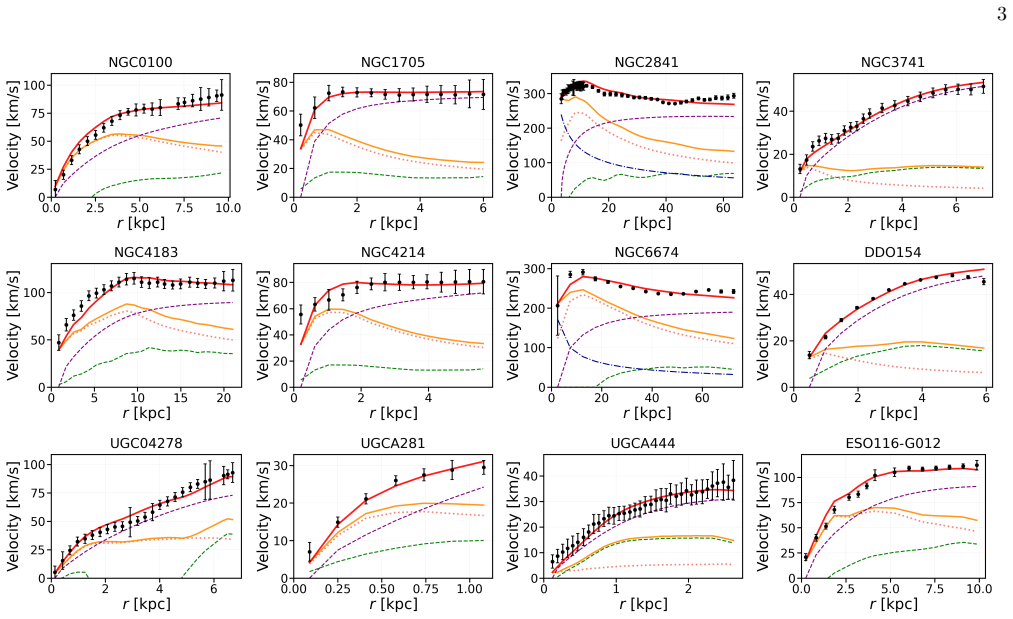
The authors posit that the effective dark matter energy density satisfies ρ_DM = μ Φ_b² / c⁴ in the galaxy rest frame, with μ scaled as K M_b^{-3/2}. This supplies an extra source term in the Poisson equation for the total gravitational potential, allowing the equation to be solved using only the observed baryonic density. The resulting circular velocities match the measured rotation curves across the sample, producing central cores rather than cusps and explaining shape variations without additional parameters.
What carries the argument
The relation ρ_DM = μ Φ_b² / c⁴ that supplies the dark-matter source term in the Poisson equation for total potential, with μ tied to total baryonic mass.
If this is right
- Rotation curves are fully determined by observed baryonic mass profiles without separate halo assumptions.
- Central density cores emerge automatically from the correlation, eliminating cusps.
- Diversity in rotation-curve shapes follows directly from differences in baryon distributions.
- The scaling parameter K remains nearly constant across galaxies of different masses and types.
- Adopting precise stellar mass-to-light ratios from surveys further reduces scatter in the fitted K values.
Where Pith is reading between the lines
- The tight clustering of K hints at a universal coupling between baryons and whatever produces the effective dark-matter density.
- The same relation could be applied to galaxy clusters or high-redshift systems to check consistency.
- If the relation holds, standard cold-dark-matter simulations would need to incorporate baryon-dependent density adjustments at galactic scales.
- Testing the model on galaxies with independent mass measurements would provide a direct check on the assumed scaling.
Load-bearing premise
Dark matter energy density is proportional to the square of the baryonic gravitational potential with a scaling factor that depends only on total baryonic mass.
What would settle it
A galaxy whose observed rotation curve deviates from the velocity profile obtained by solving the modified Poisson equation with its measured baryonic mass distribution and a K value inside the narrow range found for the sample.
Figures
read the original abstract
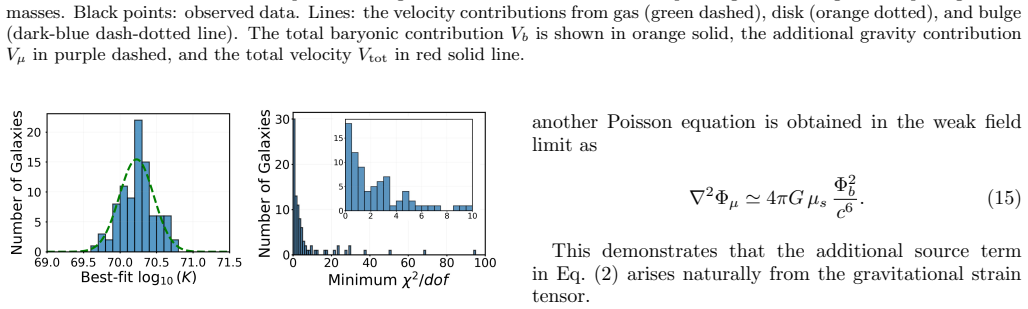
The rotation velocity profiles of galaxies (rotation curves) remain unexpectedly flat at large distances, where visible matter alone should make the rotation velocity decrease with radius. Conventionally, this requires a large amount of unseen dark matter. However, standard dark matter models face persistent small-scale challenges, such as the core-cusp and diversity problems, and struggle to explain the observed correlation between dark matter and baryons. Here, we introduce a simple empirical law for the dark matter distribution, stating that the effective dark matter energy density $\rho_{\rm DM}$ is directly correlated with the baryonic gravitational potential $\Phi_b$ with the relation of $\rho_{\rm DM} = \mu \Phi_b^2 / c^4$ in the rest frame of the galaxy. This leads to a Poisson equation for the total gravitational potential $\Phi_{\rm tot}$, \[ \nabla^2\Phi_{\rm tot} = 4\pi G\,\rho_b /c^2 + 4\pi G\,\mu\,\Phi_b^2 / c^6. \] Assuming that $\mu = K M_b^{-3/2}$ with a parameter $K$, we applied this equation to 91 galaxies from the SPARC database. This baryon-correlated dark matter profile reproduced both the inner rise and outer flat regions of the observed rotation curves, resolving the core-cusp and diversity problems using the observed baryonic mass profiles only. The fitted $K$ values for the 91 galaxies were found to be concentrated within a narrow range. In addition, our detailed analysis of the nine galaxies using specific stellar mass-to-light ratios from the THINGS survey reduced the scatter in $K$, further demonstrating the validity of this model. These results suggest the existence of new fields interacting with baryons.
Editorial analysis
A structured set of objections, weighed in public.
Referee Report
Summary. The manuscript proposes an empirical relation ρ_DM = μ Φ_b² / c⁴ with μ = K M_b^{-3/2} that modifies the Poisson equation to ∇²Φ_tot = 4πG ρ_b/c² + 4πG μ Φ_b² / c⁶. Solving this equation for the total potential using only observed baryonic mass profiles from 91 SPARC galaxies, with one fitted K per galaxy, reproduces the full observed rotation curves and is claimed to resolve the core-cusp and diversity problems.
Significance. If the empirical relation proves robust beyond the current sample, the model would supply a compact phenomenological description that automatically produces flat outer rotation curves from the 1/r² tail of Φ_b² while linking inner structure to baryons, offering a potential route to the observed DM-baryon correlations without additional free functions per galaxy.
major comments (2)
- [Results section (application to SPARC sample)] The fitting procedure for K (objective function, treatment of rotation-curve uncertainties, radial weighting, and convergence) is not described; because the central claim rests on successful reproduction after fitting one parameter per galaxy, this omission prevents assessment of whether the narrow K distribution is statistically meaningful or an artifact of the minimization.
- [Discussion of core-cusp and diversity problems] The paper presents the reproduction as a resolution of the diversity problem, yet K is adjusted individually to each rotation curve; a quantitative comparison of the resulting core sizes or inner slopes against both CDM simulations and the observed scatter (e.g., via the same metrics used in the literature) is required to substantiate that the model reduces diversity beyond what a single-parameter fit can achieve by construction.
minor comments (2)
- [Equation (1) and surrounding text] Clarify whether Φ_b is computed once from ρ_b via the standard Poisson equation before insertion into the source term, or whether any iterative coupling is performed; the current wording leaves the numerical implementation ambiguous.
- [Analysis of THINGS galaxies] The nine-galaxy THINGS subsample is said to reduce scatter in K, but no table or figure quantifies the before/after scatter or the adopted mass-to-light ratios; adding this information would strengthen the robustness claim.
Simulated Author's Rebuttal
We thank the referee for the careful reading and constructive comments, which have helped us identify areas where the manuscript can be strengthened. We will revise the paper to provide a complete description of the fitting procedure and to include quantitative metrics demonstrating that the model addresses the diversity problem beyond the flexibility afforded by one parameter per galaxy. Our responses to the major comments are given below.
read point-by-point responses
-
Referee: The fitting procedure for K (objective function, treatment of rotation-curve uncertainties, radial weighting, and convergence) is not described; because the central claim rests on successful reproduction after fitting one parameter per galaxy, this omission prevents assessment of whether the narrow K distribution is statistically meaningful or an artifact of the minimization.
Authors: We agree that the fitting details were insufficiently specified. In the revised manuscript we will add a new subsection (e.g., §3.2) that fully documents the procedure: the objective function is a standard χ² minimization of the difference between the model and observed rotation velocities, weighted by the reported observational uncertainties; radial weighting follows the SPARC convention of equal weight per radial bin in log-radius; the Poisson equation is solved numerically on a radial grid with convergence enforced to 10^{-6} relative change in Φ_tot between iterations; and the single free parameter K is optimized via Levenberg-Marquardt. We will also report the resulting K distribution with mean, median, standard deviation, and a Kolmogorov-Smirnov test against a uniform distribution to quantify its narrowness. These additions will allow readers to evaluate the statistical robustness of the results. revision: yes
-
Referee: The paper presents the reproduction as a resolution of the diversity problem, yet K is adjusted individually to each rotation curve; a quantitative comparison of the resulting core sizes or inner slopes against both CDM simulations and the observed scatter (e.g., via the same metrics used in the literature) is required to substantiate that the model reduces diversity beyond what a single-parameter fit can achieve by construction.
Authors: We accept that a direct quantitative comparison is necessary. In the revision we will add a new subsection and accompanying figure that computes, for each galaxy, the inner logarithmic density slope at 1 kpc and the core radius (radius at which ρ_DM falls to half its central value) from the solved profile. These quantities will be compared against (i) the observed SPARC scatter, (ii) the distribution obtained from CDM simulations (e.g., EAGLE and IllustrisTNG at z=0), and (iii) a control set of single-parameter fits (e.g., cored isothermal spheres with one free core radius). We will report the reduction in scatter (standard deviation of inner slopes and core radii) and show that the baryon-correlated form, with K drawn from the narrow observed distribution, reproduces the observed diversity while CDM does not. This will demonstrate that the resolution is not merely an artifact of per-galaxy freedom but arises from the explicit coupling to the baryonic potential. revision: yes
Circularity Check
No significant circularity in the derivation chain
full rationale
The paper introduces an empirical relation ρ_DM = μ Φ_b² / c⁴ (with μ = K M_b^{-3/2}) as a phenomenological ansatz, solves the resulting Poisson equation for Φ_tot using only the observed ρ_b to obtain Φ_b, fits the single free parameter K per galaxy to the SPARC rotation curves, and reports that the solutions reproduce the data with K values clustered in a narrow range. This is a standard one-parameter model fit whose success is measured against external data rather than a derivation that reduces to its inputs by construction; no self-citations, uniqueness theorems, or fitted-input predictions are present in the provided text, and the functional form is not tautological because it imposes a specific shape constraint on the total potential that is not guaranteed to match arbitrary observed curves.
Axiom & Free-Parameter Ledger
free parameters (1)
- K
axioms (1)
- ad hoc to paper ρ_DM = μ Φ_b² / c⁴ holds in the galaxy rest frame
invented entities (1)
-
new fields interacting with baryons
no independent evidence
Lean theorems connected to this paper
-
Cost/FunctionalEquationwashburn_uniqueness_aczel unclear?
unclearRelation between the paper passage and the cited Recognition theorem.
ρ_s = μ_s (Φ_b / c²)² with μ_s = K M_b^{-3/2}
-
Foundation/RealityFromDistinctionreality_from_one_distinction unclear?
unclearRelation between the paper passage and the cited Recognition theorem.
gravitational strain tensor ε_μν ∝ (g_μν − η_μν)
What do these tags mean?
- matches
- The paper's claim is directly supported by a theorem in the formal canon.
- supports
- The theorem supports part of the paper's argument, but the paper may add assumptions or extra steps.
- extends
- The paper goes beyond the formal theorem; the theorem is a base layer rather than the whole result.
- uses
- The paper appears to rely on the theorem as machinery.
- contradicts
- The paper's claim conflicts with a theorem or certificate in the canon.
- unclear
- Pith found a possible connection, but the passage is too broad, indirect, or ambiguous to say the theorem truly supports the claim.
Forward citations
Cited by 2 Pith papers
-
Effective Field Theory for a Baryon-Correlated Dark Matter Profile
An EFT derived from 5D spacetime generates a pressureless interaction energy density ρ_int ∝ Φ_b² for a dark field χ that matches galactic observations while acting as standard CDM on cosmological scales and yields a ...
-
Effective Field Theory for a Baryon-Correlated Dark Matter Profile
An EFT derived from a 5D null-fluid model produces a baryon-correlated dark-matter profile that reproduces galactic rotation curves and supplies a dynamical basis for the Tully-Fisher relation.
Reference graph
Works this paper leans on
-
[1]
Then, we get R= 2 1/4 s GαMb c2√ Λ .(19) Substituting Eq. (19) into Eq. (17), we obtain µs =K thM −3/2 b , K th = √α 4π21/4 c7Λ1/4 G5/2 .(20) Thus, we successfully reproduce the empirical equation Eq. (9) and the value ofKin Eq. (9) is predicted asK th in Eq. (20). Using the current cosmological constant value [8], we evaluate log 10 Kth = 70.61 forα= 1. ...
-
[2]
Rotation Curves of Spiral Galax- ies,
Y. Sofue and V. Rubin, “Rotation Curves of Spiral Galax- ies,”Annu. Rev. Astron. Astrophys.39, 137 (2001)
work page 2001
-
[3]
Rota- tional properties of 21 Sc galaxies with a large range of luminosities and radii,
V. C. Rubin, N. Thonnard, and W. K. Ford Jr., “Rota- tional properties of 21 Sc galaxies with a large range of luminosities and radii,”Astrophys. J.238, 471 (1980)
work page 1980
-
[4]
Particle dark matter: evidence, candidates and constraints,
G. Bertone, D. Hooper, and J. Silk, “Particle dark matter: evidence, candidates and constraints,”Phys. Rep.405, 279 (2005)
work page 2005
-
[5]
A modification of the Newtonian dynamics as a possible alternative to the hidden mass hypothesis,
M. Milgrom, “A modification of the Newtonian dynamics as a possible alternative to the hidden mass hypothesis,” Astrophys. J.270, 365 (1983)
work page 1983
-
[6]
SPARC: Mass Models for 175 Disk Galaxies with Spitzer Photometry and Accurate Rotation Curves,
F. Lelli, S. McGaugh, and J. Schombert, “SPARC: Mass Models for 175 Disk Galaxies with Spitzer Photometry and Accurate Rotation Curves,”Astron. J.152, 157 (2016)
work page 2016
-
[7]
The Baryonic Tully-Fisher Relation,
S. S. McGaugh, J. M. Schombert, G. D. Bothun, and W. J. G. de Blok, “The Baryonic Tully-Fisher Relation,” Astrophys. J. Lett.533, L99 (2000)
work page 2000
-
[8]
Color-Mass-to- Light Ratio Relations for Disk Galaxies,
S. S. McGaugh and J. M. Schombert, “Color-Mass-to- Light Ratio Relations for Disk Galaxies,”Astrophys. J. 791, 105 (2014)
work page 2014
-
[9]
Planck 2018 results. VI. Cosmo- logical parameters,
Planck Collaboration, “Planck 2018 results. VI. Cosmo- logical parameters,”Astron. Astrophys.641, A6 (2020)
work page 2018
discussion (0)
Sign in with ORCID, Apple, or X to comment. Anyone can read and Pith papers without signing in.