Uplink Multi-User MIMO Implementation in OpenAirInterface
Pith reviewed 2026-05-16 14:46 UTC · model grok-4.3
The pith
OpenAirInterface separates and decodes uplink signals from two users transmitting on non-orthogonal resources using SRS channel estimates.
A machine-rendered reading of the paper's core claim, the machinery that carries it, and where it could break.
Core claim
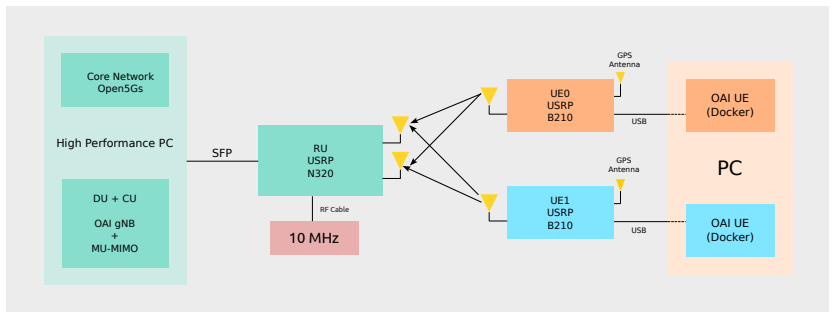
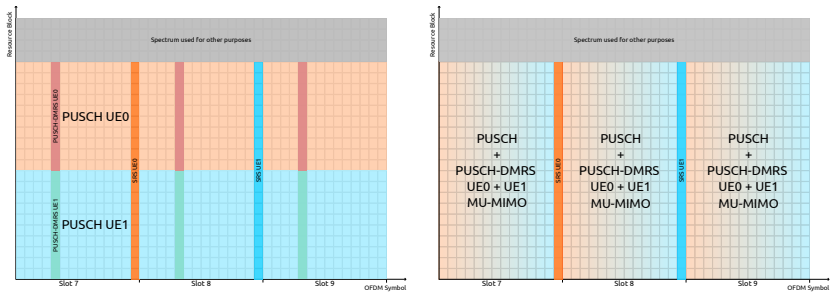
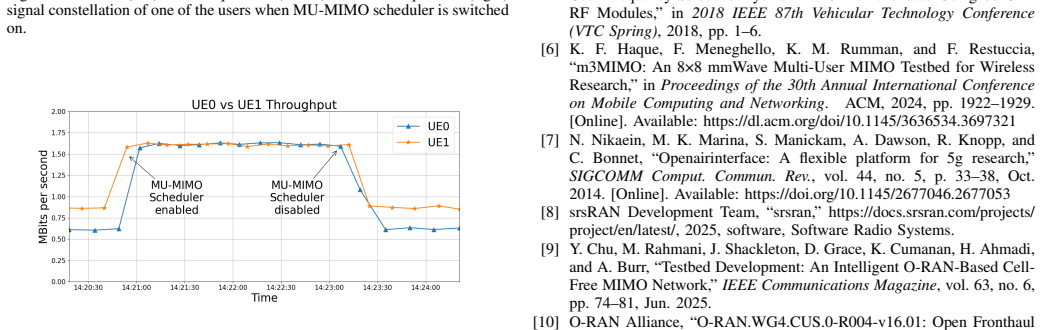
Using a modified OAI gNB and two unmodified OAI UEs, SRS channel estimates obtained in real-time hardware can be used to compute uplink combiners that separate and decode signals from two users transmitting in non-orthogonal time-frequency resources.
What carries the argument
SRS-based uplink combiner computation inside the modified OAI gNB for multi-user signal separation.
If this is right
- The same method can scale toward full cell-free MU-MIMO systems with multiple cells.
- TDD reciprocity becomes usable for downlink beamforming once uplink separation is demonstrated.
- Real-time operation is feasible with general-purpose computers and commercial SDRs.
- The testbed provides a concrete platform for further O-RAN MU-MIMO experiments.
Where Pith is reading between the lines
- The approach could be adapted to other open-source 5G protocol stacks beyond OpenAirInterface.
- Hardware validation of this kind reduces uncertainty when moving from simulation to distributed cell-free deployments.
- Success with two users suggests the combiner method may extend to larger numbers of users if channel estimation quality holds.
Load-bearing premise
The SRS channel estimates from real-time hardware are accurate enough to produce combiners that separate the two users without leaving significant residual interference.
What would settle it
High residual interference or decoding errors when both users transmit simultaneously in the same time-frequency resources would show the SRS-based combiners do not achieve separation.
Figures

read the original abstract
Cell-Free Multiple-Input Multiple-Output (MIMO) and Open Radio Access Network (O-RAN) have been active research topics in the wireless communication community in recent years. As an open-source software implementation of the 3rd Generation Partnership Project (3GPP) 5th Generation (5G) protocol stack, OpenAirInterface (OAI) has become a valuable tool for deploying and testing new ideas in wireless communication systems. In this paper, we present our OAI-based real-time uplink Multi-User MIMO (MU-MIMO) testbed developed at Fraunhofer HHI. As a part of our Cell-Free MIMO testbed development, we built a 2x2 MU-MIMO system using general purpose computers and commercially available software defined radios (SDRs). Using a modified OAI next-Generation Node-B (gNB) and two unmodified OAI user equipment (UE), we show that it is feasible to use Sounding Reference Signal (SRS) channel estimates to compute uplink combiners. Our results verify that this method can be used to separate and decode signals from two users transmitting in non-orthogonal time-frequency resources. This work serves as an important verification step to build a complete Cell-Free MU-MIMO system that leverages time domain duplexing (TDD) reciprocity to perform downlink beamforming over multiple cells
Editorial analysis
A structured set of objections, weighed in public.
Referee Report
Summary. The manuscript presents a real-time 2x2 uplink MU-MIMO testbed built on OpenAirInterface (OAI) using general-purpose computers and commercial SDRs. It modifies the OAI gNB to compute uplink combiners from real-time SRS channel estimates and demonstrates separation and decoding of signals from two unmodified UEs transmitting on identical time-frequency resources, as an experimental verification step toward cell-free MIMO systems that exploit TDD reciprocity for downlink beamforming.
Significance. If the central feasibility claim is supported by quantitative metrics, the work supplies a reproducible open-source hardware-in-the-loop platform for MU-MIMO algorithm validation. This is valuable for the O-RAN and cell-free MIMO communities because it bridges simulation studies with practical SDR constraints and provides a concrete starting point for multi-cell TDD reciprocity experiments.
major comments (3)
- [Results section] Results section: the claim that the method 'can be used to separate and decode signals' is not accompanied by any quantitative post-combining metrics (BER, BLER, SINR, or throughput per user). Without these numbers or error bars, it is impossible to verify that residual interference after combining is low enough for successful decoding of both streams.
- [Implementation section] System implementation / combiner computation subsection: the paper does not specify whether zero-forcing, regularized ZF, or MMSE combiners are used, nor how the SRS estimates are processed (e.g., averaging, interpolation, or noise variance estimation). This detail is load-bearing for the central claim that real-time SRS estimates suffice for effective nulling.
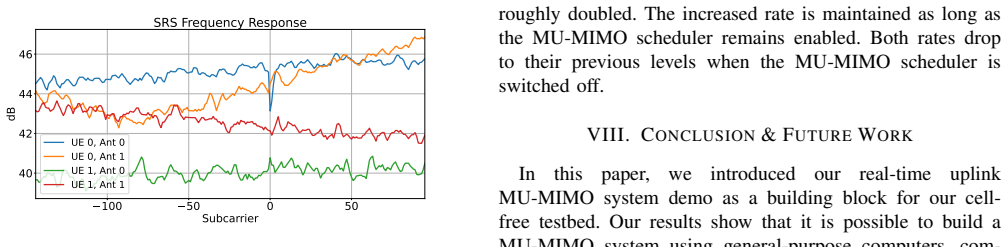
- [Hardware setup section] Hardware and channel estimation subsection: no measurements or bounds are given for SRS estimation error (noise, hardware impairments, timing offset, or power limitations). The skeptic concern that real-time SRS estimates may be insufficiently accurate for MU-MIMO nulling therefore remains unaddressed by data.
minor comments (2)
- [Abstract] Abstract: the sentence 'our results verify that this method can be used...' would be stronger if it referenced at least one concrete performance figure (e.g., 'with post-combining SINR > X dB').
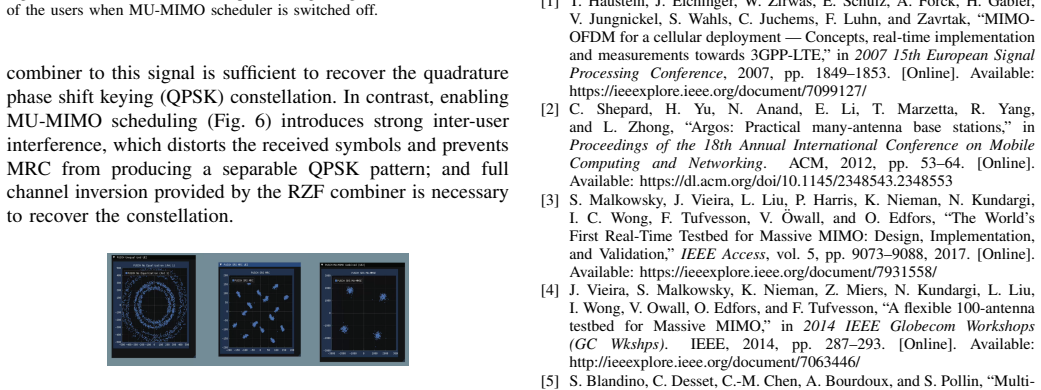
- [Figures] Figure captions: constellation or spectrum plots should explicitly state whether they correspond to single-user or MU-MIMO operation and whether they are before or after combining.
Simulated Author's Rebuttal
We thank the referee for the constructive comments, which help clarify the presentation of our implementation results. We address each major comment below and indicate the revisions that will be made.
read point-by-point responses
-
Referee: [Results section] Results section: the claim that the method 'can be used to separate and decode signals' is not accompanied by any quantitative post-combining metrics (BER, BLER, SINR, or throughput per user). Without these numbers or error bars, it is impossible to verify that residual interference after combining is low enough for successful decoding of both streams.
Authors: We agree that quantitative post-combining metrics would strengthen the central claim. In the revised manuscript we will add measured post-combining SINR values and BER for both users (with error bars from repeated trials) to demonstrate that residual interference remains low enough for reliable decoding. revision: yes
-
Referee: [Implementation section] System implementation / combiner computation subsection: the paper does not specify whether zero-forcing, regularized ZF, or MMSE combiners are used, nor how the SRS estimates are processed (e.g., averaging, interpolation, or noise variance estimation). This detail is load-bearing for the central claim that real-time SRS estimates suffice for effective nulling.
Authors: We will revise the combiner computation subsection to state explicitly that zero-forcing combiners are computed directly from the raw SRS channel estimates. No averaging, interpolation, or explicit noise-variance estimation is performed; the estimates are used as obtained in real time. revision: yes
-
Referee: [Hardware setup section] Hardware and channel estimation subsection: no measurements or bounds are given for SRS estimation error (noise, hardware impairments, timing offset, or power limitations). The skeptic concern that real-time SRS estimates may be insufficiently accurate for MU-MIMO nulling therefore remains unaddressed by data.
Authors: We acknowledge that explicit bounds on SRS estimation error would address the concern more directly. However, obtaining such quantitative bounds requires dedicated calibration experiments outside the scope of this feasibility study. We will add a discussion of the dominant error sources and note that successful decoding in the 2x2 setup provides indirect evidence that estimation accuracy is adequate for the reported case. revision: partial
Circularity Check
No circularity: experimental implementation with no derivation chain
full rationale
The paper describes a hardware testbed implementation of uplink MU-MIMO using modified OpenAirInterface on SDRs, with the central claim being experimental verification that SRS-based channel estimates can separate two users on shared time-frequency resources. No equations, fitted models, or first-principles derivations are presented that could reduce to self-definition or fitted inputs. The work relies on direct measurements rather than any load-bearing self-citation chain or ansatz smuggling, so the result is independent of its own outputs.
Axiom & Free-Parameter Ledger
axioms (1)
- domain assumption TDD channel reciprocity holds sufficiently for future downlink extensions
Reference graph
Works this paper leans on
-
[1]
T. Haustein, J. Eichinger, W. Zirwas, E. Schulz, A. Forck, H. G ¨abler, V . Jungnickel, S. Wahls, C. Juchems, F. Luhn, and Zavrtak, “MIMO- OFDM for a cellular deployment — Concepts, real-time implementation and measurements towards 3GPP-LTE,” in2007 15th European Signal Processing Conference, 2007, pp. 1849–1853. [Online]. Available: https://ieeexplore.ie...
-
[2]
Argos: Practical many-antenna base stations,
C. Shepard, H. Yu, N. Anand, E. Li, T. Marzetta, R. Yang, and L. Zhong, “Argos: Practical many-antenna base stations,” in Proceedings of the 18th Annual International Conference on Mobile Computing and Networking. ACM, 2012, pp. 53–64. [Online]. Available: https://dl.acm.org/doi/10.1145/2348543.2348553
-
[3]
The World’s First Real-Time Testbed for Massive MIMO: Design, Implementation, and Validation,
S. Malkowsky, J. Vieira, L. Liu, P. Harris, K. Nieman, N. Kundargi, I. C. Wong, F. Tufvesson, V . ¨Owall, and O. Edfors, “The World’s First Real-Time Testbed for Massive MIMO: Design, Implementation, and Validation,”IEEE Access, vol. 5, pp. 9073–9088, 2017. [Online]. Available: https://ieeexplore.ieee.org/document/7931558/
-
[4]
A flexible 100-antenna testbed for Massive MIMO,
J. Vieira, S. Malkowsky, K. Nieman, Z. Miers, N. Kundargi, L. Liu, I. Wong, V . Owall, O. Edfors, and F. Tufvesson, “A flexible 100-antenna testbed for Massive MIMO,” in2014 IEEE Globecom Workshops (GC Wkshps). IEEE, 2014, pp. 287–293. [Online]. Available: http://ieeexplore.ieee.org/document/7063446/
-
[5]
Multi- User Frequency-Selective Hybrid MIMO Demonstrated Using 60 GHz RF Modules,
S. Blandino, C. Desset, C.-M. Chen, A. Bourdoux, and S. Pollin, “Multi- User Frequency-Selective Hybrid MIMO Demonstrated Using 60 GHz RF Modules,” in2018 IEEE 87th V ehicular Technology Conference (VTC Spring), 2018, pp. 1–6
work page 2018
-
[6]
m3MIMO: An 8×8 mmWave Multi-User MIMO Testbed for Wireless Research,
K. F. Haque, F. Meneghello, K. M. Rumman, and F. Restuccia, “m3MIMO: An 8×8 mmWave Multi-User MIMO Testbed for Wireless Research,” inProceedings of the 30th Annual International Conference on Mobile Computing and Networking. ACM, 2024, pp. 1922–1929. [Online]. Available: https://dl.acm.org/doi/10.1145/3636534.3697321
-
[7]
Openairinterface: A flexible platform for 5g research,
N. Nikaein, M. K. Marina, S. Manickam, A. Dawson, R. Knopp, and C. Bonnet, “Openairinterface: A flexible platform for 5g research,” SIGCOMM Comput. Commun. Rev., vol. 44, no. 5, p. 33–38, Oct
-
[8]
Marina, Saravana Manickam, Alex Dawson, Raymond Knopp, and Christian Bonnet
[Online]. Available: https://doi.org/10.1145/2677046.2677053
-
[9]
srsRAN Development Team, “srsran,” https://docs.srsran.com/projects/ project/en/latest/, 2025, software, Software Radio Systems
work page 2025
-
[10]
Testbed Development: An Intelligent O-RAN-Based Cell- Free MIMO Network,
Y . Chu, M. Rahmani, J. Shackleton, D. Grace, K. Cumanan, H. Ahmadi, and A. Burr, “Testbed Development: An Intelligent O-RAN-Based Cell- Free MIMO Network,”IEEE Communications Magazine, vol. 63, no. 6, pp. 74–81, Jun. 2025
work page 2025
-
[11]
O-RAN Alliance, “O-RAN.WG4.CUS.0-R004-v16.01: Open Fronthaul Interfaces – Control, User, and Synchronization Plane Specification,” O-RAN Alliance, Technical Specification, 2023, accessed 2025-01-13. [Online]. Available: https://www.o-ran.org/specifications
work page 2023
-
[12]
——, “O-RAN.WG7.IPC-HRD-Opt8.0-v01.00: Hardware Reference Design Specification for Indoor Picocell (FR1) with Split Architecture Option 8,” O-RAN Alliance, Technical Specification, 2021. [Online]. Available: https://www.o-ran.org/specifications
work page 2021
-
[13]
NR MIMO Feature Implementation into OpenAirInterface,
K. A. Saaifan, T. Schlichter, and T. Heyn, “NR MIMO Feature Implementation into OpenAirInterface,” inWSA 2021; 25th International ITG Workshop on Smart Antennas, 2021, pp. 1–6. [Online]. Available: https://ieeexplore.ieee.org/document/9739185/
-
[14]
3GPP TS 38.211 V16.2.0 (2020-07): NR; Physical Channels and Modulation,
3GPP, “3GPP TS 38.211 V16.2.0 (2020-07): NR; Physical Channels and Modulation,” 3GPP / ETSI, Technical Specification, 2020. [Online]. Available: https://www.etsi.org/deliver/etsi ts/138200 138299/138211/ 16.02.00 60/ts 138211v160200p.pdf
work page 2020
discussion (0)
Sign in with ORCID, Apple, or X to comment. Anyone can read and Pith papers without signing in.