Inferring signed social networks from contact patterns
Pith reviewed 2026-05-16 13:45 UTC · model grok-4.3
The pith
A Bayesian framework infers positive and negative ties from contact data by modeling which absences reflect avoidance rather than missed opportunity.
A machine-rendered reading of the paper's core claim, the machinery that carries it, and where it could break.
Core claim
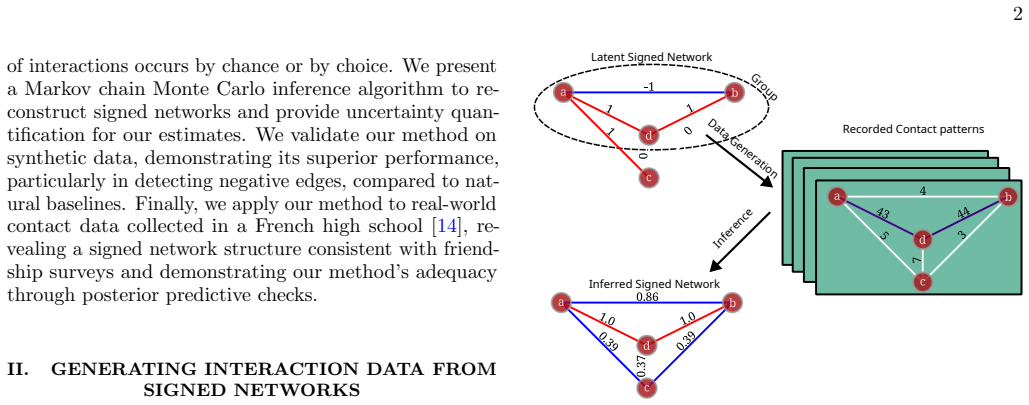
We develop a Bayesian framework with MCMC inference that models interaction groups to separate chance from choice when no interactions are observed.
What carries the argument
A hierarchical Bayesian model with MCMC sampling that partitions potential interactions into latent groups to distinguish random non-participation from deliberate avoidance.
Load-bearing premise
The chosen model of interaction groups and the separation of chance versus choice accurately reflect the underlying social process generating the contact data.
What would settle it
Applying the fitted model to a new contact dataset where negative ties have been independently verified by direct surveys and finding that the recovered negative edges match the surveys at no better than chance levels would falsify the central claim.
Figures
read the original abstract
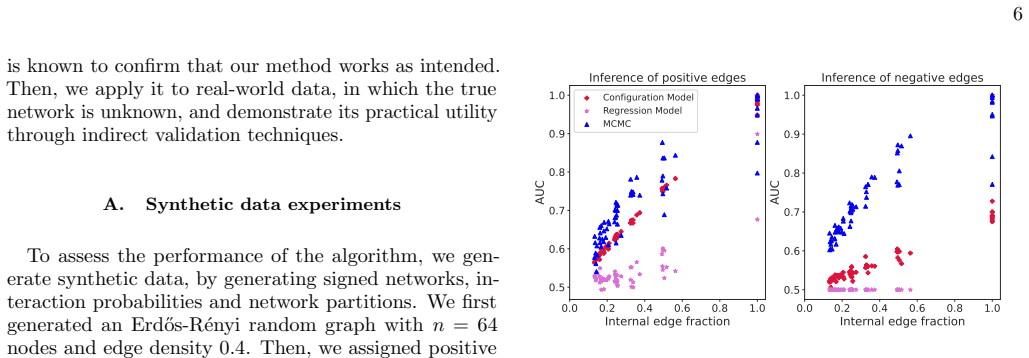
Social networks are typically inferred from indirect observations, such as proximity data; yet, most methods cannot distinguish between absent relationships and actual negative ties, as both can result in few or no interactions. We address the challenge of inferring signed networks from contact patterns while accounting for whether lack of interactions reflect a lack of opportunity as opposed to active avoidance. We develop a Bayesian framework with MCMC inference that models interaction groups to separate chance from choice when no interactions are observed. Validation on synthetic data demonstrates superior performance compared to natural baselines, particularly in detecting negative edges. We apply our method to French high school contact data to reveal a structure consistent with friendship surveys and demonstrate the model's adequacy through posterior predictive checks.
Editorial analysis
A structured set of objections, weighed in public.
Referee Report
Summary. The paper claims to develop a Bayesian framework with MCMC inference that models interaction groups to separate chance (lack of opportunity) from choice (negative ties) when inferring signed social networks from contact patterns. Validation on synthetic data shows superior performance over baselines especially for negative edges, while the application to French high-school proximity data yields a structure consistent with friendship surveys and passes posterior predictive checks for model adequacy.
Significance. If the separation of chance from choice holds under the group-based generative model, the method could advance signed-network inference from common proximity datasets by addressing a key ambiguity in contact data. The Bayesian MCMC approach and use of posterior predictive checks represent strengths for assessing adequacy. However, the absence of direct ground-truth comparisons on real signed ties limits the strength of external-validity claims.
major comments (3)
- [Methods] Methods section: the generative model for interaction groups, the likelihood, and the priors used in the MCMC inference are not specified with equations, preventing verification of whether the separation of chance versus choice is achieved without reducing to a fitted quantity by construction.
- [Validation] Validation section: superior performance is reported on synthetic data, but without explicit description of the data-generating process it is unclear whether the test data follows the same group-based assumptions as the model, which would render the comparison an internal-consistency check rather than a robustness test.
- [Empirical application] Empirical application: consistency with friendship surveys is shown, yet no direct comparison to independently observed signed ties is provided, so the inferred negative edges may be an artifact of the chosen interaction-group parameterization rather than a reflection of the true social process.
minor comments (1)
- [Abstract] Abstract: the claim of 'superior performance' is not accompanied by the specific quantitative metrics (e.g., precision, recall, or AUC) used for comparison against baselines.
Simulated Author's Rebuttal
We thank the referee for their constructive feedback. We address each major comment point by point below, indicating revisions where appropriate.
read point-by-point responses
-
Referee: [Methods] Methods section: the generative model for interaction groups, the likelihood, and the priors used in the MCMC inference are not specified with equations, preventing verification of whether the separation of chance versus choice is achieved without reducing to a fitted quantity by construction.
Authors: We agree that the Methods section lacks explicit equations, which hinders verification. In the revised manuscript we will include the full generative model for interaction groups, the complete likelihood, and all prior specifications. These additions will demonstrate that the separation of chance non-interactions (arising from group non-membership) from active avoidance (negative ties) follows directly from the hierarchical group structure rather than being imposed by construction. revision: yes
-
Referee: [Validation] Validation section: superior performance is reported on synthetic data, but without explicit description of the data-generating process it is unclear whether the test data follows the same group-based assumptions as the model, which would render the comparison an internal-consistency check rather than a robustness test.
Authors: We will add a detailed description of the synthetic data-generating process in the revision. The data were produced from a group-based process with controlled perturbations in group sizes, membership probabilities, and noise levels that deviate from the exact fitted model; this was intended as a robustness check. Explicit documentation will clarify the distinction from pure internal consistency. revision: yes
-
Referee: [Empirical application] Empirical application: consistency with friendship surveys is shown, yet no direct comparison to independently observed signed ties is provided, so the inferred negative edges may be an artifact of the chosen interaction-group parameterization rather than a reflection of the true social process.
Authors: We acknowledge that the French high-school proximity dataset contains no independently observed signed ties for direct comparison. Validation therefore rests on consistency with friendship surveys and posterior predictive checks. In revision we will expand the discussion of this limitation and add sensitivity analyses across alternative group parameterizations to address the possibility of artifacts. The model structure is designed to infer negative ties only when avoidance provides a better explanation than group non-membership. revision: partial
- Absence of independently observed signed ties in the empirical dataset, which prevents direct external validation of inferred negative edges.
Circularity Check
Bayesian generative model for signed networks is self-contained with no circular reductions
full rationale
The paper introduces a new Bayesian framework with MCMC inference that explicitly models interaction groups to distinguish absent opportunities from negative ties. The central derivation consists of specifying a generative process, performing posterior inference, and validating via synthetic data (generated under the model) plus posterior predictive checks on real contact data. No equations or steps reduce by construction to fitted parameters renamed as predictions, self-citations that bear the uniqueness claim, or ansatzes smuggled from prior author work. The framework is presented as an independent modeling choice whose adequacy is tested externally rather than assumed by definition.
Axiom & Free-Parameter Ledger
Reference graph
Works this paper leans on
-
[1]
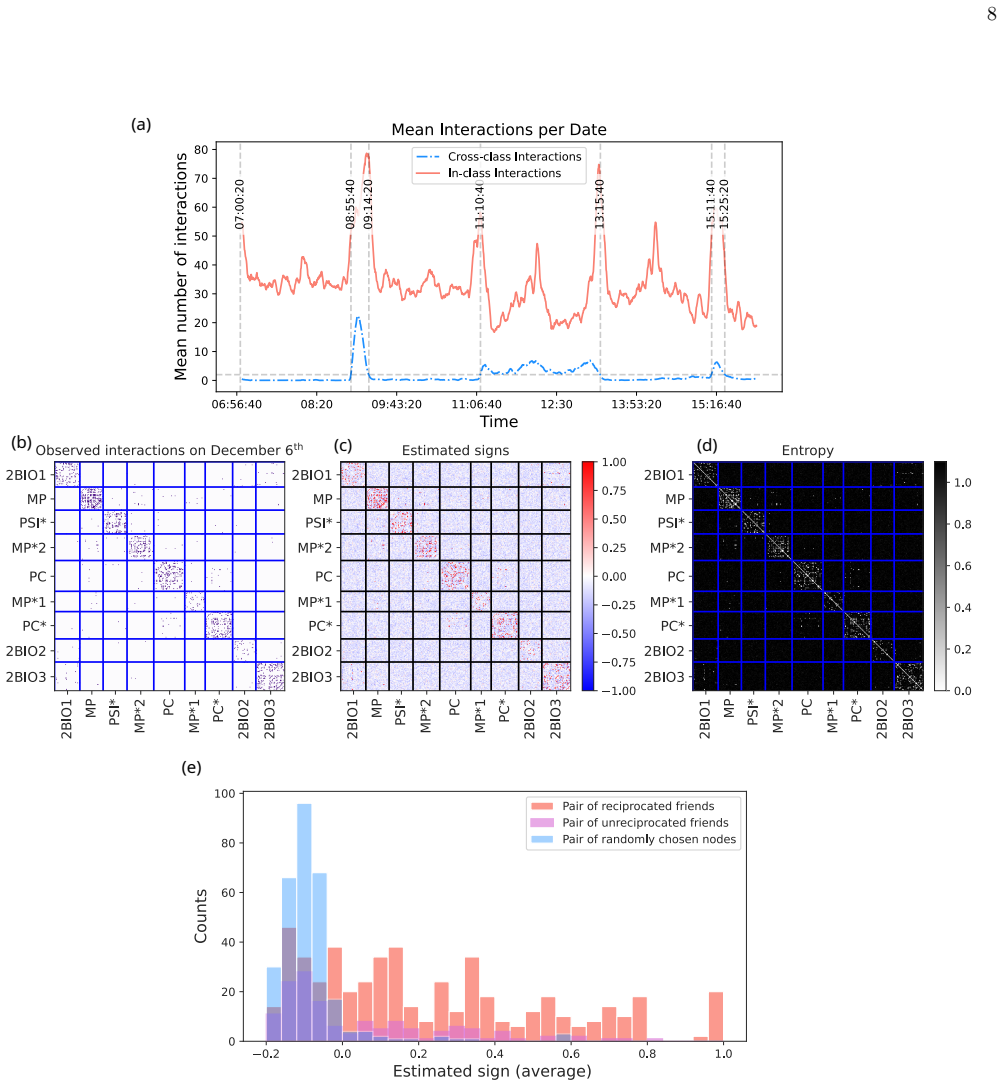
Dataset In 2013, Mastrandrea et al. [14] conducted a multi-level analysis of a French high school social network as part of the SocioPattern collaboration [ 17]. They collected multiple datasets over the span of five days (December 2-6, 2013), including contact data obtained with wearable sensors and contact diaries. To gather the contact data, each stude...
work page 2013
-
[2]
Network inference We modeled each day of the study period as a sepa- rate network, resulting in five potentially different signed networks. Within each day, we assume the latent net- work remains constant and apply the multi-observation model described in Sec. III C to the observation matri- ces obtained by breaking down the breaks in slices of four minut...
work page 2013
-
[3]
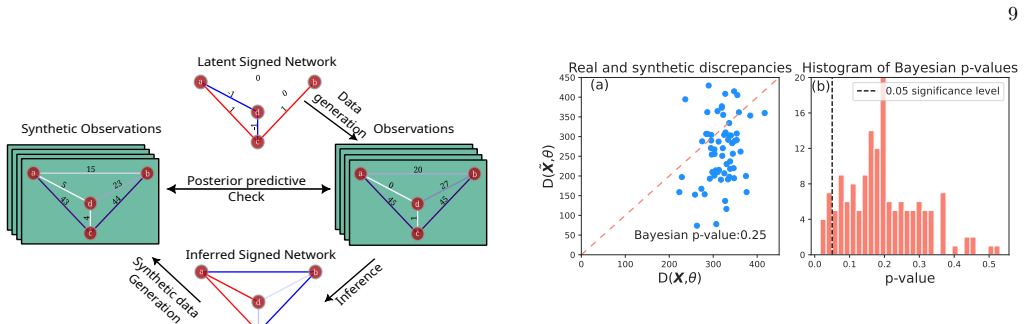
Posterior predictive check Although our model and method can give us an estimate of the latent social network foranyset of observation matrices X 1, ...Xr, there is no guarantee that the fit will be any good. This could arise if, for example, the model is missing a critical component of the data-generating process. Hence, we also complete our analysis wit...
work page 2021
-
[4]
Nicholas M Harrigan, Giuseppe Joe Labianca, and Filip Agneessens, “Negative ties and signed graphs research: Stimulating research on dissociative forces in social net- works,” Social Networks60, 1–10 (2020)
work page 2020
-
[5]
On the notion of balance of a signed graph,
Frank Harary, “On the notion of balance of a signed graph,” Mich. Math. J.2, 143–146 (1953)
work page 1953
-
[6]
Friends and enemies: A model of signed network formation,
Timo Hiller, “Friends and enemies: A model of signed network formation,” Theoretical Economics12, 1057–1087 (2017)
work page 2017
-
[7]
Influence maximization on signed networks under independent cascade model,
Wei Liu, Xin Chen, Byeungwoo Jeon, Ling Chen, and Bolun Chen, “Influence maximization on signed networks under independent cascade model,” Applied Intelligence 49, 912–928 (2019)
work page 2019
-
[8]
Information diffusion in signed networks,
Xiaochen He, Haifeng Du, Marcus W Feldman, and Guangyu Li, “Information diffusion in signed networks,” PloS one14, e0224177 (2019)
work page 2019
-
[9]
Signed networks in social media,
Jure Leskovec, Daniel Huttenlocher, and Jon Kleinberg, “Signed networks in social media,” inProceedings of the SIGCHI conference on human factors in computing sys- tems(2010) pp. 1361–1370
work page 2010
-
[10]
A survey of signed network mining in social media,
Jiliang Tang, Yi Chang, Charu Aggarwal, and Huan Liu, “A survey of signed network mining in social media,” Acm computing surveys (csur)49, 1–37 (2016)
work page 2016
-
[11]
Propagation of trust and distrust,
Ramanthan Guha, Ravi Kumar, Prabhakar Raghavan, and Andrew Tomkins, “Propagation of trust and distrust,” inProceedings of the 13th international conference on World Wide Web(2004) pp. 403–412
work page 2004
-
[12]
Discovering polarized communities in signed networks,
Francesco Bonchi, Edoardo Galimberti, Aristides Gionis, Bruno Ordozgoiti, and Giancarlo Ruffo, “Discovering polarized communities in signed networks,” inProc. 28th ACM Int. Conf. on Information and Knowledge Manage- ment (CIKM ’19)(Association for Computing Machinery, Beijing, China, 2019) pp. 961–970
work page 2019
-
[13]
Recom- mendations in signed social networks,
Jiliang Tang, Charu Aggarwal, and Huan Liu, “Recom- mendations in signed social networks,” inProceedings of the 25th international conference on world wide web (2016) pp. 31–40
work page 2016
-
[14]
Revisiting the foundations of network analysis,
Carter T. Butts, “Revisiting the foundations of network analysis,” Science325, 414–416 (2009)
work page 2009
-
[15]
Abigail Z. Jacobs and Hanna Wallach, “Measurement and fairness,” inProc. ACM Conference on Fairness, Accountability, and Transparency (F AccT ’21)(Canada,
-
[16]
Statistical inference links data and theory in network science,
Leto Peel, Tiago P. Peixoto, and Manlio De Domenico, “Statistical inference links data and theory in network science,” Nat. Commun.13, 6794 (2022)
work page 2022
-
[17]
Rossana Mastrandrea, Julie Fournet, and Alain Barrat, “Contact patterns in a high school: A comparison between data collected using wearable sensors, contact diaries and friendship surveys,” PLOS ONE10, e0136497 (2015)
work page 2015
-
[18]
Daniel Redhead, Richard McElreath, and Cody T. Ross, “Reliable network inference from unreliable data: A tuto- rial on latent network modeling using STRAND,” Psychol. Methods29, 1100–1122 (2023). 11
work page 2023
-
[19]
Latent network models to account for noisy, multiply reported social network data,
Caterina De Bacco, Martina Contisciani, Jonathan Cardoso-Silva,et al., “Latent network models to account for noisy, multiply reported social network data,” J. R. Stat. Soc., A: Stat. Soc.186, 355–375 (2023)
work page 2023
-
[20]
Dynamics of person-to-person interactions from distributed RFID sensor networks,
Ciro Cattuto, Wouter Van den Broeck, Alain Barrat, et al., “Dynamics of person-to-person interactions from distributed RFID sensor networks,” PLOS ONE5, e11596 (2010)
work page 2010
-
[21]
Hal Whitehead,Analyzing Animal Societies: Quantitative Methods for Vertebrate Social Analysis(University of Chicago Press, Chicago, IL, 2008)
work page 2008
-
[22]
Reality mining: sens- ing complex social systems,
Nathan Eagle and Alex Pentland, “Reality mining: sens- ing complex social systems,” Personal and ubiquitous computing10, 255–268 (2006)
work page 2006
-
[23]
Bayesian inference of network structure from unreliable data,
Jean-Gabriel Young, George T. Cantwell, and M. E. J. Newman, “Bayesian inference of network structure from unreliable data,” J. Complex Netw.8, cnaa046 (2021)
work page 2021
-
[24]
Reconstructing networks with un- known and heterogeneous errors,
Tiago P. Peixoto, “Reconstructing networks with un- known and heterogeneous errors,” Phys. Rev. X8, 041011 (2018)
work page 2018
-
[25]
Missing and spurious interactions and the reconstruction of complex networks,
Roger Guimer` a and Marta Sales-Pardo, “Missing and spurious interactions and the reconstruction of complex networks,” Proc. Natl. Acad. Sci. U.S.A.106, 22073– 22078 (2009)
work page 2009
-
[26]
Network reconstruction from infection cas- cades,
Alfredo Braunstein, Alessandro Ingrosso, and Anna Paola Muntoni, “Network reconstruction from infection cas- cades,” Journal of the Royal Society Interface16, 20180844 (2019)
work page 2019
-
[27]
Network reconstruction and community detection from dynamics,
Tiago P Peixoto, “Network reconstruction and community detection from dynamics,” Physical review letters123, 128301 (2019)
work page 2019
-
[28]
Predicting positive and negative links in online social networks,
Jure Leskovec, Daniel Huttenlocher, and Jon Kleinberg, “Predicting positive and negative links in online social networks,” inProceedings of the 19th International Con- ference on World Wide Web, WWW ’10 (Association for Computing Machinery, New York, NY, USA, 2010) p. 641–650
work page 2010
-
[29]
Inferring signed networks from preschoolers’ observed parallel and social play,
Jennifer Watling Neal, Zachary P. Neal, and C. Emily Durbin, “Inferring signed networks from preschoolers’ observed parallel and social play,” Soc. Netw.71, 80–86 (2022)
work page 2022
-
[30]
Reconstructing signed relations from interaction data,
Georges Andres, Giona Casiraghi, Giacomo Vaccario, and Frank Schweitzer, “Reconstructing signed relations from interaction data,” Sci. Rep.13, 20689 (2023)
work page 2023
-
[31]
Detecting social (in)stability in primates from their temporal co-presence network,
Valeria Gelardi, Jo¨ el Fagot, Alain Barrat, and Nicolas Claidi` ere, “Detecting social (in)stability in primates from their temporal co-presence network,” Anim. Behav.157, 239–254 (2019)
work page 2019
-
[32]
Stochastic blockmodels: First steps,
Paul W Holland, Kathryn Blackmond Laskey, and Samuel Leinhardt, “Stochastic blockmodels: First steps,” Social networks5, 109–137 (1983)
work page 1983
-
[33]
Estimation and prediction for stochastic blockstructures,
Krzysztof Nowicki and Tom A B Snijders, “Estimation and prediction for stochastic blockstructures,” Journal of the American statistical association96, 1077–1087 (2001)
work page 2001
-
[34]
Monte Carlo sampling methods using Markov chains and their applications,
W. K. Hastings, “Monte Carlo sampling methods using Markov chains and their applications,” Biometrika57, 97–109 (1970)
work page 1970
-
[35]
Christian P. Robert and George Casella,Monte Carlo Statistical Methods, 2nd ed., Springer Texts in Statistics (Springer, New York, NY, 2004)
work page 2004
-
[36]
An introduction to the Markov chain Monte Carlo method,
Wenlong Wang, “An introduction to the Markov chain Monte Carlo method,” Am. J. Phys.90, 921–934 (2022)
work page 2022
-
[37]
Alicia A. Johnson, Galin L. Jones, and Ronald C. Neath, “Component-wise Markov chain Monte Carlo: Uniform and geometric ergodicity under mixing and composition,” Stat. Sci.28, 360–375 (2013)
work page 2013
-
[38]
Merge-split markov chain monte carlo for community detection,
Tiago P. Peixoto, “Merge-split markov chain monte carlo for community detection,” Phys. Rev. E102, 012305 (2020)
work page 2020
-
[39]
Parallel tempering: Theory, applications, and new perspectives,
David J. Earl and Michael W. Deem, “Parallel tempering: Theory, applications, and new perspectives,” Phys. Chem. Chem. Phys.7, 3910–3916 (2005)
work page 2005
-
[40]
Evaluation of parallel tempering to accelerate bayesian parameter estimation in systems biology,
Sanjana Gupta, Liam Hainsworth, Justin S. Hogg, et al., “Evaluation of parallel tempering to accelerate bayesian parameter estimation in systems biology,” in Proc. 26th Euromicro Int. Conf. on Parallel, Distributed and Network -based Processing (PDP ’18), IEEE (IEEE Computer Society, Turin, Italy, 2018) pp. 690–697
work page 2018
-
[41]
An introduction to ROC analysis,
Tom Fawcett, “An introduction to ROC analysis,” Pattern recognition letters27, 861–874 (2006)
work page 2006
-
[42]
David J Hand and Robert J Till, “A simple generalisa- tion of the area under the roc curve for multiple class classification problems,” Machine learning45, 171–186 (2001)
work page 2001
-
[43]
Well-trained pets: Improving probability estimation trees,
Pedro Domingos and Foster Provost, “Well-trained pets: Improving probability estimation trees,” CDER Work- ingPaper, Stern School of Business. New York, NY: New York University (2000)
work page 2000
-
[44]
Regression models with ordinal variables,
Christopher Winship and Robert D Mare, “Regression models with ordinal variables,” American sociological review , 512–525 (1984)
work page 1984
-
[45]
A probabilistic proof of an asymptotic for- mula for the number of labelled regular graphs,
B´ ela Bollob´ as, “A probabilistic proof of an asymptotic for- mula for the number of labelled regular graphs,” European Journal of Combinatorics1, 311–316 (1980)
work page 1980
-
[46]
Network structure from rich but noisy data,
M. E. J. Newman, “Network structure from rich but noisy data,” Nat. Phys.14, 542–545 (2018)
work page 2018
-
[47]
Andrew Gelman, John B. Carlin, Hal S. Stern, David B. Dunson, Aki Vehtari, and Donald B. Rubin,Bayesian Data Analysis, 3rd ed., CRC Texts in Statistical Science (CRC, Boca Raton, FL, 2013)
work page 2013
-
[48]
Pos- terior predictive assessment of model fitness via realized discrepancies,
Andrew Gelman, Xiao-Li Meng, and Hal Stern, “Pos- terior predictive assessment of model fitness via realized discrepancies,” Stat. Sin. , 733–760 (1996). Appendix A: Convergence of the MCMC algorithm In the main text, we have constructed the transition probabilities with the Metropolis-Hastings method and, as a result, the conditions for detailed balance ...
work page 1996
discussion (0)
Sign in with ORCID, Apple, or X to comment. Anyone can read and Pith papers without signing in.