Two-dimensional FrBD friction models for rolling contact: extension to linear viscoelasticity
Pith reviewed 2026-05-16 12:47 UTC · model grok-4.3
The pith
Linear viscoelasticity extends the FrBD rolling contact framework to a system of 2(n+1) hyperbolic PDEs that capture relaxation while ensuring well-posedness and passivity.
A machine-rendered reading of the paper's core claim, the machinery that carries it, and where it could break.
Core claim
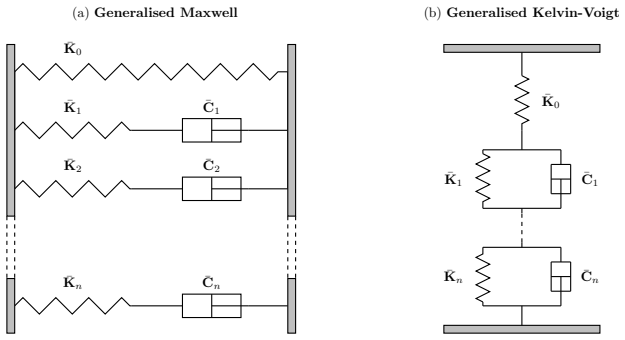
By representing the bristle with derivative Generalised Maxwell and Kelvin-Voigt models, the dynamics of the bristle, generated friction forces, and internal deformation states are described by a system of 2(n+1) hyperbolic partial differential equations, which capture complex relaxation phenomena. Three distributed formulations account for different levels of spin excitation by specifying analytical expressions for transport and rigid relative velocity. For the linear variants, well-posedness and passivity hold for any physically meaningful parametrisation.
What carries the argument
The distributed bristle element using classic derivative Generalised Maxwell and Kelvin-Voigt rheological representations, which leads to the system of hyperbolic PDEs governing the friction model.
If this is right
- Three formulations of increasing complexity handle different spin excitations in rolling contact.
- Steady-state characteristics and transient relaxation effects are illustrated through numerical experiments.
- Well-posedness and passivity are proven to hold for any physically meaningful parameters in the linear cases.
- The FrBD paradigm is advanced to enable systematic treatment of linear viscoelasticity in friction modeling.
Where Pith is reading between the lines
- This modeling could improve accuracy in simulations of viscoelastic materials under rolling, such as in tire dynamics or conveyor systems.
- Discretization of the PDE system might allow efficient numerical solvers for real-time applications.
- Similar extensions could be considered for nonlinear viscoelasticity to broaden the applicability.
Load-bearing premise
The bristle can be accurately represented by classic derivative Generalised Maxwell and Kelvin-Voigt models with specified analytical expressions for transport and rigid relative velocity.
What would settle it
An experiment or calculation showing that for some physically valid parameters the system loses well-posedness or passivity, or that simulated relaxation does not match observed viscoelastic behavior in rolling contact.
Figures



read the original abstract
This paper extends the distributed rolling contact FrBD framework to linear viscoelasticity by considering classic derivative Generalised Maxwell and Kelvin-Voigt rheological representations of the bristle element. With this modelling approach, the dynamics of the bristle, generated friction forces, and internal deformation states are described by a system of 2(n+1) hyperbolic partial differential equations (PDEs), which can capture complex relaxation phenomena originating from viscoelastic behaviours. By appropriately specifying the analytical expressions for the transport and rigid relative velocity, three distributed formulations of increasing complexity are introduced, which account for different levels of spin excitation. For the linear variants, well-posedness and passivity are analysed rigorously, showing that these properties hold for any physically meaningful parametrisation. Numerical experiments complement the theoretical results by illustrating steady-state characteristics and transient relaxation effects. The findings of this paper substantially advance the FrBD paradigm by enabling a unified and systematic treatment of linear viscoelasticity.
Editorial analysis
A structured set of objections, weighed in public.
Referee Report
Summary. The paper extends the distributed FrBD rolling-contact framework to linear viscoelasticity by representing the bristle element with classic derivative Generalised Maxwell and Kelvin-Voigt rheological models. This yields a system of 2(n+1) hyperbolic PDEs governing bristle dynamics, friction forces, and internal states; three formulations of increasing complexity are introduced by specifying analytical transport and rigid-body velocities that incorporate different levels of spin excitation. Rigorous analysis is claimed to establish well-posedness and passivity for any physically meaningful parameter set, with numerical experiments illustrating steady-state characteristics and transient relaxation effects.
Significance. If the well-posedness and passivity results hold without hidden restrictions on the relaxation parameters, the work supplies a systematic, unified extension of the FrBD paradigm that can capture complex viscoelastic relaxation in rolling contact. This would be valuable for applications requiring accurate transient friction modeling, such as tire dynamics or robotic grasping, and the provision of explicit analytical velocity expressions plus numerical illustrations strengthens the practical utility.
major comments (2)
- [Abstract / PDE derivation] Abstract and the section deriving the hyperbolic system: the central guarantee that well-posedness and passivity hold for any physically meaningful parametrisation must be shown to survive the spin-induced transport velocities that appear as coefficients in the PDEs; the skeptic concern that these terms can produce non-hyperbolic regions or sign-indefinite dissipation for admissible relaxation times/moduli is load-bearing and requires an explicit check (e.g., characteristic speeds or energy-balance identity) rather than an implicit assumption.
- [Spin-excitation formulations] Section on the three spin-excitation formulations: the passage from the rheological constitutive relations to the final first-order system must verify that the internal-state equations remain strictly hyperbolic and dissipative independently of the particular analytical expressions chosen for the rigid relative velocity; if any of the three formulations introduces parameter-dependent characteristic directions, the “any physically meaningful parametrisation” claim is compromised.
minor comments (2)
- [Numerical experiments] Numerical experiments: state the concrete values of n employed and the specific relaxation-time/modulus sets used to generate the steady-state and transient plots; without these, it is difficult to assess how the reported relaxation phenomena scale with the number of Maxwell elements.
- [Notation] Notation: ensure that the transport velocity fields and the rigid-body velocity are denoted consistently between the analytical expressions and the PDE coefficients; minor inconsistencies in subscript usage can obscure the link between the three formulations.
Simulated Author's Rebuttal
We thank the referee for the constructive and detailed comments. We address the two major comments point by point below, clarifying the structure of the proofs and indicating the revisions that will be made to render the well-posedness and passivity arguments fully explicit.
read point-by-point responses
-
Referee: [Abstract / PDE derivation] Abstract and the section deriving the hyperbolic system: the central guarantee that well-posedness and passivity hold for any physically meaningful parametrisation must be shown to survive the spin-induced transport velocities that appear as coefficients in the PDEs; the skeptic concern that these terms can produce non-hyperbolic regions or sign-indefinite dissipation for admissible relaxation times/moduli is load-bearing and requires an explicit check (e.g., characteristic speeds or energy-balance identity) rather than an implicit assumption.
Authors: The transport velocities enter the system only through lower-order terms (advection and source terms) once the rheological constitutive laws are substituted. Consequently, the principal symbol that determines hyperbolicity depends solely on the positive stiffness and viscosity parameters of the Generalized Maxwell or Kelvin-Voigt elements and remains independent of the velocity field. The passivity identity is obtained by multiplying the state equations by the appropriate dual variables and integrating by parts; the resulting dissipation integral is non-negative for any bounded, physically admissible velocity because it contains only the viscoelastic relaxation terms. To remove any ambiguity, the revised manuscript will contain a new appendix that explicitly computes the characteristic speeds (showing they remain real and distinct) and writes out the energy-balance identity for the general spin-excited case. revision: yes
-
Referee: [Spin-excitation formulations] Section on the three spin-excitation formulations: the passage from the rheological constitutive relations to the final first-order system must verify that the internal-state equations remain strictly hyperbolic and dissipative independently of the particular analytical expressions chosen for the rigid relative velocity; if any of the three formulations introduces parameter-dependent characteristic directions, the “any physically meaningful parametrisation” claim is compromised.
Authors: The three formulations differ only in the explicit functional form chosen for the rigid-body velocity (zero spin, constant spin, and spin varying with contact coordinates). Because these expressions appear exclusively in the lower-order terms after substitution of the constitutive relations, they do not alter the coefficient matrix of the highest-order spatial derivatives. Hence the eigenvalues that govern hyperbolicity and the sign of the dissipation remain unchanged across the three cases. The revised section will contain a short paragraph and a short table that list the characteristic speeds for each formulation, confirming that no velocity-dependent directions arise for any admissible set of relaxation parameters. revision: yes
Circularity Check
Minor self-citation to prior FrBD framework; central PDE derivation and well-posedness analysis remain independent
full rationale
The derivation introduces Generalised Maxwell/Kelvin-Voigt rheological models and derives a 2(n+1) hyperbolic PDE system with transport and spin terms specified analytically. Well-posedness and passivity are claimed to hold for any physically meaningful parameters via direct analysis of the resulting first-order system. No quoted step reduces a prediction or uniqueness claim to a fitted input or self-citation chain by construction; the rheological constitutive laws and energy-balance arguments supply independent content. Self-citation to the base FrBD model is present but not load-bearing for the viscoelastic extension or the passivity proof.
Axiom & Free-Parameter Ledger
free parameters (1)
- rheological parameters (relaxation times, moduli)
axioms (2)
- domain assumption Linear viscoelasticity of the bristle element
- domain assumption Analytical specification of transport and rigid relative velocity
discussion (0)
Sign in with ORCID, Apple, or X to comment. Anyone can read and Pith papers without signing in.