Beyond directions: Symmetry-aware rotation sets for triaxial diffusion encoding by geometric filter optimization
Pith reviewed 2026-05-16 12:12 UTC · model grok-4.3
The pith
Geometric filter optimization exploits D2 symmetry to improve powder averaging accuracy in triaxial diffusion encoding.
A machine-rendered reading of the paper's core claim, the machinery that carries it, and where it could break.
Core claim
Diffusion signals for arbitrary diffusion encoding exhibit an intrinsic dihedral D2 symmetry that defines their natural signal space as a quotient of 3D rotations. Geometric Filter Optimization designs rotation sets by creating a sampling filter that is approximately flat over the relevant frequency space, yielding optimal powder averages with improved accuracy and precision over existing methods.
What carries the argument
The intrinsic dihedral D2 symmetry of the diffusion signal, which quotients the rotation group, together with the geometric filter optimization procedure that produces approximately flat sampling filters in the associated frequency space.
If this is right
- GFO rotation sets produce powder averages with marked gains in precision and accuracy for axisymmetric and triaxial b-tensors.
- Higher-order rotational invariants show trade-offs in bias versus precision that vary with b-value and number of orientations.
- The method supplies an efficient recipe for orientations that works with existing gradient systems and can reduce total scan time.
- Performance holds across different b-tensor shapes without imposing extra hardware requirements.
Where Pith is reading between the lines
- The same D2 symmetry could guide sampling design in other tensor-valued diffusion protocols beyond simple powder averaging.
- GFO filters might be further tuned for multi-shell or model-specific acquisitions to reduce bias in derived parameters.
- The approach suggests a general route for deriving rotation sets for new encoding waveforms without parameter fitting.
Load-bearing premise
That the identified D2 symmetry fully defines the natural signal space and that the geometric filter optimization produces a sufficiently flat filter over the relevant frequency domain for arbitrary b-tensors.
What would settle it
Direct measurement of residual angular dependence in powder-averaged signals from an isotropic phantom at high b-values when using GFO rotation sets versus exhaustive or reference sampling.
Figures


read the original abstract
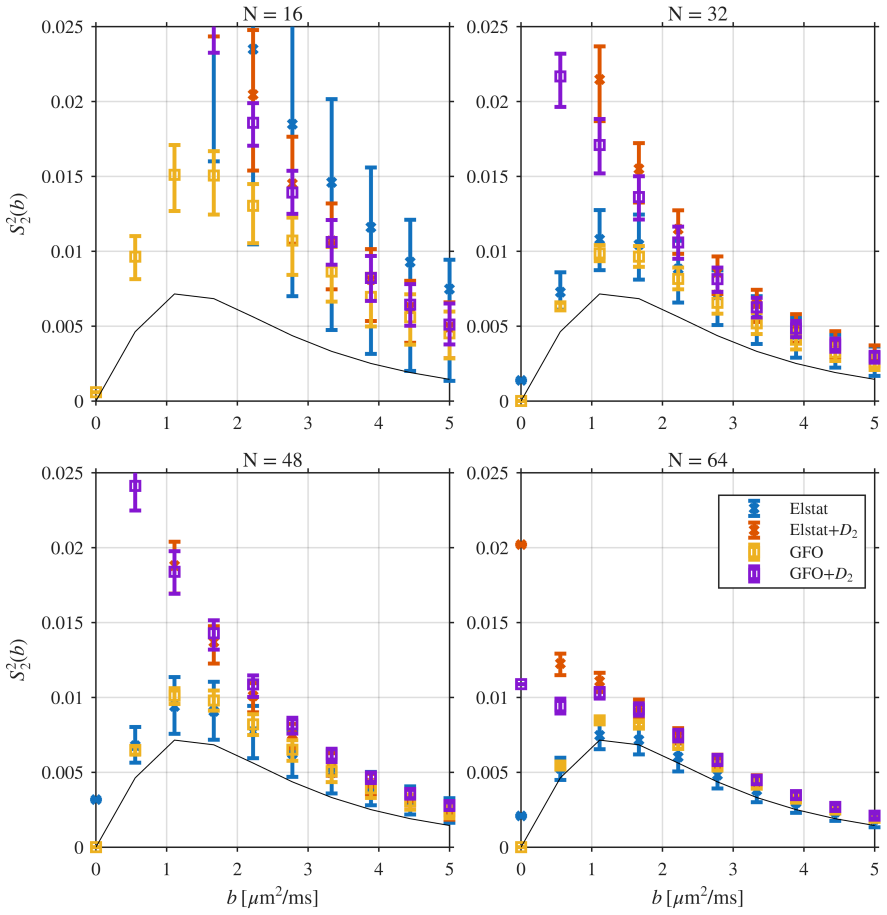
Purpose: To improve the accuracy of diffusion-weighted powder average signals for diffusion encoding with arbitrary b-tensors. Methods: We identify an intrinsic dihedral ($D_2$) symmetry of diffusion signals for arbitrary diffusion encoding, which defines their natural signal space (a quotient of 3D rotations). Based on this, we propose a method to generate optimal rotation sets that are applied to the diffusion-encoding gradient waveform to yield powder averages with maximal accuracy. The method, termed ``Geometric Filter Optimization'' (GFO), amounts to designing a sampling filter that is approximately flat over the relevant part of the associated frequency space. We characterize the filter properties and benchmark performance in terms of the accuracy and precision of powder averages and higher-order rotational invariants, including comparison with spherical designs and electrostatic-repulsion-based designs defined on the same space. Results: We found that GFO leads to marked improvements in precision and accuracy in powder averaging over diffusion encoding b-tensors, including axisymmetric and triaxial configurations. For higher-order rotational invariants, the performance was more nuanced, with GFO, electrostatic repulsion, and spherical designs exhibiting different trade-offs in bias and precision depending on $b$ and $N$. Conclusion: A fundamental $D_2$-symmetry of tensor-valued diffusion encoding was shown to constrain its rotational structure and guide the design of optimal rotation sets. This yielded GFO, which provides an efficient recipe for obtaining orientations for powder averaging of signals with axisymmetric and triaxial diffusion encoding. It places no additional demands on gradient system performance and can be used to shorten scan time.
Editorial analysis
A structured set of objections, weighed in public.
Referee Report
Summary. The manuscript identifies an intrinsic D2 symmetry in diffusion signals for arbitrary b-tensor encodings, which defines a natural quotient signal space, and introduces Geometric Filter Optimization (GFO) to generate optimal rotation sets for powder averaging. It benchmarks GFO against spherical designs and electrostatic-repulsion methods, claiming marked gains in accuracy and precision for powder averages (including axisymmetric and triaxial cases) and more nuanced trade-offs for higher-order rotational invariants.
Significance. If the central claims are substantiated, the work supplies a symmetry-based, parameter-free recipe for rotation-set design that imposes no extra gradient hardware demands and can shorten scan times while improving powder-average fidelity for advanced tensor-valued diffusion encoding; this could meaningfully advance quantitative dMRI protocols that rely on rotational invariants.
major comments (2)
- [Methods] Methods (GFO construction): the claim that the identified D2 quotient fully parametrizes the signal space and that the resulting filter is sufficiently flat for arbitrary triaxial b-tensors is load-bearing; the manuscript must supply quantitative bounds (maximum ripple or L-infinity deviation) over the relevant frequency domain, especially for b > 2000 s/mm², to rule out configuration-dependent residual errors.
- [Results] Results (benchmarking): the abstract asserts 'marked improvements' in precision and accuracy, yet the provided text supplies no numerical tables, bias/variance values, or exclusion criteria for the tested b-tensors and N; without these data the generality of the gains versus spherical and electrostatic designs cannot be verified.
minor comments (2)
- [Abstract] Abstract: the statement that GFO 'places no additional demands on gradient system performance' would benefit from a one-sentence clarification on waveform implementation.
- [Introduction] Notation: the precise definition of the D2 quotient manifold and its coordinate chart should be stated once in the main text to avoid ambiguity when comparing to prior rotation-set literature.
Simulated Author's Rebuttal
We thank the referee for the constructive feedback and positive assessment of the potential impact of our work. We address each major comment point by point below and will revise the manuscript to incorporate the requested clarifications and data.
read point-by-point responses
-
Referee: [Methods] Methods (GFO construction): the claim that the identified D2 quotient fully parametrizes the signal space and that the resulting filter is sufficiently flat for arbitrary triaxial b-tensors is load-bearing; the manuscript must supply quantitative bounds (maximum ripple or L-infinity deviation) over the relevant frequency domain, especially for b > 2000 s/mm², to rule out configuration-dependent residual errors.
Authors: We agree that quantitative bounds on filter flatness are necessary to fully substantiate the parametrization claim. In the revised manuscript we will add a dedicated subsection (or supplementary figure) reporting the maximum ripple and L-infinity deviation of the GFO-designed filter across the relevant frequency domain for a representative set of triaxial b-tensors with b-values up to and beyond 2000 s/mm². These bounds will be computed directly from the optimized sampling filter and will demonstrate that residual deviations remain negligible and do not introduce measurable configuration-dependent errors in the powder-average signal. revision: yes
-
Referee: [Results] Results (benchmarking): the abstract asserts 'marked improvements' in precision and accuracy, yet the provided text supplies no numerical tables, bias/variance values, or exclusion criteria for the tested b-tensors and N; without these data the generality of the gains versus spherical and electrostatic designs cannot be verified.
Authors: We acknowledge that while comparative performance is shown via figures, explicit numerical summaries would improve verifiability. In the revision we will insert a new table that reports bias and variance (or equivalent precision/accuracy metrics) for both powder averages and higher-order rotational invariants, covering the full range of tested b-tensors (axisymmetric and triaxial) and rotation-set sizes N. The table will also list the exact b-tensor parameters, N values, and any simulation/exclusion criteria used, enabling direct quantitative comparison against the spherical-design and electrostatic-repulsion baselines. revision: yes
Circularity Check
No circularity: derivation rests on independent symmetry identification and optimization criterion
full rationale
The paper first identifies the D2 symmetry of diffusion signals for arbitrary b-tensors as a mathematical property that defines the quotient signal space, then constructs GFO as an optimization procedure to approximate a flat sampling filter over that space. Benchmarks compare GFO against spherical designs and electrostatic repulsion on the same manifold, with performance quantified by accuracy/precision metrics rather than by re-deriving fitted parameters or self-referential equations. No load-bearing step reduces by construction to its own inputs, and no self-citation chain is invoked to justify uniqueness or the core ansatz; the method is therefore self-contained against external benchmarks.
Axiom & Free-Parameter Ledger
axioms (1)
- domain assumption Intrinsic dihedral D2 symmetry of diffusion signals for arbitrary diffusion encoding defines their natural signal space as a quotient of 3D rotations.
Reference graph
Works this paper leans on
-
[1]
Thus, for simplicity, our filter design neglects contributions from oddl. The amplitude decays rapidly withl, but the mean is well described by the Sobolev form(1+(l(l+1))/κ2)−s withκandsdepending onbsuch that higher b-values increase the power at higherl. Figure 3 shows the effect of GFO hyper parameterssandκon the coefficient of variation 10 FIG. 3: The...
-
[2]
E. O. Stejskal and J. E. Tanner, Spin Diffusion Measurements: Spin Echoes in the Presence of a Time-Dependent Field Gradient, J Chem Phys42, 288 (1965)
work page 1965
-
[3]
Y. Cheng and D. G. Cory, Multiple scattering by NMR, J. Am. Chem. Soc.121, 7935 (1999)
work page 1999
-
[4]
N. Shemesh, S. N. Jespersen, D. C. Alexander, Y. Cohen, I. Drobnjak, T. B. Dyrby, J. Fin- sterbusch, M. A. Koch, T. Kuder, F. Laun, M. Lawrenz, H. Lundell, P. P. Mitra, M. Nilsson, E. Ozarslan, D. Topgaard, and C. F. Westin, Conventions and nomenclature for double diffu- sion encoding NMR and MRI, Magn Reson Med75, 82 (2016)
work page 2016
-
[5]
F. Szczepankiewicz, C. F. Westin, and M. Nilsson, Gradient waveform design for tensor-valued encoding in diffusion MRI, J Neurosci Methods348, 109007 (2021)
work page 2021
-
[6]
Topgaard, Multidimensional diffusion MRI, J Magn Reson275, 98 (2017)
D. Topgaard, Multidimensional diffusion MRI, J Magn Reson275, 98 (2017)
work page 2017
-
[7]
C. F. Westin, H. Knutsson, O. Pasternak, F. Szczepankiewicz, E. Ozarslan, D. van Westen, C. Mattisson, M. Bogren, L. J. O’Donnell, M. Kubicki, D. Topgaard, and M. Nilsson, Q-space trajectory imaging for multidimensional diffusion MRI of the human brain, NeuroImage135, 345 (2016)
work page 2016
-
[8]
S. Lasič, F. Szczepankiewicz, S. Eriksson, M. Nilsson, and D. Topgaard, Microanisotropy imaging: Quantification of microscopic diffusion anisotropy and orientational order param- eter by diffusion MRI with magic-angle spinning of the q-vector, Frontiers in Physics2, 10.3389/fphy.2014.00011 (2014)
-
[9]
S.N.Jespersen, H.Lundell, C.K.Sønderby,andT.B.Dyrby,Orientationallyinvariantmetrics of apparent compartment eccentricity from double pulsed field gradient diffusion experiments, NMR in Biomedicine26, 1647 (2013). 18
work page 2013
-
[10]
F. Szczepankiewicz, D. van Westen, E. Englund, C. F. Westin, F. Stahlberg, J. Latt, P. C. Sundgren, and M. Nilsson, The link between diffusion MRI and tumor heterogeneity: Mapping cell eccentricity and density by diffusional variance decomposition (DIVIDE), NeuroImage 142, 522 (2016)
work page 2016
- [11]
-
[12]
M. Reisert, V. G. Kiselev, and B. Dhital, A unique analytical solution of the white matter standard model using linear and planar encodings, Magn Reson Med 10.1002/mrm.27685 (2019)
- [13]
-
[14]
B. Lampinen, F. Szczepankiewicz, J. Latt, L. Knutsson, J. Martensson, I. M. Bjorkman- Burtscher, D. van Westen, P. C. Sundgren, F. Stahlberg, and M. Nilsson, Probing brain tissue microstructure with MRI: Principles, challenges, and the role of multidimensional diffusion- relaxation encoding, NeuroImage282, 120338 (2023)
work page 2023
- [15]
- [16]
-
[17]
D. S. Novikov, J. Veraart, I. O. Jelescu, and E. Fieremans, Rotationally-invariant mapping of scalar and orientational metrics of neuronal microstructure with diffusion MRI, NeuroImage 174, 518 (2018)
work page 2018
-
[18]
F. Szczepankiewicz, J. Sjölund, F. Ståhlberg, J. Lätt, and M. Nilsson, Tensor-valued diffusion encoding for diffusional variance decomposition (DIVIDE): Technical feasibility in clinical MRI systems, PLOS ONE14, e0214238 (2019)
work page 2019
-
[19]
Edén, Computer simulations in solid-state NMR
M. Edén, Computer simulations in solid-state NMR. III. Powder averaging, Concepts in Mag- netic Resonance Part A18A, 24 (2003)
work page 2003
-
[20]
E. T. McKinnon, J. H. Jensen, G. R. Glenn, and J. A. Helpern, Dependence on b-value of the direction-averaged diffusion-weighted imaging signal in brain, Magnetic Resonance Imaging 19 36, 121 (2017)
work page 2017
-
[21]
J. Veraart, D. Nunes, U. Rudrapatna, E. Fieremans, D. K. Jones, D. S. Novikov, and N. Shemesh, Nonivasive quantification of axon radii using diffusion MRI, Elife9, 10.7554/eLife.49855 (2020)
- [22]
-
[23]
M.GräfandD.Potts,SamplingSetsandQuadratureFormulaeontheRotationGroup,Numer Func Anal Opt30, 665 (2009)
work page 2009
-
[24]
S. N. Jespersen, Isotropic sampling of tensor-encoded diffusion MRI, Magnetic Resonance in Medicine93, 2040 (2025)
work page 2040
-
[25]
C.-F. Westin and F. Szczepankiewicz, Isotropic sampling for skewed encoding: novel rotation schemes for non-axisymmetric encoding objects in diffusion mri, Proceedings of the Interna- tional Society for Magnetic Resonance in Medicine28(2020)
work page 2020
-
[26]
H. Knutsson, M. Andersson, and J. Wiklund, Advanced filter design, Proceedings of the 11th Scandinavian Conference on Image Analysis (1999)
work page 1999
- [27]
-
[28]
F. Szczepankiewicz, C.-F. Westin, and H. Knutsson, A measurement weighting scheme for optimal powder average estimation, Proceedings of the International Society for Magnetic Resonance in Medicine25(2017)
work page 2017
-
[29]
A. Yershova, S. Jain, S. M. LaValle, and J. C. Mitchell, Generating Uniform Incremental Grids on SO(3) Using the Hopf Fibration, The International Journal of Robotics Research29, 801 (2010)
work page 2010
- [30]
-
[31]
H. Lundell, T. B. Dyrby, P. L. Hubbard, F.-L. Zhou, G. J. Parker, and S. N. Jespersen, Vali- dation of double diffusion schemes of microscopic fractional anisotropy,Proc. Int. Soc. Magn. Reson. Med., Proceedings of the International Society for Magnetic Resonance in Medicine 20 23(2016)
work page 2016
-
[32]
L. Ning, F. Szczepankiewicz, M. Nilsson, Y. Rathi, and C.-F. Westin, Probing tissue mi- crostructure by diffusion skewness tensor imaging, Scientific Reports11, 135 (2021)
work page 2021
-
[33]
F. Szczepankiewicz, M. Molendowska, S. Lasič, M. E. Safi, M. Gottschalk, E. Sereti, A. Bjartell, L. Knutsson, O. V. Timmermand, C. Ceberg, and J. Strand, Restriction-weighted q-space trajectory imaging (ResQ): Toward mapping diffusion time effects with tensor-valued diffusion encoding in human prostate cancer xenografts, bioRxiv , 2025.12.08.692924 (2025)
work page 2025
-
[34]
D. S. Novikov, E. Fieremans, S. N. Jespersen, and V. G. Kiselev, Quantifying brain mi- crostructure with diffusion MRI: Theory and parameter estimation, NMR Biomed32, e3998 (2019)
work page 2019
-
[35]
J. L. Olesen, L. Østergaard, N. Shemesh, and S. N. Jespersen, Diffusion time dependence, power-law scaling, and exchange in gray matter, NeuroImage251, 118976 (2022)
work page 2022
-
[36]
I. O. Jelescu, A. de Skowronski, F. Geffroy, M. Palombo, and D. S. Novikov, Neurite Exchange Imaging (NEXI): A minimal model of diffusion in gray matter with inter-compartment water exchange, NeuroImage256, 119277 (2022)
work page 2022
-
[37]
R. N. Henriques, S. N. Jespersen, and N. Shemesh, Correlation tensor magnetic resonance imaging, NeuroImage211, 116605 (2020)
work page 2020
-
[38]
R. N. Henriques, M. Palombo, S. N. Jespersen, N. Shemesh, H. Lundell, and A. Ianus, Double diffusion encoding and applications for biomedical imaging, J Neurosci Methods348, 108989 (2021)
work page 2021
-
[39]
S. N. Jespersen and F. Szczepankiewicz, Accurate powder averaging in dmri by optimal en- coding rotations and signal weighting, Proceedings of the International Society for Magnetic Resonance in Medicine34(2026)
work page 2026
-
[40]
D. Christiaens, J. Veraart, L. Cordero-Grande, A. N. Price, J. Hutter, J. V. Hajnal, and J. D. Tournier, On the need for bundle-specific microstructure kernels in diffusion MRI, NeuroImage 208, 116460 (2020). 21
work page 2020
discussion (0)
Sign in with ORCID, Apple, or X to comment. Anyone can read and Pith papers without signing in.