Extreme-Value Distribution Analysis of the Second CHIME/FRB Catalog: Assessing the Rarity of the One-off FRB 20250316A
Pith reviewed 2026-05-16 09:32 UTC · model grok-4.3
The pith
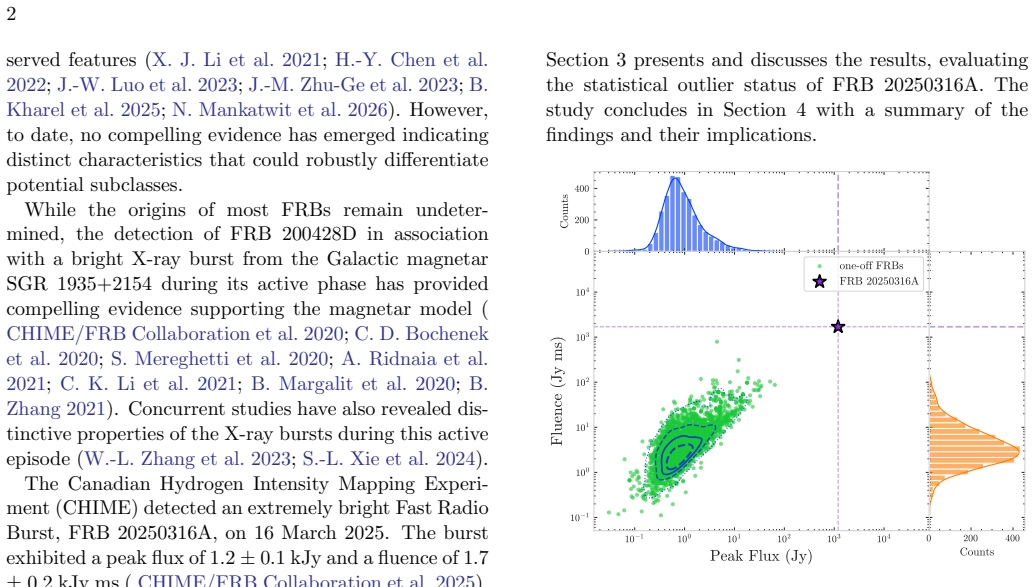
FRB 20250316A is a statistical outlier whose peak flux follows a heavy-tailed distribution with return periods of decades to centuries.
A machine-rendered reading of the paper's core claim, the machinery that carries it, and where it could break.
Core claim
The paper establishes that FRB 20250316A is a pronounced statistical outlier in both peak flux and fluence. The peak-flux block maxima are described by an unbounded, heavy-tailed Fréchet-type GEV distribution, producing return periods of approximately 802 years at 68% CL, 81 years at 95% CL, and 30 years at 99% CL. The fluence distribution for the full sample is likewise consistent with a Fréchet form (return periods ~55, 15, and 8 years), but cleaning three other conspicuous outliers yields a light-tailed Weibull distribution with a finite upper bound that FRB 20250316A still exceeds. Its inferred recurrence time is shorter than that of the gamma-ray BOAT GRB 221009A, yet the event remains
What carries the argument
Bayesian fits of the Generalized Extreme Value (GEV) family to the block maxima of peak flux and fluence extracted from the second CHIME/FRB catalog.
If this is right
- Extremely bright one-off FRBs occur on timescales of decades to centuries under the fitted GEV model.
- The shift from Fréchet to Weibull after outlier removal shows that fluence-tail shape depends on whether other bright events are retained.
- FRB 20250316A qualifies as a candidate FRB "BOAT" analogous to GRB 221009A within radio-survey baselines.
- Rare luminous events at the upper end of the distribution may trace either a distinct physical channel or the extreme tail of a complex luminosity function.
Where Pith is reading between the lines
- Longer observational baselines from future wide-field surveys can directly test whether events appear at the predicted return intervals.
- The sensitivity of the fluence distribution to a handful of outliers underscores the need for uniform catalog cleaning before tail inference.
- Confirmation of such extremes would require progenitor models to accommodate rare high-luminosity channels in addition to the more common population.
Load-bearing premise
The block maxima of peak flux and fluence are assumed to follow a GEV distribution without significant distortion from selection effects or catalog incompleteness.
What would settle it
Detection of another FRB with peak flux comparable to or exceeding that of FRB 20250316A within the next 10–20 years would falsify the derived 99% CL return period of 30 years.
Figures


read the original abstract
We present a statistical analysis of the extremely bright, apparently non-repeating fast radio burst FRB 20250316A, detected by the Canadian Hydrogen Intensity Mapping Experiment (CHIME), to assess its rarity. Using a model-agnostic framework based on the Generalized Extreme Value (GEV) distribution and the second CHIME/FRB catalog, we perform Bayesian fits to the block-maxima of its peak flux and fluence. Our analysis confirms FRB 20250316A as a pronounced statistical outlier in both quantities. For the peak flux, the best-fit GEV model follows an unbounded, heavy-tailed Fr\'echet-type distribution, yielding return periods of approximately $802$ years at the $68\%$ confidence level (CL), $81$ years at the $95\%$ CL, and $30$ years at the $99\%$ CL. The fluence distribution exhibits greater complexity: while the full sample is consistent with a Fr\'echet-type distribution (return period of approximately $55$, $15$, and $8$ years at the $68\%$, $95\%$ and $99\%$ CLs, respectively), removing three other conspicuous outliers reveals a light-tailed Weibull-type distribution with a finite upper bound that is far exceeded by the fluence of FRB 20250316A. Although its inferred recurrence time is shorter than that of the ``Brightest Of All Time'' (BOAT) gamma-ray burst GRB 221009A, FRB 20250316A represents a similarly exceptional event (a potential FRB ``BOAT'') within the relatively short observational baseline of wide-field radio surveys. This work affirms the existence of rare, extremely luminous events at the extreme upper end of the FRB luminosity distribution, which may delineate a distinct physical channel or the extreme tail of a complex luminosity function.
Editorial analysis
A structured set of objections, weighed in public.
Referee Report
Summary. The paper applies a Bayesian Generalized Extreme Value (GEV) analysis to the block maxima of peak flux and fluence drawn from the second CHIME/FRB catalog in order to quantify the rarity of the apparently one-off FRB 20250316A. It reports that the peak-flux distribution is well-described by an unbounded Fréchet-type GEV yielding return periods of ~802 yr (68 % CL), ~81 yr (95 % CL) and ~30 yr (99 % CL), while the fluence distribution is Fréchet for the full sample but becomes Weibull (finite upper bound) after removal of three outliers; the event is therefore presented as a statistical outlier and a possible radio analogue of the BOAT GRB.
Significance. If the GEV fits prove robust, the work supplies the first quantitative, catalog-based return-period estimates for the extreme tail of the FRB luminosity distribution and thereby strengthens the case that rare, ultra-luminous events exist and may trace a distinct physical channel. The model-agnostic Bayesian framework and explicit comparison with the BOAT GRB are clear strengths that could be adopted by future wide-field radio surveys.
major comments (3)
- [Abstract] Abstract: the fluence analysis reports that removal of three conspicuous outliers changes the posterior from Fréchet (ξ > 0, unbounded) to Weibull (ξ < 0, finite upper bound exceeded by FRB 20250316A). Because the removal is performed after visual inspection and lacks pre-specified, independent selection criteria, the shape-parameter inference and the bounded-vs-unbounded conclusion are sensitive to this choice; a sensitivity study or justification for the outlier threshold is required.
- [Abstract] Abstract and methods description: the block-maxima fits assume that the observed peak-flux and fluence values are unaffected by CHIME/FRB catalog incompleteness, saturation, or beam-response selection at the bright end. No robustness checks (e.g., injection-recovery tests or flux-dependent completeness corrections) are described; if such effects truncate or bias the upper tail, both the fitted ξ and the quoted return periods (e.g., 30 yr at 99 % CL for peak flux) become unreliable.
- [Abstract] Abstract: the reported return periods are obtained directly from the posterior of the fitted GEV location, scale and shape parameters. While this is the standard parametric procedure, the manuscript should explicitly propagate the full posterior uncertainty into the return-period quantiles and discuss the extrapolation risk inherent in using a three-parameter model fitted to a modest number of block maxima.
minor comments (2)
- The abstract would benefit from a concise table or bullet list that tabulates the three return-period values for both peak flux and fluence (full and cleaned samples) at the three stated confidence levels.
- Clarify whether the block size used to define the maxima is fixed (e.g., per observing session) or chosen to optimize the GEV approximation; any dependence on this choice should be shown.
Simulated Author's Rebuttal
We thank the referee for their detailed and constructive feedback on our manuscript. We have addressed each of the major comments point by point below, making revisions to the manuscript where feasible to improve clarity and robustness.
read point-by-point responses
-
Referee: [Abstract] Abstract: the fluence analysis reports that removal of three conspicuous outliers changes the posterior from Fréchet (ξ > 0, unbounded) to Weibull (ξ < 0, finite upper bound exceeded by FRB 20250316A). Because the removal is performed after visual inspection and lacks pre-specified, independent selection criteria, the shape-parameter inference and the bounded-vs-unbounded conclusion are sensitive to this choice; a sensitivity study or justification for the outlier threshold is required.
Authors: We agree that the outlier removal was performed post-hoc based on visual inspection, which introduces subjectivity. In the revised manuscript, we have added a dedicated sensitivity analysis section. This includes varying the number of outliers removed (from 0 to 5) and examining the resulting posterior distributions for the shape parameter ξ. We also provide a justification for the three outliers by quantifying their deviation using standardized residuals from the initial fit. This demonstrates that the conclusion regarding the bounded nature after removal is robust within reasonable thresholds, while acknowledging the exploratory nature of the analysis. revision: partial
-
Referee: [Abstract] Abstract and methods description: the block-maxima fits assume that the observed peak-flux and fluence values are unaffected by CHIME/FRB catalog incompleteness, saturation, or beam-response selection at the bright end. No robustness checks (e.g., injection-recovery tests or flux-dependent completeness corrections) are described; if such effects truncate or bias the upper tail, both the fitted ξ and the quoted return periods (e.g., 30 yr at 99 % CL for peak flux) become unreliable.
Authors: We acknowledge the importance of assessing catalog completeness at the bright end. For CHIME/FRB, the brightest events are generally well-detected due to the survey's design, and saturation effects are mitigated by the instrument's dynamic range. However, we have not performed explicit injection-recovery tests in the original analysis. In the revision, we have added a discussion in the Methods section explaining why we believe the upper tail is not significantly biased, based on the catalog's reported detection thresholds and comparisons with other surveys. We note that full injection tests would require detailed simulation of the CHIME beam and noise properties, which is beyond the scope of this statistical paper but could be addressed in future work. We have also included a caveat on this assumption in the abstract and conclusions. revision: partial
-
Referee: [Abstract] Abstract: the reported return periods are obtained directly from the posterior of the fitted GEV location, scale and shape parameters. While this is the standard parametric procedure, the manuscript should explicitly propagate the full posterior uncertainty into the return-period quantiles and discuss the extrapolation risk inherent in using a three-parameter model fitted to a modest number of block maxima.
Authors: We thank the referee for this suggestion. In the revised version, we have updated the results section to explicitly compute and report the return periods with full posterior uncertainty, providing credible intervals derived from the joint posterior samples of the GEV parameters. Additionally, we have added a paragraph discussing the extrapolation risks, including the limitations of fitting a three-parameter model to a small number of block maxima (approximately 10-20 blocks depending on the catalog partitioning) and the potential for model misspecification in the extreme tail. revision: yes
Circularity Check
Return periods are direct outputs of Bayesian GEV fits to block maxima
specific steps
-
fitted input called prediction
[Abstract]
"For the peak flux, the best-fit GEV model follows an unbounded, heavy-tailed Fréchet-type distribution, yielding return periods of approximately 802 years at the 68% CL, 81 years at the 95% CL, and 30 years at the 99% CL."
The quoted return periods are obtained by plugging the fitted GEV location, scale, and shape parameters (from the Bayesian posterior on the catalog block maxima) into the standard return-period formula 1/(1-F(x)). The rarity claim is therefore a direct algebraic consequence of the model fit to the same data rather than an independent prediction.
full rationale
The paper fits the GEV distribution to the observed block maxima of peak flux and fluence via Bayesian methods, then computes return periods from the resulting posterior parameters. This is the standard parametric extrapolation in extreme-value statistics and does not reduce the central claim to a tautology or self-definition. No load-bearing self-citations, uniqueness theorems, or ansatzes imported from prior author work are present. The analysis remains self-contained against the catalog data once the GEV modeling assumption is granted; the post-hoc outlier removal for fluence affects the shape parameter but is an explicit modeling choice rather than a hidden circular step.
Axiom & Free-Parameter Ledger
free parameters (1)
- GEV shape, location, and scale parameters
axioms (2)
- standard math Block maxima of i.i.d. random variables converge to a GEV distribution for large block size
- domain assumption The CHIME/FRB catalog provides a representative sample of the underlying fluence and flux distribution
Reference graph
Works this paper leans on
-
[1]
Acero, F. J., Carrasco, V. M. S., Gallego, M. C., Usoskin, I. G., & Vaquero, J. M. 2025, SoPh, 300, 50, doi: 10.1007/s11207-025-02464-6
-
[2]
2025, ApJL, 991, L20, doi: 10.3847/2041-8213/ae0324
An, T., Wang, A., Huang, Y.-C., et al. 2025, ApJL, 991, L20, doi: 10.3847/2041-8213/ae0324
-
[3]
2025, The Astronomer’s Telegram, 17114, 1
Andrew, S., & Chime/Frb Collaboration. 2025, The Astronomer’s Telegram, 17114, 1
work page 2025
-
[4]
Bochenek, C. D., Ravi, V., Belov, K. V., et al. 2020, Nature, 587, 59, doi: 10.1038/s41586-020-2872-x
-
[5]
2023, ApJL, 946, L31, doi: 10.3847/2041-8213/acc39c
Burns, E., Svinkin, D., Fenimore, E., et al. 2023, ApJL, 946, L31, doi: 10.3847/2041-8213/acc39c
-
[6]
2022, ApJ, 939, 27, doi: 10.3847/1538-4357/ac958a CHIME/FRB Collaboration, Andersen, B
Chen, H.-Y., Gu, W.-M., Sun, M., & Yi, T. 2022, ApJ, 939, 27, doi: 10.3847/1538-4357/ac958a CHIME/FRB Collaboration, Andersen, B. C., Bandura, K. M., et al. 2020, Nature, 587, 54, doi: 10.1038/s41586-020-2863-y CHIME/FRB Collaboration, Abbott, T. C., Amouyal, D., et al. 2025, ApJL, 989, L48, doi: 10.3847/2041-8213/adf62f
-
[7]
2001, An introduction to statistical modeling of extreme values, Vol
Coles, S., Bawa, J., Trenner, L., & Dorazio, P. 2001, An introduction to statistical modeling of extreme values, Vol. 208 (Springer)
work page 2001
-
[8]
2025, A&A, 701, A109, doi: 10.1051/0004-6361/202555059
Covino, S. 2025, A&A, 701, A109, doi: 10.1051/0004-6361/202555059
-
[9]
Dai, Z. G. 2020, ApJL, 897, L40, doi: 10.3847/2041-8213/aba11b
-
[10]
Dai, Z. G., Wang, J. S., Wu, X. F., & Huang, Y. F. 2016, ApJ, 829, 27, doi: 10.3847/0004-637X/829/1/27
-
[11]
2025, The Astronomer’s Telegram, 17112, 1 FRB Collaboration, Abbott, T., Andersen, B
Dong, Y. 2025, The Astronomer’s Telegram, 17112, 1 FRB Collaboration, Abbott, T., Andersen, B. C., et al. 2026, arXiv e-prints, arXiv:2601.09399, doi: 10.48550/arXiv.2601.09399
-
[12]
2020, ApJL, 898, L55, doi: 10.3847/2041-8213/aba83c
Geng, J.-J., Li, B., Li, L.-B., et al. 2020, ApJL, 898, L55, doi: 10.3847/2041-8213/aba83c
-
[13]
2025, MNRAS, 543, 3783, doi: 10.1093/mnras/staf1690
Chainakun, P. 2025, MNRAS, 543, 3783, doi: 10.1093/mnras/staf1690
-
[14]
2024, MNRAS, 534, 173, doi: 10.1093/mnras/stae2051
Heather, C., Chantavat, T., Chongchitnan, S., & Silk, J. 2024, MNRAS, 534, 173, doi: 10.1093/mnras/stae2051
-
[15]
2023, ApJS, 269, 17, doi: 10.3847/1538-4365/acf566
Hu, C.-R., & Huang, Y.-F. 2023, ApJS, 269, 17, doi: 10.3847/1538-4365/acf566
-
[16]
Ioka, K., & Zhang, B. 2020, ApJL, 893, L26, doi: 10.3847/2041-8213/ab83fb
-
[17]
Katz, J. I. 2025, arXiv e-prints, arXiv:2510.19143, doi: 10.48550/arXiv.2510.19143
-
[18]
Kaur, B., Kanekar, N., & Prochaska, J. X. 2025, arXiv e-prints, arXiv:2509.04563, doi: 10.48550/arXiv.2509.04563
-
[19]
2025, arXiv e-prints, arXiv:2509.06208, doi: 10.48550/arXiv.2509.06208
Kharel, B., Fonseca, E., Brar, C., et al. 2025, arXiv e-prints, arXiv:2509.06208, doi: 10.48550/arXiv.2509.06208
-
[20]
2024, ApJL, 967, L44, doi: 10.3847/2041-8213/ad4ae8
Lan, H.-T., Zhao, Z.-Y., Wei, Y.-J., & Wang, F.-Y. 2024, ApJL, 967, L44, doi: 10.3847/2041-8213/ad4ae8
-
[21]
Li, C. K., Lin, L., Xiong, S. L., et al. 2021, Nature Astronomy, 5, 378, doi: 10.1038/s41550-021-01302-6
-
[22]
Li, X. J., Dong, X. F., Zhang, Z. B., & Li, D. 2021, ApJ, 923, 230, doi: 10.3847/1538-4357/ac3085
-
[23]
2025, ApJ, 995, 8, doi: 10.3847/1538-4357/ae1463
Li, Y., Sun, H., Qian, L., et al. 2025, ApJ, 995, 8, doi: 10.3847/1538-4357/ae1463
-
[24]
2025, ApJL, 994, L32, doi: 10.3847/2041-8213/ae1d60
Liang, Y.-F., Li, Y., Tang, Z.-F., et al. 2025, ApJL, 994, L32, doi: 10.3847/2041-8213/ae1d60
-
[25]
Lorimer, D. R., Bailes, M., McLaughlin, M. A., Narkevic, D. J., & Crawford, F. 2007, Science, 318, 777, doi: 10.1126/science.1147532
-
[26]
2023, MNRAS, 518, 1629, doi: 10.1093/mnras/stac3206
Luo, J.-W., Zhu-Ge, J.-M., & Zhang, B. 2023, MNRAS, 518, 1629, doi: 10.1093/mnras/stac3206 6
-
[27]
2026, MNRAS, 545, staf2178, doi: 10.1093/mnras/staf2178
Mankatwit, N., Thongkonsing, P., Loekkesee, S., et al. 2026, MNRAS, 545, staf2178, doi: 10.1093/mnras/staf2178
-
[28]
Margalit, B., Beniamini, P., Sridhar, N., & Metzger, B. D. 2020, ApJL, 899, L27, doi: 10.3847/2041-8213/abac57
-
[29]
2020, ApJL, 898, L29, doi: 10.3847/2041-8213/aba2cf
Mereghetti, S., Savchenko, V., Ferrigno, C., et al. 2020, ApJL, 898, L29, doi: 10.3847/2041-8213/aba2cf
-
[30]
2025, The Astronomer’s Telegram, 17081, 1
Ng, M., & CHIME/FRB Collaboration. 2025, The Astronomer’s Telegram, 17081, 1
work page 2025
-
[31]
2026, MNRAS, 545, staf2148, doi: 10.1093/mnras/staf2148
Nurmamat, N., Huang, Y.-F., Dong, X.-F., et al. 2026, MNRAS, 545, staf2148, doi: 10.1093/mnras/staf2148
-
[32]
S., Blaauw, R., Buchsteiner, T., et al
Ould-Boukattine, O. S., Blaauw, R., Buchsteiner, T., et al. 2025, The Astronomer’s Telegram, 17124, 1
work page 2025
-
[33]
Petroff, E., Hessels, J. W. T., & Lorimer, D. R. 2019, A&A Rv, 27, 4, doi: 10.1007/s00159-019-0116-6
-
[34]
2019, PhR, 821, 1, doi: 10.1016/j.physrep.2019.06.003
Platts, E., Weltman, A., Walters, A., et al. 2019, PhR, 821, 1, doi: 10.1016/j.physrep.2019.06.003
-
[35]
2016, MNRAS, 456, 641, doi: 10.1093/mnras/stv2677
Reischke, R., Maturi, M., & Bartelmann, M. 2016, MNRAS, 456, 641, doi: 10.1093/mnras/stv2677
-
[36]
2018, MNRAS, 473, 3598, doi: 10.1093/mnras/stx2615
Repp, A., & Szapudi, I. 2018, MNRAS, 473, 3598, doi: 10.1093/mnras/stx2615
-
[37]
2021, Nature Astronomy, 5, 372, doi: 10.1038/s41550-020-01265-0
Ridnaia, A., Svinkin, D., Frederiks, D., et al. 2021, Nature Astronomy, 5, 372, doi: 10.1038/s41550-020-01265-0
-
[38]
Sun, H., Li, D. Y., Jin, C. C., et al. 2025, The Astronomer’s Telegram, 17119, 1
work page 2025
-
[39]
Waizmann, J.-C., Ettori, S., & Moscardini, L. 2012, MNRAS, 422, 3554, doi: 10.1111/j.1365-2966.2012.20865.x
-
[40]
Wang, F. Y., Lan, H. T., Zhao, Z. Y., et al. 2025, arXiv e-prints, arXiv:2512.07140. https://arxiv.org/abs/2512.07140
-
[41]
Wang, F. Y., Zhang, G. Q., Dai, Z. G., & Cheng, K. S. 2022, Nature Communications, 13, 4382, doi: 10.1038/s41467-022-31923-y
-
[42]
2021, Science China Physics, Mechanics, and Astronomy, 64, 249501, doi: 10.1007/s11433-020-1661-7
Xiao, D., Wang, F., & Dai, Z. 2021, Science China Physics, Mechanics, and Astronomy, 64, 249501, doi: 10.1007/s11433-020-1661-7
-
[43]
2024, ApJ, 967, 108, doi: 10.3847/1538-4357/ad4093
Xie, S.-L., Yu, Y.-W., Xiong, S.-L., et al. 2024, ApJ, 967, 108, doi: 10.3847/1538-4357/ad4093
-
[44]
2021, ApJL, 907, L17, doi: 10.3847/2041-8213/abd628
Zhang, B. 2021, ApJL, 907, L17, doi: 10.3847/2041-8213/abd628
-
[45]
2023, Reviews of Modern Physics, 95, 035005, doi: 10.1103/RevModPhys.95.035005
Zhang, B. 2023, Reviews of Modern Physics, 95, 035005, doi: 10.1103/RevModPhys.95.035005
-
[46]
2025, ApJL, 994, L20, doi: 10.3847/2041-8213/ae1023
Zhang, B., & Hu, R.-C. 2025, ApJL, 994, L20, doi: 10.3847/2041-8213/ae1023
-
[47]
2024, Journal of Astrophysics and Astronomy, 45, 14, doi: 10.1007/s12036-024-09999-3
Zhang, R., Chen, Y.-Q., Zeng, S.-G., et al. 2024, Journal of Astrophysics and Astronomy, 45, 14, doi: 10.1007/s12036-024-09999-3
-
[48]
2023, Research in Astronomy and Astrophysics, 23, 115013, doi: 10.1088/1674-4527/acf979
Zhang, W.-L., Li, X.-J., Yang, Y.-P., et al. 2023, Research in Astronomy and Astrophysics, 23, 115013, doi: 10.1088/1674-4527/acf979
-
[49]
2025, arXiv e-prints, arXiv:2505.17880, doi: 10.48550/arXiv.2505.17880
Zhang, W.-L., Hu, C.-R., Du, C., et al. 2025, arXiv e-prints, arXiv:2505.17880, doi: 10.48550/arXiv.2505.17880
-
[50]
Zhao, Z. Y., Zhang, G. Q., Wang, F. Y., & Dai, Z. G. 2023, ApJ, 942, 102, doi: 10.3847/1538-4357/aca66b
-
[51]
Zhu-Ge, J.-M., Luo, J.-W., & Zhang, B. 2023, MNRAS, 519, 1823, doi: 10.1093/mnras/stac3599 7 a b c d Figure 2.GEV analysis of the peak flux.(a)Block maxima time series compared to FRB 20250316A (red horizontal dashed line).(b)Fitted GEV model and return level curve. The intersection with the FRB 20250316A flux defines return periods at 1σand 2σcredible le...
discussion (0)
Sign in with ORCID, Apple, or X to comment. Anyone can read and Pith papers without signing in.