Planar Degenerate Anchoring in Landau-de Gennes Energy
Pith reviewed 2026-05-21 13:10 UTC · model grok-4.3
The pith
The energy-minimizing S²-valued harmonic map with tangential boundary condition arises as the singular limit of Landau-de Gennes minimizers under Fournier-Galatola planar degenerate anchoring.
A machine-rendered reading of the paper's core claim, the machinery that carries it, and where it could break.
Core claim
The canonical harmonic map on Ω ⊂ R³ with tangential boundary condition is the singular limit of the Landau-de Gennes minimizers with planar degenerate anchoring. Near each boojum the tangent map is a half-bubble with hedgehog or anti-hedgehog structure, determined uniquely up to planar rotation; the full SO(3) action of the interior case is reduced to SO(2) to keep the tangential condition intact. The boundary condition on the half-bubble is Dirichlet on the curved part and tangential on the flat part, so the Schoen-Uhlenbeck bubbling argument must be adapted to these mixed conditions.
What carries the argument
The canonical harmonic map with tangential boundary condition, whose tangent maps at boojums are half-bubbles invariant under planar rotations.
If this is right
- Boojum singularities of the canonical harmonic map are completely classified by half-bubbles with hedgehog or anti-hedgehog profiles up to planar rotation.
- The tangential boundary condition restricts the symmetry group acting on tangent maps from SO(3) to SO(2).
- The large-body limit connects the Landau-de Gennes model directly to the Dirichlet energy of tangential harmonic maps.
- Local analysis near the boundary requires a bubbling procedure that respects the mixed Dirichlet-tangential conditions.
Where Pith is reading between the lines
- The same limit procedure may yield explicit defect profiles for other degenerate anchoring conditions once their corresponding harmonic-map problems are solved.
- The half-bubble classification supplies a concrete test for numerical codes that simulate boojum formation in confined nematics.
- The mixed-boundary bubbling technique could be reused for harmonic maps with other physically motivated boundary conditions that are neither fully Dirichlet nor fully free.
- Global regularity or partial regularity results for the canonical harmonic map would immediately translate into statements about defect locations in the corresponding Landau-de Gennes model.
Load-bearing premise
The Schoen-Uhlenbeck bubbling analysis for Dirichlet boundary conditions extends to mixed Dirichlet-tangential boundary conditions while preserving the tangential condition under only planar rotations.
What would settle it
A numerical computation that tracks whether the Landau-de Gennes minimizer with planar anchoring, as the body size tends to infinity below the transition temperature, converges in energy and in C¹_loc away from boojums to the explicit canonical harmonic map with the predicted half-bubble structure at each boundary singularity.
Figures
read the original abstract
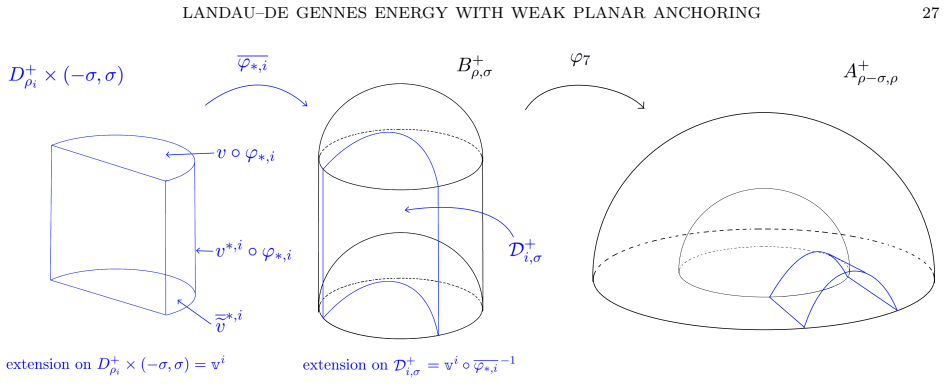
The aim of this article is twofold. First, in the large-body limit and when the temperature is below the nematic-isotropic transition threshold, we verify that the $\mathbb{S}^2$-valued energy-minimizing harmonic map on a bounded smooth domain $\Omega \subset \mathbb{R}^3$ with tangential boundary condition is a singular limit of the Landau-de Gennes energy minimizers subject to the Fournier-Galatola planar degenerate anchoring [22]. This harmonic map is referred to as the canonical harmonic map. Our second aim is to address the local structure of the canonical harmonic map near the boundary singularities, which we call boojums. We show that the tangent map of the canonical harmonic map near a boojum is uniquely characterized by a half bubble with a hedgehog or an anti-hedgehog structure, up to a planar rotation. Comparing to the interior counterpart studied by Brezis-Coron-Lieb in [7], for which the full SO(3) group action can be applied to the tangent map near an interior singularity, we can only apply planar rotations to the tangent map near a boojum to maintain the tangential boundary condition. The degeneracy of the group action from SO(3) to SO(2) makes it challenging to investigate the local structure of the boojum singularity. On the other hand, the boundary condition for the half bubble is Dirichlet on the curved boundary and tangential on the flat boundary. We need to extend the Schoen-Uhlenbeck bubbling analysis in [45,46] for energy-minimizing harmonic maps with Dirichlet boundary conditions to our current case with the mixed-type boundary conditions.
Editorial analysis
A structured set of objections, weighed in public.
Referee Report
Summary. The manuscript verifies that, in the large-body limit below the nematic-isotropic transition, the minimizers of the Landau-de Gennes energy with Fournier-Galatola planar degenerate anchoring converge to the S^2-valued energy-minimizing harmonic map with tangential boundary conditions (the canonical harmonic map) on a bounded smooth domain Ω ⊂ R^3. It further establishes uniqueness of the tangent map at boundary singularities (boojums), showing that it must be a half-bubble with hedgehog or anti-hedgehog structure up to planar rotation, by extending the Schoen-Uhlenbeck bubbling and ε-regularity theory from pure Dirichlet conditions to the mixed Dirichlet-tangential boundary setting.
Significance. If the central claims hold, the work supplies a rigorous singular-limit justification for approximating Landau-de Gennes models by harmonic maps under a physically relevant degenerate anchoring condition. The uniqueness result for boojum tangent maps is a substantive contribution, as it handles the reduced symmetry (SO(2) rather than SO(3)) while preserving the tangential condition. The paper explicitly builds on Brezis-Coron-Lieb and Schoen-Uhlenbeck, and the extension to mixed boundary conditions is carried out with attention to the interface between curved and flat boundary portions.
major comments (2)
- [§4] §4 (extension of Schoen-Uhlenbeck theory): the monotonicity formula and ε-regularity statements for the mixed boundary conditions are load-bearing for both the global convergence and the local tangent-map uniqueness. The manuscript must confirm that the standard reflection arguments or boundary monotonicity estimates continue to hold when only planar SO(2) rotations are permitted to preserve the tangential condition on the flat portion; any additional error terms arising at the curved-flat interface curve must be controlled uniformly.
- [tangent-map uniqueness theorem] Theorem on tangent-map uniqueness (near boojums): the identification of the half-bubble as the only possible tangent map up to planar rotation relies on the adapted bubbling analysis. It is necessary to verify that no other energy-minimizing maps with the mixed boundary condition (Dirichlet on the hemisphere, tangential on the equatorial disk) exist; the current argument should include an explicit compactness or classification step that rules out additional possibilities under the reduced symmetry group.
minor comments (3)
- [references] The bibliography entry for the Fournier-Galatola anchoring [22] should be expanded to include the precise form of the anchoring energy density used in the analysis.
- [§2] Notation for the rescaled Landau-de Gennes functional and the associated Euler-Lagrange equation should be introduced once in §2 and used consistently; occasional shifts between Q-tensor and director formulations can be clarified.
- [figures] Figure captions describing the boojum configurations would benefit from explicit indication of the hedgehog versus anti-hedgehog orientation relative to the flat boundary.
Simulated Author's Rebuttal
We thank the referee for the careful reading and constructive suggestions. We address the two major comments below and will revise the manuscript to incorporate clarifications where needed.
read point-by-point responses
-
Referee: [§4] §4 (extension of Schoen-Uhlenbeck theory): the monotonicity formula and ε-regularity statements for the mixed boundary conditions are load-bearing for both the global convergence and the local tangent-map uniqueness. The manuscript must confirm that the standard reflection arguments or boundary monotonicity estimates continue to hold when only planar SO(2) rotations are permitted to preserve the tangential condition on the flat portion; any additional error terms arising at the curved-flat interface curve must be controlled uniformly.
Authors: We thank the referee for this observation. In Section 4 the reflection across the flat boundary is performed using only vector fields invariant under the planar SO(2) action that preserves the tangential condition; the resulting monotonicity identity retains the same form as in the classical Dirichlet case because the boundary term vanishes identically on the flat portion. Error terms at the curved-flat interface are controlled by a standard cutoff argument together with the C^{2} regularity of ∂Ω, yielding bounds uniform in the scaling parameter. We will add an explicit remark after the statement of the monotonicity formula that records these controls and the adaptation of the reflection. revision: yes
-
Referee: [tangent-map uniqueness theorem] Theorem on tangent-map uniqueness (near boojums): the identification of the half-bubble as the only possible tangent map up to planar rotation relies on the adapted bubbling analysis. It is necessary to verify that no other energy-minimizing maps with the mixed boundary condition (Dirichlet on the hemisphere, tangential on the equatorial disk) exist; the current argument should include an explicit compactness or classification step that rules out additional possibilities under the reduced symmetry group.
Authors: The adapted bubbling analysis already produces a limit map satisfying the mixed boundary conditions. To rule out other possibilities under the reduced SO(2) symmetry we invoke the energy quantization and the fact that any such minimizer must attain the minimal energy of the standard half-bubble; a direct computation in spherical coordinates then shows that the only harmonic maps meeting the Dirichlet-tangential conditions are the hedgehog and anti-hedgehog configurations, up to planar rotation. We will insert a short classification lemma immediately before the uniqueness statement that makes this compactness-plus-classification step fully explicit. revision: yes
Circularity Check
No significant circularity; derivation extends external bubbling theory with new boundary estimates.
full rationale
The paper's central claims rest on a claimed extension of the Schoen-Uhlenbeck epsilon-regularity and bubbling analysis (cited from [45,46]) to mixed Dirichlet-tangential boundary conditions, together with the known Brezis-Coron-Lieb interior singularity classification [7]. These are external results whose proofs are independent of the present manuscript; the new work supplies the necessary boundary estimates near the flat-tangential interface while preserving the SO(2) symmetry. No step reduces a derived quantity to a fitted parameter, a self-definition, or a load-bearing self-citation whose validity is assumed rather than re-proven. The singular-limit identification and boojum tangent-map uniqueness are therefore presented as consequences of this independent analytic extension rather than tautological re-labelings of the inputs.
Axiom & Free-Parameter Ledger
axioms (2)
- domain assumption The domain Ω is bounded and smooth in R^3.
- domain assumption Temperature is below the nematic-isotropic transition threshold.
Lean theorems connected to this paper
-
IndisputableMonolith/Foundation/AbsoluteFloorClosure.leanreality_from_one_distinction unclear?
unclearRelation between the paper passage and the cited Recognition theorem.
We need to extend the Schoen-Uhlenbeck bubbling analysis in [45,46] for energy-minimizing harmonic maps with Dirichlet boundary conditions to our current case with the mixed-type boundary conditions.
-
IndisputableMonolith/Cost/FunctionalEquation.leanwashburn_uniqueness_aczel unclear?
unclearRelation between the paper passage and the cited Recognition theorem.
the tangent map of u∗∘Φ⁻¹(x) near 0 is equal to either x/|x| or −x/|x|
What do these tags mean?
- matches
- The paper's claim is directly supported by a theorem in the formal canon.
- supports
- The theorem supports part of the paper's argument, but the paper may add assumptions or extra steps.
- extends
- The paper goes beyond the formal theorem; the theorem is a base layer rather than the whole result.
- uses
- The paper appears to rely on the theorem as machinery.
- contradicts
- The paper's claim conflicts with a theorem or certificate in the canon.
- unclear
- Pith found a possible connection, but the passage is too broad, indirect, or ambiguous to say the theorem truly supports the claim.
Reference graph
Works this paper leans on
- [1]
- [2]
- [3]
-
[4]
J. M. Ball and A. Zarnescu. Orientability and energy minimization in liquid crystal models. Archive for Rational Mechanics and Analysis, 202(2):493–535, 2011
work page 2011
- [5]
- [6]
-
[7]
H. Brezis, J.-M. Coron, and E. H. Lieb. Harmonic maps with defects.Communications in mathematical physics, 107:649–705, 1986
work page 1986
-
[8]
L. Bronsard, A. Colinet, and D. Stantejsky. Minimizing harmonic maps on the unit ball with tangential anchoring.arXiv preprint arXiv:2501.11565, 2025
- [9]
-
[10]
A. Contreras, X. Lamy, and R. Rodiac. Boundary regularity of weakly anchored harmonic maps.Comptes Rendus. Math´ ematique, 353(12):1093–1097, 2015
work page 2015
-
[11]
T. A. Davis and E. C. Gartland Jr. Finite element analysis of the Landau–de Gennes min- imization problem for liquid crystals.SIAM Journal on Numerical Analysis, 35(1):336–362, 1998
work page 1998
-
[12]
P.-G. de Gennes and J. Prost.The physics of liquid crystals. Number 83. Oxford university press, 1993
work page 1993
-
[13]
G. Di Fratta, J. M. Robbins, V. Slastikov, and A. Zarnescu. Half-integer point defects in the Q-tensor theory of nematic liquid crystals.Journal of Nonlinear Science, 26:121–140, 2016
work page 2016
-
[14]
F. Dipasquale, V. Millot, and A. Pisante. Torus-like solutions for the Landau–de Gennes model. Part I: the Lyuksyutov regime.Archive for Rational Mechanics and Analysis, 239:599–678, 2021
work page 2021
-
[15]
F. Dipasquale, V. Millot, and A. Pisante. Torus-like solutions for the Landau–de Gennes model. Part II: Topology ofS 1-equivariant minimizers.Journal of Functional Analysis, 286:110314, 2024
work page 2024
-
[16]
F. Dipasquale, V. Millot, and A. Pisante. Torus-like solutions for the Landau–de Gennes model. Part III: torus vs split minimizers.Calculus of Variations and Partial Differential Equations, 63:136, 2024
work page 2024
-
[17]
F. Duzaar and K. Steffen. An optimal estimate for the singular set of a harmonic map in the free boundary.Journal f¨ ur die reine und angewandte Mathematik, 1989(401):157–187, 1989
work page 1989
-
[18]
F. Duzaar and K. Steffen. A partial regularity theorem for harmonic maps at a free boundary. Asymptotic Analysis, 2(4):299–343, 1989
work page 1989
-
[19]
L. C. Evans.Partial Differential Equations, volume 19. American Mathematical Soc., 2010
work page 2010
-
[20]
J.-B. Fournier and P. Galatola. Modeling planar degenerate wetting and anchoring in nematic liquid crystals.Europhysics Letters, 72(3):403, 2005
work page 2005
-
[21]
Grisvard.Elliptic problems in nonsmooth domains
P. Grisvard.Elliptic problems in nonsmooth domains. SIAM, 1985
work page 1985
-
[22]
R. Hardt and F.-H. Lin. Mappings minimizing theL p norm of the gradient.Communications on Pure and Applied Mathematics, 40(5):555–588, 1987. LANDAU–DE GENNES ENERGY WITH WEAK PLANAR ANCHORING 51
work page 1987
-
[23]
R. Hardt and F. H. Lin. Partially constrained boundary conditions with energy minimizing mappings.Communications on pure and applied mathematics, 42(3):309–334, 1989
work page 1989
- [24]
-
[25]
T. Huang and C. Wang. Boundary bubbling analysis of approximate harmonic maps under either weak or strong anchoring conditions in dimension 2.International mathematics research notices, 2018(22):7026–7066, 2018
work page 2018
- [26]
- [27]
- [28]
-
[29]
O. D. Lavrentovich. Topological defects in dispersed words and worlds around liquid crystals, or liquid crystal drops.Liquid crystals, 24(1):117–126, 1998
work page 1998
- [30]
- [31]
-
[32]
Mattila.Geometry of sets and measures in Euclidean spaces: fractals and rectifiability
P. Mattila.Geometry of sets and measures in Euclidean spaces: fractals and rectifiability. Number 44. Cambridge university press, 1999
work page 1999
-
[33]
S. Mkaddem and E. Gartland Jr. Fine structure of defects in radial nematic droplets.Physical Review E, 62(5):6694, 2000
work page 2000
-
[34]
E. Penzenstadler and H.-R. Trebin. Fine structure of point defects and soliton decay in nematic liquid crystals.Journal de Physique, 50(9):1027–1040, 1989
work page 1989
-
[35]
C. Scheven. Variationally harmonic maps with general boundary conditions: boundary regu- larity.Calculus of Variations and Partial Differential Equations, 25(4):409–429, 2006
work page 2006
-
[36]
R. Schoen and K. Uhlenbeck. A regularity theory for harmonic maps.Journal of Differential Geometry, 17(2):307–335, 1982
work page 1982
-
[37]
N. Schopohl and T. Sluckin. Defect core structure in nematic liquid crystals.Physical review letters, 59(22):2582, 1987
work page 1987
- [38]
-
[39]
G. Volovik and O. Lavrentovich. Topological dynamics of defects: boojums in nematic drops. Zh Eksp Teor Fiz, 85(6):1997–2010, 1983
work page 1997
-
[40]
Y. Yu. Disclinations in limiting Landau–de Gennes theory.Archive for Rational Mechanics and Analysis, 237(1):147–200, 2020. 52 H. M. TAI AND Y. YU School of Mathematics and Statistics, University of Sydney, New South W ales 2006, Australia Email address:homan.tai@sydney.edu.au Department of Mathematics, The Chinese University of Hong Kong, Hong Kong Email...
work page 2020
discussion (0)
Sign in with ORCID, Apple, or X to comment. Anyone can read and Pith papers without signing in.