Recognition: no theorem link
Long-term optical variability of high-mass X-ray binaries. III. Polarimetry
Pith reviewed 2026-05-15 20:00 UTC · model grok-4.3
The pith
Polarization monitoring shows circumstellar disks in Be/X-ray binaries are smaller and denser than in isolated Be stars.
A machine-rendered reading of the paper's core claim, the machinery that carries it, and where it could break.
Core claim
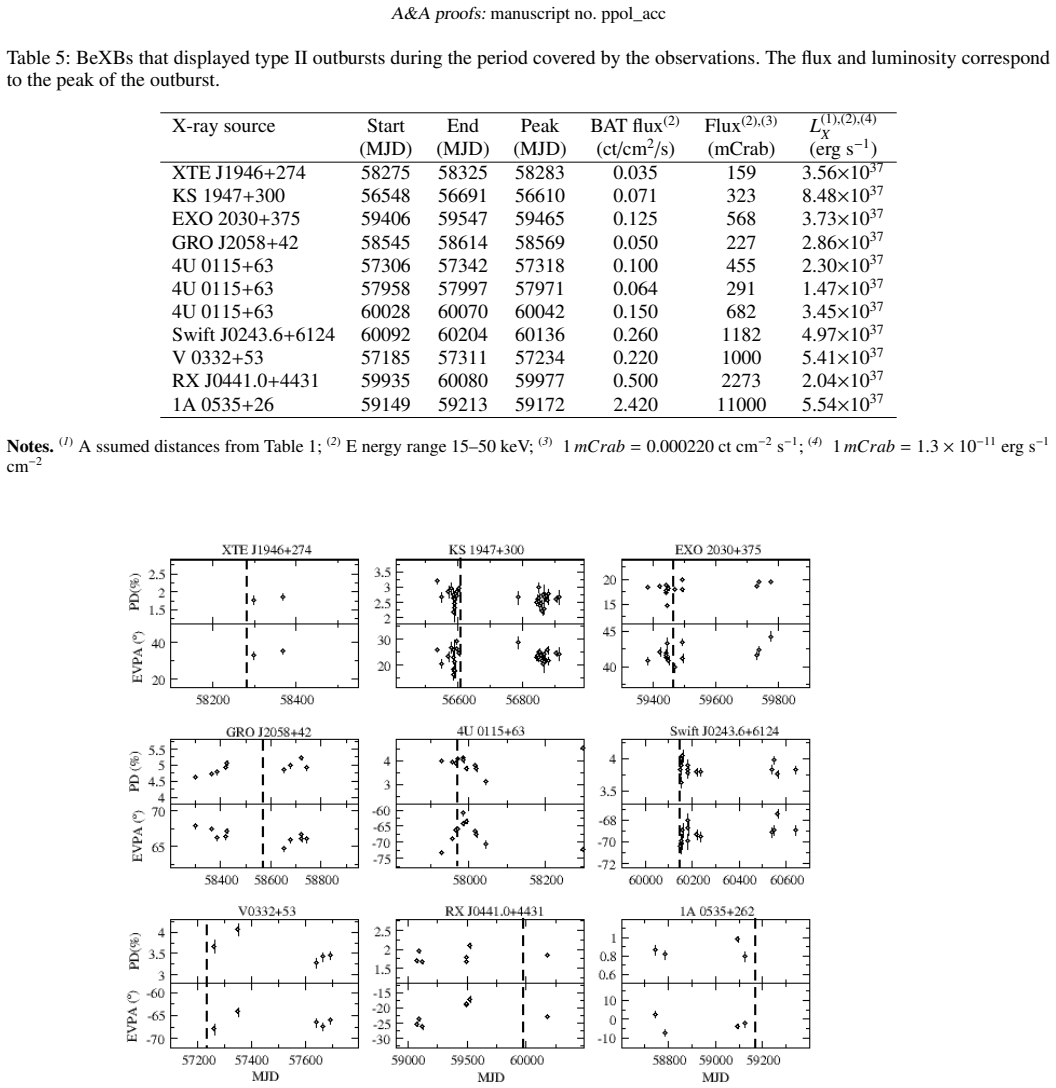
The polarization analysis confirms previous claims based on spectroscopic data that the circumstellar disks in BeXBs are, on average, smaller and denser than those in Be stars in non-binary systems. The data also support the presence of highly distorted disks before giant X-ray outbursts, although this result remains limited by the scarcity of simultaneous, well-sampled observations during major events.
What carries the argument
Long-term optical linear polarimetry produced by scattering in the Be star circumstellar disk, used to constrain disk size and density through comparison with isolated Be stars.
If this is right
- The neutron star companion truncates the outer disk, producing higher average densities than in single Be stars.
- Polarimetric changes can serve as an early indicator of disk conditions that precede giant X-ray outbursts.
- Disks in Be/X-ray binaries evolve on different timescales than isolated disks due to binary interaction.
- Systematic polarimetric monitoring offers a new tool to track disk state independently of photometric or spectroscopic data.
Where Pith is reading between the lines
- Binary truncation may set an upper limit on disk radius that could be tested by comparing polarization-derived sizes with hydrodynamic models of disk-neutron star interaction.
- Adding simultaneous X-ray and polarimetric coverage during outbursts would directly test whether disk distortion is required for giant events.
- The same polarization technique could be applied to other high-mass binaries to check whether disk properties correlate with the presence of a compact object.
Load-bearing premise
The observed polarimetric variability arises entirely from the Be star's circumstellar disk without significant contamination from interstellar polarization or the neutron star companion.
What would settle it
If matched samples of isolated Be stars exhibit the same average polarization levels and variability amplitudes as the Be/X-ray binaries, the claim of systematically smaller and denser disks in the binaries would be contradicted.
Figures



read the original abstract
Be/X-ray binaries are the most numerous group of high-mass X-ray binaries. Their long-term optical and infrared variability reflects the evolution of the circumstellar disk around the luminous companion. This variability manifests photometrically as an excess of flux that increases with wavelength and spectroscopically as line emission. The disk is also expected to generate linear polarization. We present a systematic study of the optical long-term polarimetric variability of Be/X-ray binaries on data collected over 10 years. Our aim is to characterize the polarimetric properties of these systems and to probe the structure of their circumstellar disks. We have been monitoring Be/X-ray binaries visible from the Northern hemisphere with the RoboPol polarimeter. Optical polarimetric variability is a common trait in Be/X-ray binaries. The variability can be attributed to the Be star's circumstellar disk. Our polarization analysis confirms previous claims based on spectroscopic data that the circumstellar disks in BeXBs are, on average, smaller and denser than those in Be stars in non-binary systems. Our data also confirms the presence of highly distorted disks before giant X-ray outbursts, although this result is still affected by the lack of simultaneous and well-sampled observations during major X-ray outbursts.
Editorial analysis
A structured set of objections, weighed in public.
Referee Report
Summary. The paper reports on a 10-year RoboPol polarimetric monitoring campaign of Be/X-ray binaries visible from the Northern hemisphere. It finds that optical polarimetric variability is common and attributable to the Be star circumstellar disks, uses this to confirm prior spectroscopic claims that BeXB disks are on average smaller and denser than those around isolated Be stars, and reports evidence for highly distorted disks prior to giant X-ray outbursts while noting the limitation of missing simultaneous coverage.
Significance. If the interstellar polarization subtraction holds, the work supplies an independent polarimetric confirmation of disk properties in BeXBs over a long baseline, reinforcing spectroscopic evidence on the effects of binarity and providing a valuable dataset for long-term variability studies in high-mass X-ray binaries.
major comments (2)
- [Results and disk-property comparison] The claim that BeXB disks are smaller and denser (abstract and results section) depends on accurate removal of interstellar polarization to isolate intrinsic disk scattering; the manuscript must expand on the ISP subtraction method (e.g., field-star selection or constancy assumptions) and propagate uncertainties, as residual ISP could systematically bias the polarization degree and variability used for the size/density comparison.
- [Discussion of pre-outburst disk geometry] The conclusion on highly distorted disks before giant outbursts (abstract) is weakened by the acknowledged lack of simultaneous and well-sampled observations during major X-ray events; this limitation should be stated more explicitly when assessing the robustness of that specific finding.
minor comments (1)
- [Abstract] The abstract could usefully state the number of targets and total observations to give immediate context for the monitoring baseline.
Simulated Author's Rebuttal
We thank the referee for the constructive comments and positive assessment of our work. We address each major comment below and will revise the manuscript to incorporate the suggested clarifications.
read point-by-point responses
-
Referee: The claim that BeXB disks are smaller and denser (abstract and results section) depends on accurate removal of interstellar polarization to isolate intrinsic disk scattering; the manuscript must expand on the ISP subtraction method (e.g., field-star selection or constancy assumptions) and propagate uncertainties, as residual ISP could systematically bias the polarization degree and variability used for the size/density comparison.
Authors: We agree that further details on the interstellar polarization subtraction are required to support the disk-property comparison. In the revised manuscript we will expand the methods section to describe the field-star selection criteria, the assumptions of constancy for the reference stars, and the propagation of ISP uncertainties into the derived intrinsic polarization values and variability amplitudes. We will also add a brief quantitative discussion of possible residual biases. revision: yes
-
Referee: The conclusion on highly distorted disks before giant outbursts (abstract) is weakened by the acknowledged lack of simultaneous and well-sampled observations during major X-ray events; this limitation should be stated more explicitly when assessing the robustness of that specific finding.
Authors: We accept that the pre-outburst distortion result requires a more explicit statement of its limitations. In the revised manuscript we will strengthen the wording in both the abstract and the discussion section to emphasize that, while the polarimetric data indicate highly distorted disks prior to giant outbursts, the lack of simultaneous and well-sampled coverage during the major X-ray events limits the robustness of this specific conclusion. revision: yes
Circularity Check
No significant circularity: purely observational confirmation via independent polarimetric technique
full rationale
The paper reports long-term RoboPol monitoring of Be/X-ray binaries and attributes observed polarimetric variability to the circumstellar disk, using this to confirm prior spectroscopic claims that BeXB disks are on average smaller and denser than those around isolated Be stars. No equations, parameter fits, or derivations are described that reduce any result to the same data by construction. The central claim is a direct comparison of measured polarization properties against external benchmarks from spectroscopy; interstellar polarization subtraction is a standard observational correction, not a self-referential step. The analysis is self-contained and does not rely on load-bearing self-citations or ansatzes imported from the authors' prior work.
Axiom & Free-Parameter Ledger
axioms (1)
- domain assumption Linear polarization observed in Be stars is produced by scattering within the circumstellar disk
Reference graph
Works this paper leans on
-
[1]
Aragona, C., McSwain, M. V ., Grundstrom, E. D., et al. 2009, ApJ, 698, 514
work page 2009
-
[2]
Bailer-Jones, C. A. L., Rybizki, J., Fouesneau, M., Demleitner, M., & Andrae, R. 2021, AJ, 161, 147
work page 2021
-
[3]
Balona, L. A. 2003, Ap&SS, 284, 121
work page 2003
-
[4]
Balona, L. A. & Ozuyar, D. 2021, ApJ, 921, 5
work page 2021
-
[5]
Bartlett, J. A. & Kobulnicky, H. A. 2025, AJ, 170, 265
work page 2025
-
[6]
2007, in Astronomical Society of the Pacific Conference Series, V ol
Bastien, P., Vernet, E., Drissen, L., et al. 2007, in Astronomical Society of the Pacific Conference Series, V ol. 364, The Future of Photometric, Spectropho- tometric and Polarimetric Standardization, ed. C. Sterken, 529
work page 2007
- [7]
- [8]
-
[9]
Blinov, D., Kiehlmann, S., Pavlidou, V ., et al. 2021, MNRAS, 501, 3715
work page 2021
-
[10]
Blinov, D., Maharana, S., Bouzelou, F., et al. 2023, A&A, 677, A144
work page 2023
-
[11]
Bonnet-Bidaud, J. M. & Mouchet, M. 1998, A&A, 332, L9
work page 1998
-
[12]
Carciofi, A. C. 2011, in IAU Symposium, V ol. 272, IAU Symposium, ed. C. Neiner, G. Wade, G. Meynet, & G. Peters, 325–336
work page 2011
-
[13]
Carciofi, A. C. & Bjorkman, J. E. 2006, ApJ, 639, 1081
work page 2006
-
[14]
Carciofi, A. C., Bolzan, G. P. P., Querido, P. R., et al. 2025, Galaxies, 13, 77
work page 2025
-
[15]
Carciofi, A. C., Magalhães, A. M., Leister, N. V ., Bjorkman, J. E., & Levenhagen, R. S. 2007, ApJ, 671, L49
work page 2007
-
[16]
Chhotaray, B., Naik, S., Jaisawal, G. K., & Ahuja, G. 2024, MNRAS, 534, 2830
work page 2024
- [17]
-
[18]
Corbet, R. H. D., Markwardt, C. B., & Tueller, J. 2007, ApJ, 655, 458
work page 2007
-
[19]
V ., Gehrels, T., & Serkowski, K
Coyne, G. V ., Gehrels, T., & Serkowski, K. 1974, AJ, 79, 581
work page 1974
-
[20]
Coyne, G. V . & Kruszewski, A. 1969, AJ, 74, 528
work page 1969
-
[21]
Cyr, I. H., Jones, C. E., Panoglou, D., Carciofi, A. C., & Okazaki, A. T. 2017, MNRAS, 471, 596 Article number, page 10 of 19 Reig et al.: Polarimetric variability of BeXBs
work page 2017
-
[22]
Doroshenko, V ., Tsygankov, S., & Santangelo, A. 2016, A&A, 589, A72
work page 2016
-
[23]
Draper, Z. H., Wisniewski, J. P., Bjorkman, K. S., et al. 2014, ApJ, 786, 120
work page 2014
- [24]
-
[25]
Esposito, P., Israel, G. L., Sidoli, L., et al. 2013, MNRAS, 433, 2028
work page 2013
-
[26]
Ferrigno, C., Farinelli, R., Bozzo, E., et al. 2013, A&A, 553, A103
work page 2013
-
[27]
Fosalba, P., Lazarian, A., Prunet, S., & Tauber, J. A. 2002, ApJ, 564, 762
work page 2002
- [28]
-
[29]
M., Schlafly, E., Zucker, C., Speagle, J
Green, G. M., Schlafly, E., Zucker, C., Speagle, J. S., & Finkbeiner, D. 2019, ApJ, 887, 93
work page 2019
-
[30]
Grundstrom, E. D., Boyajian, T. S., Finch, C., et al. 2007, ApJ, 660, 1398
work page 2007
-
[31]
Grundstrom, E. D. & Gies, D. R. 2006, ApJ, 651, L53
work page 2006
- [32]
- [33]
- [34]
-
[35]
Hiltner, W. A. 1956, ApJS, 2, 389
work page 1956
- [36]
-
[37]
Ignace, R., Fullard, A. G., Panopoulou, G. V ., et al. 2025, Ap&SS, 370, 57 in’t Zand, J. J. M., Swank, J., Corbet, R. H. D., & Markwardt, C. B. 2001, A&A, 380, L26
work page 2025
- [38]
-
[39]
Jones, T. J. 1989, ApJ, 346, 728
work page 1989
-
[40]
Kaur, R., Paul, B., Kumar, B., & Sagar, R. 2008, MNRAS, 386, 2253
work page 2008
-
[41]
G., Blinov, D., Ramaprakash, A
King, O. G., Blinov, D., Ramaprakash, A. N., et al. 2014, MNRAS, 442, 1706 Kızıloˇglu, U., Kızıloˇglu, N., Baykal, A., Yerli, S. K., & Özbey, M. 2007, A&A, 470, 1023
work page 2014
-
[42]
Kravtsov, V ., Berdyugin, A. V ., Piirola, V ., et al. 2020, A&A, 643, A170
work page 2020
-
[43]
2015, in Polarimetry of Stars and Planetary Systems, ed
Lazarian, A., Andersson, B.-G., & Hoang, T. 2015, in Polarimetry of Stars and Planetary Systems, ed. L. Kolokolova, J. Hough, & A.-C. Levasseur-Regourd, 81
work page 2015
- [44]
- [45]
-
[46]
M., Pottschmidt, K., Kühnel, M., et al
Marcu-Cheatham, D. M., Pottschmidt, K., Kühnel, M., et al. 2015, ApJ, 815, 44
work page 2015
- [47]
-
[48]
Martin, R. G. & Franchini, A. 2021, ApJ, 922, L37
work page 2021
- [49]
-
[50]
Martin, R. G., Nixon, C., Armitage, P. J., Lubow, S. H., & Price, D. J. 2014, ApJ, 790, L34
work page 2014
-
[51]
Martin, R. G., Pringle, J. E., Tout, C. A., & Lubow, S. H. 2011, MNRAS, 416, 2827
work page 2011
- [52]
- [53]
- [54]
- [55]
- [56]
-
[57]
Negueruela, I., Okazaki, A. T., Fabregat, J., et al. 2001, A&A, 369, 117
work page 2001
-
[58]
Negueruela, I., Roche, P., Fabregat, J., & Coe, M. J. 1999, MNRAS, 307, 695
work page 1999
- [59]
-
[60]
Okazaki, A. T., Bate, M. R., Ogilvie, G. I., & Pringle, J. E. 2002, MNRAS, 337, 967
work page 2002
-
[61]
T., Hayasaki, K., & Moritani, Y
Okazaki, A. T., Hayasaki, K., & Moritani, Y . 2013, PASJ, 65, 41
work page 2013
-
[62]
Okazaki, A. T. & Negueruela, I. 2001, A&A, 377, 161
work page 2001
-
[63]
Panoglou, D., Carciofi, A. C., Vieira, R. G., et al. 2016, MNRAS, 461, 2616
work page 2016
-
[64]
Panopoulou, G. V ., Hensley, B. S., Skalidis, R., Blinov, D., & Tassis, K. 2019, A&A, 624, L8
work page 2019
-
[65]
V ., Markopoulioti, L., Bouzelou, F., et al
Panopoulou, G. V ., Markopoulioti, L., Bouzelou, F., et al. 2025, ApJS, 276, 15
work page 2025
-
[66]
Parmar, A. N., White, N. E., Stella, L., Izzo, C., & Ferri, P. 1989, ApJ, 338, 359
work page 1989
-
[67]
Plaszczynski, S., Montier, L., Levrier, F., & Tristram, M. 2014, MNRAS, 439, 4048
work page 2014
-
[68]
Poeckert, R., Bastien, P., & Landstreet, J. D. 1979, AJ, 84, 812
work page 1979
-
[69]
Quirrenbach, A., Bjorkman, K. S., Bjorkman, J. E., et al. 1997, ApJ, 479, 477
work page 1997
- [70]
-
[71]
Ramaprakash, A. N., Rajarshi, C. V ., Das, H. K., et al. 2019, MNRAS, 485, 2355
work page 2019
- [72]
- [73]
- [74]
-
[75]
Reig, P., Blinov, D., Papadakis, I., Kylafis, N., & Tassis, K. 2014, MNRAS, 445, 4235
work page 2014
- [76]
- [77]
-
[78]
Reig, P., Larionov, V ., Negueruela, I., Arkharov, A. A., & Kudryavtseva, N. A. 2007, A&A, 462, 1081
work page 2007
- [79]
-
[80]
Reig, P., Negueruela, I., Fabregat, J., et al. 2004, A&A, 421, 673
work page 2004
discussion (0)
Sign in with ORCID, Apple, or X to comment. Anyone can read and Pith papers without signing in.