Micrometer-scale displacement and thickness sensing using a single terahertz resonant-tunneling diode
Pith reviewed 2026-05-15 19:23 UTC · model grok-4.3
The pith
A single 280 GHz resonant-tunneling diode detects displacements as small as 5 micrometers and resolves polymer film thicknesses of 12.5, 25, and 50 micrometers.
A machine-rendered reading of the paper's core claim, the machinery that carries it, and where it could break.
Core claim
The authors show that a monostatic 280 GHz radar built on a single RTD exploits the self-mixing effect to produce a low-frequency interferometric signal. Radar analysis of this signal extracts micrometer-scale target displacement and thin-film thickness, demonstrated by a minimum detectable displacement of approximately 5 um and quantitative resolution of polymer films 12.5, 25, and 50 um thick.
What carries the argument
The self-mixing effect inside the single RTD, which generates a low-frequency interferometric signal from the interaction of outgoing and reflected terahertz waves for subsequent radar processing.
If this is right
- Compact monostatic THz sensors become feasible with only one device handling both transmission and reception.
- Room-temperature operation supports practical cost-effective sensing without cryogenic equipment.
- The processed self-mixing signal enables quantitative measurement of displacements down to approximately 5 micrometers.
- Polymer film thicknesses at 12.5, 25, and 50 micrometers can be distinguished through the extracted signal.
Where Pith is reading between the lines
- The same single-device approach might extend to sensing other materials if the signal processing remains stable across different reflectivities.
- Embedding the RTD in portable electronics could enable on-site industrial inspection or medical surface measurements.
- Refinements to the radar analysis could potentially lower the detectable displacement limit below the reported 5 micrometers.
Load-bearing premise
The low-frequency signal created by self-mixing in the RTD can be processed from a radar viewpoint to extract displacement and thickness values without additional unstated calibration or filtering steps.
What would settle it
A controlled experiment in which a target is moved by a known 10 micrometers but the extracted displacement from the RTD signal deviates by more than 5 micrometers on repeated trials.
Figures


read the original abstract
Resonant tunneling diodes (RTDs) support room-temperature terahertz (THz) oscillation and simultaneous THz-band detection, enabling compact monostatic THz sensors for practical and cost-effective sensing applications. In this paper, we present a highly integrated 280 GHz-band radar system based on a single RTD that exploits the self-mixing effect to generate a low-frequency interferometric signal. The resulting self-mixing signal is further analyzed from a radar perspective and processed to extract micrometer-scale displacement and thin-film thickness variations. Experimentally, the proposed system demonstrates a minimum detectable displacement of approximately 5 um and quantitatively resolves polymer film thicknesses of 12.5, 25, and 50 um.
Editorial analysis
A structured set of objections, weighed in public.
Referee Report
Summary. The paper claims to demonstrate a compact monostatic 280 GHz radar sensor based on a single resonant-tunneling diode (RTD) that uses the self-mixing effect to produce a low-frequency interferometric signal; this signal is then processed from a radar perspective to extract micrometer-scale target displacement (minimum detectable ~5 μm) and to quantitatively resolve polymer film thicknesses of 12.5, 25, and 50 μm.
Significance. If the reported experimental performance is confirmed, the work would establish a practical, highly integrated THz sensing platform that eliminates the need for separate transmitter and receiver chains, potentially enabling low-cost, room-temperature displacement and thickness metrology at sub-millimeter wavelengths.
major comments (2)
- [Experimental Results] Experimental Results section: the central claim of a 5 μm minimum detectable displacement and quantitative film-thickness resolution rests on treating the low-frequency self-mixing voltage as a clean interferometric signal whose phase is strictly proportional to round-trip path length at 280 GHz, yet no simultaneous reference trace from a calibrated laser interferometer or controlled phase-step calibration is reported to verify this linear mapping.
- [Methods] Methods / Experimental Setup: the description of the self-mixing signal acquisition omits the RTD bias point, the cutoff frequency and order of any low-pass filtering, DC-offset removal procedure, and any amplitude normalization steps; without these details the reproducibility of the reported 12.5/25/50 μm thickness values cannot be assessed.
minor comments (2)
- [Abstract] Abstract: the operating frequency is given as “280 GHz-band” while the title uses “terahertz”; a single consistent frequency statement would improve clarity.
- [Figures] Figure captions: units are inconsistently rendered as “um” versus “μm”; adopt SI notation throughout.
Simulated Author's Rebuttal
We thank the referee for the positive evaluation of our work's significance and for the constructive major comments. We address each point below and indicate the revisions we will make.
read point-by-point responses
-
Referee: [Experimental Results] Experimental Results section: the central claim of a 5 μm minimum detectable displacement and quantitative film-thickness resolution rests on treating the low-frequency self-mixing voltage as a clean interferometric signal whose phase is strictly proportional to round-trip path length at 280 GHz, yet no simultaneous reference trace from a calibrated laser interferometer or controlled phase-step calibration is reported to verify this linear mapping.
Authors: We agree that a simultaneous calibrated reference would constitute stronger direct validation. The phase-to-path-length mapping follows from the established self-mixing interferometric response of RTDs, where the detected low-frequency voltage is proportional to cos(4πd/λ) with λ ≈ 1.07 mm at 280 GHz. The reported 5 μm sensitivity is obtained from the rms phase noise of stationary-target recordings converted via δd = (λ/4π)·δφ, and the thickness values are obtained by matching observed phase shifts to the expected round-trip delay through films of known refractive index. We will revise the Experimental Results section to include an explicit derivation of this conversion, the noise-floor calculation, and a discussion of the underlying assumptions, together with uncertainty estimates on the extracted displacements and thicknesses. This is a partial revision. revision: partial
-
Referee: [Methods] Methods / Experimental Setup: the description of the self-mixing signal acquisition omits the RTD bias point, the cutoff frequency and order of any low-pass filtering, DC-offset removal procedure, and any amplitude normalization steps; without these details the reproducibility of the reported 12.5/25/50 μm thickness values cannot be assessed.
Authors: We thank the referee for noting this omission. The RTD was biased at 0.45 V in the negative-differential-resistance region. The self-mixing voltage was passed through a first-order low-pass filter with 20 Hz cutoff before digitization. DC offset was removed by subtracting the temporal mean of each trace, and the signal was normalized to unit peak-to-peak amplitude prior to phase extraction. These processing steps will be added in full to the Methods section of the revised manuscript. revision: yes
Circularity Check
No circularity; central claims are direct experimental measurements without derivation or fitted-parameter reduction
full rationale
The manuscript describes an experimental THz radar setup using a single RTD and self-mixing to produce a low-frequency interferometric signal, then reports measured minimum detectable displacement (~5 µm) and resolved film thicknesses (12.5/25/50 µm). No equations, parameter-fitting steps, or self-citation chains are presented that would reduce any claimed prediction or result to the input data by construction. The radar-perspective analysis is descriptive processing of the observed signal rather than a load-bearing derivation. The paper is therefore self-contained against external benchmarks and receives the default non-circularity finding.
Axiom & Free-Parameter Ledger
axioms (2)
- domain assumption RTDs support simultaneous room-temperature THz oscillation and detection
- domain assumption Self-mixing produces a usable low-frequency interferometric signal amenable to radar-style processing
Lean theorems connected to this paper
-
IndisputableMonolith/Cost/FunctionalEquation.leanwashburn_uniqueness_aczel unclear?
unclearRelation between the paper passage and the cited Recognition theorem.
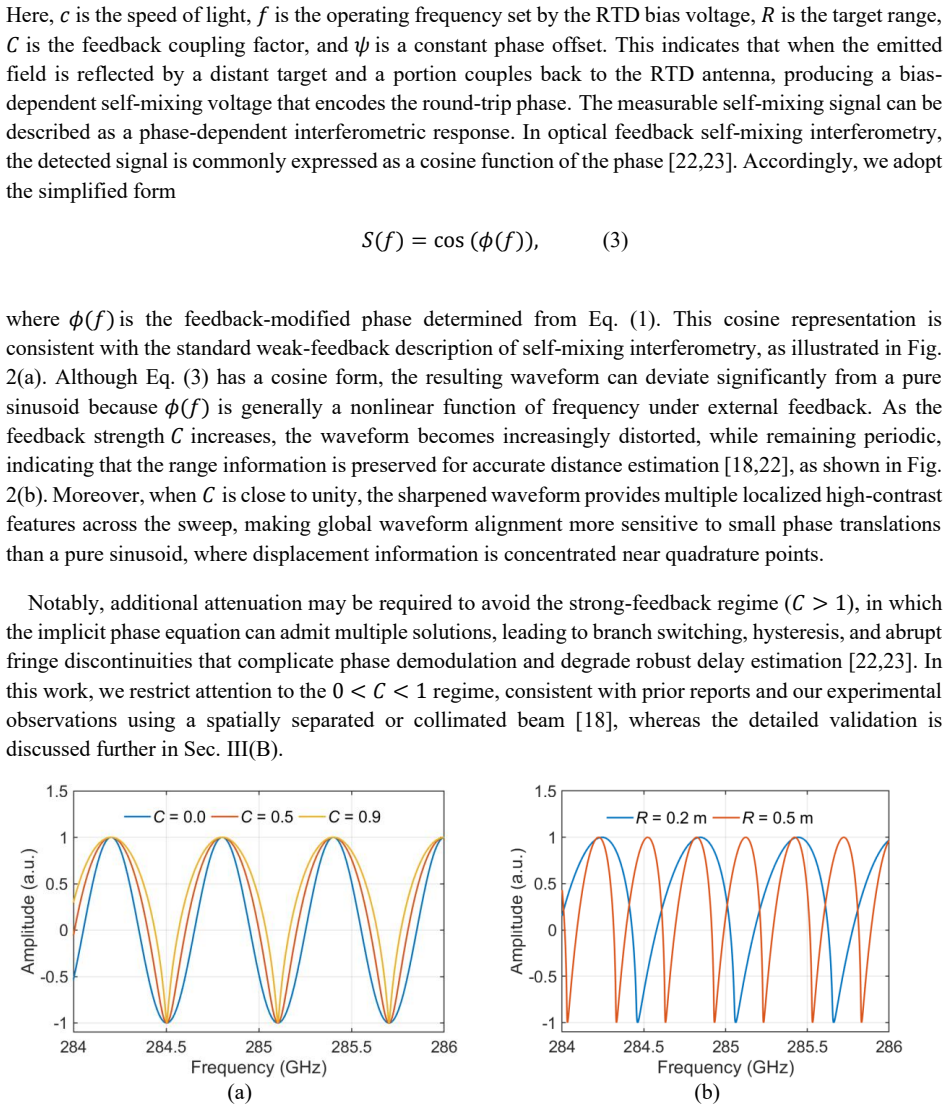
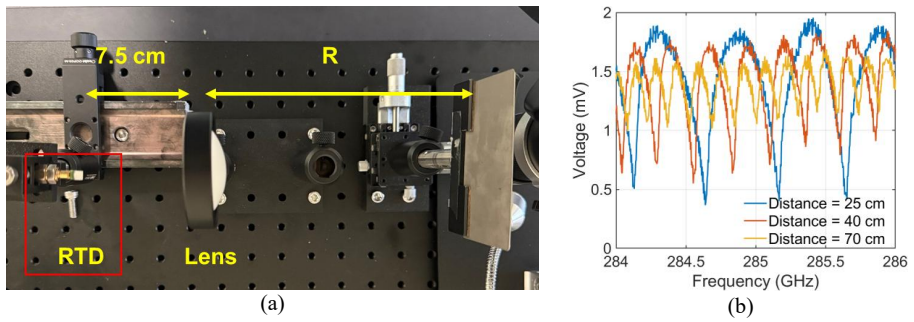
self-mixing signal S(f)=cos(φ(f)) with excess-phase relation φ0(f)=φ(f)+C sin(φ(f)+ψ) and Δd≈(R/fc)Δf from waveform shift
-
IndisputableMonolith/Foundation/RealityFromDistinction.leanreality_from_one_distinction unclear?
unclearRelation between the paper passage and the cited Recognition theorem.
phase difference Δϕ0(f)≜∠{S2∗(f)S1(f)}=4πfΔd/c under narrowband approximation
What do these tags mean?
- matches
- The paper's claim is directly supported by a theorem in the formal canon.
- supports
- The theorem supports part of the paper's argument, but the paper may add assumptions or extra steps.
- extends
- The paper goes beyond the formal theorem; the theorem is a base layer rather than the whole result.
- uses
- The paper appears to rely on the theorem as machinery.
- contradicts
- The paper's claim conflicts with a theorem or certificate in the canon.
- unclear
- Pith found a possible connection, but the passage is too broad, indirect, or ambiguous to say the theorem truly supports the claim.
Reference graph
Works this paper leans on
-
[1]
𝟕𝐚𝐧𝐝𝐧𝐨𝐢𝐬𝐞𝝈 = 𝟎. 𝟎𝟓). Fig. 9 Relationship between sweep modulation speed and the required moving - average window length. Finally, since the self -mixing signal is recorded versus bias voltage rather than versus oscillation frequency, the relation between the bias voltage and the oscillation frequency should be characterized, as shown in Fig. 5(b). Howe...
-
[2]
Twenty years of terahertz imaging,
D. M. Mittleman, “Twenty years of terahertz imaging,” Opt. Express, vol. 26, no. 8, pp. 9417 –9431, 2018
work page 2018
-
[3]
Towards practical terahertz imaging systems with compact continuous-wave transceivers,
L. Yi, Y. Nishida, T. Sagisaka, R. Kaname, R. Mizuno, M. Fujita, and T. Nagatsuma, “Towards practical terahertz imaging systems with compact continuous-wave transceivers,” J. Lightwave Technol., vol. 39, no. 24, pp. 7850–7861, 2021
work page 2021
-
[4]
Terahertz time-domain spectroscopy,
M. Koch, D. M. Mittleman, J. Ornik and E. Castro-Camus, “Terahertz time-domain spectroscopy,” Nat. Rev. Methods Primers, vol. 3, Art. no. 49, 2023
work page 2023
-
[5]
Terahertz spectroscopy and imaging —Modern techniques and applications,
P. U. Jepsen, D. G. Cooke, and M. Koch, “Terahertz spectroscopy and imaging —Modern techniques and applications,” Laser Photon. Rev., vol. 5, no. 1, pp. 124–166, 2011
work page 2011
-
[6]
Photonic Radar for 3D Imaging: From Millimeter to Terahertz Waves,
L. Yi, Y. Li and T. Nagatsuma, "Photonic Radar for 3D Imaging: From Millimeter to Terahertz Waves," in IEEE Journal of Selected Topics in Quantum Electronics, vol. 29, no. 5: Terahertz Photonics, pp. 1-14
-
[7]
M. A. Richards, J. A. Scheer, and W. A. Holm, Principles of Modern Radar: Basic Principles. Raleigh, NC, USA: SciTech Publishing, 2014
work page 2014
-
[8]
Signal processing for FMCW SAR,
A. Meta, P. Hoogeboom, and L. P. Ligthart, “Signal processing for FMCW SAR,” IEEE Trans. Geosci. Remote Sens., vol. 45, no. 11, pp. 3519–3532, Nov. 2007
work page 2007
-
[9]
Synthetic aperture radar interferometry,
P. A. Rosen, S. Hensley, I. R. Joughin, F. K. Li, S. N. Madsen, E. Rodriguez, and R. M. Goldstein, “Synthetic aperture radar interferometry,” Proc. IEEE, vol. 88, no. 3, pp. 333–382, 2000
work page 2000
-
[10]
Optoelectronic frequency-modulated continuous- wave terahertz spectroscopy with 4 THz bandwidth,
L. Liebermeister, S. Nellen, R. B. Kohlhaas, et al., “Optoelectronic frequency-modulated continuous- wave terahertz spectroscopy with 4 THz bandwidth,” Nature Communications, vol. 12, Art. no. 1071, 2021
work page 2021
-
[11]
N. S. Schreiner, D. J. Bock, M. Hoffmann, V. Krozer, and N. Pohl, “Multilayer thickness measurements below the Rayleigh limit using FMCW millimeter and terahertz waves,” Sensors, vol. 19, no. 18, Art. no. 3910, 2019
work page 2019
-
[12]
K. O. Kenneth, W. Choi, and R. Han, “Perspective on active submillimeter electromagnetic wave imaging using CMOS integrated circuit technologies,” J. Appl. Phys., vol. 133, no. 15, Art. no. 150903, Apr. 2023
work page 2023
-
[13]
A high-resolution 300-GHz FMCW-radar sensor using a dual -function SiGe transceiver MMIC,
T. Ziegler-Bellenberg, D. Funke, C. Bredendiek, S. Hansen, J. Wessel, and N. Pohl, “A high-resolution 300-GHz FMCW-radar sensor using a dual -function SiGe transceiver MMIC,” Int. J. Microw. Wireless Technol., vol. 17, no. 9, pp. 1–13, Aug. 2025
work page 2025
-
[14]
Fundamentals and recent advances of terahertz resonant tunneling diodes,
S. Suzuki, “Fundamentals and recent advances of terahertz resonant tunneling diodes,” Appl. Sci., vol. 12, no. 7, Art. no. 3822, 2022
work page 2022
-
[15]
M. Asada and S. Suzuki, “Room-temperature oscillation of resonant tunneling diodes close to 2 THz and their functions for various applications,” J. Infrared Millim. Terahz. Waves, vol. 37, no. 12, pp. 1185– 1198, 2016
work page 2016
-
[16]
Development of practical terahertz packages for resonant tunneling diode oscillators and detectors,
K. Tsuruda et al., “Development of practical terahertz packages for resonant tunneling diode oscillators and detectors,” in Proc. IEEE Int. Symp. Radio -Frequency Integration Technology (RFIT), Hiroshima, Japan, 2020, pp. 193–195
work page 2020
-
[17]
M. Asada and S. Suzuki, “Theoretical analysis of external feedback effect on oscillation characteristics of resonant-tunneling-diode terahertz oscillators,” Jpn. J. Appl. Phys., vol. 54, no. 7, Art. no. 070309, 2015
work page 2015
-
[18]
Terahertz coherent receiver using a single resonant tunnelling diode,
Y. Nishida, N. Nishigami, S. Diebold, J. Kim, and M. Fujita, “Terahertz coherent receiver using a single resonant tunnelling diode,” Sci. Rep., vol. 9, Art. no. 18125, 2019
work page 2019
-
[19]
Resonant tunneling diode transceiver for integrated terahertz-band 3D image sensors,
L. Yi, Y. Inose, N. Ngo, S. Wang, Y. Nishida, and M. Fujita, “Resonant tunneling diode transceiver for integrated terahertz-band 3D image sensors,” in Proc. 49th Int. Conf. Infrared, Millimeter, and Terahertz Waves (IRMMW-THz), Perth, Australia, 2024
work page 2024
-
[20]
Resonant -tunneling-diode terahertz oscillators and its radar applications,
S. Suzuki, A. Dobroiu, and M. Asada, “Resonant -tunneling-diode terahertz oscillators and its radar applications,” The Review of Laser Engineering, vol. 50, no. 4, pp. 183–187, 2022
work page 2022
-
[21]
A. Dobroiu, Y. Shirakawa, S. Suzuki, M. Asada, and H. Ito, “Subcarrier frequency -modulated continuous-wave radar in the terahertz range based on a resonant-tunneling-diode oscillator,” Sensors, vol. 20, no. 23, Art. no. 6848, 2020
work page 2020
-
[22]
H. Konno, A. Dobroiu, S. Suzuki, M. Asada, and H. Ito, “Discrete Fourier transform radar in the terahertz-wave range based on a resonant -tunneling-diode oscillator,” Sensors, vol. 21, no. 13, Art. no. 4367, 2021
work page 2021
-
[23]
Laser feedback interferometry: A tutorial on the self -mixing effect,
Y. Taimre, A. D. Rakić, K. Bertling, T. Lim, T. Bosch, and A. D. D. Rakić, “Laser feedback interferometry: A tutorial on the self -mixing effect,” Advances in Optics and Photonics, vol. 7, no. 3, pp. 570–631, 2015
work page 2015
-
[24]
Fan, Y. Yu, J. Xi, and J. F. Chicharo, “Improving the measurement performance for a self -mixing interferometry-based displacement sensing system,” Appl. Opt., vol. 50, no. 26, pp. 5064–5072, 2011
work page 2011
-
[25]
External optical feedback effects on semiconductor injection laser properties,
R. Lang and K. Kobayashi, “External optical feedback effects on semiconductor injection laser properties,” IEEE J. Quantum Electron., vol. 16, no. 3, pp. 347–355, 1980
work page 1980
-
[26]
Localization of narrowband radio emitters based on Doppler frequency shifts,
A. Amar and A. J. Weiss, “Localization of narrowband radio emitters based on Doppler frequency shifts,” IEEE Transactions on Signal Processing, vol. 56, no. 11, pp. 5500–5508, Nov. 2008
work page 2008
-
[27]
The generalized correlation method for estimation of time delay,
C. H. Knapp and G. C. Carter, “The generalized correlation method for estimation of time delay,” IEEE Trans. Acoust., Speech, Signal Process., vol. 24, no. 4, pp. 320–327, 1976
work page 1976
-
[28]
L. Svilainis, K. Lukoseviciute, V. Dumbrava, and A. Chaziachmetovas, “Subsample interpolation bias error in time of flight estimation by direct correlation in digital domain,” Measurement, vol. 46, no. 10, pp. 3950–3958, Dec. 2013
work page 2013
-
[29]
A study of injection locking and pulling in oscillators,
B. Razavi, “A study of injection locking and pulling in oscillators,” IEEE J. Solid-State Circuits, vol. 39, no. 9, pp. 1415–1424, Sep. 2004
work page 2004
discussion (0)
Sign in with ORCID, Apple, or X to comment. Anyone can read and Pith papers without signing in.