Hollow toroidal rotation profiles in strongly electron heated H-mode plasmas in the ASDEX Upgrade tokamak
Pith reviewed 2026-05-15 16:03 UTC · model grok-4.3
The pith
Hollow toroidal rotation profiles form when counter-current intrinsic torque balances inward convective momentum transport in electron-heated H-mode plasmas.
A machine-rendered reading of the paper's core claim, the machinery that carries it, and where it could break.
Core claim
The central claim is that hollow rotation profiles emerge from a balance between counter-current intrinsic torque and inward convective momentum transport. This balance is strongly influenced by the pedestal-top rotation level, which is dominantly set by variations in the pedestal-top density. The diffusive Prandtl number and Coriolis pinch stay comparable with and without strong ECRH, while the intrinsic torque reverses to counter-current only in the high-ECRH phase. Gyrokinetic simulations confirm the turbulence regime change that produces the observed torque sign and particle pinch.
What carries the argument
Self-consistent inference of diffusive, convective, and residual-stress momentum transport coefficients from NBI modulation experiments, which remain robust when strong ECRH is added.
If this is right
- Intrinsic torque and inward convection can maintain usable rotation profiles in future low-torque tokamak operation.
- Pedestal-top density provides a practical control knob for the overall rotation profile shape.
- The momentum transport framework remains usable for predictive modeling when electron heating dominates.
- Edge-localized torque generation mechanisms become critical once external torque is reduced.
Where Pith is reading between the lines
- Similar density-dependent torque balances may set rotation in other machines or heating mixes once external torque is low.
- Targeted edge density control experiments could test whether rotation can be shaped on demand without changing core heating.
- If the ITG-TEM transition is general, reduced-torque scenarios in ITER-scale devices may routinely develop hollow profiles unless edge torque sources are engineered.
Load-bearing premise
The established momentum transport analysis framework can be applied self-consistently to infer the coefficients even when strong ECRH is added, without unaccounted changes in the underlying transport physics.
What would settle it
A direct observation that the inferred counter-current intrinsic torque fails to reproduce the measured rotation collapse when the same transport coefficients are used in the modeling, or that the gyrokinetic turbulence regime does not shift to ITG-TEM under the experimental ECRH conditions.
Figures




read the original abstract
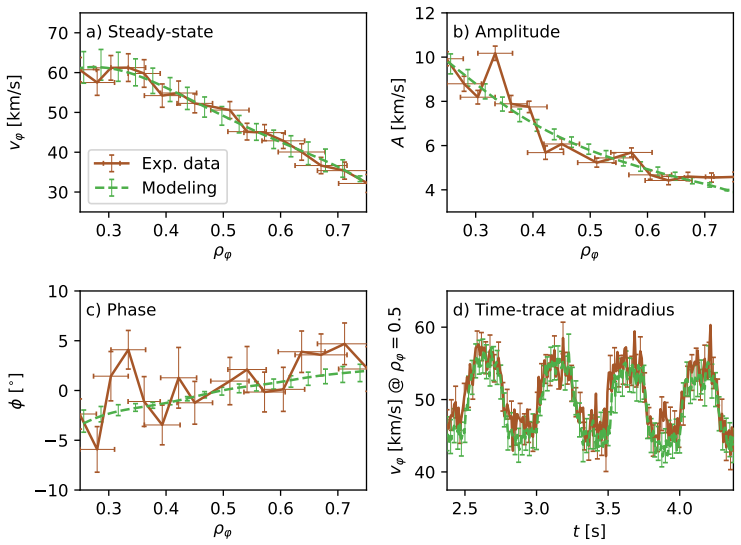
This work investigates toroidal momentum transport in type-I ELMy H-mode plasmas in the ASDEX Upgrade tokamak, focusing on the formation of hollow rotation profiles under strong electron cyclotron resonance heating (ECRH). Applying the established momentum transport analysis framework to a neutral beam injection (NBI) modulation experiment, momentum transport coefficients were inferred self-consistently. This was done for phases with dominant NBI heating and with additional strong ECRH, during which the rotation profile severely collapsed without significant changes in the externally applied torque. The experimental rotation profiles were accurately reproduced, confirming the robustness of the inferred diffusive, convective, and residual-stress contributions. While the Prandtl number and inward Coriolis pinch remained comparable between phases, the NBI+ECRH phase exhibited a strong counter-current intrinsic torque. Linear gyrokinetic simulations indicate a transition from ion-temperature-gradient (ITG) turbulence to an ITG-trapped-electron-mode (TEM) mixed regime under strong ECRH, consistent with the observed counter-current intrinsic torque and particle pinch behavior. Additional high-ECRH discharges with modified density demonstrated that hollow rotation profiles emerge from a balance between counter-current intrinsic torque and inward convective momentum transport, strongly influenced by the pedestal-top rotation level, which is dominantly set by variations in the pedestal-top density. These findings highlight the importance of intrinsic torque and inward convection for maintaining favorable rotation profiles in future low-torque tokamak scenarios and motivate further exploration of edge torque generation mechanisms.
Editorial analysis
A structured set of objections, weighed in public.
Referee Report
Summary. The paper claims that hollow toroidal rotation profiles in strongly ECRH-heated ASDEX Upgrade H-mode plasmas arise from a balance between strong counter-current intrinsic torque and inward convective momentum transport. Coefficients (diffusive, convective, residual-stress) are inferred self-consistently from NBI-modulation experiments in both NBI-only and NBI+ECRH phases; the measured profiles are reproduced, Prandtl number and Coriolis pinch remain comparable, and linear gyrokinetic simulations show an ITG-to-mixed-ITG/TEM transition consistent with the observed torque sign. Additional high-ECRH discharges demonstrate that the hollow shape is controlled by the pedestal-top rotation level, which is set primarily by variations in pedestal-top density.
Significance. If the central attribution holds, the work supplies concrete evidence that intrinsic torque and inward convection can dominate rotation-profile evolution once external torque is low, with direct implications for rotation control in ITER and DEMO. The experimental inference plus linear-GK cross-check is a strength; the density dependence offers a testable, falsifiable prediction for edge torque mechanisms.
major comments (3)
- [§4] §4 (NBI-modulation analysis): the reproduction of the rotation profiles using coefficients inferred from the same dataset is partly tautological; quantitative validation metrics (e.g., reduced χ², residual norms, or cross-validation on held-out time slices) and uncertainty ranges on the fitted Prandtl number, pinch velocity, and residual stress are not reported, weakening the claim that the three-coefficient model remains valid across the ITG-to-ITG/TEM transition.
- [§5] §5 (linear gyrokinetic simulations): the transition to a mixed ITG/TEM regime is shown to be consistent with counter-current torque, yet the manuscript does not demonstrate that the momentum flux spectrum in the mixed state is still captured by a radially constant diffusive-convective-residual-stress model; a direct comparison of the simulated momentum flux (including possible radial variation of the pinch or residual-stress spectrum) against the inferred coefficients is needed to close the loop.
- [§6] §6 (density-variation discharges): the assertion that pedestal-top rotation is 'dominantly set by variations in the pedestal-top density' requires explicit quantification (e.g., correlation coefficient or partial-derivative sensitivity) and exclusion of confounding changes in edge Er or neutral-beam deposition; without these, the causal link to the hollow-profile formation remains correlative rather than demonstrated.
minor comments (2)
- [Figure 3] Figure 3: axis labels and units for the inferred residual stress should be stated explicitly; the color scale for the linear growth rates in the accompanying GK plots is not defined.
- Notation: the symbol for the Coriolis pinch velocity is introduced without a clear definition in the text; a short table of symbols would improve readability.
Simulated Author's Rebuttal
We thank the referee for the careful and constructive review of our manuscript. We address each major comment point by point below, providing clarifications and indicating the revisions we will make to strengthen the paper.
read point-by-point responses
-
Referee: §4 (NBI-modulation analysis): the reproduction of the rotation profiles using coefficients inferred from the same dataset is partly tautological; quantitative validation metrics (e.g., reduced χ², residual norms, or cross-validation on held-out time slices) and uncertainty ranges on the fitted Prandtl number, pinch velocity, and residual stress are not reported, weakening the claim that the three-coefficient model remains valid across the ITG-to-ITG/TEM transition.
Authors: We agree that quantitative validation metrics would strengthen the analysis. The reproduction of the profiles is a standard consistency check in momentum transport studies, but we acknowledge it is not fully independent. In the revised manuscript, we will report reduced χ² values for the coefficient fits in both NBI-only and NBI+ECRH phases, provide uncertainty ranges on the Prandtl number, Coriolis pinch velocity, and residual stress obtained from the fitting procedure, and include a cross-validation test on held-out time slices where feasible. These additions will better demonstrate the robustness of the three-coefficient model across the turbulence transition. revision: yes
-
Referee: §5 (linear gyrokinetic simulations): the transition to a mixed ITG/TEM regime is shown to be consistent with counter-current torque, yet the manuscript does not demonstrate that the momentum flux spectrum in the mixed state is still captured by a radially constant diffusive-convective-residual-stress model; a direct comparison of the simulated momentum flux (including possible radial variation of the pinch or residual-stress spectrum) against the inferred coefficients is needed to close the loop.
Authors: We appreciate the suggestion to strengthen the connection between simulation and experiment. The linear gyrokinetic simulations were used to identify the ITG-to-mixed ITG/TEM transition and its consistency with the observed torque sign. A direct quantitative comparison of the momentum flux spectrum would require nonlinear simulations or additional post-processing assumptions not included in the present work. In the revised manuscript, we will add a discussion clarifying this limitation, noting that the sign agreement supports the interpretation, and emphasizing that the radially constant model is an experimental approximation validated by profile reproduction. A full direct comparison lies beyond the current scope. revision: partial
-
Referee: §6 (density-variation discharges): the assertion that pedestal-top rotation is 'dominantly set by variations in the pedestal-top density' requires explicit quantification (e.g., correlation coefficient or partial-derivative sensitivity) and exclusion of confounding changes in edge Er or neutral-beam deposition; without these, the causal link to the hollow-profile formation remains correlative rather than demonstrated.
Authors: We agree that explicit quantification is required to establish causality. In the revised manuscript, we will add a correlation analysis (Pearson coefficient) between pedestal-top density and rotation level across the high-ECRH discharges, together with a sensitivity study (partial derivatives via regression). We will also explicitly discuss and exclude confounding effects by showing that edge Er and NBI deposition profiles exhibit no significant correlated variations with the observed rotation changes in these discharges. This will convert the current correlative evidence into a more quantitative demonstration. revision: yes
Circularity Check
Reproduction of rotation profiles is tautological after fitting coefficients to the same NBI-modulation data
specific steps
-
fitted input called prediction
[Abstract (momentum transport analysis paragraph)]
"Applying the established momentum transport analysis framework to a neutral beam injection (NBI) modulation experiment, momentum transport coefficients were inferred self-consistently. ... The experimental rotation profiles were accurately reproduced, confirming the robustness of the inferred diffusive, convective, and residual-stress contributions."
Coefficients are extracted from the NBI-modulation data to match the observed rotation evolution; the subsequent statement that the model reproduces the same profiles is then guaranteed by the fitting procedure rather than constituting an independent prediction.
full rationale
The paper infers diffusive, convective and residual-stress coefficients self-consistently from NBI-modulation experiments and then states that the experimental rotation profiles were accurately reproduced with those coefficients. This reproduction step reduces by construction to the fitting procedure itself. Linear gyrokinetic simulations supply an independent check on the ITG-to-ITG/TEM transition, and the additional density-variation discharges provide separate evidence for the role of pedestal-top density. The central claim therefore retains independent content outside the reproduction step, limiting the circularity to partial (score 6).
Axiom & Free-Parameter Ledger
free parameters (1)
- inferred diffusive, convective, and residual-stress coefficients
axioms (1)
- domain assumption Linear gyrokinetic simulations accurately capture the transition from ITG to ITG-TEM mixed turbulence and the associated intrinsic torque direction
Lean theorems connected to this paper
-
IndisputableMonolith/Cost/FunctionalEquation.leanwashburn_uniqueness_aczel (J-cost uniqueness) unclear?
unclearRelation between the paper passage and the cited Recognition theorem.
The flux-surface-averaged radial transport of toroidal angular momentum is expressed as Γφ = −mnR (χφ ∂vφ/∂r − Vc vφ) + ΠRs … The coefficient χφ represents the momentum diffusivity … The dimensionless quantity −R Vc/χφ is commonly referred to as the pinch number … residual stress contribution … intrinsic torque τint = −∂V/∂r ΠRs
What do these tags mean?
- matches
- The paper's claim is directly supported by a theorem in the formal canon.
- supports
- The theorem supports part of the paper's argument, but the paper may add assumptions or extra steps.
- extends
- The paper goes beyond the formal theorem; the theorem is a base layer rather than the whole result.
- uses
- The paper appears to rely on the theorem as machinery.
- contradicts
- The paper's claim conflicts with a theorem or certificate in the canon.
- unclear
- Pith found a possible connection, but the passage is too broad, indirect, or ambiguous to say the theorem truly supports the claim.
Reference graph
Works this paper leans on
- [1]
-
[2]
F. J. Casson et al. 2013.Nucl. Fusion. 53. 063026
work page 2013
- [3]
-
[4]
F. J. Casson et al. 2015.Plasma Phys. Control. Fusion. 57. 014031
work page 2015
- [5]
- [6]
-
[7]
T. S. Hahm. 1994.Phys. Plasmas. 1. 2940–2944
work page 1994
-
[8]
R. E. Waltz et al. 1995.Phys. Plasmas. 2. 2408–2416
work page 1995
-
[9]
T. S. Hahm and K. H. Burrell. 1995.Phys. Plasmas. 2. 1648–1651
work page 1995
-
[10]
K. H. Burrell. 1997.Phys. Plasmas. 4. 1499–1518
work page 1997
-
[11]
P. W. Terry. 2000.Reviews of Modern Physics. 72. 109–165
work page 2000
-
[12]
E. J. Strait et al. 1995.Phys. Rev. Lett.74. 2483–2486
work page 1995
-
[13]
A. M. Garofalo et al. 2002.Phys. Rev. Lett.89. 235001
work page 2002
- [14]
-
[15]
P. A. Politzer et al. 2008.Nucl. Fusion. 48. 075001
work page 2008
-
[16]
R. J. Buttery et al. 2008.Proceedings of 22nd IAEA Fusion Energy Conference
work page 2008
-
[17]
P. C. de Vries et al. 2011.Nucl. Fusion. 51. 053018
work page 2011
- [18]
-
[19]
P. H. Diamond et al. 2009.Nucl. Fusion. 49. 045002
work page 2009
- [20]
- [21]
- [23]
- [24]
-
[25]
W. M. Solomon et al. 2009.Nucl. Fusion. 49. 085005
work page 2009
-
[26]
W. M. Solomon et al. 2011.Nucl. Fusion. 51. 073010
work page 2011
-
[27]
W. M. Solomon et al. 2010.Phys. Plasmas. 17. 056108
work page 2010
- [28]
-
[29]
J. E. Rice et al. 1998.Nucl. Fusion. 38. 75
work page 1998
-
[30]
W. D. Lee et al. 2003.Phys. Rev. Lett.91. 205003
work page 2003
-
[31]
J. E. Rice et al. 2004.Nucl. Fusion. 44. 379–386
work page 2004
- [32]
-
[33]
A. G. Peeters et al. 2007.Phys. Rev. Lett.98. 265003
work page 2007
-
[34]
T. S. Hahm et al. 2007.Phys. Plasmas. 14. 072302
work page 2007
- [35]
-
[36]
T. S. Hahm et al. 2008.Phys. Plasmas. 15. 055902
work page 2008
-
[37]
A. G. Peeters et al. 2011.Nucl. Fusion. 51. 094027
work page 2011
- [38]
- [39]
- [40]
- [41]
- [42]
- [43]
-
[44]
K. Ida. 1998.Plasma Phys. Control. Fusion. 40. 1429
work page 1998
-
[45]
J. S. DeGrassie. 2009.Plasma Phys. Control. Fusion. 51. 124047
work page 2009
- [46]
-
[47]
J. E. Rice. 2016.Plasma Phys. Control. Fusion. 58. 083001
work page 2016
-
[48]
J. E. Rice. 2022.Springer Nature. Vol. 119
work page 2022
-
[49]
C. F. B. Zimmermann et al. 2024.Phys. Plasmas. 31. 042306
work page 2024
-
[50]
R. M. McDermott et al. 2011.Plasma Phys. Control. Fusion. 53. 035007
work page 2011
-
[51]
R. M. McDermott et al. 2011.Plasma Phys. Control. Fusion. 53. 124013
work page 2011
- [52]
-
[53]
C. F. B. Zimmermann et al. 2022.Plasma Phys. Control. Fusion. 64. 055020
work page 2022
-
[54]
C. F. B. Zimmermann et al. 2023.Nucl. Fusion. 63. 124003
work page 2023
-
[55]
C. F. B. Zimmermann et al. 2023.Nucl. Fusion. 63. 126006
work page 2023
- [56]
-
[57]
R. M. McDermott et al. 2017.Review of Scientific Instruments. 88
work page 2017
-
[58]
G. Pereverzev and P. N. Yushmanov. 2002.MPI for Plasma Physics, Garching, Germany
work page 2002
- [59]
-
[60]
ASTRA-8: a modern framework for transport analysis and mod- elling in fusion devices
G. Tardini et al. “ASTRA-8: a modern framework for transport analysis and mod- elling in fusion devices”. Submitted to Plasma Physics and Controlled Fusion. 2026
work page 2026
-
[61]
E. Fable. 2015.Plasma Phys. Control. Fusion. 57. 045007
work page 2015
- [62]
-
[63]
A. G. Peeters and C. Angioni. 2005.Phys. Plasmas. 12. 072515
work page 2005
-
[64]
R. E. Waltz et al. 2007.Phys. Plasmas. 14. 056116
work page 2007
- [65]
-
[66]
A. G. Peeters et al. 2006.Plasma Phys. Control. Fusion. 48. B413
work page 2006
- [67]
- [68]
- [69]
-
[70]
J. Breslau et al. 2018.Princeton Plasma Physics Laboratory, Princeton, New Jersey, USA
work page 2018
-
[71]
An empirical approach to tokamak transport
R. J. Hawryluk. “An empirical approach to tokamak transport”. In:Phys. Plasmas close to thermonuclear conditions. Elsevier, 1981, pp. 19–46
work page 1981
- [72]
- [73]
- [74]
- [75]
- [76]
- [77]
- [78]
- [79]
- [80]
- [81]
discussion (0)
Sign in with ORCID, Apple, or X to comment. Anyone can read and Pith papers without signing in.