Technical design report of a complete and compact broadband high-harmonics femtosecond beamline based on a modular hollow waveguide for photons generation centered on the upper region of the extreme ultraviolet spectral range
Pith reviewed 2026-05-15 15:21 UTC · model grok-4.3
The pith
A compact table-top beamline generates broadband extreme ultraviolet pulses from 22 to 132 eV using a modular hollow waveguide.
A machine-rendered reading of the paper's core claim, the machinery that carries it, and where it could break.
Core claim
We have successfully developed and implemented an entire and compact table-top high-order harmonics generation setup from monochromatic and intense femtosecond laser pulses launched in a target composed of a high-purity monoatomic noble gas specie, which can be Argon or Helium. Its frequency arrangement is distributed both in the full extreme ultraviolet spectral region and in the bottom part of the soft-X ray range at once. The core of this coherent secondary light source is based solely on a homemade, modular, affordable, though sturdy, design. We found very good consistency between the experimental and cost-effective time-consuming numerical results, and the setup provides very good真空性能下高
What carries the argument
The modular hollow capillary waveguide that confines the intense femtosecond laser pulse inside the noble gas to drive high-order harmonic generation across the desired XUV band.
If this is right
- The source supplies coherent photons across 22–132 eV in a single compact footprint suitable for table-top ultrafast spectroscopy.
- The modular waveguide design permits straightforward realignment and replacement, reducing downtime for routine operation.
- Numerical modeling of the gas-filled waveguide interaction reproduces experimental spectra, enabling predictive optimization of gas pressure and waveguide geometry.
- Good vacuum performance under high gas load supports differential pumping schemes needed for downstream sample chambers in pump-probe setups.
- The demonstrated spectral coverage reaches the upper XUV and lower soft-X-ray region, enabling element-selective excitation of magnetic materials.
Where Pith is reading between the lines
- Because the alignment recipe is described as simple and the components are affordable, the approach may lower the barrier for smaller laboratories to enter time-resolved XUV studies.
- The same modular waveguide concept could be tested with other driving wavelengths or pulse durations to shift the harmonic cutoff without redesigning the entire beamline.
- If the numerical-experimental agreement holds across repeated alignments, the setup could serve as a reference platform for validating new gas-target or waveguide models in the literature.
Load-bearing premise
The homemade modular hollow waveguide can be aligned and operated stably enough to deliver consistent broadband output without specialized facilities or extensive post-hoc adjustments.
What would settle it
Measure the generated XUV spectral intensity and vacuum pressure at the interaction region while the waveguide is filled to several atmospheres of argon or helium; a large drop in harmonic yield or failure to maintain the reported vacuum levels would falsify the performance claims.
Figures






read the original abstract
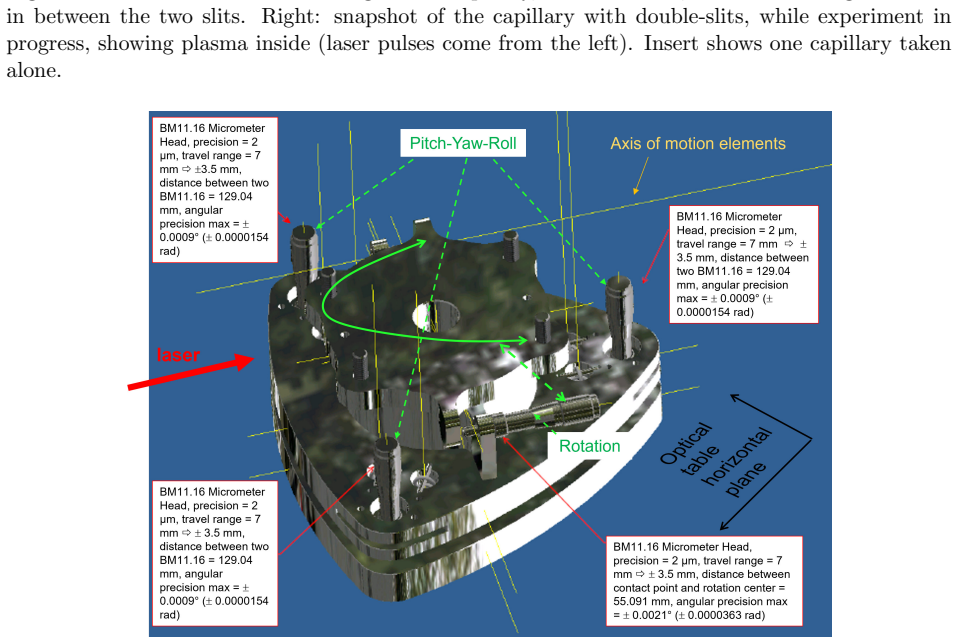
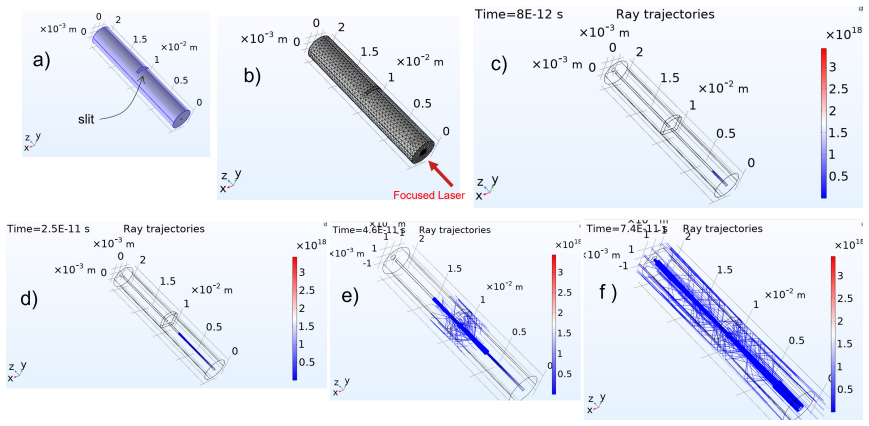
We have successfully developed and implemented an entire and compact table-top high-order harmonics generation (HHG) setup from monochromatic and intense femtosecond ($10^{-15}$ s) laser pulses launched in a target composed of a high-purity monoatomic noble gas specie, which can be Argon or Helium, distinctively. Its frequency arrangement is distributed both in the full eXtreme UltraViolet (XUV, $22-124$ eV) spectral region and in the bottom part of the Soft-X Ray range (SXR, $124-132$ eV), at once. Specifically, the core of this coherent secondary light source is based solely on a homemade, modular, affordable, though sturdy, design. We take advantage of this opportunity to present our design guidance of the XUV generation from a hollow capillary waveguide apparatus, and our simple recipe regarding the alignment process of the latter, which is easily carried out thanks to our adjustable design. Then, a comprehensive description of our entire XUV beamline is described, and participate in adding essential contents to the existing literature. Concurrently, we conducted theoretical studies, in order to anticipate or explain our experimental results. Overall, we found very good consistency between the experimental and cost-effective time-consuming numerical results. Finally, our setup provides very good vacuum performance under high gas load pressures, to a few atmospheres. All of these attributes fulfill the requirements regarding ultrafast time-resolved pump-probe configuration in table-top element-sensitive spectroscopy of complex and integrated optoelectronic devices made of magnetic materials.
Editorial analysis
A structured set of objections, weighed in public.
Referee Report
Summary. The manuscript presents the technical design and implementation of a compact table-top high-harmonic generation (HHG) beamline using a homemade modular hollow waveguide to generate broadband XUV radiation (22-124 eV) and lower SXR (124-132 eV) from intense femtosecond laser pulses in noble gases (Ar or He). It provides design guidance for the waveguide, a simple alignment recipe, a full description of the beamline, theoretical modeling, and reports very good experimental-numerical consistency plus strong vacuum performance under high gas loads up to a few atmospheres, targeting ultrafast pump-probe spectroscopy of magnetic materials.
Significance. If the central claims hold, the work offers a practical, affordable modular design for accessible table-top XUV sources that could lower barriers for ultrafast element-sensitive spectroscopy. The alignment recipe and reported vacuum performance under gas load are potentially useful additions to the literature on compact HHG setups, though the primarily descriptive character limits broader impact without stronger quantitative validation.
major comments (2)
- [Alignment procedure] Alignment procedure section: The claim that the homemade modular hollow waveguide delivers consistent broadband output without specialized facilities rests on the untested assumption of stable alignment under sustained high gas load. No long-term drift measurements, vibration sensitivity tests, or thermal stability data for the modular joints and capillary during continuous operation are reported, which is load-bearing for the practical usability assertion in pump-probe configurations.
- [Results and numerical comparison] Results and numerical comparison section: The repeated assertion of 'very good consistency' between experimental and numerical results lacks quantitative support such as specific metrics (e.g., spectral overlap percentages, RMS deviations), error bars, or detailed overlaid comparisons in figures or tables. This absence prevents independent assessment of the setup's performance and undermines the central experimental validation.
minor comments (2)
- [Abstract] Abstract: The title refers to the 'upper region of the extreme ultraviolet' while the text specifies 22-124 eV XUV plus 124-132 eV SXR; standardize terminology for clarity.
- [Vacuum performance] Vacuum performance paragraph: Specific quantitative values (e.g., achieved base pressures, leak rates, or pump-down times under gas load) are referenced but not tabulated or plotted; adding these would strengthen the claims.
Simulated Author's Rebuttal
We thank the referee for the constructive comments, which help us improve the clarity and rigor of our technical design report. We address each major point below and indicate the revisions planned for the next version of the manuscript.
read point-by-point responses
-
Referee: [Alignment procedure] Alignment procedure section: The claim that the homemade modular hollow waveguide delivers consistent broadband output without specialized facilities rests on the untested assumption of stable alignment under sustained high gas load. No long-term drift measurements, vibration sensitivity tests, or thermal stability data for the modular joints and capillary during continuous operation are reported, which is load-bearing for the practical usability assertion in pump-probe configurations.
Authors: We acknowledge that explicit long-term stability metrics would strengthen the practical-usability claim for pump-probe use. Our modular waveguide incorporates adjustable joints and a simple alignment recipe precisely to enable repeatable performance without specialized facilities; during our campaigns we routinely obtained stable broadband output over multi-hour runs at gas loads up to a few atmospheres. In the revised manuscript we will add a dedicated stability subsection that reports (i) spectral drift measurements over 4–6 h of continuous operation at representative pressures and (ii) a brief description of the vibration-isolation measures already present in the setup. These data were collected as part of routine operation but had not been quantified in the original text. revision: yes
-
Referee: [Results and numerical comparison] Results and numerical comparison section: The repeated assertion of 'very good consistency' between experimental and numerical results lacks quantitative support such as specific metrics (e.g., spectral overlap percentages, RMS deviations), error bars, or detailed overlaid comparisons in figures or tables. This absence prevents independent assessment of the setup's performance and undermines the central experimental validation.
Authors: We agree that quantitative metrics are necessary for independent evaluation. In the revised version we will (i) overlay experimental and simulated spectra with error bars on the measured data, (ii) report RMS deviations and spectral-overlap percentages for the principal cases (Ar and He at selected pressures), and (iii) add a compact table summarizing these metrics across the parameter space explored. These additions will be placed in the Results and numerical comparison section and will be supported by the existing figures. revision: yes
Circularity Check
Descriptive experimental report with no load-bearing derivations or self-referential predictions
full rationale
The manuscript is a technical design report focused on apparatus construction, alignment procedure, beamline description, and basic performance characterization (vacuum under high gas load, broadband HHG output). It reports consistency between experimental spectra and numerical simulations but presents no equations, fitted parameters, or predictions that reduce to inputs by construction. No self-citations are invoked as uniqueness theorems or load-bearing justifications for core claims. The central assertions rest on direct experimental observation rather than any derivation chain that collapses to self-definition or fitted renaming. This yields a low circularity score consistent with a primarily descriptive engineering paper.
Axiom & Free-Parameter Ledger
Lean theorems connected to this paper
-
IndisputableMonolith/Cost/FunctionalEquation.leanwashburn_uniqueness_aczel unclear?
unclearRelation between the paper passage and the cited Recognition theorem.
We have successfully developed and implemented an entire and compact table-top high-order harmonics generation (HHG) setup... homemade, modular, affordable, though sturdy, design... simple recipe regarding the alignment process... very good vacuum performance under high gas load pressures, to a few atmospheres.
-
IndisputableMonolith/Foundation/AbsoluteFloorClosure.leanabsolute_floor_iff_bare_distinguishability unclear?
unclearRelation between the paper passage and the cited Recognition theorem.
Macroscopic phase matching for HHG... Δk = Δk_q,g + Δk_q,n + Δk_q,e + ...
What do these tags mean?
- matches
- The paper's claim is directly supported by a theorem in the formal canon.
- supports
- The theorem supports part of the paper's argument, but the paper may add assumptions or extra steps.
- extends
- The paper goes beyond the formal theorem; the theorem is a base layer rather than the whole result.
- uses
- The paper appears to rely on the theorem as machinery.
- contradicts
- The paper's claim conflicts with a theorem or certificate in the canon.
- unclear
- Pith found a possible connection, but the passage is too broad, indirect, or ambiguous to say the theorem truly supports the claim.
Reference graph
Works this paper leans on
-
[1]
A. McPherson, G. Gibson, H. Jara, U. Johann, T. S. Luk, I. A. McIntyre, K. Boyer, and C. K. Rhodes. Studies of multiphoton production of vacuum-ultraviolet radiation in the rare gases. J. Opt. Soc. Am. B, 4(4):595–601, Apr 1987
work page 1987
-
[2]
C´ edric Schmidt, Yoann Pertot, Tadas Balciunas, Kristina Zinchenko, Mary Matthews, Hans Jakob W¨ orner, and Jean-Pierre Wolf. High-order harmonic source spanning up to the oxygen k-edge based on filamentation pulse compression.Opt. Express, 26(9):11834–11842, Apr 2018
work page 2018
-
[3]
P.-A. Chevreuil, F. Brunner, S. Hrisafov, J. Pupeikis, C. R. Phillips, U. Keller, and L. Gall- mann. Water-window high harmonic generation with 0.8-µm and 2.2-µm opcpas at 100 khz. Opt. Express, 29(21):32996–33008, Oct 2021
work page 2021
-
[4]
V Cardin, B E Schimdt, N Thir´ e, S Beaulieu, V Wanie, M Negro, C Vozzi, V Tosa, and F L´ egar´ e. Self-channelled high harmonic generation of water window soft x-rays.Journal of Physics B: Atomic, Molecular and Optical Physics, 51(17):174004, aug 2018
work page 2018
-
[5]
Gregory J Stein, Phillip D Keathley, Peter Krogen, Houkun Liang, Jonathas P Siqueira, Chun- Lin Chang, Chien-Jen Lai, Kyung-Han Hong, Guillaume M Laurent, and Franz X K¨ artner. Water-window soft x-ray high-harmonic generation up to the nitrogen k-edge driven by a kHz, 2.1µm OPCPA source.Journal of Physics B: Atomic, Molecular and Optical Physics, 49(15):...
work page 2016
-
[6]
Smith, Tadas Balˇ ciunas, Yi-Ping Chang, C´ edric Schmidt, Kristina Zinchenko, Fer- nanda B
Adam D. Smith, Tadas Balˇ ciunas, Yi-Ping Chang, C´ edric Schmidt, Kristina Zinchenko, Fer- nanda B. Nunes, Emanuele Rossi, V´ ıt Svoboda, Zhong Yin, Jean-Pierre Wolf, and Hans Jakob W¨ orner. Femtosecond soft-x-ray absorption spectroscopy of liquids with a water-window high- harmonic source.The Journal of Physical Chemistry Letters, 11(6):1981–1988, 2020...
work page 1981
-
[7]
M. Hentschel, R. Kienberger, Ch Spielmann, G. A. Reider, N. Milosevic, T. Brabec, P. Corkum, U. Heinzmann, M. Drescher, and F. Krausz. Attosecond metrology.Nature, 414:509–513, 2001
work page 2001
-
[8]
P. M. Paul, E. S. Toma, P. Breger, G. Mullot, F. Aug´ e, Ph. Balcou, H. G. Muller, and P. Agostini. Observation of a train of attosecond pulses from high harmonic generation. Science, 292:1689–1692, 2001
work page 2001
-
[9]
Dandan Hui, Husain Alqattan, Mohamed Sennary, Nikolay V. Golubev, and Mohammed Th. Hassan. Attosecond electron microscopy and diffraction.Science Advances, 10(34):eadp5805, 2024
work page 2024
- [10]
-
[11]
O. Hort, M. Albrecht, V. E. Nefedova, O. Finke, D. D. Mai, S. Reyn´ e, F. Giambruno, F. Fras- setto, L. Poletto, J. Andreasson, J. Gautier, S. Sebban, and J. Nejdl. High-flux source of coherent xuv pulses for user applications.Opt. Express, 27(6):8871–8883, Mar 2019
work page 2019
-
[12]
A com- pact, turnkey, narrow-bandwidth, tunable, and high-photon-flux extreme ultraviolet source
Vinzenz Hilbert, Maxim Tschernajew, Robert Klas, Jens Limpert, and Jan Rothhardt. A com- pact, turnkey, narrow-bandwidth, tunable, and high-photon-flux extreme ultraviolet source. AIP Advances, 10(4):045227, 2020
work page 2020
-
[13]
M. Gebhardt, T. Heuermann, R. Klas, and et al. Bright, high-repetition-rate water window soft x-ray source enabled by nonlinear pulse self-compression in an antiresonant hollow-core fibre.Light Sci Appl, 10:2047, 2021. 63
work page 2047
-
[14]
Maxim R. Shcherbakov, Haizhong Zhang, Michael Tripepi, Giovanni Sartorello, Noah Tal- isa, Abdallah AlShafey, Zhiyuan Fan, Justin Twardowski, Leonid A. Krivitsky, Arseniy I. Kuznetsov, Enam Chowdhury, and Gennady Shvets. Generation of even and odd high har- monics in resonant metasurfaces using single and multiple ultra-intense laser pulses.Nature Communi...
work page 2021
-
[15]
Jong-Kwan An and Kwang-Hyon Kim. Efficient non-perturbative high-harmonic genera- tion from nonlinear metasurfaces with low pump intensity.Optics and Laser Technology, 135:106702, 2021
work page 2021
-
[16]
P. B. Corkum. Plasma perspective on strong field multiphoton ionization.Phys. Rev. Lett., 71:1994–1997, Sep 1993
work page 1994
-
[17]
M. Lewenstein, Ph. Balcou, M. Yu. Ivanov, Anne L’Huillier, and P. B. Corkum. Theory of high-harmonic generation by low-frequency laser fields.Phys. Rev. A, 49:2117–2132, Mar 1994
work page 1994
-
[18]
A. Gorlach, O. Neufeld, N. Rivera, andet al.The quantum-optical nature of high harmonic generation.Nat Commun, 11:4598, 2020
work page 2020
-
[19]
I. Gonoskov, N. Tsatrafyllis, I. Kominis, andet al.Quantum optical signatures in strong-field laser physics: Infrared photon counting in high-order-harmonic generation.Sci Rep, 6:32821, 2016
work page 2016
-
[20]
Charles G. Durfee, Andy R. Rundquist, Sterling Backus, Catherine Herne, Margaret M. Mur- nane, and Henry C. Kapteyn. Phase matching of high-order harmonics in hollow waveguides. Phys. Rev. Lett., 83:2187–2190, Sep 1999
work page 1999
-
[21]
Durfee, Zenghu Chang, Catherine Herne, Sterling Backus, Mar- garet M
Andy Rundquist, Charles G. Durfee, Zenghu Chang, Catherine Herne, Sterling Backus, Mar- garet M. Murnane, and Henry C. Kapteyn. Phase-matched generation of coherent soft x-rays. Science, 280(5368):1412–1415, 1998
work page 1998
-
[22]
Kevin Cassou, Sameh Daboussi, Ondrej Hort, Olivier Guilbaud, Dominique Descamps, St´ ephane Petit, Eric M´ evel, Eric Constant, and Sophie Kazamias. Enhanced high harmonic generation driven by high-intensity laser in argon gas-filled hollow core waveguide.Opt. Lett., 39(13):3770–3773, Jul 2014
work page 2014
- [23]
-
[24]
M.-C. Chen, M. R. Gerrity, S. Backus, T. Popmintchev, X. Zhou, P. Arpin, X. Zhang, H.C. Kapteyn, and M. M. Murnane. Spatially coherent, phase matched, high-order harmonic euv beams at 50 khz.Opt. Express, 17(20):17376–17383, Sep 2009
work page 2009
-
[25]
Yong Soo Kim, Byunghyuck Moon, Chulki Kim, Byeong-Kwon Ju, Ju Han Lee, and Young Min Jhon. Optimizing high harmonic generation in hollow-core gas cell considering variation of gas density.Optics and Laser Technology, 149:107803, 2022
work page 2022
-
[27]
T. Fert´ e, M. Beens, G. Malinowski, K. Holldack, R. Abrudan, F. Radu, T. Kachel, M. Hehn, C. Boeglin, B. Koopmans, and N. Bergeard. Laser induced ultrafast Gd 4f spin dynamics in Co100−xGdx alloys by means of time-resolved XMCD.The European Physical Journal Special Topics, 232:2213–2219, 2023. 64
work page 2023
-
[28]
Chan La-O-Vorakiat, Mark Siemens, Margaret M. Murnane, Henry C. Kapteyn, Stefan Math- ias, Martin Aeschlimann, Patrik Grychtol, Roman Adam, Claus M. Schneider, Justin M. Shaw, Hans Nembach, and T. J. Silva. Ultrafast demagnetization dynamics at themedges of mag- netic elements observed using a tabletop high-harmonic soft x-ray source.Phys. Rev. Lett., 103...
work page 2009
-
[29]
Stefan Mathias, Chan La-O-Vorakiat, Patrik Grychtol, Patrick Granitzka, Emrah Turgut, Justin M. Shaw, Roman Adam, Hans T. Nembach, Mark E. Siemens, Steffen Eich, Claus M. Schneider, Thomas J. Silva, Martin Aeschlimann, Margaret M. Murnane, and Henry C. Kapteyn. Probing the timescale of the exchange interaction in a ferromagnetic alloy.Pro- ceedings of the...
work page 2012
-
[30]
Mette B Gaarde, Jennifer L Tate, and Kenneth J Schafer. Macroscopic aspects of attosecond pulse generation.Journal of Physics B: Atomic, Molecular and Optical Physics, 41(13):132001, jun 2008
work page 2008
-
[31]
Coherence control of high-order harmonics.Phys
Pascal Sali` eres, Anne L’Huillier, and Maciej Lewenstein. Coherence control of high-order harmonics.Phys. Rev. Lett., 74:3776–3779, May 1995
work page 1995
-
[32]
P. Rudawski, C. M. Heyl, F. Brizuela, J. Schwenke, A. Persson, E. Mansten, R. Rakowski, L. Rading, F. Campi, B. Kim, P. Johnsson, and A. L’Huillier. A high-flux high-order harmonic source.Review of Scientific Instruments, 84(7):073103, 2013
work page 2013
-
[33]
Tenio Popmintchev, Ming-Chang Chen, Alon Bahabad, Michael Gerrity, Pavel Sidorenko, Oren Cohen, Ivan P. Christov, Margaret M. Murnane, and Henry C. Kapteyn. Phase matching of high harmonic generation in the soft and hard x-ray regions of the spectrum.Proceedings of the National Academy of Sciences, 106(26):10516–10521, 2009
work page 2009
-
[34]
Bj¨ orn Minneker, Robert Klas, Jan Rothhardt, and Stephan Fritzsche. Critical laser intensity of phase-matched high-order harmonic generation in noble gases.Photonics, 10(1), 2023
work page 2023
-
[35]
J Maurer and U Keller. Ionization in intense laser fields beyond the electric dipole approxima- tion: concepts, methods, achievements and future directions.Journal of Physics B: Atomic, Molecular and Optical Physics, 54(9):094001, may 2021
work page 2021
-
[36]
A. Dalgarno, A. E. Kingston, and David Robert Bates. The refractive indices and verdet con- stants of the inert gases.Proceedings of the Royal Society of London. Series A. Mathematical and Physical Sciences, 259(1298):424–431, 1960
work page 1960
-
[37]
X-Rays Data Booklet.https://xdb.lbl.gov/
XDB.LBL. X-Rays Data Booklet.https://xdb.lbl.gov/
-
[38]
The Center for X-Rays Optics.https://henke.lbl.gov/optical_constants/
CXRO. The Center for X-Rays Optics.https://henke.lbl.gov/optical_constants/
-
[39]
R. Weissenbilder, S. Carlstr¨ om, L. Rego, andet al. How to optimize high-order harmonic generation in gases.Nat Rev Phys, 4:713–722, 2022
work page 2022
-
[40]
PhD thesis, Colorado University, 2001
A.Lytle.Phase Matching and Coherence of High-Order Harmonic Generation in Hollow Waveguides. PhD thesis, Colorado University, 2001
work page 2001
-
[41]
Nicholas L. Wagner, Emily A. Gibson, Tenio Popmintchev, Ivan P. Christov, Margaret M. Murnane, and Henry C. Kapteyn. Self-compression of ultrashort pulses through ionization- induced spatiotemporal reshaping.Phys. Rev. Lett., 93:173902, Oct 2004
work page 2004
-
[42]
M. Bellini, C. Corsi, and M. C. Gambino. Neutral depletion and beam defocusing in harmonic generation from strongly ionized media.Phys. Rev. A, 64:023411, Jul 2001
work page 2001
-
[43]
Tenio Popmintchev, Ming-Chang Chen, Oren Cohen, Michael E. Grisham, Jorge J. Rocca, Margaret M. Murnane, and Henry C. Kapteyn. Extended phase matching of high harmonics driven by mid-infrared light.Opt. Lett., 33(18):2128–2130, Sep 2008. 65
work page 2008
-
[44]
Generalized phase- matching conditions for high harmonics: The role of field-gradient forces.Phys
Philippe Balcou, Pascal Sali` eres, Anne L’Huillier, and Maciej Lewenstein. Generalized phase- matching conditions for high harmonics: The role of field-gradient forces.Phys. Rev. A, 55:3204–3210, Apr 1997
work page 1997
-
[45]
G.V. Marr and J.B. West. Absolute photoionization cross-section tables for helium, neon, argon, and krypton in the vuv spectral regions.Atomic Data and Nuclear Data Tables, 18(5):497–508, 1976
work page 1976
-
[46]
E. Constant, D. Garzella, P. Breger, E. M´ evel, Ch. Dorrer, C. Le Blanc, F. Salin, and P. Agos- tini. Optimizing high harmonic generation in absorbing gases: Model and experiment.Phys. Rev. Lett., 82:1668–1671, Feb 1999
work page 1999
-
[47]
Johanna Richter, Somnath Jana, Martin Hennecke, Daniel Schick, Clemens von Korff Schmis- ing, and Stefan Eisebitt. Relationship between magnetic asymmetry and magnetization in ultrafast transverse magneto-optical kerr effect spectroscopy in the extreme ultraviolet spec- tral range.Phys. Rev. B, 109:184440, May 2024
work page 2024
-
[48]
S. J. Goh, Y. Tao, P. J. M. van der Slot, H. J. M. Bastiaens, J. Herek, S. G. Biedron, M. B. Danailov, S. V. Milton, and K.-J. Boller. Single-shot fluctuations in waveguided high-harmonic generation.Opt. Express, 23(19):24888–24902, Sep 2015
work page 2015
-
[49]
Chan La-O-Vorakiat, Emrah Turgut, Carson A. Teale, Henry C. Kapteyn, Margaret M. Mur- nane, Stefan Mathias, Martin Aeschlimann, Claus M. Schneider, Justin M. Shaw, Hans T. Nembach, and T. J. Silva. Ultrafast demagnetization measurements using extreme ultraviolet light: Comparison of electronic and magnetic contributions.Phys. Rev. X, 2:011005, Jan 2012
work page 2012
-
[50]
Guillaume Point, Yohann Brelet, Aur´ elien Houard, Vytautas Jukna, Carles Mili´ an, J´ erˆ ome Carbonnel, Yi Liu, Arnaud Couairon, and Andr´ e Mysyrowicz. Superfilamentation in air. Phys. Rev. Lett., 112:223902, Jun 2014
work page 2014
-
[51]
Ciliary white light: Optical aspect of ultrashort laser ablation on transparent dielectrics.Phys
Yi Liu, Yohann Brelet, Zhanbing He, Linwei Yu, Sergey Mitryukovskiy, Aur´ elien Houard, Benjamin Forestier, Arnaud Couairon, and Andr´ e Mysyrowicz. Ciliary white light: Optical aspect of ultrashort laser ablation on transparent dielectrics.Phys. Rev. Lett., 110:097601, Mar 2013
work page 2013
-
[52]
Gibson, Ariel Paul, Nick Wagner, Ra’anan Tobey, Sterling Backus, Ivan P
Emily A. Gibson, Ariel Paul, Nick Wagner, Ra’anan Tobey, Sterling Backus, Ivan P. Christov, Margaret M. Murnane, and Henry C. Kapteyn. High-order harmonic generation up to 250 ev from highly ionized argon.Phys. Rev. Lett., 92:033001, Jan 2004
work page 2004
-
[53]
Jan Troß, Shashank Pathak, Adam Summers, Dimitrios Rompotis, Benjamin Erk, Christopher Passow, Bastian Manschwetus, Rebecca Boll, Patrik Grychtol, Sadia Bari, Vinod Kumarap- pan, Anh-Thu Le, Cheng Jin, Carlos Trallero, and Daniel Rolles. High harmonic generation in mixed XUV and NIR fields at a free-electron laser.Journal of Optics, 24(2):025502, jan 2022
work page 2022
-
[54]
Allan S. Johnson, Timur Avni, Esben W. Larsen, Dane R. Austin, and Jon P. Marangos. Attosecond soft x-ray high harmonic generation.Philosophical Transactions of the Royal Society A: Mathematical, Physical and Engineering Sciences, 377(2145):20170468, 2019
work page 2019
-
[55]
Zongyuan Fu, Yudong Chen, Sainan Peng, Bingbing Zhu, Baochang Li, Rodrigo Mart´ ın- Hern´ andez, Guangyu Fan, Yihua Wang, Carlos Hern´ andez-Garc´ ıa, Cheng Jin, Margaret Mur- nane, Henry Kapteyn, and Zhensheng Tao. Extension of the bright high-harmonic photon energy range via nonadiabatic critical phase matching.Science Advances, 8(51):eadd7482, 2022
work page 2022
-
[56]
Allan S. Johnson, Dane R. Austin, David A. Wood, Christian Brahms, Andrew Gregory, Kon- stantin B. Holzner, Sebastian Jarosch, Esben W. Larsen, Susan Parker, Christian S. Str¨ uber, Peng Ye, John W. G. Tisch, and Jon P. Marangos. High-flux soft x-ray harmonic generation from ionization-shaped few-cycle laser pulses.Science Advances, 4(5):eaar3761, 2018. 66
work page 2018
-
[57]
T Popmintchev, MC Chen, P Arpin, andet al.The attosecond nonlinear optics of bright coherent x-ray generation.Nature Photon, 4:822–832, 2010
work page 2010
-
[58]
S. H¨ adrich, A. Klenke, J. Rothhardt, andet al.High photon flux table-top coherent extreme- ultraviolet source.Nature Photon, 8:779–783, 2014
work page 2014
-
[59]
C M Heyl, C L Arnold, A Couairon, and A L’Huillier. Introduction to macroscopic power scaling principles for high-order harmonic generation.Journal of Physics B: Atomic, Molecular and Optical Physics, 50(1):013001, dec 2016
work page 2016
-
[60]
Suppression of driving laser in high harmonic generation with a microchannel plate
Qi Zhang, Kun Zhao, Jie Li, Michael Chini, Yan Cheng, Yi Wu, Eric Cunningham, and Zenghu Chang. Suppression of driving laser in high harmonic generation with a microchannel plate. Opt. Lett., 39(12):3670–3673, Jun 2014
work page 2014
-
[61]
S. Kazamias, S. Daboussi, O. Guilbaud, K. Cassou, D. Ros, B. Cros, and G. Maynard. Pressure-induced phase matching in high-order harmonic generation.Phys. Rev. A, 83:063405, Jun 2011
work page 2011
-
[62]
C M Heyl, J G¨ udde, A L’Huillier, and U H¨ ofer. High-order harmonic generation withµj laser pulses at high repetition rates.Journal of Physics B: Atomic, Molecular and Optical Physics, 45(7):074020, mar 2012
work page 2012
-
[63]
Jan Rothhardt, Manuel Krebs, Steffen H¨ adrich, Stefan Demmler, Jens Limpert, and Andreas T¨ unnermann. Absorption-limited and phase-matched high harmonic generation in the tight focusing regime.New Journal of Physics, 16(3):033022, mar 2014
work page 2014
-
[64]
T. J. Butcher, P. N. Anderson, R. T. Chapman, P. Horak, J. G. Frey, and W. S. Brocklesby. Bright extreme-ultraviolet high-order-harmonic radiation from optimized pulse compression in short hollow waveguides.Phys. Rev. A, 87:043822, Apr 2013
work page 2013
-
[65]
Boyd.Nonlinear Optics, Third Edition
Robert W. Boyd.Nonlinear Optics, Third Edition. Academic Press, Inc., 3rd edition, 2008
work page 2008
-
[66]
Michael Werner Z¨ urch. High-resolution extreme ultraviolet microscopy - imaging of artificial and biological specimens with laser-driven ultrafast xuv sources. In Cham Springer, editor, High-Resolution Extreme Ultraviolet Microscopy. Springer Theses, 2015
work page 2015
-
[67]
Hickstein, Dmitriy Zusin, Christian Gentry, Franklin J
Tingting Fan, Patrik Grychtol, Ronny Knut, Carlos Hern´ andez-Garc´ ıa, Daniel D. Hickstein, Dmitriy Zusin, Christian Gentry, Franklin J. Dollar, Christopher A. Mancuso, Craig W. Hogle, Ofer Kfir, Dominik Legut, Karel Carva, Jennifer L. Ellis, Kevin M. Dorney, Cong Chen, Oleg G. Shpyrko, Eric E. Fullerton, Oren Cohen, Peter M. Oppeneer, Dejan B. Miloˇ sev...
work page 2015
-
[68]
Sayrac.HIGH HARMONIC GENERATION OPTIMIZATION IN ATOMIC AND MOLECULAR GASES
M. Sayrac.HIGH HARMONIC GENERATION OPTIMIZATION IN ATOMIC AND MOLECULAR GASES. PhD thesis, A&M Texas University, 2017
work page 2017
-
[69]
N. Izumi, J. Emig, J. Moody, C. Middeleton, J. Holder, S. Glenn, T. Pond, R. Shellman, M. Cardenas, P. J. Walsh, S. J. Chelli, D. K. Bradley, and P. M. Bell. Measurement of cathode luminescence efficiency of phosphors for micro-channel plate based x-ray framing cameras. In Perry Bell and Gary P. Grim, editors,Target Diagnostics Physics and Engineering for...
work page 2012
-
[70]
I. Kandarakis, D. Cavouras, D. Nikolopoulos, A. Episkopakis, N. Kalivas, P. Liaparinos, I. Valais, G. Kagadis, K. Kourkoutas, I. Sianoudis, N. Dimitropoulos, C. Nomicos, and G. Panayiotakis. A theoretical model evaluating the angular distribution of luminescence emission in x-ray scintillating screens.Applied Radiation and Isotopes, 64(4):508–519, 2006. 67
work page 2006
-
[71]
N. Fedorov, S. Beaulieu, A. Belsky, V. Blanchet, R. Bouillaud, M. De Anda Villa, A. Filippov, C. Fourment, J. Gaudin, R. E. Grisenti, E. Lamour, A. L´ evy, S. Mac´ e, Y. Mairesse, P. Martin, P. Martinez, P. No´ e, I. Papagiannouli, M. Patanen, S. Petit, D. Vernhet, K. Veyrinas, and D. Descamps. Aurore: A platform for ultrafast sciences.Review of Scientifi...
work page 2020
-
[72]
C.S. Goncalves, Silva A.S., D. Navas, M. Miranda, F. Silva, H. Crespo, and D. S. Schmool. A dual-colour architecture for pump-probe spectroscopy of ultrafast magnetization dynamics in the sub-10-femtosecond range.Scientific Reports, 6:22872, 2016
work page 2016
-
[73]
W. Holgado.Study of high-order harmonic generation effects under variations of focusing conditions of few cycle laser pulses. PhD thesis, Universidad de Salamanca, 2016
work page 2016
-
[74]
T. Popmintchev, M.-C. Chen, P. Arpin, M. Gerrity, M. Seaberg, B. Zhang, D. Popmintchev, G. Andriukaitis, T. Balciunas, O. D. M¨ ucke, A. Pugzlys, A. Baltuˇ ska, M. M. Murnane, and H. C. Kapteyn. Bright coherent ultrafast x-rays from mid-ir lasers. InAdvances in Optical Materials, page HThB5. Optica Publishing Group, 2011
work page 2011
-
[75]
A. Maghraoui, F. Fras, M. Vomir, Y. Brelet, V. Halt´ e, J. Y. Bigot, and M. Barthelemy. Role of intersublattice exchange interaction in ultrafast longitudinal and transverse magnetization dynamics in permalloy.Phys. Rev. B, 107:134424, Apr 2023
work page 2023
-
[76]
P. Colosimo, G. Doumy, C. Blaga, andet al. Scaling strong-field interactions towards the classical limit.Nature Phys, 4:386–389, 2008
work page 2008
-
[77]
Kruchinin, Ferenc Krausz, and Vladislav S
Stanislav Yu. Kruchinin, Ferenc Krausz, and Vladislav S. Yakovlev. Colloquium: Strong-field phenomena in periodic systems.Rev. Mod. Phys., 90:021002, Apr 2018
work page 2018
-
[78]
A. Ben Levy, A. Hen, M. Kahn, Y. Aharon, T. Levin, N. Mazurski, U. Levy, and G. Marcus. Simulation of laser-induced tunnel ionization based on a curved waveguide.Scientific Reports, 13:12612, Augsut 2023
work page 2023
-
[79]
Strong-field ionization phenomena re- vealed by quantum trajectories.Phys
Taylor Moon, Klaus Bartschat, and Nicolas Douguet. Strong-field ionization phenomena re- vealed by quantum trajectories.Phys. Rev. Lett., 133:073201, Aug 2024
work page 2024
-
[80]
Hatsagortsyan, Thomas Pfeifer, Christoph H
Nicolas Camus, Enderalp Yakaboylu, Lutz Fechner, Michael Klaiber, Martin Laux, Yonghao Mi, Karen Z. Hatsagortsyan, Thomas Pfeifer, Christoph H. Keitel, and Robert Moshammer. Experimental evidence for quantum tunneling time.Phys. Rev. Lett., 119:023201, Jul 2017
work page 2017
-
[81]
C. Spielmann, C. Kan, N.H. Burnett, T. Brabec, M. Geissler, A. Scrinzi, M. Schnurer, and F. Krausz. Near-kev coherent x-ray generation with sub-10-fs lasers.IEEE Journal of Selected Topics in Quantum Electronics, 4(2):249–265, 1998
work page 1998
discussion (0)
Sign in with ORCID, Apple, or X to comment. Anyone can read and Pith papers without signing in.