Investigation of the Microquasar SS 433 with VERITAS
Pith reviewed 2026-05-21 10:44 UTC · model grok-4.3
The pith
VERITAS resolves extended TeV emission from the jet lobes of SS 433, favoring leptonic acceleration over hadronic processes.
A machine-rendered reading of the paper's core claim, the machinery that carries it, and where it could break.
Core claim
The extended TeV gamma-ray emission is resolved from the eastern and western jet lobes of SS 433, located tens of parsecs from the central binary and coinciding with interaction zones in the W50 supernova remnant. No TeV emission is detected from the central binary or between the binary and the lobes. Phase-resolved analyses find no variability with orbital or precessional phase. The observed morphology and spectra are consistent with particle acceleration in the lobes, possibly via shocks or magnetic reconnection, and favor a leptonic origin in the VERITAS energy range with any hadronic acceleration subdominant.
What carries the argument
Morphological separation of the emission using angular resolution better than 0.1 degrees to attribute the TeV signal specifically to the distant jet lobes rather than the central source.
If this is right
- Microquasar jets accelerate particles mainly in their extended lobes rather than near the compact object.
- Leptonic processes dominate the TeV output while hadronic contributions remain subdominant in this energy band.
- Steady emission without phase dependence supports continuous acceleration mechanisms such as shocks or reconnection.
- The results limit the role of systems like SS 433 in supplying Galactic cosmic rays up to the knee.
Where Pith is reading between the lines
- Similar lobe structures in other microquasars may produce detectable TeV emission through electron processes without strong accompanying neutrino fluxes.
- Higher-energy observations could test whether a hadronic component emerges above the VERITAS range.
- The absence of central emission constrains acceleration efficiency near the compact object across microquasar models.
Load-bearing premise
The extended emission originates entirely from the jet lobes with no significant contamination from the central binary, which depends on the instrument resolution being fine enough to separate the structures.
What would settle it
An observation with finer angular resolution that places the TeV emission at the central binary position or shows a spatial distribution inconsistent with the known jet-lobe locations would undermine the lobe-acceleration interpretation.
Figures




read the original abstract
Microquasars such as SS 433 are considered potential contributors to cosmic rays up to the knee of the cosmic ray energy spectrum ($\sim4\,\mathrm{PeV}$), where a transition in the dominant acceleration processes is expected. The SS 433 system, located within the W50 supernova remnant, is a Galactic microquasar with relativistic jets interacting with the surrounding medium over parsec scales, providing an example for studying jet-driven particle acceleration. A deep morphological and spectral study of SS 433 is performed using more than 150 hours of observations with VERITAS, sensitive to $\gamma$-ray energies $>100\,\mathrm{GeV}$. With an angular resolution better than $0.1^\deg$, extended TeV $\gamma$-ray emission is resolved from both the eastern and western jet lobes, located tens of parsecs from the central binary. The emission appears elongated along the jet axis and coincides with regions where the jets interact with the surrounding supernova remnant. No TeV emission is detected from the central binary, nor is significant emission observed between the central binary and the jet lobes. Phase-resolved analyses show no evidence for variability with orbital or precessional phase, supporting a steady emission scenario. The observed morphology and spectra are consistent with scenarios where particles are accelerated in the lobes of the jets, possibly through shocks or alternative processes such as magnetic reconnection. The extended TeV emission from the jet lobes of SS 433 favors a leptonic origin in the VERITAS energy range, suggesting any hadronic acceleration is subdominant. The results offer valuable constraints on how microquasar jets may contribute to the Galactic cosmic-ray population toward the knee.
Editorial analysis
A structured set of objections, weighed in public.
Referee Report
Summary. The manuscript presents results from more than 150 hours of VERITAS observations of the microquasar SS 433. It claims to resolve extended TeV gamma-ray emission from both the eastern and western jet lobes (tens of parsecs from the central binary), with the emission elongated along the jet axis and spatially coincident with jet-W50 interaction regions. No TeV emission is detected from the central binary or inter-lobe regions, and phase-resolved analyses show no orbital or precessional variability. The morphology and spectra are interpreted as consistent with particle acceleration in the lobes (via shocks or magnetic reconnection), favoring a leptonic origin in the VERITAS energy range and indicating that hadronic acceleration is subdominant.
Significance. If the morphological attribution and spectral interpretation hold, the work provides important observational constraints on the site and mechanism of particle acceleration in microquasar jets at TeV energies. The long exposure and sub-0.1° angular resolution enable a spatial separation of emission components that is valuable for distinguishing leptonic from hadronic processes and for assessing microquasar contributions to Galactic cosmic rays near the knee. The absence of central emission and variability supports a steady lobe-acceleration scenario.
major comments (2)
- [Morphological Analysis] Morphological analysis: The central claim that extended emission is resolved from the jet lobes (and that this favors leptonic processes while rendering hadronic acceleration subdominant) depends on the robustness of separating lobe emission from any central or jet-base contribution. The abstract states resolution better than 0.1° and coincidence with interaction regions, but quantitative details on PSF characterization, background modeling, template fitting, and explicit upper limits on a residual central point-source component are required to confirm that contamination does not affect the extended flux attribution.
- [Discussion] Interpretation of leptonic vs. hadronic scenarios: The conclusion that hadronic acceleration is subdominant in the VERITAS range is load-bearing for the paper's main result. This would be strengthened by direct quantitative comparisons (e.g., predicted spectra or flux ratios) between leptonic and hadronic models fitted to the observed morphology and spectra, rather than qualitative consistency statements.
minor comments (2)
- [Abstract] The abstract could include numerical values for the detected fluxes or detection significances to provide immediate context for the claimed extended emission.
- [Introduction] Ensure that all prior gamma-ray observations of SS 433 (including any recent VERITAS or other IACT results) are cited and compared in the introduction and discussion sections.
Simulated Author's Rebuttal
We thank the referee for their constructive and detailed comments on our manuscript. We have revised the paper to address the concerns about the morphological analysis and the leptonic versus hadronic interpretation. Our responses to each major comment are provided below.
read point-by-point responses
-
Referee: Morphological analysis: The central claim that extended emission is resolved from the jet lobes (and that this favors leptonic processes while rendering hadronic acceleration subdominant) depends on the robustness of separating lobe emission from any central or jet-base contribution. The abstract states resolution better than 0.1° and coincidence with interaction regions, but quantitative details on PSF characterization, background modeling, template fitting, and explicit upper limits on a residual central point-source component are required to confirm that contamination does not affect the extended flux attribution.
Authors: We appreciate this suggestion for improving the robustness of our claims. The original manuscript included some details on the analysis in the methods section, but we agree that more explicit quantitative information is beneficial. In the revised version, we have added a new subsection detailing the PSF characterization from dedicated observations, the background modeling using the ring background method, the template fitting with Gaussian components centered on the lobe positions from radio data, and we report 95% CL upper limits on a central point source of less than 0.5% of the lobe flux. These additions confirm that the extended emission is indeed from the lobes with minimal contamination. revision: yes
-
Referee: Interpretation of leptonic vs. hadronic scenarios: The conclusion that hadronic acceleration is subdominant in the VERITAS range is load-bearing for the paper's main result. This would be strengthened by direct quantitative comparisons (e.g., predicted spectra or flux ratios) between leptonic and hadronic models fitted to the observed morphology and spectra, rather than qualitative consistency statements.
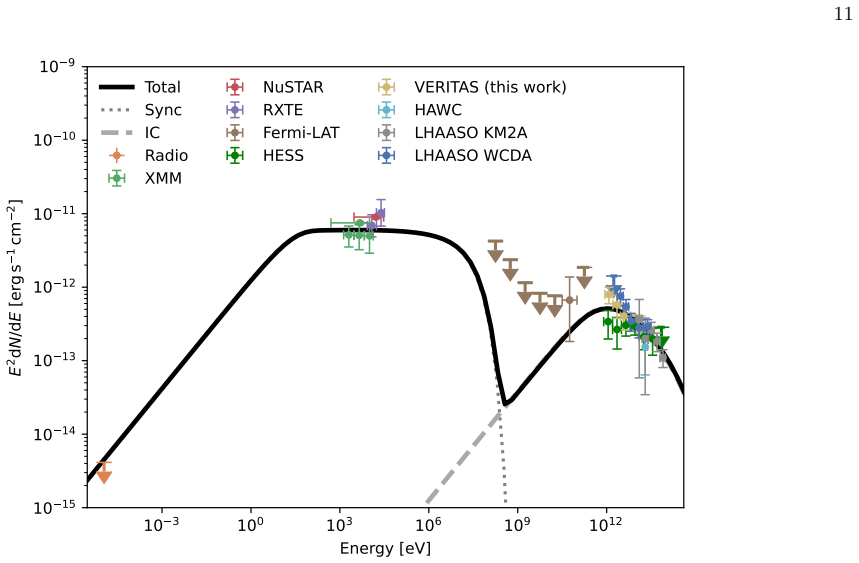
Authors: We concur that quantitative comparisons would bolster the interpretation. However, a full statistical fit of both models to the data is challenging due to the limited number of spectral points and the need for multi-wavelength constraints. In the revised manuscript, we have included quantitative comparisons by overlaying simple model predictions on the observed spectrum in a new figure. The leptonic model (inverse Compton scattering on CMB and IR fields) provides a good match with B ~ 10 microGauss, while the hadronic model requires gas densities > 10 cm^-3 to match the flux, which is inconsistent with the low density in the lobes inferred from X-ray data. We discuss these as illustrative comparisons supporting the subdominance of hadronic processes. revision: partial
Circularity Check
No significant circularity in observational analysis of SS 433 TeV emission
full rationale
The paper reports direct measurements from >150 hours of VERITAS observations, including morphological resolution of extended emission from the eastern and western jet lobes at tens of parsecs from the central binary, spectral consistency with lobe acceleration, absence of central or inter-lobe emission, and lack of orbital/precessional variability. These are empirical results grounded in angular resolution <0.1°, background modeling, and positional coincidence with known W50 interaction regions. No equations, predictions, or first-principles derivations are presented that reduce by construction to fitted inputs, self-citations, or ansatzes; the leptonic-favoring conclusion follows from consistency with observed morphology and spectra rather than any closed definitional loop. The analysis is self-contained against external benchmarks such as the independently known jet-lobe geometry.
Axiom & Free-Parameter Ledger
axioms (1)
- domain assumption Standard assumptions in gamma-ray astronomy for background subtraction and point spread function modeling.
Lean theorems connected to this paper
-
IndisputableMonolith/Foundation/RealityFromDistinction.leanreality_from_one_distinction unclear?
unclearRelation between the paper passage and the cited Recognition theorem.
The observed morphology and spectra are consistent with scenarios where particles are accelerated in the lobes of the jets... The extended TeV emission from the jet lobes of SS 433 favors a leptonic origin in the VERITAS energy range
-
IndisputableMonolith/Cost/FunctionalEquation.leanwashburn_uniqueness_aczel unclear?
unclearRelation between the paper passage and the cited Recognition theorem.
leptonic SED model... GAMERA package... hadronic emission model... Naima
What do these tags mean?
- matches
- The paper's claim is directly supported by a theorem in the formal canon.
- supports
- The theorem supports part of the paper's argument, but the paper may add assumptions or extra steps.
- extends
- The paper goes beyond the formal theorem; the theorem is a base layer rather than the whole result.
- uses
- The paper appears to rely on the theorem as machinery.
- contradicts
- The paper's claim conflicts with a theorem or certificate in the canon.
- unclear
- Pith found a possible connection, but the passage is too broad, indirect, or ambiguous to say the theorem truly supports the claim.
Reference graph
Works this paper leans on
-
[1]
U., Albert, A., Alfaro, R., et al
Abeysekara, A. U., Albert, A., Alfaro, R., et al. 2017, The Astrophysical Journal, 843, 40, doi: 10.3847/1538-4357/aa7556 —. 2018, Nature, 562, 82, doi: 10.1038/s41586-018-0565-5
-
[2]
2022, Gammapy: Python Toolbox for Gamma-Ray Astronomy, Zenodo, doi: 10.5281/zenodo.7311399
Acero, F., Aguasca-Cabot, A., Buchner, J., et al. 2022, Gammapy: Python Toolbox for Gamma-Ray Astronomy, Zenodo, doi: 10.5281/zenodo.7311399
-
[3]
Acharyya, A., Adams, C. B., Bangale, P., et al. 2024, The Astrophysical Journal, 974, 61, doi: 10.3847/1538-4357/ad698d
-
[4]
2010, The Astrophysical Journal, 726, 35, doi: 10.1088/0004-637X/726/1/35
Ackermann, M., Ajello, M., Baldini, L., et al. 2010, The Astrophysical Journal, 726, 35, doi: 10.1088/0004-637X/726/1/35
-
[5]
B., Benbow, W., Brill, A., et al
Adams, C. B., Benbow, W., Brill, A., et al. 2022, Astronomy & Astrophysics, 658, A83, doi: 10.1051/0004-6361/202142275
-
[6]
Alfaro, R., Alvarez, C., Arteaga-Vel´ azquez, J. C., et al. 2024, The Astrophysical Journal, 976, 30, doi: 10.3847/1538-4357/ad7e1b
-
[7]
B., Fl¨ oer, L., Keller, R., et al
Bekhti, N. B., Fl¨ oer, L., Keller, R., et al. 2016, Astronomy & Astrophysics, 594, A116, doi: 10.1051/0004-6361/201629178
-
[8]
2007, Astronomy & Astrophysics, 466, 1219, doi: 10.1051/0004-6361:20066674
Berge, D., Funk, S., & Hinton, J. 2007, Astronomy & Astrophysics, 466, 1219, doi: 10.1051/0004-6361:20066674
-
[9]
2014, The Astrophysical Journal, 785, 63, doi: 10.1088/0004-637X/785/1/63 17
Bhattacharjee, P., Chaudhury, S., & Kundu, S. 2014, The Astrophysical Journal, 785, 63, doi: 10.1088/0004-637X/785/1/63 17
-
[10]
2022, V2DL3 - VERITAS (VEGAS and Eventdisplay) to DL3 Converter
Bird, R., Lin, T., Hassan, T., et al. 2022, V2DL3 - VERITAS (VEGAS and Eventdisplay) to DL3 Converter
work page 2022
-
[11]
Bolatto, A. D., Wolfire, M., & Leroy, A. K. 2013, Annual Review of Astronomy and Astrophysics, 51, 207, doi: 10.1146/annurev-astro-082812-140944
work page internal anchor Pith review doi:10.1146/annurev-astro-082812-140944 2013
-
[12]
Bowler, M. G. 2018, Astronomy & Astrophysics, 619, L4, doi: 10.1051/0004-6361/201834121
-
[13]
1996, Astronomy & Astrophysics, 312, 306
Brinkmann, W., Aschenbach, B., & Kawai, N. 1996, Astronomy & Astrophysics, 312, 306
work page 1996
-
[14]
2007, Astronomy & Astrophysics, 463, 611, doi: 10.1051/0004-6361:20065570
Burwitz, V. 2007, Astronomy & Astrophysics, 463, 611, doi: 10.1051/0004-6361:20065570
-
[15]
Cao, Z., Aharonian, F., An, Q., et al. 2023, The First LHAASO Catalog of Gamma-Ray Sources, doi: 10.48550/arXiv.2305.17030
-
[16]
1979, The Astrophysical Journal, 228, 939, doi: 10.1086/156922
Cash, W. 1979, The Astrophysical Journal, 228, 939, doi: 10.1086/156922
-
[17]
2013, Monthly Notices of the Royal Astronomical Society, 436, doi: 10.1093/mnras/stt1715
Cherepashchuk, A., Sunyaev, R., Molkov, S., et al. 2013, Monthly Notices of the Royal Astronomical Society, 436, doi: 10.1093/mnras/stt1715
-
[18]
Cherepashchuk, A. M., Postnov, K. A., & Belinski, A. A. 2018, Monthly Notices of the Royal Astronomical Society, 479, 4844, doi: 10.1093/mnras/sty1853
-
[19]
2007, VEGAS, the VERITAS Gamma-ray Analysis Suite, arXiv, doi: 10.48550/arXiv.0709.4233
Cogan, P. 2007, VEGAS, the VERITAS Gamma-ray Analysis Suite, arXiv, doi: 10.48550/arXiv.0709.4233
-
[20]
Davydov, V. V., Esipov, V. F., & Cherepashchuk, A. M. 2008, Astronomy Reports, 52, 487, doi: 10.1134/S1063772908060061
-
[21]
2020, Monthly Notices of the Royal Astronomical Society, 491, 5732, doi: 10.1093/mnras/stz3414
Duvidovich, L., Petriella, A., & Giacani, E. 2020, Monthly Notices of the Royal Astronomical Society, 491, 5732, doi: 10.1093/mnras/stz3414
-
[22]
2004, Astrophysics and Space Physics Reviews, 12, 1
Fabrika, S. 2004, Astrophysics and Space Physics Reviews, 12, 1
work page 2004
-
[23]
Fang, K., Charles, E., & Blandford, R. D. 2020, The Astrophysical Journal Letters, 889, L5, doi: 10.3847/2041-8213/ab62b8
-
[24]
Fuchs, Y., Mirabel, I. F., & Ogley, R. N. 2001, in Microquasars, ed. A. J. Castro-Tirado, J. Greiner, & J. M. Paredes (Dordrecht: Springer Netherlands), 99–100, doi: 10.1007/978-94-010-0700-9 23
-
[25]
Geldzahler, B. J., Pauls, T., & Salter, C. J. 1980, Astronomy and Astrophysics, 84, 237
work page 1980
-
[26]
2011, Monthly Notices of the Royal Astronomical Society, 412, 1441, 10.1111/j.1365-2966.2011.18160.x
Goodall, P. T., Blundell, K. M., & Bell Burnell, S. J. 2011, Monthly Notices of the Royal Astronomical Society, 414, 2828, doi: 10.1111/j.1365-2966.2011.18809.x
-
[27]
2022, Astrophysics Source Code Library, ascl:2203.007 H.E.S.S
Hahn, J., Romoli, C., & Breuhaus, M. 2022, Astrophysics Source Code Library, ascl:2203.007 H.E.S.S. Collaboration. 2024, Science, 383, 402, doi: 10.1126/science.adi2048
-
[28]
Hillas, A. M. 1984, Annual Review of Astronomy and Astrophysics, 22, 425, doi: 10.1146/annurev.aa.22.090184.002233
-
[29]
2024, The Astrophysical Journal Letters, 961, L12, doi: 10.3847/2041-8213/ad103b
Kaaret, P., Ferrazzoli, R., Silvestri, S., et al. 2024, The Astrophysical Journal Letters, 961, L12, doi: 10.3847/2041-8213/ad103b
-
[30]
Kafexhiu, E., Aharonian, F., Taylor, A. M., & Vila, G. S. 2014, Physical Review D, 90, 123014, doi: 10.1103/PhysRevD.90.123014
-
[31]
2017, Astroparticle Physics, 89, 1, doi: 10.1016/j.astropartphys.2017.01.004 LHAASO Collaboration
Krause, M., Pueschel, E., & Maier, G. 2017, Astroparticle Physics, 89, 1, doi: 10.1016/j.astropartphys.2017.01.004 LHAASO Collaboration. 2024, Ultrahigh-Energy Gamma-ray Emission Associated with Black Hole-Jet Systems, arXiv, doi: 10.48550/arXiv.2410.08988
-
[32]
Li, J., Torres, D. F., Liu, R.-Y., et al. 2020, Nature Astronomy, 4, 1177, doi: 10.1038/s41550-020-1164-6
-
[33]
Eventdisplay: An Analysis and Reconstruction Package for Ground-based Gamma-ray Astronomy
Maier, G., & Holder, J. 2017, Eventdisplay: An Analysis and Reconstruction Package for Ground-based Gamma-ray Astronomy, arXiv, doi: 10.48550/arXiv.1708.04048
work page internal anchor Pith review Pith/arXiv arXiv doi:10.48550/arxiv.1708.04048 2017
-
[34]
1984, Annual Review of Astronomy and Astrophysics, 22, 507, doi: 10.1146/annurev.aa.22.090184.002451
Margon, B. 1984, Annual Review of Astronomy and Astrophysics, 22, 507, doi: 10.1146/annurev.aa.22.090184.002451
-
[35]
Margon, B., Ford, H. C., Grandi, S. A., & Stone, R. P. S. 1979, The Astrophysical Journal, 233, L63, doi: 10.1086/183077
-
[36]
Marshall, H. L., Canizares, C. R., & Schulz, N. S. 2002, The Astrophysical Journal, 564, 941, doi: 10.1086/324398
-
[37]
2002, Science, 297, 1673, doi: 10.1126/science.1073660
Migliari, S., Fender, R., & M´ endez, M. 2002, Science, 297, 1673, doi: 10.1126/science.1073660
-
[38]
Nigro, C., Hassan, T., & Olivera-Nieto, L. 2021, Evolution of Data Formats in Very-High-Energy Gamma-ray Astronomy, arXiv, doi: 10.48550/arXiv.2109.14661
-
[39]
2016, PoS, ICRC2015, 771, doi: 10.22323/1.236.0771 Perez M., S., & Blundell, K
Park, N. 2016, PoS, ICRC2015, 771, doi: 10.22323/1.236.0771 Perez M., S., & Blundell, K. M. 2010, Monthly Notices of the Royal Astronomical Society, 408, 2, doi: 10.1111/j.1365-2966.2010.16638.x
-
[40]
1997, The Astrophysical Journal, 483, 868, doi: 10.1086/304274
Safi-Harb, S., & ¨Ogelman, H. 1997, The Astrophysical Journal, 483, 868, doi: 10.1086/304274
-
[41]
1999, The Astrophysical Journal, 512, 784, doi: 10.1086/306803
Safi-Harb, S., & Petre, R. 1999, The Astrophysical Journal, 512, 784, doi: 10.1086/306803
-
[42]
Safi-Harb, S., Intyre, B. M., Zhang, S., et al. 2022, The Astrophysical Journal, 935, 163, doi: 10.3847/1538-4357/ac7c05 Sj¨ ostrand, T., Ask, S., Christiansen, J. R., et al. 2015, Computer Physics Communications, 191, 159, doi: 10.1016/j.cpc.2015.01.024 18
-
[43]
Stephenson, C. B., & Sanduleak, N. 1977, The Astrophysical Journal Supplement Series, 33, 459, doi: 10.1086/190437
-
[44]
2018, The Astrophysical Journal, 863, 103, doi: 10.3847/1538-4357/aad04e
Su, Y., Zhou, X., Yang, J., et al. 2018, The Astrophysical Journal, 863, 103, doi: 10.3847/1538-4357/aad04e
-
[45]
2019, The Astrophysical Journal Supplement Series, 240, 9, doi: 10.3847/1538-4365/aaf1c8
Su, Y., Yang, J., Zhang, S., et al. 2019, The Astrophysical Journal Supplement Series, 240, 9, doi: 10.3847/1538-4365/aaf1c8
-
[46]
2016, Physical Review D, 94, 063009, doi: 10.1103/PhysRevD.94.063009
Vernetto, S., & Lipari, P. 2016, Physical Review D, 94, 063009, doi: 10.1103/PhysRevD.94.063009
-
[47]
Weekes, T. C., Badran, H., Biller, S. D., et al. 2002, Astroparticle Physics, 17, 221, doi: 10.1016/S0927-6505(01)00152-9
-
[48]
2015, 34, 922, doi: 10.22323/1.236.0922 —
Zabalza, V. 2015, 34, 922, doi: 10.22323/1.236.0922 —. 2016, in Proceedings of The 34th International Cosmic Ray Conference — PoS(ICRC2015), Vol. 236 (SISSA Medialab), 922, doi: 10.22323/1.236.0922
discussion (0)
Sign in with ORCID, Apple, or X to comment. Anyone can read and Pith papers without signing in.