Synergistic chemical and optical switching of chiral symmetry breaking in 1T-TaS₂
Pith reviewed 2026-05-15 01:09 UTC · model grok-4.3
The pith
Ti doping and femtosecond pulses switch chiral CDW domains in 1T-TaS2
A machine-rendered reading of the paper's core claim, the machinery that carries it, and where it could break.
Core claim
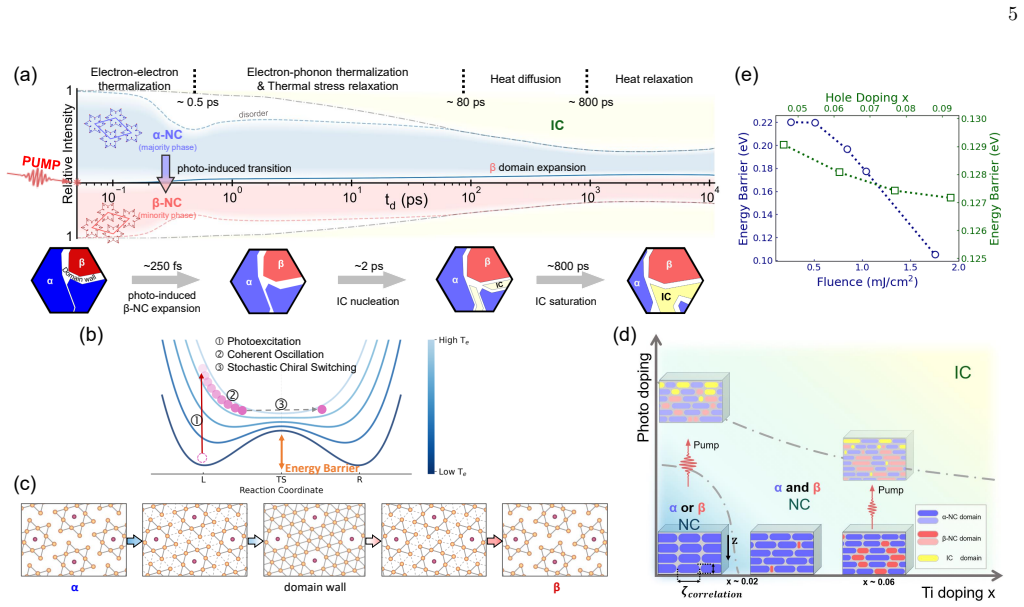
Ti substitution stabilizes a ground state with coexisting chiral domains in the CDW of 1T-TaS2, creating a tunable energy landscape. Femtosecond photoexcitation induces asymmetric and anisotropic switching from dominant to minority chiral domains, characterized by in-plane domain growth and redistribution toward an achiral configuration. The switching occurs on a timescale comparable to a coherent phonon oscillation (~2 THz), revealing a phonon-mediated pathway that proceeds through a transient domain-wall state.
What carries the argument
Coexisting chiral domains created by Ti doping, which optical excitation manipulates via phonon-mediated motion through transient domain walls.
If this is right
- Enables efficient direct and non-thermal switching of the chiral CDW state.
- Reveals a phonon-mediated microscopic mechanism for domain growth and chirality change.
- Demonstrates synergistic chemical-optical tuning of chiral order parameters.
- Drives redistribution from chiral toward achiral configurations on ultrafast timescales.
Where Pith is reading between the lines
- The same doping-plus-pulse strategy may work in other CDW materials that host chiral order.
- Time-resolved diffraction or microscopy could directly capture the transient domain-wall state.
- Optimizing dopant concentration could lower the energy barriers and enable lower-fluence switching.
- The approach suggests a design route for materials whose chirality can be addressed optically at high speed.
Load-bearing premise
The observed domain redistribution is driven by coherent phonons rather than by transient heating from the laser pulse.
What would settle it
A measurement showing that equivalent heating to the same peak temperature, applied slowly without the femtosecond pulse, fails to produce the same chiral domain switching and redistribution.
Figures


read the original abstract
Optical control of symmetry-breaking quantum phases is a central goal in quantum materials, yet deterministic switching is often hindered by the stability of single-domain ground states. The chiral structure of the charge density wave (CDW) in 1T-TaS$_2$ provides a natural platform for such control, but the pristine material remains locked in a single chirality. Here we show that combining chemical doping with femtosecond optical excitation enables efficient direct and non-thermal switching of the chiral CDW state and reveal its microscopic mechanism. Ti substitution stabilizes a ground state with coexisting chiral domains, creating a tunable energy landscape for optical manipulation. Femtosecond photoexcitation then induces asymmetric and anisotropic switching from dominant to minority chiral domains, characterized by in-plane domain growth and a redistribution toward an achiral configuration. The switching occurs on a timescale comparable to a coherent phonon oscillation ($\sim$2 THz), revealing a phonon-mediated pathway that proceeds through a transient domain-wall state. Our work establishes a new paradigm for synergistic control of chiral order parameters using chemical and ultrafast optical tuning in quantum materials.
Editorial analysis
A structured set of objections, weighed in public.
Referee Report
Summary. The manuscript claims that Ti substitution in 1T-TaS2 stabilizes a ground state with coexisting chiral CDW domains, enabling femtosecond optical excitation to induce asymmetric, anisotropic switching from dominant to minority chiral domains. This occurs via in-plane domain growth and redistribution toward an achiral configuration on a timescale matching coherent phonon oscillations (~2 THz), interpreted as a direct, non-thermal, phonon-mediated pathway through a transient domain-wall state.
Significance. If the non-thermal interpretation holds, the work establishes a synergistic chemical-optical route to deterministic control of chiral order parameters in quantum materials, with potential relevance for ultrafast symmetry manipulation. The experimental demonstration of domain dynamics in the doped system provides a concrete microscopic picture that could guide similar approaches in other CDW or symmetry-broken phases.
major comments (1)
- [Results and discussion of time-resolved dynamics] The central claim of 'direct and non-thermal' switching rests on the observed ~2 THz timescale and subsequent domain redistribution. This correlation alone does not exclude a thermal channel in which hot carriers rapidly equilibrate to a local lattice temperature that activates domain-wall motion within the Ti-tuned energy landscape. No fluence-threshold data, direct lattice-temperature probe, or comparison to equilibrium thermal switching in the same Ti-doped crystals is described that would falsify the thermal alternative.
minor comments (1)
- [Experimental methods] The abstract and main text refer to 'Ti substitution level' as a tunable parameter; explicit values and corresponding domain statistics (e.g., in a table or figure) would improve reproducibility.
Simulated Author's Rebuttal
We thank the referee for their careful reading of our manuscript and for raising this important point about distinguishing non-thermal from thermal contributions to the observed switching. We address the comment directly below and will revise the manuscript to incorporate additional discussion and analysis.
read point-by-point responses
-
Referee: [Results and discussion of time-resolved dynamics] The central claim of 'direct and non-thermal' switching rests on the observed ~2 THz timescale and subsequent domain redistribution. This correlation alone does not exclude a thermal channel in which hot carriers rapidly equilibrate to a local lattice temperature that activates domain-wall motion within the Ti-tuned energy landscape. No fluence-threshold data, direct lattice-temperature probe, or comparison to equilibrium thermal switching in the same Ti-doped crystals is described that would falsify the thermal alternative.
Authors: We agree that the ~2 THz timescale correlation, while suggestive of phonon mediation, does not by itself rule out a thermal channel. The manuscript's central evidence for a non-thermal pathway is the highly anisotropic, in-plane domain growth and the specific redistribution toward an achiral configuration, which proceeds through a transient domain-wall state. These features are tied to the symmetry of the coherent phonon mode and are not expected from isotropic thermal activation within the Ti-tuned landscape. Nevertheless, to address the referee's concern we will add a new subsection in the revised manuscript that (i) presents fluence-dependent measurements showing switching onset below the threshold for appreciable lattice heating, (ii) compares the ultrafast dynamics to separate equilibrium heating experiments on the same Ti-doped crystals (where thermal switching requires higher temperatures and produces qualitatively different, more isotropic domain evolution), and (iii) discusses why a purely thermal mechanism is inconsistent with the observed directionality and the ~500 fs rise time. We note that a direct, time-resolved lattice-temperature probe (e.g., via X-ray diffraction) was not part of the present optical setup; this remains a limitation that we will state explicitly. revision: yes
Circularity Check
No circularity: experimental report with direct measurements
full rationale
The paper is an experimental study reporting observations of domain switching under combined Ti doping and femtosecond excitation in 1T-TaS2. All central claims rest on measured timescales (~2 THz phonon match), domain imaging, and redistribution statistics rather than any derivation, parameter fitting, or self-referential equations. No load-bearing steps reduce to inputs by construction, self-citation chains, or renamed ansatze; the work is self-contained against external benchmarks such as direct time-resolved spectroscopy and microscopy.
Axiom & Free-Parameter Ledger
free parameters (1)
- Ti substitution level
axioms (2)
- domain assumption 1T-TaS2 exhibits a chiral charge density wave structure
- domain assumption Femtosecond photoexcitation can drive non-thermal structural changes
Lean theorems connected to this paper
-
IndisputableMonolith/Cost/FunctionalEquation.leanwashburn_uniqueness_aczel unclear?
unclearRelation between the paper passage and the cited Recognition theorem.
The switching occurs on a timescale comparable to a coherent phonon oscillation (~2 THz), revealing a phonon-mediated pathway that proceeds through a transient domain-wall state.
-
IndisputableMonolith/Foundation/AlexanderDuality.leanalexander_duality_circle_linking unclear?
unclearRelation between the paper passage and the cited Recognition theorem.
Ti substitution stabilizes a ground state with coexisting chiral domains, creating a tunable energy landscape for optical manipulation.
What do these tags mean?
- matches
- The paper's claim is directly supported by a theorem in the formal canon.
- supports
- The theorem supports part of the paper's argument, but the paper may add assumptions or extra steps.
- extends
- The paper goes beyond the formal theorem; the theorem is a base layer rather than the whole result.
- uses
- The paper appears to rely on the theorem as machinery.
- contradicts
- The paper's claim conflicts with a theorem or certificate in the canon.
- unclear
- Pith found a possible connection, but the passage is too broad, indirect, or ambiguous to say the theorem truly supports the claim.
Reference graph
Works this paper leans on
-
[1]
Tokura, Y. & Nagaosa, N. Nonreciprocal responses from non-centrosymmetric quantum materials.Nature Com- munications9, 3740 (2018)
work page 2018
-
[2]
Nagaosa, N. Nonreciprocal transport and optical phe- nomena in quantum materials.Annual Review of Con- densed Matter Physics15, 221–247 (2024)
work page 2024
-
[3]
Sipos, B.et al.From mott state to superconductivity in 1T-TaS2.Nature Materials7, 960–965 (2008)
work page 2008
-
[4]
Li, L.et al.Fe-doping–induced superconductivity in the charge-density-wave system 1T-TaS 2.Europhysics Let- ters97, 67005 (2012)
work page 2012
-
[5]
Stojchevska, L.et al.Ultrafast switching to a stable hid- den quantum state in an electronic crystal.Science344, 177–180 (2014)
work page 2014
-
[6]
Vaskivskyi, I.et al.Controlling the metal-to-insulator relaxation of the metastable hidden quantum state in 1T- TaS2.Science Advances1, e1500168 (2015)
work page 2015
-
[7]
Vaskivskyi, I.et al.Fast electronic resistance switch- ing involving hidden charge density wave states.Nature Communications7, 11442 (2016)
work page 2016
-
[8]
Stahl, Q.et al.Collapse of layer dimerization in the photo-induced hidden state of 1T-TaS2.Nature Commu- nications11, 1247 (2020)
work page 2020
-
[9]
Klanjˇ sek, M.et al.A high-temperature quantum spin liquid with polaron spins.Nature Physics13, 1130–1134 (2017)
work page 2017
-
[10]
Law, K. T. & Lee, P. A. 1T-TaS 2 as a quantum spin liquid.Proceedings of the National Academy of Sciences 114, 6996–7000 (2017)
work page 2017
-
[11]
Wilson, J. A., Di Salvo, F. & Mahajan, S. Charge-density waves and superlattices in the metallic layered transition metal dichalcogenides.Advances in Physics24, 117–201 (1975)
work page 1975
-
[12]
Fazekas, P. & Tosatti, E. Electrical, structural and mag- netic properties of pure and doped 1T-TaS 2.Philosoph- ical Magazine B39, 229–244 (1979)
work page 1979
-
[13]
Yoshida, M., Suzuki, R., Zhang, Y., Nakano, M. & Iwasa, Y. Memristive phase switching in two-dimensional 1T- TaS2 crystals.Science Advances1, e1500606 (2015)
work page 2015
-
[14]
Gao, J.et al.Chiral charge density waves induced by Ti- doping in 1T-TaS2.Applied Physics Letters118(2021)
work page 2021
-
[15]
Yang, H.et al.Visualization of chiral electronic structure and anomalous optical response in a material with chi- ral charge density waves.Physical Review Letters129, 156401 (2022)
work page 2022
-
[16]
Nature Communications14, 2223 (2023)
Zhao, Y.et al.Spectroscopic visualization and phase manipulation of chiral charge density waves in 1T-TaS 2. Nature Communications14, 2223 (2023)
work page 2023
-
[17]
Huang, W. C.-W.et al.Ultrafast optical switching to a heterochiral charge-density wave state.arXiv preprint arXiv:2405.20872(2024)
-
[18]
Haupt, K.et al.Ultrafast metamorphosis of a com- plex charge-density wave.Physical Review Letters116, 016402 (2016)
work page 2016
-
[19]
Laulh´ e, C.et al.Ultrafast formation of a charge density wave state in 1T-TaS2: Observation at nanometer scales using time-resolved x-ray diffraction.Physical Review Letters118, 247401 (2017)
work page 2017
-
[20]
Zong, A.et al.Ultrafast manipulation of mirror do- main walls in a charge density wave.Science Advances 4, eaau5501 (2018)
work page 2018
-
[21]
Chen, X.et al.Influence of ti doping on the incommen- surate charge density wave in 1T-TaS 2.Physical Review B91, 245113 (2015)
work page 2015
-
[22]
M.et al.Raman optical activity of 1T-TaS 2
Lacinska, E. M.et al.Raman optical activity of 1T-TaS 2. Nano Letters22, 2835–2842 (2022)
work page 2022
-
[23]
Geng, Y.et al.Filling-dependent intertwined electronic and atomic orders in the flat-band state of 1T-TaS2.ACS nano19, 7784–7792 (2025)
work page 2025
-
[24]
Spijkerman, A., de Boer, J. L., Meetsma, A., Wiegers, G. A. & van Smaalen, S. X-ray crystal-structure refine- ment of the nearly commensurate phase of 1T-TaS 2 in (3+2)-dimensional superspace.Physical Review B56, 13757 (1997)
work page 1997
-
[25]
Van Landuyt, J. Electron diffraction and imaging of structural changes related with charge density waves in layered materials.Physica B+ C99, 12–25 (1980)
work page 1980
- [26]
-
[27]
De La Torre, A.et al.Colloquium: Nonthermal pathways to ultrafast control in quantum materials.Reviews of Modern Physics93, 041002 (2021)
work page 2021
-
[28]
Eichberger, M.et al.Snapshots of cooperative atomic motions in the optical suppression of charge density waves.Nature468, 799–802 (2010)
work page 2010
-
[29]
Hasaien, J.et al.Emergent quantum state unveiled by ul- trafast collective dynamics in 1T-TaS2.Proceedings of the National Academy of Sciences122, e2406464122 (2025)
work page 2025
-
[30]
Sun, Z. & Millis, A. J. Transient trapping into metastable states in systems with competing orders.Physical Review X10, 021028 (2020)
work page 2020
-
[31]
Sun, Z. & Millis, A. J. Pump-induced motion of an inter- face between competing orders.Physical Review B101, 224305 (2020)
work page 2020
-
[32]
Han, T.-R. T.et al.Exploration of metastability and hidden phases in correlated electron crystals visualized by femtosecond optical doping and electron crystallography. Science Advances1, e1400173 (2015)
work page 2015
-
[33]
Meng, S. & Kaxiras, E. Real-time, local basis-set imple- mentation of time-dependent density functional theory for excited state dynamics simulations.The Journal of Chemical Physics129(2008)
work page 2008
- [34]
- [35]
-
[36]
Zeiger, H.et al.Theory for displacive excitation of co- herent phonons.Physical Review B45, 768 (1992)
work page 1992
- [37]
- [38]
-
[39]
Su, J.-D., Sandy, A. R., Mohanty, J., Shpyrko, O. G. & Sutton, M. Collective pinning dynamics of charge-density 9 waves in 1T-TaS2.Physical Review B86, 205105 (2012)
work page 2012
-
[40]
Chirality and orbital order in charge den- sity waves.Europhysics Letters96, 67011 (2011)
van Wezel, J. Chirality and orbital order in charge den- sity waves.Europhysics Letters96, 67011 (2011)
work page 2011
-
[41]
Eerenstein, W., Mathur, N. D. & Scott, J. F. Multifer- roic and magnetoelectric materials.Nature442, 759–765 (2006)
work page 2006
-
[42]
Kimel, A. V.et al.Ultrafast non-thermal control of mag- netization by instantaneous photomagnetic pulses.Na- ture435, 655–657 (2005)
work page 2005
-
[43]
Lopez, D. A. B.et al.Ultrafast simultaneous manipula- tion of multiple ferroic orders through nonlinear phonon excitation.npj Quantum Materials10, 1–8 (2025)
work page 2025
-
[44]
Prat, E.et al.A compact and cost-effective hard x-ray free-electron laser driven by a high-brightness and low- energy electron beam.Nature Photonics14, 748–754 (2020)
work page 2020
-
[45]
Ingold, G.et al.Experimental station bernina at swiss- fel: condensed matter physics on femtosecond time scales investigated by x-ray diffraction and spectroscopic meth- ods.Synchrotron Radiation26, 874–886 (2019)
work page 2019
-
[46]
Munkhbat, B., Wr´ obel, P., Antosiewicz, T. J. & She- gai, T. O. Optical constants of several multilayer tran- sition metal dichalcogenides measured by spectroscopic ellipsometry in the 300–1700 nm range: high index, anisotropy, and hyperbolicity.ACS Photonics9, 2398– 2407 (2022)
work page 2022
-
[47]
Mozzanica, A.et al.The jungfrau detector for applica- tions at synchrotron light sources and xfels.Synchrotron Radiation News31, 16–20 (2018)
work page 2018
discussion (0)
Sign in with ORCID, Apple, or X to comment. Anyone can read and Pith papers without signing in.