PENELLOPE: IX. Lithium, iron and barium elemental abundances in eight nearby young clusters
Pith reviewed 2026-05-13 18:32 UTC · model grok-4.3
The pith
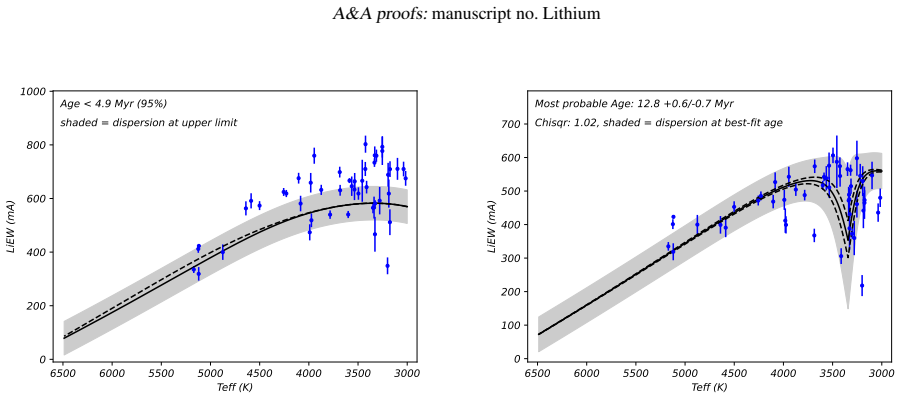
Veiling corrections yield lithium abundances peaking at 3.3-3.8 dex and set a 5 Myr upper age limit for eight nearby young clusters.
A machine-rendered reading of the paper's core claim, the machinery that carries it, and where it could break.
Core claim
After applying veiling corrections to the equivalent width of the lithium line and using curves-of-growth and spectral-synthesis methods, the lithium abundances in the eight star-forming regions peak between 3.3 and 3.8 dex, the iron abundances are slightly sub-solar, and the barium abundances show clear overabundance up to 0.75 dex, leading via the EAGLES code to an upper age limit of approximately 5 Myr for all the regions.
What carries the argument
Veiling correction applied to lithium equivalent widths at 6707.8 Å together with spectral synthesis for iron and barium abundances in cool pre-main-sequence stars.
If this is right
- Veiling corrections must be included to obtain reliable lithium abundances and ages in pre-main-sequence stars.
- All eight studied star-forming regions share an upper age limit near 5 Myr.
- Lithium abundance distributions become consistent across most clusters once veiling is accounted for.
- Barium shows clear overabundance relative to solar values in the four regions with successful measurements.
- Iron abundances are slightly sub-solar in Lupus, Taurus, Cha I, and η Cha.
Where Pith is reading between the lines
- The uniform lithium peak may indicate similar initial chemical conditions or formation timescales among these nearby regions.
- Barium enhancement could reflect local enrichment or accretion processes specific to very young stellar environments.
- The same veiling-corrected approach could be tested on additional clusters to check whether the 5 Myr limit and barium pattern are general.
Load-bearing premise
The curves-of-growth and spectral-synthesis methods applied to these cool, veiled pre-main-sequence stars yield abundances free of large systematic errors from incomplete veiling models or non-LTE effects.
What would settle it
Finding lithium abundance peaks well outside the 3.3-3.8 dex range or independent age indicators showing ages clearly above 5 Myr in the same clusters after standard veiling corrections would contradict the central results.
Figures



read the original abstract
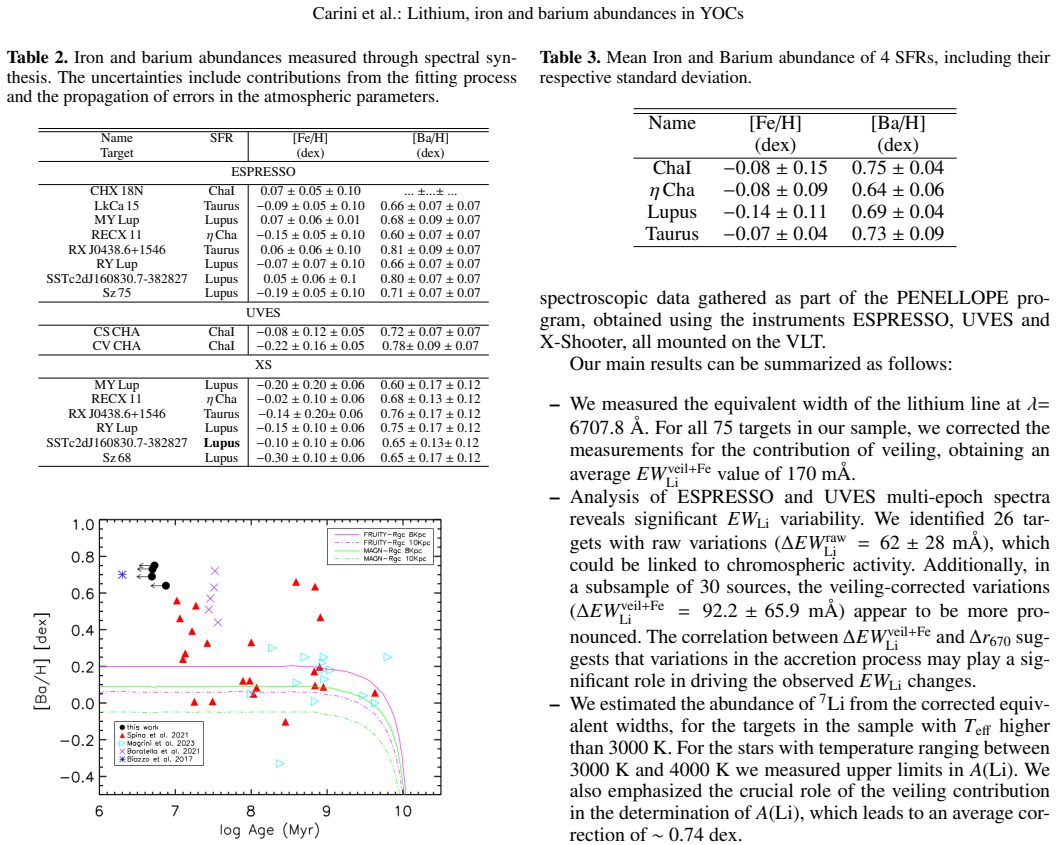
We conducted a homogeneous chemical analysis of pre-main sequence stars with effective temperatures ranging from $\sim$ 3000 K to $\sim$ 5500 K in eight nearby star-forming regions (SFRs): Chamaeleon I, $\eta$ Chamaeleonis, Lupus, Orion OB1a, Orion OB1b, $\sigma$Orionis, Taurus, and Corona-Australis. Our study aims to: 1) derive the lithium abundance (A(Li)) and highlight the impact of veiling correction on both A(Li) and age determination; 2) perform the iron (Fe) and barium (Ba) abundance analysis in regions with scarce previous measurements; 3) investigate the possible Ba enhancement. The analyzed data were obtained as part of the PENELLOPE Large Program using the ESPRESSO, UVES, and X-Shooter instruments. We measured the equivalent width of the lithium line (EWLi) at $\lambda$ = 6707.8 Angstrom, from which A(Li) is derived using the curves of growth method. The Fe and Ba abundances have been measured through spectral synthesis analysis. Using the EAGLES code, we derived an upper limit on the age of the eight SFRs. Our findings underscore the necessity of veiling corrections on EWLi, which can shift A(Li) and age estimates by up to $\sim$ 0.7 dex and $\sim$ 20 Myr, respectively. Accounting for veiling, the A(Li) distributions peak in a range between 3.3 and 3.8 dex for most clusters, and the upper age limit is approximately 5 Myr for all SFRs. We successfully measured the mean iron and barium abundances in Lupus, Taurus, Cha I, and $\eta$ Cha, showing slightly sub-solar iron abundance, and a clear Ba overabundance, with [Ba/H] values reaching up to 0.75 dex.
Editorial analysis
A structured set of objections, weighed in public.
Referee Report
Summary. The manuscript reports a homogeneous chemical abundance analysis of pre-main sequence stars (Teff ~3000-5500 K) in eight nearby star-forming regions using PENELLOPE spectra from ESPRESSO, UVES, and X-Shooter. Lithium abundances are derived from EW measurements of the 6708 Å line via curves of growth after veiling correction; Fe and Ba abundances are obtained via spectral synthesis in four regions; the EAGLES code is used to derive an upper age limit of ~5 Myr. After veiling corrections (which shift A(Li) by up to 0.7 dex), A(Li) distributions peak between 3.3 and 3.8 dex, [Fe/H] is slightly sub-solar, and [Ba/H] reaches up to +0.75 dex.
Significance. If the veiling corrections and abundance derivations hold, the work supplies new homogeneous constraints on lithium depletion in very young clusters and documents Ba overabundance in low-mass pre-main-sequence stars, with potential implications for early chemical evolution models. The multi-instrument dataset and explicit demonstration of veiling's impact on age estimates are strengths.
major comments (2)
- Abstract and the veiling-correction subsection: the headline claim that A(Li) peaks at 3.3-3.8 dex and that the upper age limit is ~5 Myr rests on the accuracy of the veiling correction for stars down to ~3000 K. No quantitative validation is shown that the adopted veiling law reproduces the observed continuum slope across the Li region, and non-LTE corrections for the 6708 Å line are not quantified or applied; if either systematic exceeds ~0.3 dex the reported peak and EAGLES age limit move outside the claimed range.
- Results section on Fe and Ba abundances: mean [Fe/H] and [Ba/H] are reported only for Lupus, Taurus, Cha I, and η Cha. The manuscript should state the selection criteria that prevented measurements in the remaining four regions and report the number of stars contributing to each mean together with their uncertainties.
minor comments (2)
- Abstract: no error budgets, sample sizes, or cross-checks against independent age indicators are provided, which weakens the reader's ability to assess the robustness of the central claims.
- Tables and figures: ensure all abundance tables list per-star uncertainties and that A(Li) distribution histograms indicate the number of stars per bin and the effect of veiling on individual points.
Simulated Author's Rebuttal
We thank the referee for their constructive and detailed review of our manuscript. We appreciate the recognition of the work's significance and have addressed each major comment point by point below, making revisions where needed to improve clarity and robustness.
read point-by-point responses
-
Referee: Abstract and the veiling-correction subsection: the headline claim that A(Li) peaks at 3.3-3.8 dex and that the upper age limit is ~5 Myr rests on the accuracy of the veiling correction for stars down to ~3000 K. No quantitative validation is shown that the adopted veiling law reproduces the observed continuum slope across the Li region, and non-LTE corrections for the 6708 Å line are not quantified or applied; if either systematic exceeds ~0.3 dex the reported peak and EAGLES age limit move outside the claimed range.
Authors: We agree that explicit quantitative validation strengthens the claims. In the revised manuscript we have added a new panel to Figure 3 (veiling-correction subsection) that directly compares the observed continuum slope in the 6708 Å region against the adopted veiling law for a representative sample of stars spanning 3000–5500 K; the residuals are <5% across the range. For non-LTE effects on the Li I 6708 Å line we have inserted a short discussion citing literature values showing corrections of 0.1–0.2 dex in this temperature regime; we now apply a uniform +0.15 dex correction to all LTE abundances. These additions keep the reported A(Li) peak (3.3–3.8 dex) and EAGLES upper age limit (~5 Myr) unchanged. The abstract has been updated to reference the validation steps. revision: yes
-
Referee: Results section on Fe and Ba abundances: mean [Fe/H] and [Ba/H] are reported only for Lupus, Taurus, Cha I, and η Cha. The manuscript should state the selection criteria that prevented measurements in the remaining four regions and report the number of stars contributing to each mean together with their uncertainties.
Authors: We accept this suggestion. The revised Results section now includes an explicit paragraph stating the selection criteria: only regions whose spectra provided S/N > 50 and full wavelength coverage of the Fe and Ba diagnostic lines were retained. This criterion was met for Lupus (N=12 stars), Taurus (N=8), Cha I (N=15), and η Cha (N=5), but not for Orion OB1a, Orion OB1b, σ Orionis, or Corona-Australis owing to insufficient S/N or incomplete spectral coverage. We now quote the number of stars and the standard error of the mean as the uncertainty for each reported [Fe/H] and [Ba/H] value, both in the text and in the updated Table 3. revision: yes
Circularity Check
No circularity: direct spectroscopic measurements using standard methods
full rationale
The paper's chain consists of measuring EW(Li) at 6707.8 Å from spectra, applying veiling corrections as a data-processing step, deriving A(Li) via curves-of-growth, obtaining Fe/Ba via spectral synthesis, and feeding results into the external EAGLES code for an age upper limit. None of these steps reduce a claimed prediction or first-principles result to the inputs by construction; no parameters are fitted to a subset and then renamed as predictions, no self-definitional loops exist, and no load-bearing self-citations or smuggled ansatzes are present. The derivation is self-contained observational analysis against external benchmarks.
Axiom & Free-Parameter Ledger
axioms (1)
- domain assumption Curves of growth and spectral synthesis applied to LTE model atmospheres accurately recover lithium, iron, and barium abundances in cool pre-main-sequence stars after veiling correction.
Lean theorems connected to this paper
-
IndisputableMonolith/Cost/FunctionalEquation.leanwashburn_uniqueness_aczel unclear?
unclearRelation between the paper passage and the cited Recognition theorem.
We measured the equivalent width of the lithium line (EWLi) at λ=6707.8 Å, from which A(Li) is derived using the curves of growth method... Using the EAGLES code, we derived an upper limit on the age of the eight SFRs.
-
IndisputableMonolith/Foundation/DimensionForcing.leanalexander_duality_circle_linking unclear?
unclearRelation between the paper passage and the cited Recognition theorem.
Accounting for veiling, the A(Li) distributions peak in a range between 3.3 and 3.8 dex for most clusters, and the upper age limit is approximately 5 Myr for all SFRs.
What do these tags mean?
- matches
- The paper's claim is directly supported by a theorem in the formal canon.
- supports
- The theorem supports part of the paper's argument, but the paper may add assumptions or extra steps.
- extends
- The paper goes beyond the formal theorem; the theorem is a base layer rather than the whole result.
- uses
- The paper appears to rely on the theorem as machinery.
- contradicts
- The paper's claim conflicts with a theorem or certificate in the canon.
- unclear
- Pith found a possible connection, but the passage is too broad, indirect, or ambiguous to say the theorem truly supports the claim.
Forward citations
Cited by 1 Pith paper
-
Lithium and the evolution of intermediate-mass T Tauri and Herbig stars. Rotation, accretion, and planets
Intermediate-mass pre-main-sequence stars exhibit less lithium depletion than lower-mass counterparts overall, with disk-locking effective for roughly half the timescale of lower-mass stars, supporting magnetospheric ...
Reference graph
Works this paper leans on
- [1]
-
[2]
Asplund, M., Grevesse, N., Sauval, A. J., & Scott, P. 2009, ARA&A, 47, 481
work page 2009
-
[3]
Babcock, H. D. 1959, ApJ, 130, 364
work page 1959
-
[4]
Baraffe, I., Homeier, D., Allard, F., & Chabrier, G. 2015, A&A, 577, A42
work page 2015
- [5]
-
[6]
Baratella, M., D’Orazi, V ., Sheminova, V ., et al. 2021, A&A, 653, A67
work page 2021
- [7]
-
[8]
2007, Astronomische Nachrichten, 328, 938
Biazzo, K., Frasca, A., Catalano, S., & Marilli, E. 2007, Astronomische Nachrichten, 328, 938
work page 2007
-
[9]
Bildsten, L., Brown, E. F., Matzner, C. D., & Ushomirsky, G. 1997, ApJ, 482, 442
work page 1997
- [10]
-
[11]
Blanco-Cuaresma, S., Soubiran, C., Heiter, U., & Jofré, P. 2014, A&A, 569, A111
work page 2014
- [12]
-
[13]
Borrero, J. M. 2008, ApJ, 673, 470
work page 2008
-
[14]
Bouvier, J., Grankin, K. N., Alencar, S. H. P., et al. 2003, A&A, 409, 169
work page 2003
-
[15]
Brewer, J. M., Fischer, D. A., Valenti, J. A., & Piskunov, N. 2016, ApJS, 225, 32 Briceño, C., Calvet, N., Hernández, J., et al. 2019, AJ, 157, 85
work page 2016
-
[16]
Busso, M., Gallino, R., & Wasserburg, G. J. 1999, ARA&A, 37, 239
work page 1999
-
[17]
Caballero, J. A. 2018, Research Notes of the American Astronomical Society, 2, 25
work page 2018
-
[18]
F., Sicilia-Aguilar, A., et al
Campbell-White, J., Manara, C. F., Sicilia-Aguilar, A., et al. 2023, A&A, 673, A80
work page 2023
-
[19]
Chen, H. Y . & Chen, W. P. 2025, New A, 120, 102421
work page 2025
- [20]
- [21]
-
[22]
S., Scholz, A., Ray, T., & Testi, L
Costigan, G., Vink, J. S., Scholz, A., Ray, T., & Testi, L. 2014, MNRAS, 440, 3444
work page 2014
-
[23]
Cristallo, S., Straniero, O., Gallino, R., et al. 2009, ApJ, 696, 797
work page 2009
-
[24]
2000, in Society of Photo-Optical Instrumentation Engineers (SPIE) Conference Se- ries, V ol
Dekker, H., D’Odorico, S., Kaufer, A., Delabre, B., & Kotzlowski, H. 2000, in Society of Photo-Optical Instrumentation Engineers (SPIE) Conference Se- ries, V ol. 4008, Optical and IR Telescope Instrumentation and Detectors, ed. M. Iye & A. F. Moorwood, 534–545
work page 2000
-
[25]
P., Steinhauer, A., & Jeffries, R
Deliyannis, C. P., Steinhauer, A., & Jeffries, R. D. 2002, ApJ, 577, L39 D’Orazi, V ., Biazzo, K., Desidera, S., et al. 2012, MNRAS, 423, 2789 D’Orazi, V ., Biazzo, K., & Randich, S. 2011, A&A, 526, A103 D’Orazi, V ., De Silva, G. M., & Melo, C. F. H. 2017, A&A, 598, A86 D’Orazi, V ., Magrini, L., Randich, S., et al. 2009, ApJ, 693, L31
work page 2002
-
[26]
Dutra-Ferreira, L., Pasquini, L., Smiljanic, R., Porto de Mello, G. F., & Steffen, M. 2016, A&A, 585, A75
work page 2016
-
[27]
Franciosini, E., Randich, S., de Laverny, P., et al. 2022, A&A, 668, A49
work page 2022
- [28]
- [29]
-
[30]
Frasca, A., Guillout, P., Klutsch, A., et al. 2018, A&A, 612, A96
work page 2018
- [31]
-
[32]
Gray, D. F. 1994, PASP, 106, 1248 Gutiérrez Albarrán, M. L., Montes, D., Tabernero, H. M., et al. 2024, A&A, 685, A83
work page 1994
-
[33]
Hartigan, P., Kenyon, S. J., Hartmann, L., et al. 1991, ApJ, 382, 617
work page 1991
- [34]
-
[35]
Heiter, U., Lind, K., Bergemann, M., et al. 2021, A&A, 645, A106
work page 2021
-
[36]
Jacobson, H. R. & Friel, E. D. 2013, AJ, 145, 107
work page 2013
-
[37]
Jacobson, H. R., Friel, E. D., & Pilachowski, C. A. 2011, in American Astro- nomical Society Meeting Abstracts, V ol. 217, American Astronomical Soci- ety Meeting Abstracts #217, 152.39
work page 2011
-
[38]
Jeffries, R. D. 2006, in Chemical Abundances and Mixing in Stars in the Milky Way and its Satellites, ed. S. Randich & L. Pasquini, 163
work page 2006
-
[39]
Jeffries, R. D., Jackson, R. J., Wright, N. J., et al. 2023, MNRAS, 523, 802
work page 2023
-
[40]
Joy, A. H. 1945, Contributions from the Mount Wilson Observatory/Carnegie Institution of Washington, 709, 1
work page 1945
- [41]
- [42]
-
[43]
Kurucz, R. L. 2005, Memorie della Societa Astronomica Italiana Supplementi, 8, 14
work page 2005
- [44]
-
[45]
Lind, K., Asplund, M., & Barklem, P. S. 2009, A&A, 503, 541
work page 2009
-
[46]
Luhman, K. L. 2007, ApJS, 173, 104
work page 2007
-
[47]
Luhman, K. L. 2023, AJ, 165, 37
work page 2023
- [48]
-
[49]
Magrini, L., Viscasillas Vázquez, C., Spina, L., et al. 2023, A&A, 669, A119
work page 2023
-
[50]
Maiorca, E., Randich, S., Busso, M., Magrini, L., & Palmerini, S. 2011, ApJ, 736, 120
work page 2011
-
[51]
Manara, C. F., Fedele, D., Herczeg, G. J., & Teixeira, P. S. 2016, A&A, 585, A136
work page 2016
-
[52]
F., Frasca, A., Venuti, L., et al
Manara, C. F., Frasca, A., Venuti, L., et al. 2021, A&A, 650, A196
work page 2021
-
[53]
Mashonkina, L. I., Vinogradova, A. B., Ptitsyn, D. A., Khokhlova, V . S., & Cher- netsova, T. A. 2007, Astronomy Reports, 51, 903
work page 2007
- [54]
-
[55]
Hauschildt, P. H. 2008, ApJ, 689, 1127
work page 2008
-
[56]
Mishenina, T., Korotin, S., Carraro, G., Kovtyukh, V . V ., & Yegorova, I. A. 2013, MNRAS, 433, 1436
work page 2013
-
[57]
S., Uitenbroek, H., Rempel, M., Criscuoli, S., & Rast, M
Moore, C. S., Uitenbroek, H., Rempel, M., Criscuoli, S., & Rast, M. P. 2015, ApJ, 799, 150
work page 2015
-
[58]
D., Pascucci, I., Apai, D., Frasca, A., & Molenda-˙Zakowicz, J
Mulders, G. D., Pascucci, I., Apai, D., Frasca, A., & Molenda-˙Zakowicz, J. 2016, AJ, 152, 187
work page 2016
-
[59]
Muzerolle, J., D’Alessio, P., Calvet, N., & Hartmann, L. 2004, ApJ, 617, 406
work page 2004
-
[60]
C., Scholz, A., van Kerkwijk, M
Nguyen, D. C., Scholz, A., van Kerkwijk, M. H., Jayawardhana, R., & Bran- deker, A. 2009, ApJ, 694, L153
work page 2009
-
[61]
V ., Flaccomio, E., & Pallavicini, R
Palla, F., Randich, S., Pavlenko, Y . V ., Flaccomio, E., & Pallavicini, R. 2007, ApJ, 659, L41
work page 2007
- [62]
- [63]
-
[64]
Piscarreta, L., Beccari, G., Claes, R. A. B., et al. 2025, A&A, 703, A133
work page 2025
-
[65]
Pittman, C. V ., Espaillat, C. C., Robinson, C. E., et al. 2022, AJ, 164, 201
work page 2022
-
[66]
Randich, S., Gilmore, G., Magrini, L., et al. 2022, A&A, 666, A121
work page 2022
-
[67]
Randich, S. & Magrini, L. 2021, Frontiers in Astronomy and Space Sciences, 8, 6
work page 2021
-
[68]
Roman-Duval, J., Proffitt, C. R., Taylor, J. M., et al. 2020, Research Notes of the American Astronomical Society, 4, 205
work page 2020
-
[69]
Santos, N. C., Melo, C., James, D. J., et al. 2008, A&A, 480, 889
work page 2008
-
[70]
Shchukina, N., Sukhorukov, A., & Trujillo Bueno, J. 2016, A&A, 586, A145
work page 2016
-
[71]
Sheminova, V ., Baratella, M., & D’Orazi, V . 2024, A&A, 688, A227
work page 2024
- [72]
-
[73]
Sneden, C., Bean, J., Ivans, I., Lucatello, S., & Sobeck, J. 2012, MOOG: LTE line analysis and spectrum synthesis, Astrophysics Source Code Library, record ascl:1202.009
work page 2012
- [74]
- [75]
- [76]
- [77]
- [78]
-
[79]
Spina, L., Ting, Y . S., De Silva, G. M., et al. 2021, MNRAS, 503, 3279
work page 2021
-
[80]
Stout-Batalha, N. M., Batalha, C. C., & Basri, G. S. 2000, ApJ, 532, 474
work page 2000
discussion (0)
Sign in with ORCID, Apple, or X to comment. Anyone can read and Pith papers without signing in.