Isochrone-cloud fitting and asteroseismology of the Kepler open cluster NGC6866
Pith reviewed 2026-05-13 18:54 UTC · model grok-4.3
The pith
Age dating of open cluster NGC 6866 varies from 467 to 759 million years depending on the stellar models and initial conditions chosen.
A machine-rendered reading of the paper's core claim, the machinery that carries it, and where it could break.
Core claim
Isochrone-cloud fitting to Gaia-selected members of NGC 6866 returns discrepant ages of 690 Myr with PARSEC models and 467 Myr with MIST models. Asteroseismic modeling of 19 g-mode pulsators, using grids of rotating models constrained by spectroscopic parameters, asymptotic period spacing, and near-core rotation, produces a common cluster age of 759 Myr when all stars are forced to share one age. This value aligns with the PARSEC isochrone result. The spread arises from differences in how the models treat internal mixing and rotation; the isochrone-derived critical rotation distribution peaks at 0.6, about twice the seismically inferred value. The work concludes that open-cluster age dating,
What carries the argument
Isochrone-cloud fitting method that varies free parameters across input physics, applied to Gaia DR3 cluster members, paired with dedicated grids of rotating stellar models fitted to g-mode period spacing and near-core rotation rates for 19 pulsators.
If this is right
- Seismic and isochronal masses agree for the modeled pulsators.
- Individual seismic modeling reveals age scatter from variations in internal mixing.
- Isochrone fits imply an initial rotation distribution twice as high as the seismic value.
- Forcing a shared age in seismic modeling reconciles the result with PARSEC isochrones but not MIST.
Where Pith is reading between the lines
- The same model sensitivities are likely to affect age estimates for other Kepler or TESS open clusters.
- Refining mixing prescriptions across codes could shrink the spread in derived cluster ages.
- Joint isochrone-seismic analyses on additional clusters could help calibrate the uncertain input physics.
- Residual field-star contamination in the Gaia membership list could systematically shift the isochrone ages.
Load-bearing premise
The 180 Gaia-selected stars are genuine cluster members with negligible field contamination, and the stellar models correctly capture the effects of internal mixing and rotation.
What would settle it
An independent age for NGC 6866 obtained from white-dwarf cooling sequences or lithium depletion boundaries that lies well outside the 467–759 Myr range would show that the reported model sensitivity does not account for the full discrepancy or that membership selection is incomplete.
Figures



read the original abstract
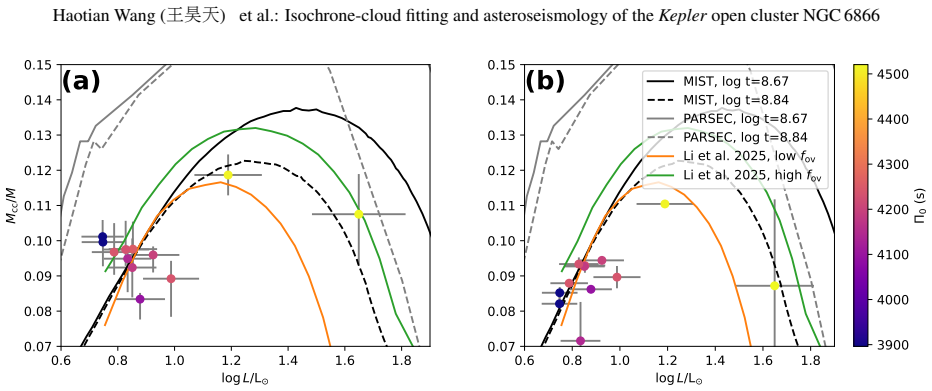
We investigate how isochrones computed with different input physics and initial conditions affect the age dating of the open cluster NGC 6866, and compare the results with asteroseismic ages derived from Kepler photometry. Using Gaia DR3 data, we identified 180 cluster members with a clustering algorithm. We then developed an isochrone-cloud fitting method that accounts for a range of free parameters in the input physics. Variable stars were subsequently identified among the cluster members. For 19 g-mode pulsators, we carried out modelling with a dedicated grid of rotating stellar models, constrained by spectroscopic and photometric parameters, the asymptotic gravity-mode period spacing, and the near-core rotation rate. We considered two cases: modelling each pulsator individually and modelling them under the assumption of a common cluster age. PARSEC and MIST isochrones yield discrepant ages of 690 and 467 Myr, respectively. The isochrone-cloud fit indicates an initial critical rotation distribution peaking at 0.6, about a factor of two higher than inferred from asteroseismology. The seismic modelling shows agreement between seismic and isochronal masses, but substantial differences in the derived ages due to differences in internal mixing. When the g-mode pulsators are modelled with a shared cluster age, we obtain 759 Myr, consistent with the PARSEC isochronal age. We conclude that age dating of open clusters is sensitive to the adopted input physics and initial conditions, highlighting the need for better calibrated stellar evolutionary models.
Editorial analysis
A structured set of objections, weighed in public.
Referee Report
Summary. The paper selects 180 Gaia DR3 members of NGC 6866 via clustering, applies an isochrone-cloud fitting procedure to PARSEC and MIST grids (yielding 690 Myr and 467 Myr respectively), identifies 19 g-mode pulsators, and performs asteroseismic modeling on a rotating-model grid constrained by spectroscopy, photometry, asymptotic period spacing, and near-core rotation. Individual and common-age seismic fits are presented; the shared-age seismic solution is 759 Myr (consistent with PARSEC), masses agree between methods, but ages differ substantially owing to internal mixing. The isochrone-cloud fit prefers a higher initial critical rotation distribution than inferred from seismology. The central claim is that open-cluster age dating is sensitive to input physics and initial conditions, underscoring the need for better-calibrated models.
Significance. If the reported age spread is shown to arise cleanly from the tested variations in physics rather than from inconsistent assumptions across model families, the work provides concrete evidence that current isochrone and seismic grids are not interchangeable for precise cluster dating. The mass agreement and the explicit comparison of rotation distributions are useful benchmarks. The result would strengthen the case for systematic model-calibration efforts using clusters with both isochrone and seismic constraints.
major comments (3)
- [asteroseismic modelling] Asteroseismic modelling section: the shared-age seismic solution (759 Myr) is presented as consistent with PARSEC while differing from MIST, yet the rotating-model grid employs fixed prescriptions for overshooting and diffusive mixing that are not varied in parallel with the PARSEC/MIST grids. Without an explicit demonstration that these fixed choices do not introduce an offset comparable to the reported 290 Myr spread, the interpretation that the discrepancies demonstrate genuine input-physics sensitivity remains vulnerable to the alternative that they reflect inconsistent model families.
- [isochrone-cloud fitting] Isochrone-cloud fitting and results sections: the cloud fit reports an initial critical rotation distribution peaking at 0.6 (factor of two higher than the seismic inference), but the paper does not quantify how this tension propagates into the age posterior or whether it is absorbed by the free-parameter marginalization. This directly affects the claim that the method accounts for a range of initial conditions.
- [member selection] Member selection and data sections: the assumption that the 180 Gaia-selected members are free of significant field contamination is load-bearing for both the isochrone and seismic results, yet no quantitative contamination fraction or membership-probability threshold is reported. A sensitivity test removing the lowest-probability members would strengthen the central claim.
minor comments (2)
- [abstract] The abstract states that variable stars were identified among cluster members, but the criteria and period-search method are not summarized; a brief statement would improve readability.
- [modelling] Notation for the asymptotic period spacing and near-core rotation rate should be defined at first use in the modelling section to avoid ambiguity for readers unfamiliar with g-mode asteroseismology.
Simulated Author's Rebuttal
We thank the referee for their constructive comments, which have helped clarify several aspects of our analysis. We address each major comment below and outline the revisions we will make to strengthen the manuscript.
read point-by-point responses
-
Referee: [asteroseismic modelling] Asteroseismic modelling section: the shared-age seismic solution (759 Myr) is presented as consistent with PARSEC while differing from MIST, yet the rotating-model grid employs fixed prescriptions for overshooting and diffusive mixing that are not varied in parallel with the PARSEC/MIST grids. Without an explicit demonstration that these fixed choices do not introduce an offset comparable to the reported 290 Myr spread, the interpretation that the discrepancies demonstrate genuine input-physics sensitivity remains vulnerable to the alternative that they reflect inconsistent model families.
Authors: We acknowledge that the dedicated rotating-model grid for asteroseismology uses fixed prescriptions for overshooting and diffusive mixing, which are not varied in parallel with the PARSEC and MIST isochrone grids. The seismic models are constrained by the observed spectroscopic, photometric, period-spacing, and near-core rotation data for the 19 g-mode pulsators. The shared-age solution of 759 Myr is consistent with the PARSEC isochrone age, while MIST yields 467 Myr. To address the concern, we will add an explicit discussion in the asteroseismic modelling and conclusions sections noting the fixed parameters and stating that a full parallel variation of overshooting within the seismic grid lies beyond the present scope. The close agreement in derived masses between the isochrone-cloud and seismic methods nevertheless indicates that the age differences arise primarily from differences in internal mixing treatments across the model families. revision: partial
-
Referee: [isochrone-cloud fitting] Isochrone-cloud fitting and results sections: the cloud fit reports an initial critical rotation distribution peaking at 0.6 (factor of two higher than the seismic inference), but the paper does not quantify how this tension propagates into the age posterior or whether it is absorbed by the free-parameter marginalization. This directly affects the claim that the method accounts for a range of initial conditions.
Authors: The isochrone-cloud procedure marginalizes over the initial critical rotation distribution as one of several free parameters. We will revise the isochrone-cloud fitting and results sections to quantify the effect of this tension on the age posterior. Specifically, we will present the marginalized age posterior alongside a comparison case in which the rotation distribution is fixed to the seismically inferred peak (~0.3). This addition will show the degree to which the tension is absorbed by marginalization over other parameters or influences the final age. revision: yes
-
Referee: [member selection] Member selection and data sections: the assumption that the 180 Gaia-selected members are free of significant field contamination is load-bearing for both the isochrone and seismic results, yet no quantitative contamination fraction or membership-probability threshold is reported. A sensitivity test removing the lowest-probability members would strengthen the central claim.
Authors: We agree that explicit reporting of membership probabilities and a contamination sensitivity test would strengthen the results. In the revised member selection and data sections we will state the probability threshold adopted from the clustering algorithm and include a sensitivity test in which the isochrone-cloud fit is repeated after removal of the lowest-probability members (e.g., the bottom 10%). The test will demonstrate that the derived ages and rotation distributions remain consistent within the reported uncertainties. revision: yes
Circularity Check
No circularity detected: independent comparison of two techniques
full rationale
The paper applies isochrone-cloud fitting (with PARSEC and MIST grids) and separate asteroseismic modeling (with a dedicated rotating-model grid constrained by asymptotic period spacing, near-core rotation, and spectroscopic parameters) to the same Gaia-selected members. Neither age result is obtained by fitting a parameter to the other technique's output and then relabeling it as a prediction; the reported discrepancies (PARSEC 690 Myr, MIST 467 Myr, shared-age seismic 759 Myr) are presented as arising from differences in input physics and mixing prescriptions rather than from any self-definitional reduction or load-bearing self-citation chain. The derivation therefore remains self-contained against external benchmarks.
Axiom & Free-Parameter Ledger
free parameters (1)
- initial critical rotation distribution =
peaking at 0.6
axioms (2)
- domain assumption Standard input physics and initial conditions in PARSEC and MIST stellar evolution codes
- domain assumption Assumptions about internal mixing and rotation in the dedicated grid of rotating stellar models
Forward citations
Cited by 1 Pith paper
-
Variability classification of TESS targets in LOPS2, the first long-term pointing field of PLATO. Version 1 of the public variability catalogue
Machine learning classification of TESS data for 6 million stars in the LOPS2 field identifies 28% as candidate variables after filtering out 72% instrumental signals, producing one of the largest automated variabilit...
Reference graph
Works this paper leans on
-
[1]
Critical sampling constraint: The rotation rates, expressed as the ratio of Keplerian critical speed (v/v crit), range from 0 to 0.9 with a step size of 0.1
-
[2]
Normalisation condition: The sum of the fractions of stars with different initial rotations must equal 1
-
[3]
Multiplicity requirement: Each rotation distribution must contain at least three distinct initial rotation values
-
[4]
This results in a total of 72 possible distributions
Continuity condition: The distribution of initial rotation values is continuous, meaning that there cannot be a zero fraction20 between two non-zero fractions. This results in a total of 72 possible distributions. Appendix C: Choice of the number of bins Demonstrated here is the robustness of different bin sizes chosen for our comparison method. We aimed ...
work page 2023
discussion (0)
Sign in with ORCID, Apple, or X to comment. Anyone can read and Pith papers without signing in.