Incidental Interaction: Technology to Support Elder Strength Training through Everyday Movements
Pith reviewed 2026-05-16 07:31 UTC · model grok-4.3
The pith
Everyday movements like sitting and standing become strength exercises when instrumented objects provide real-time quality feedback and prompt repetition.
A machine-rendered reading of the paper's core claim, the machinery that carries it, and where it could break.
Core claim
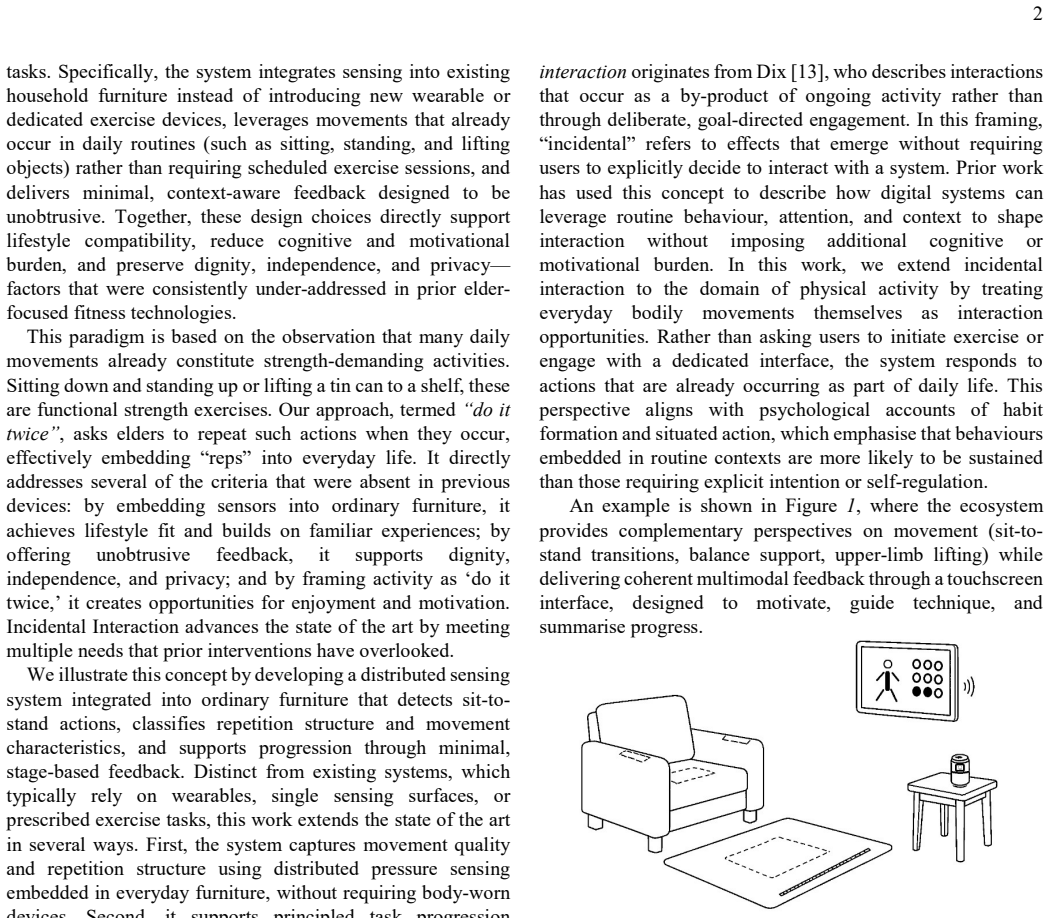
Incidental Interaction operationalizes everyday movements such as sitting, standing, or lifting objects as strength exercises by combining the repetition principle of 'do it twice' with real-time movement quality metrics delivered through an ecosystem of instrumented everyday objects and pressure-sensitive mats, thereby supporting progression and functional capacity gains without new routines or equipment.
What carries the argument
The 'do it twice' repetition rule paired with real-time movement quality feedback from embedded sensors in ordinary objects and furniture.
If this is right
- Older adults can accumulate strength-building repetitions through actions already performed in daily life rather than scheduled sessions.
- Embedded sensors in furniture enable continuous progress tracking and motivational cues without wearables or separate devices.
- Movement quality metrics allow users to refine form during routine tasks, supporting safer and more effective practice.
- The approach scales to home environments by augmenting existing objects rather than introducing new hardware.
- Pilot data from two- and four-week deployments confirm that the sensor ecosystem functions reliably for elders.
Where Pith is reading between the lines
- The same sensor approach could extend to other daily actions such as walking or reaching to address additional mobility goals.
- Data collected over months might reveal whether incidental practice slows typical age-related declines in muscle function.
- Combining the system with simple home automation could automatically adjust feedback thresholds as users improve.
- Similar incidental designs might support strength maintenance in other populations that struggle with formal exercise adherence.
Load-bearing premise
That real-time feedback on the quality of everyday movements will increase both repetition frequency and movement quality enough to produce measurable gains in functional strength.
What would settle it
A controlled trial that measures no rise in daily repetition rates of the targeted movements and no improvement in standardized strength or functional tests after participants use the feedback system compared with a no-feedback baseline.
Figures
read the original abstract
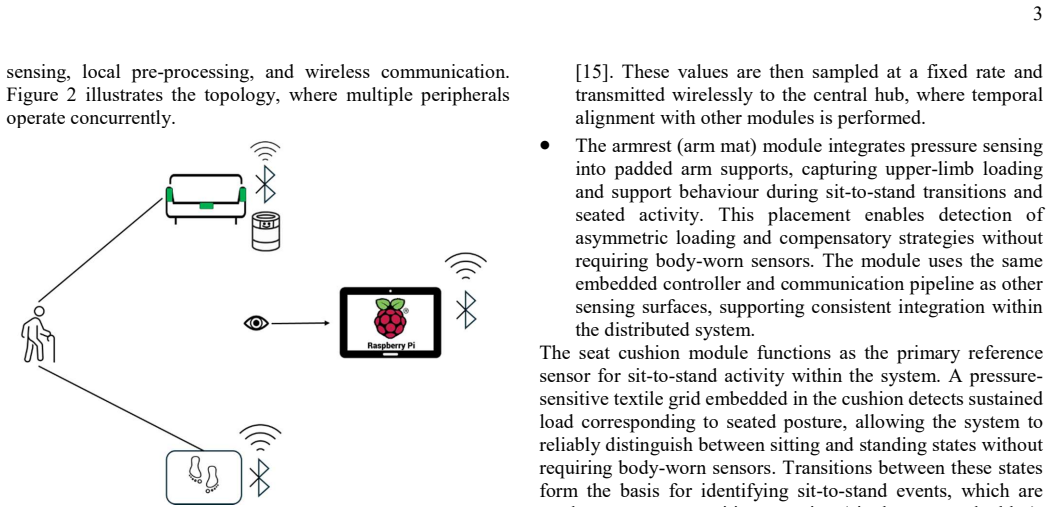
Strength training is a key determinant of healthy aging, yet adherence to formal exercise programs among older adults remains low. While many technologies aim to encourage physical activity in older adults, they typically rely on dedicated devices, wearables, or explicit exercise tasks. They therefore do not embed task practice into daily life. Our new approach, termed Incidental Interaction, instead transforms everyday actions into opportunities for deliberate strength building. It thereby operationalizes everyday movements such as sitting, standing, or lifting objects as strength exercises, encouraging participants to repeat them to build functional capacity. This repetition is encapsulated in the phrase "do it twice", and is combined with movement quality metrics to provide feedback and support progression, without requiring users to adopt new routines or equipment. We illustrate the concept by designing and implementing an ecosystem of instrumented everyday objects and pressure-sensitive mats embedded into ordinary furniture, providing real-time feedback, progress tracking, and motivational cues. To evaluate technical efficacy, we report on two structured pilot deployments with elders (2 week and 4 week studies, n=7).
Editorial analysis
A structured set of objections, weighed in public.
Referee Report
Summary. The manuscript introduces 'Incidental Interaction' as an approach that embeds strength training into everyday movements (e.g., sit-to-stand, object lifting) for older adults via the 'do it twice' principle, real-time quality feedback, and progress tracking. It describes an ecosystem of instrumented furniture and objects and reports two short technical pilot studies (2-week and 4-week, total n=7) focused on sensing accuracy and usability.
Significance. If validated, the design could meaningfully advance HCI for healthy aging by lowering barriers to adherence compared to wearables or explicit exercise apps. The embedded sensing in ordinary objects is a concrete strength that avoids new routines or equipment. However, the current evidence remains limited to technical feasibility, so the significance of the behavioral claim is not yet established.
major comments (2)
- Pilot deployments section: the two studies (n=7 total) report only sensor accuracy and system usability; no chair-stand test scores, grip strength, timed up-and-go, or logged repetition counts versus baseline/control are provided, leaving the central claim that feedback increases repetitions and functional strength untested.
- Abstract and evaluation description: the assertion that the system 'encourages participants to repeat them to build functional capacity' without new routines rests on an unverified assumption, as no adherence or repetition data beyond the short pilot windows are described.
minor comments (1)
- Abstract: quantitative results or error metrics from the pilots should be summarized to allow readers to assess technical efficacy directly.
Simulated Author's Rebuttal
We thank the referee for the constructive feedback on our manuscript. The comments highlight important distinctions between technical feasibility and behavioral efficacy, which we address below by clarifying the scope of the work and proposing targeted revisions.
read point-by-point responses
-
Referee: Pilot deployments section: the two studies (n=7 total) report only sensor accuracy and system usability; no chair-stand test scores, grip strength, timed up-and-go, or logged repetition counts versus baseline/control are provided, leaving the central claim that feedback increases repetitions and functional strength untested.
Authors: We agree that the pilots were limited to technical validation of sensing accuracy and usability. No functional strength assessments or controlled repetition data were collected, as the studies focused on whether everyday movements could be reliably detected and whether the system was acceptable in situ. The manuscript will be revised to explicitly state that these deployments do not test behavioral or strength outcomes, and any references to increased repetitions or functional capacity gains will be reframed as design goals and directions for future longitudinal studies rather than results from the current work. revision: yes
-
Referee: Abstract and evaluation description: the assertion that the system 'encourages participants to repeat them to build functional capacity' without new routines rests on an unverified assumption, as no adherence or repetition data beyond the short pilot windows are described.
Authors: The phrasing in the abstract and introduction was intended to convey the rationale and intended mechanism of the Incidental Interaction approach. However, we acknowledge that the short pilots provide no data on adherence, repetition counts, or long-term behavior change. In revision we will adjust the abstract to emphasize the technical implementation and feasibility evaluation, while relocating the discussion of repetition encouragement and functional capacity to the introduction as a hypothesized benefit, clearly noting that it remains to be tested in future work. revision: yes
Circularity Check
Design proposal with technical pilots shows no circularity in derivations
full rationale
The paper advances a conceptual design framework ('Incidental Interaction') and reports small-scale hardware pilots for sensing accuracy and usability. No equations, fitted parameters, predictions, or uniqueness theorems appear. The central claim—that real-time feedback on everyday movements will increase repetitions and strength—is presented as a design hypothesis, not derived from prior results or self-referential fits. All load-bearing steps remain independent of the paper's own outputs.
Axiom & Free-Parameter Ledger
axioms (2)
- domain assumption Adherence to formal exercise programs among older adults remains low
- domain assumption Everyday movements such as sitting and standing can be operationalized as strength exercises when repeated deliberately
invented entities (1)
-
Incidental Interaction
no independent evidence
Reference graph
Works this paper leans on
-
[1]
E. Rudnicka, P. Napierała, A. Podfigurna, B. Męczekalski, R. Smolarczyk and M. Grymowicz. The World Health Organization (WHO) approach to healthy ageing. Maturitas, 139:6-11, 2020
work page 2020
-
[2]
K. A. Schutzer and B. S. Graves, Barriers and motivations to exercise in older adults, Prev. Med., 39(5), pp. 1056–1061, 2004
work page 2004
-
[3]
United Nations, Department of Economic and Social Affairs, Population Division, World Population Ageing, 2019
work page 2019
-
[4]
C. J. Liu and N. K. Latham. Progressive resistance strength training for improving physical function in older adults. Cochrane Database of Systematic Reviews 2009, Issue 3. Art. No.: CD002759
work page 2009
-
[5]
D. F. Cabral, P. J. Fried, M. Bigliass, L. P. Cahalin and J. Gomes-Osman. Determinants of exercise adherence in sedentary middle-aged and older adults. Psychophysiology. Sep;61(9):e14591. 2024
work page 2024
-
[6]
J. Wu, H. Cheng, J. Zhang, S. Yang and S. Cai, Robot-Assisted Therapy for Upper Extremity Motor Impairment After Stroke: A Systematic Review and Meta- Analysis, Physical Therapy, Volume 101, Issue 4, April 2021
work page 2021
- [7]
-
[8]
M. Herdman, C. Gudex, A. Lloyd, M. Janssen, P. Kind, D. Parkin, G. Bonsel, and X. Badia. Development and preliminary testing of the new five-level version of EQ-5D (EQ-5D-5L). Qual Life Res. Dec;20(10):1727-36. 2011
work page 2011
-
[9]
R. W. Bohannon. Reference values for the five-repetition sit-to-stand test: a descriptive meta-analysis of data from elders. Percept Mot Skills. Aug;103(1):215-
-
[10]
D. Podsiadlo D and S. Richardson. The timed "Up & Go": a test of basic functional mobility for frail elderly persons. J Am Geriatr Soc. Feb;39(2):142-8. 1991
work page 1991
-
[11]
J. M. Guralnik, L. Ferrucci, E. M. Simonsick, M. E. Salive and R. B. Wallace. Lower-extremity function in persons over the age of 70 years as a predictor of subsequent disability. N Engl J Med. 1995 Mar 2;332(9):556-61
work page 1995
-
[12]
A. C. King, E. B. Hekler, L. A. Grieco, S. J. Winter, J. L. Sheats, M. P. Buman, B. Banerjee, T. N. Robinson and J. Cirimele. Harnessing different motivational frames via mobile phones to promote daily physical activity and reduce sedentary behavior in aging adults. PLoS One. Apr 25;8(4):e62613. 2013
work page 2013
-
[13]
A. Dix. Beyond intention-pushing boundaries with incidental interaction. Proceedings of Building Bridges: Interdisciplinary Context-Sensitive Computing, Glasgow University, 2002
work page 2002
- [14]
-
[15]
A. D. Bincalar., C. Freeman, mc. Schraefel. Optimal Algorithms for Improving Pressure-Sensitive Mat Centre of Pressure Measurements. Sensors. 2025; 25(5):1283
work page 2025
discussion (0)
Sign in with ORCID, Apple, or X to comment. Anyone can read and Pith papers without signing in.