Computational Microwave Imaging Relying on Orbital Angular Momentum Transmitarrays for Improved Diversity
Pith reviewed 2026-05-10 20:02 UTC · model grok-4.3
The pith
Leveraging multiple orbital angular momentum waves in a microwave imaging system increases measurement diversity enough to achieve accurate reconstructions of complex targets with only one-eighth the bandwidth of frequency-diverse methods.
A machine-rendered reading of the paper's core claim, the machinery that carries it, and where it could break.
Core claim
The paper claims that a computational imaging system operating at Ka-band frequencies can be improved by generating multiple orbital angular momentum waves with fully dielectric transmitarrays placed inside two metalized three-dimensional printed cavities. Compared with a purely frequency-diverse baseline, the additional OAM modes raise the diversity of the sensing matrix, yielding superior reconstructions of both simple and complex targets. The same quality is reached when the frequency sweep is restricted to one-eighth of the original bandwidth, provided the multi-OAM data are retained.
What carries the argument
Dielectric transmitarrays inside 3D-printed cavities that convert incident waves into distinct orbital angular momentum states, each supplying independent information to the imaging reconstruction algorithm.
If this is right
- Complex distributed targets that cannot be reconstructed with frequency diversity alone become recoverable when multiple OAM modes are added.
- The operational frequency bandwidth needed for high-quality imaging drops to one-eighth of the bandwidth required by frequency-diverse operation.
- The same hardware can deliver better image fidelity for a given spectrum allocation by switching from single-OAM to multi-OAM illumination.
- Transmitarray-based OAM generation can be combined with existing cavity-based computational imaging architectures without redesigning the entire front end.
Where Pith is reading between the lines
- The approach may allow imaging systems to operate in spectrum-constrained environments such as shared radio bands or portable devices with limited power amplifiers.
- Similar multiplexing of OAM states could be tested in other sensing modalities like millimeter-wave radar or terahertz imaging to reduce acquisition time.
- If the transmitarrays can be reconfigured electronically, the method might support dynamic selection of OAM modes to further optimize reconstructions for specific target classes.
- Extending the prototype to higher frequencies or larger apertures would test whether the bandwidth-reduction factor remains constant or improves with more available OAM states.
Load-bearing premise
The OAM modes generated by the transmitarrays must each carry unique information that frequency changes alone do not already provide, and the hardware must produce sufficiently pure and distinct states for the targets being imaged.
What would settle it
Imaging the same complex distributed target once with a single OAM mode across the full bandwidth and once with multiple OAM modes across one-eighth the bandwidth; if the multi-OAM reduced-bandwidth result is not at least as accurate as the single-OAM full-bandwidth result, the diversity benefit is refuted.
Figures
read the original abstract
This work proposes the use of orbital angular momentum (OAM) waves to improve the performance of a computational imaging (CI) system. Specifically, in contrast to a solely frequency-diverse operation, leveraging multiple OAM waves leads to a significant increase in the diversity of the measurement modes of a CI system. This significantly reduces the frequency bandwidth required to achieve high-quality image reconstructions. A proof-of-concept prototype working at Ka-band frequencies is used to validate the proposed approach. The prototype consists of two metalized three-dimensional (3D) printed cavities, with fully-dielectric transmitarrays inside that generate OAM waves. Imaging results from various targets reveal that the CI system achieves superior imaging quality when multiple OAM waves are considered, compared to when it solely relies on frequency-diversity. This is specially noticeable in the case of complex distributed targets, which can only be reconstructed with the prototype when multiple OAM waves are used. Furthermore, it is shown that accurate image reconstructions can be obtained employing only one eighth of the operational bandwidth of the frequency-diverse system.
Editorial analysis
A structured set of objections, weighed in public.
Referee Report
Summary. The paper proposes using orbital angular momentum (OAM) waves generated by dielectric transmitarrays in a Ka-band computational imaging (CI) system to increase measurement-mode diversity beyond frequency stepping alone. This is claimed to enable high-quality reconstructions of complex targets with only one-eighth the operational bandwidth of a frequency-diverse system. Validation is provided via a prototype consisting of two metalized 3D-printed cavities with fully dielectric transmitarrays, with qualitative imaging results showing superior performance when multiple OAM states are included.
Significance. If the OAM modes demonstrably supply independent information, the approach could meaningfully lower bandwidth and hardware demands for practical microwave CI systems. The physical prototype constitutes a concrete experimental strength, moving beyond simulation-only claims.
major comments (2)
- [Abstract and §4 (Imaging Results)] Abstract and §4 (Imaging Results): the headline claim of achieving accurate reconstructions with only one-eighth the bandwidth of the frequency-diverse system is not supported by any quantitative metrics (RMSE, SSIM, or equivalent) or error bars; only qualitative visual comparisons are described.
- [§3 (Prototype) and §4] §3 (Prototype) and §4: no sensing-matrix analysis (mutual coherence, singular-value spectrum, or condition number) is presented comparing the frequency-only forward operator against the multi-OAM operator at matched frequency sets. Without this, it is impossible to confirm that the observed improvement arises from genuinely orthogonal modes rather than altered spatial illumination or target-specific effects.
minor comments (2)
- [Figures] Figure captions should explicitly state the exact frequency range, number of OAM states, and post-processing algorithm used for each reconstruction panel.
- [§3 (Prototype)] The manuscript should clarify whether the transmitarray designs were optimized for purity of OAM modes across the full Ka-band or only at discrete frequencies.
Simulated Author's Rebuttal
We thank the referee for the detailed and constructive review. We address each major comment below and have revised the manuscript to incorporate quantitative support and matrix analysis where feasible.
read point-by-point responses
-
Referee: Abstract and §4 (Imaging Results): the headline claim of achieving accurate reconstructions with only one-eighth the bandwidth of the frequency-diverse system is not supported by any quantitative metrics (RMSE, SSIM, or equivalent) or error bars; only qualitative visual comparisons are described.
Authors: We acknowledge that quantitative metrics would strengthen the headline claim. In the revised manuscript we have added RMSE and SSIM values (with error bars obtained from repeated measurements) to the imaging results in Section 4 for both the frequency-only and multi-OAM cases. These metrics confirm that the multi-OAM configuration achieves comparable reconstruction fidelity at one-eighth the bandwidth. revision: yes
-
Referee: §3 (Prototype) and §4: no sensing-matrix analysis (mutual coherence, singular-value spectrum, or condition number) is presented comparing the frequency-only forward operator against the multi-OAM operator at matched frequency sets. Without this, it is impossible to confirm that the observed improvement arises from genuinely orthogonal modes rather than altered spatial illumination or target-specific effects.
Authors: We agree that an explicit sensing-matrix comparison is necessary to isolate the contribution of OAM diversity. The revised Section 3 now includes mutual-coherence values, singular-value spectra, and condition numbers for the frequency-only and multi-OAM forward operators evaluated on identical frequency sets. The multi-OAM operator exhibits lower average mutual coherence and a slower decay of singular values, supporting that the improvement stems from added orthogonal modes rather than illumination changes alone. revision: yes
Circularity Check
No circularity: experimental prototype validation with no fitted derivations or self-referential claims
full rationale
The paper describes a physical prototype (two metalized 3D-printed cavities with dielectric transmitarrays) and reports empirical imaging results on real targets, comparing multi-OAM versus frequency-only operation. No mathematical derivation chain, fitted parameters, or equations are presented that reduce the reported bandwidth reduction or image-quality gains to prior self-citations or definitions by construction. The central claims rest on direct experimental comparisons rather than any self-definitional, fitted-input, or uniqueness-theorem steps, making the work self-contained.
Axiom & Free-Parameter Ledger
axioms (1)
- domain assumption OAM waves generated by the dielectric transmitarrays provide distinct measurement modes that are independent of and additive to frequency diversity.
Lean theorems connected to this paper
-
IndisputableMonolith/Foundation/AlexanderDuality.leanalexander_duality_circle_linking unclear?
unclearRelation between the paper passage and the cited Recognition theorem.
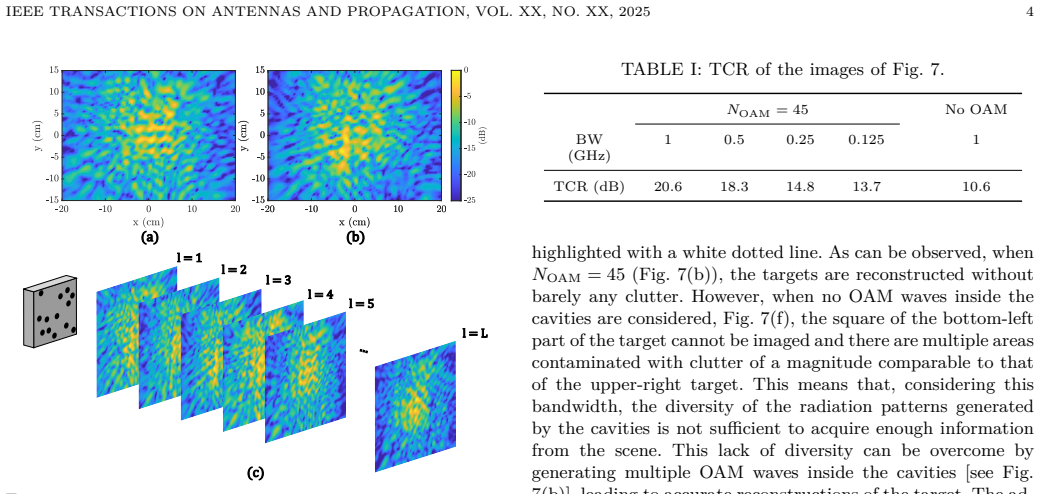
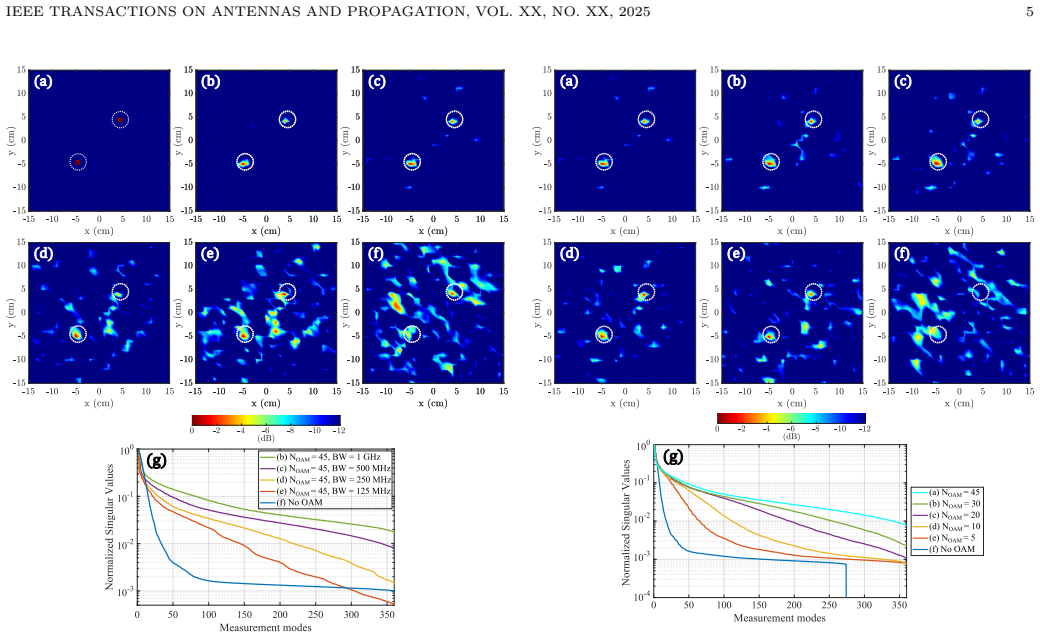
Different OAM eigenstates are mutually orthogonal to each other in each frequency... SVD of the sensing matrix... flatter SVD spectrum... NOAM = 45... one eighth of the operational bandwidth
-
IndisputableMonolith/Cost/FunctionalEquation.leanwashburn_uniqueness_aczel unclear?
unclearRelation between the paper passage and the cited Recognition theorem.
M = Nf · NOAM... least squares minimization σest = arg min ||g − Hσ||₂²
What do these tags mean?
- matches
- The paper's claim is directly supported by a theorem in the formal canon.
- supports
- The theorem supports part of the paper's argument, but the paper may add assumptions or extra steps.
- extends
- The paper goes beyond the formal theorem; the theorem is a base layer rather than the whole result.
- uses
- The paper appears to rely on the theorem as machinery.
- contradicts
- The paper's claim conflicts with a theorem or certificate in the canon.
- unclear
- Pith found a possible connection, but the passage is too broad, indirect, or ambiguous to say the theorem truly supports the claim.
Reference graph
Works this paper leans on
-
[1]
Evolution mechanisms modeling of cloud- ice, cloud-water and rain from microwave remote sensing,
J. He and K. Liu, “Evolution mechanisms modeling of cloud- ice, cloud-water and rain from microwave remote sensing,” in 2023 IEEE International Geoscience and Remote Sensing Symposium, 2023, pp. 1830–1833
work page 2023
-
[2]
X. Zhang, S. Wang, L. Jiang, R. Zhang, and P. Wang, “Esti- mation of 4-km all-sky sea surface temperature from thermal infrared and passive microwave remote sensing observations,” in 2022 IEEE International Geoscience and Remote Sensing Symposium, 2022, pp. 6868–6871
work page 2022
-
[3]
Passive l-band microwave remote sensing of organic soil surface layers: A tower-based experiment,
F. Jonard, S. Bircher, F. Demontoux, L. Weihermüller, S. Razafindratsima, J.-P. Wigneron, and H. Vereecken, “Passive l-band microwave remote sensing of organic soil surface layers: A tower-based experiment,” Remote Sensing, vol. 10, no. 2, 2018
work page 2018
-
[4]
C. Ma, X. Li, S. Wang, Z. Wang, T. Che, R. Jin, and W. Wang, “Quantifying uncertainties in passive microwave remote sensing of soil moisture via a bayesian probabilistic inversion method,” IEEE Trans. Geosci. Remote Sens., vol. 60, pp. 1–18, 2022
work page 2022
-
[5]
C. Montzka, T. Jagdhuber, R. Horn, H. R. Bogena, I. Hajnsek, A. Reigber, and H. Vereecken, “Investigation of smap fusion algorithms with airborne active and passive l-band microwave remote sensing,” IEEE Trans. Geosci. Remote Sens., vol. 54, no. 7, pp. 3878–3889, 2016
work page 2016
-
[6]
S. Qanoune, H. Ammor, and Z. Er-Reguig, “Revolutionizing early breast cancer detection: Insights from radiofrequency- based imaging and simulation studies,” in 2024 International Conference on Computing, Internet of Things and Microwave Systems (ICCIMS), 2024, pp. 1–5
work page 2024
-
[7]
Fast 3-d tomographic microwave imaging for breast cancer detection,
T. M. Grzegorczyk, P. M. Meaney, P. A. Kaufman, R. M. diFlorio Alexander, and K. D. Paulsen, “Fast 3-d tomographic microwave imaging for breast cancer detection,” IEEE Transac- tions on Medical Imaging, vol. 31, no. 8, pp. 1584–1592, 2012
work page 2012
-
[8]
Microwave and ultrasound imaging for biomedical tissue identification,
P. Mojabi and J. LoVetri, “Microwave and ultrasound imaging for biomedical tissue identification,” in 2014 USNC-URSI Radio Science Meeting (Joint with AP-S Symposium), 2014, pp. 56–56
work page 2014
-
[9]
Low-cost mi- crowave biomedical imaging,
K. Bialkowski, J. Marimuthu, and A. Abbosh, “Low-cost mi- crowave biomedical imaging,” in 2016 International Conference on Electromagnetics in Advanced Applications (ICEAA), 2016, pp. 697–699
work page 2016
-
[10]
A. Zhuravlev, V. Razevig, A. Rogozin, and M. Chizh, “Mi- crowave imaging of concealed objects with linear antenna array and optical tracking of the target for high-performance security screening systems,” IEEE Trans. Microw. Theory Tech., vol. 71, no. 3, pp. 1326–1336, 2023
work page 2023
-
[11]
Microwave imaging in security — two decades of innovation,
S. S. Ahmed, “Microwave imaging in security — two decades of innovation,” IEEE Journal of Microwaves, vol. 1, no. 1, pp. 191–201, 2021
work page 2021
-
[12]
N. A. Salmon, “Indoor full-body security screening: Radiomet- ric microwave imaging phenomenology and polarimetric scene simulation,” IEEE Access, vol. 8, pp. 144 621–144 637, 2020
work page 2020
-
[13]
Towards real-time processing for UA V-mounted GPR-SAR imaging systems,
M. García-Fernández, G. Álvarez Narciandi, J. Laviada, Y. Ál- varez López, and F. Las-Heras, “Towards real-time processing for UA V-mounted GPR-SAR imaging systems,” ISPRS Journal of Photogrammetry and Remote Sensing, vol. 212, pp. 1–12, 2024
work page 2024
-
[14]
Freehand, agile, and high-resolution imaging with compact mm-wave radar,
G. Álvarez Narciandi, M. López-Portugués, F. Las-Heras, and J. Laviada, “Freehand, agile, and high-resolution imaging with compact mm-wave radar,” IEEE Access, vol. 7, pp. 95 516– 95 526, 2019
work page 2019
-
[15]
Metamaterial apertures for computa- tional imaging,
J. Hunt, T. Driscoll, A. Mrozack, G. Lipworth, M. Reynolds, D. Brady, and D. Smith, “Metamaterial apertures for computa- tional imaging,” Science, vol. 339, no. 6117, pp. 310–313, 2013
work page 2013
-
[16]
Comprehensive simulation platform for a metamaterial imag- ing system,
G. Lipworth, A. Rose, O. Yurduseven, V. R. Gowda, M. F. Imani, H. Odabasi, P. Trofatter, J. Gollub, and D. R. Smith, “Comprehensive simulation platform for a metamaterial imag- ing system,” Applied Optics, vol. 54, no. 31, pp. 9343–9353, Nov 2015
work page 2015
-
[17]
Large metasurface aperture for millimeter wave computational imaging at the human-scale,
J. Gollub and et al., “Large metasurface aperture for millimeter wave computational imaging at the human-scale,” Sci Rep, vol. 7, no. 42650, 2017
work page 2017
-
[18]
Single channel frequency-diverse computational imaging sys- tem for through-the-wall sensing,
M. García-Fernández, G. Álvarez Narciandi, and O. Yurduseven, “Single channel frequency-diverse computational imaging sys- tem for through-the-wall sensing,” IEEE Trans. Geosci. Remote Sens., vol. 62, pp. 1–10, 2024. IEEE TRANSACTIONS ON ANTENNAS AND PROPAGATION, VOL. XX, NO. XX, 2025 7
work page 2024
-
[19]
Dynamic Metasurface Antenna-based Mills-Cross Aperture for 3D Computational Microwave Imag- ing,
G. Álvarez Narciandi, M. García-Fernández, V. Skouroliakou, and O. Yurduseven, “Dynamic Metasurface Antenna-based Mills-Cross Aperture for 3D Computational Microwave Imag- ing,” IEEE Antennas Wireless Propag. Lett., pp. 1–5, 2024
work page 2024
-
[20]
Near Field Computational Imaging with RIS Generated Virtual Masks,
Y. Jiang, F. Gao, Y. Liu, S. Jin, and T. Cui, “Near Field Computational Imaging with RIS Generated Virtual Masks,” IEEE Trans. Antennas Propag., pp. 1–1, 2024
work page 2024
-
[21]
Review of metasurface antennas for compu- tational microwave imaging,
M. F. Imani, J. N. Gollub, O. Yurduseven, A. V. Diebold, M. Boyarsky, T. Fromenteze, L. Pulido-Mancera, T. Sleasman, and D. R. Smith, “Review of metasurface antennas for compu- tational microwave imaging,” IEEE Trans. Antennas Propag., vol. 68, no. 3, pp. 1860–1875, 2020
work page 2020
-
[22]
D. J. Griffiths, Introduction to Electrodynamics. Pearson, 2013
work page 2013
-
[23]
Orbital angular momentum of light and the trans- formation of Laguerre-Gaussian laser modes,
L. Allen, M. W. Beijersbergen, R. J. C. Spreeuw, and J. P. Woerdman, “Orbital angular momentum of light and the trans- formation of Laguerre-Gaussian laser modes,” Phys. Rev. A, vol. 45, pp. 8185–8189, Jun 1992
work page 1992
-
[24]
S. Yu, L. Li, G. Shi, C. Zhu, X. Zhou, and Y. Shi, “Design, fab- rication, and measurement of reflective metasurface for orbital angular momentum vortex wave in radio frequency domain,” Applied Physics Letters, vol. 108, no. 12, 2016
work page 2016
-
[25]
Im- plementation of vortex electromagnetic waves high-resolution synthetic aperture radar imaging,
X. Bu, Z. Zhang, L. Chen, X. Liang, H. Tang, and X. Wang, “Im- plementation of vortex electromagnetic waves high-resolution synthetic aperture radar imaging,” IEEE Antennas Wireless Propag. Lett., vol. 17, no. 5, pp. 764–767, 2018
work page 2018
-
[26]
Passive OAM-Based Radar Imaging With Single-In-Multiple-Out Mode,
K. Liu, Y. Cheng, X. Li, and Y. Jiang, “Passive OAM-Based Radar Imaging With Single-In-Multiple-Out Mode,” IEEE Mi- crow. Wireless Compon. Lett., vol. 28, no. 9, pp. 840–842, 2018
work page 2018
-
[27]
Microwave Vortex Imaging Based on Dual Coupled OAM Beams,
H. Liu, K. Liu, Y. Cheng, and H. Wang, “Microwave Vortex Imaging Based on Dual Coupled OAM Beams,” IEEE Sensors Journal, vol. 20, no. 2, pp. 806–815, 2020
work page 2020
-
[28]
K. Zhang, Y. Wang, Y. Yuan, and S. N. Burokur, “A review of orbital angular momentum vortex beams generation: From traditional methods to metasurfaces,” Applied Sciences, vol. 10, no. 3, 2020
work page 2020
-
[29]
Y. Wang, X. Sun, and L. Liu, “Millimeter-wave orbital angular momentum: Generation, detection, and applications: A review on millimeter wave orbital angular momentum antennas,” IEEE Microwave Magazine, vol. 25, no. 1, pp. 37–57, 2024
work page 2024
-
[30]
Ultralow Reflectivity Spiral Phase Plate for Generation of Millimeter-wave OAM Beam,
X. Hui, S. Zheng, Y. Hu, C. Xu, X. Jin, H. Chi, and X. Zhang, “Ultralow Reflectivity Spiral Phase Plate for Generation of Millimeter-wave OAM Beam,” IEEE Antennas Wireless Propag. Lett., vol. 14, pp. 966–969, 2015
work page 2015
-
[31]
Y. Chen, S. Zheng, Y. Li, X. Hui, X. Jin, H. Chi, and X. Zhang, “A Flat-Lensed Spiral Phase Plate Based on Phase-Shifting Surface for Generation of Millimeter-Wave OAM Beam,” IEEE Antennas Wireless Propag. Lett., vol. 15, pp. 1156–1158, 2016
work page 2016
-
[32]
Transmis- sion characteristics of a twisted radio wave based on circu- lar traveling-wave antenna,
S. Zheng, X. Hui, X. Jin, H. Chi, and X. Zhang, “Transmis- sion characteristics of a twisted radio wave based on circu- lar traveling-wave antenna,” IEEE Trans. Antennas Propag., vol. 63, no. 4, pp. 1530–1536, 2015
work page 2015
-
[33]
Radial Uniform Circular Antenna Array for Dual-Mode OAM Communication,
Z.-G. Guo and G.-M. Yang, “Radial Uniform Circular Antenna Array for Dual-Mode OAM Communication,” IEEE Antennas Wireless Propag. Lett., vol. 16, pp. 404–407, 2017
work page 2017
-
[34]
Modeling Partially-Dielectric Unit Cells for OAM Transmitarrays,
M. A. Balmaseda-Márquez, G. Valerio, P. Padilla, A. Palomares- Caballero, J. F. Valenzuela-Valdés, and C. Molero, “Modeling Partially-Dielectric Unit Cells for OAM Transmitarrays,” IEEE Access, vol. 12, pp. 110 840–110 849, 2024
work page 2024
-
[35]
M. Lin, J. Yi, J. Wang, L. Zhu, Z. H. Jiang, P. Qi, and X. Chen, “Single-layer re-organizable all-dielectric meta-lens platform for arbitrary transmissive phase manipulation at millimeter-wave frequencies,” IEEE Trans. Antennas Propag., vol. 70, no. 3, pp. 2059–2069, 2022
work page 2059
-
[36]
S. Moreno-Rodríguez, M. A. Balmaseda-Márquez, J. Carmona- Murillo, and A. Palomares-Caballero, “Polarization-Insensitive Unit Cells for a Cost-Effective Design of a 3-D-Printed Fresnel- Lens Antenna,” Electronics, vol. 11, no. 3, 2022
work page 2022
-
[37]
A review of stereolithography: Processes and systems,
J. Huang, Q. Qin, and J. Wang, “A review of stereolithography: Processes and systems,” Processes, vol. 8, no. 9, 2020
work page 2020
-
[38]
Frequency domain image reconstruction for imaging with multistatic dynamic metasur- face antennas,
V. Skouroliakou, A. M. Molaei, M. García-Fernández, G. Ál- varez Narciandi, and O. Yurduseven, “Frequency domain image reconstruction for imaging with multistatic dynamic metasur- face antennas,” IEEE Access, vol. 10, pp. 124 728–124 737, 2022
work page 2022
-
[39]
A. M. Molaei, M. García-Fernández, G. Álvarez Narciandi, and O. Yurduseven, “Kirchhoff migration-enabled near-field compu- tational imaging with dynamically reconfigurable metasurface antennas,” IEEE Antennas Wireless Propag. Lett., pp. 1–5, 2025
work page 2025
-
[40]
Freehand mm-wave imaging with a compact mimo radar,
G. Álvarez Narciandi, J. Laviada, and F. Las-Heras, “Freehand mm-wave imaging with a compact mimo radar,” IEEE Trans. Antennas Propag., vol. 69, no. 2, pp. 1224–1229, 2021
work page 2021
discussion (0)
Sign in with ORCID, Apple, or X to comment. Anyone can read and Pith papers without signing in.