Recognition: no theorem link
Timing performance of large prototype based on upmuRWELL- PICOSEC detector technology with 10 times 10\ cm² active area
Pith reviewed 2026-05-10 19:51 UTC · model grok-4.3
The pith
A 10x10 cm gaseous detector prototype achieves 48 and 52 picosecond timing resolution on individual pads.
A machine-rendered reading of the paper's core claim, the machinery that carries it, and where it could break.
Core claim
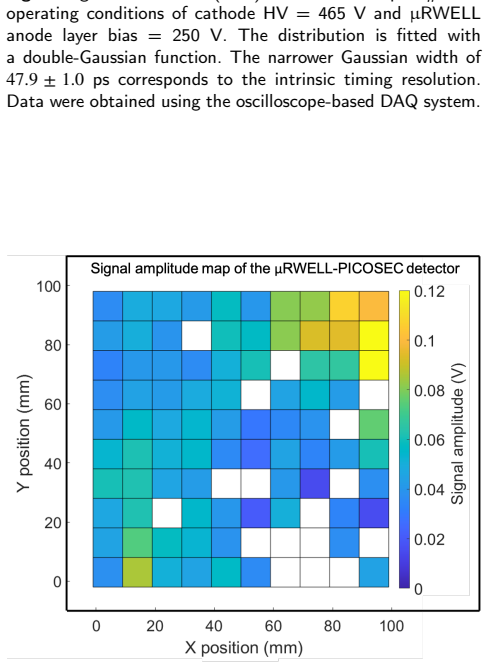
Beam tests on the 10x10 cm² μRWELL-PICOSEC prototype with CsI photocathode yield timing resolutions of ≈48 ps and ≈52 ps on two separate pads using oscilloscope-based single-channel readout under different biasing conditions.
What carries the argument
The μRWELL-PICOSEC detector, which combines a micro-Resistive WELL gaseous amplification structure with a Cherenkov radiator and photocathode to generate fast primary signals for high-precision timing.
If this is right
- The approach supports time-of-flight applications in particle physics experiments requiring tens-of-picoseconds precision over large areas.
- It opens a path toward gaseous detectors for medical imaging that need fast timing without the limitations of solid-state sensors.
- The results validate scaling the μRWELL-PICOSEC concept to 10x10 cm² while preserving picosecond-level performance.
Where Pith is reading between the lines
- Multi-pad simultaneous readout tests would show whether crosstalk or signal distribution affects the overall timing uniformity across the detector surface.
- Direct comparison with silicon-based fast timing sensors in the same beam setup could quantify trade-offs in cost, area coverage, and radiation tolerance for gaseous versus solid-state options.
- Varying the radiator thickness or photocathode material in follow-up prototypes might further improve the achieved resolution or reduce the required bias voltages.
Load-bearing premise
Single-channel oscilloscope measurements on two pads under the tested conditions and with the CsI photocathode accurately capture the detector technology's intrinsic timing performance without major unaccounted readout or pad-specific effects.
What would settle it
A full multi-channel readout of the same prototype producing timing resolution substantially worse than 50 ps, or tests at lower particle energies showing clear degradation, would indicate the single-pad results do not represent the technology's capability.
Figures


read the original abstract
The $\upmu$RWELL-PICOSEC detector, which combines a $\upmu$RWELL gaseous amplification structure with a Cherenkov radiator and photocathode, is a novel approach to acheive fast and precise timing in gaseous detectors. With timing precision at the level of tens of picoseconds, this technology is particularly suited for time-of-flight (TOF) applications in particle physics and potentially medical imaging. Beam tests with a 150~GeV/$c$ muon beam have been carried out on a large-area (10~$\times$~10~cm$^{2}$) prototype equipped with a cesium iodide (CsI) photocathode. Using an oscilloscope-based single-channel readout, timing measurements on two individual pads of the detector have yielded resolutions of $\approx$ 48 ps and $\approx$ 52 ps under different biasing conditions respectively.
Editorial analysis
A structured set of objections, weighed in public.
Referee Report
Summary. The manuscript describes beam tests of a 10 × 10 cm² μRWELL-PICOSEC prototype equipped with a CsI photocathode. Using an oscilloscope-based single-channel readout on two individual pads, the authors report timing resolutions of approximately 48 ps and 52 ps under different biasing conditions with a 150 GeV/c muon beam.
Significance. If the reported resolutions are shown to be intrinsic (after quadrature subtraction of reference jitter) and representative of the full active area, the result would demonstrate that gaseous detectors can reach tens-of-picoseconds timing on large surfaces, which is relevant for TOF applications in particle physics.
major comments (2)
- [Abstract / Results] Abstract and results section: the reported resolutions of ≈48 ps and ≈52 ps are presented without any information on the reference detector's timing resolution, the number of events used, data-selection cuts, or the method used to extract the detector contribution (e.g., quadrature subtraction or CFD corrections). Without these details the headline numbers cannot be evaluated.
- [Results] Results section: measurements are shown for only two pads under specific biasing conditions. No data or discussion is provided on pad-to-pad uniformity or performance variation across the full 10 × 10 cm² area, which is required to support the claim that the technology is suitable for large-area applications.
minor comments (1)
- [Abstract] Abstract: 'acheive' should be 'achieve'.
Simulated Author's Rebuttal
We thank the referee for the constructive feedback on our manuscript. We will revise the paper to supply the missing methodological details requested and to better contextualize the scope and limitations of the presented measurements on the large-area prototype.
read point-by-point responses
-
Referee: [Abstract / Results] Abstract and results section: the reported resolutions of ≈48 ps and ≈52 ps are presented without any information on the reference detector's timing resolution, the number of events used, data-selection cuts, or the method used to extract the detector contribution (e.g., quadrature subtraction or CFD corrections). Without these details the headline numbers cannot be evaluated.
Authors: We agree that these details are required for a complete evaluation of the results. In the revised manuscript we will add the measured timing resolution of the reference detector, the total number of events recorded and analyzed, the specific data-selection cuts applied, and a step-by-step description of the timing-extraction procedure, including the quadrature subtraction of the reference jitter and any constant-fraction discrimination corrections used. The quoted 48 ps and 52 ps values are already the detector contributions after this subtraction; the added text will make this explicit. revision: yes
-
Referee: [Results] Results section: measurements are shown for only two pads under specific biasing conditions. No data or discussion is provided on pad-to-pad uniformity or performance variation across the full 10 × 10 cm² area, which is required to support the claim that the technology is suitable for large-area applications.
Authors: We acknowledge that only two pads were instrumented with the single-channel oscilloscope readout, so full-area uniformity maps are not available in the present data set. In the revision we will (i) explain the technical reason for the limited readout (oscilloscope bandwidth and channel count), (ii) add a short discussion of expected pad-to-pad uniformity based on the μRWELL foil and photocathode fabrication tolerances, and (iii) explicitly state that the reported resolutions demonstrate the intrinsic timing capability of the technology on a 10×10 cm² device while comprehensive multi-channel uniformity studies are planned for a follow-up measurement campaign. We will also tone down any implication that the two-pad results already prove uniform large-area performance. revision: partial
Circularity Check
No circularity: direct experimental timing measurements with no derivation chain
full rationale
The paper reports empirical timing resolutions (≈48 ps and ≈52 ps) obtained from beam-test oscilloscope waveforms on two pads of a 10×10 cm² prototype. No equations, first-principles derivations, fitted parameters renamed as predictions, or self-citation load-bearing steps appear in the provided text. The central claim is a measurement result, not a reduction of any output to its own inputs by construction. This is the expected non-finding for a pure instrumentation paper.
Axiom & Free-Parameter Ledger
Reference graph
Works this paper leans on
-
[1]
Experimental Challenges of the European Strategy for Particle Physics
Sebastian White. Experimental Challenges of the European Strategy for Particle Physics. In International Conference on Calorimetry for the High Energy Frontier, pages 118–127, 2013
work page 2013
-
[2]
J. Va’vra. Pid techniques: Alternatives to rich methods.Nuclear Instruments and Methods in Physics Research Section A: Accelerators, Spectrometers, Detectors and Associated Equipment, 876:185–193,2017. The9thinternationalworkshoponRingImaging Cherenkov Detectors (RICH2016)
work page 2017
-
[3]
Fast and precise timing with resistiveµrwell-picosec de- tector technology
K.Gnanvo,A.Pandey,J.Mckisson,W.Xi,B.Kross,andA.Weisen- berger. Fast and precise timing with resistiveµrwell-picosec de- tector technology. In 2024 IEEE Nuclear Science Symposium (NSS), Medical Imaging Conference (MIC) and Room Temperature SemiconductorDetectorConference(RTSD), pages 1–1, 2024
work page 2024
-
[4]
G. Bencivenni, R. De Oliveira, G. Morello, and M. Poli Lener. The micro-resistive well detector: a compact spark-protected single amplification-stage mpgd. Journal of Instrumentation, 10(02):P02008, feb 2015
work page 2015
-
[5]
Hamamatsu mcp-pmt, bialkali photocathode - r3809u-50. https://www.hamamatsu.com/jp/en/product/optical-sensors/pmt/ pmt_tube-alone/mcp-pmt/R3809U-50.html, 2020
work page 2020
-
[6]
M.J. French, L.L. Jones, Q. Morrissey, A. Neviani, R. Turchetta, J. Fulcher, G. Hall, E. Noah, M. Raymond, G. Cervelli, P. Mor- eira, and G. Marseguerra. Design and results from the apv25, a deep sub-micron cmos front-end chip for the cms tracker. Nuclear Instruments and Methods in Physics Research Section A: Accelerators, Spectrometers, Detectors and Ass...
work page 2001
-
[7]
S. Martoiu, H. Muller, and J. Toledo. Front-end electronics for the scalable readout system of rd51. In 2011 IEEE Nuclear Science SymposiumConferenceRecord, pages 2036–2038, 2011
work page 2011
- [8]
-
[9]
teledynelecroy.com/files/pdf/waverunner8000-datasheet.pdf, 2018
Waverunner 8000, teledynelecroy, lecroy.https://cdn. teledynelecroy.com/files/pdf/waverunner8000-datasheet.pdf, 2018
work page 2018
-
[10]
D. Breton, V. De Cacqueray, E. Delagnes, H. Grabas, J. Maalmi, N. Minafra, C. Royon, and M. Saimpert. Measurements of timing resolution of ultra-fast silicon detectors with the sampic waveform digitizer. Nuclear Instruments and Methods in Physics Research Section A: Accelerators, Spectrometers, Detectors and Associated Equipment, 835:51–60, 2016
work page 2016
-
[11]
M. Lisowska, J. Bortfeldt, F. Brunbauer, G. Fanourakis, K.J. Floeth- ner,M.Gallinaro,F.Garcia,I.Giomataris,T.Gustavsson,F.J.Iguaz, D.Janssens,A.Kallitsopoulou,M.Kovacic,P.Legou,J.Liu,M.Lup- berger, I. Maniatis, Y. Meng, H. Muller, E. Oliveri, G. Orlandini, T. Papaevangelou, M. Pomorski, L. Ropelewski, D. Sampsonidis, L. Scharenberg, T. Schneider, L. Sohl,...
work page 2023
-
[12]
J. Bortfeldt, F. Brunbauer, C. David, D. Desforge, G. Fanourakis, J.Franchi,M.Gallinaro,I.Giomataris,D.González-Díaz,T.Gustavs- son,C.Guyot,F.J.Iguaz,M.Kebbiri,P.Legou,J.Liu,M.Lupberger, O. Maillard, I. Manthos, H. Müller, V. Niaouris, E. Oliveri, T. Pa- paevangelou, K. Paraschou, M. Pomorski, B. Qi, F. Resnati, L. Ro- pelewski, D. Sampsonidis, T. Schneid...
work page 2018
discussion (0)
Sign in with ORCID, Apple, or X to comment. Anyone can read and Pith papers without signing in.