Influence of van der Waals forces on the instability of a liquid film in a tube
Pith reviewed 2026-05-10 19:46 UTC · model grok-4.3
The pith
Van der Waals forces accelerate perturbation growth and lower the critical thickness for liquid film collapse inside tubes.
A machine-rendered reading of the paper's core claim, the machinery that carries it, and where it could break.
Core claim
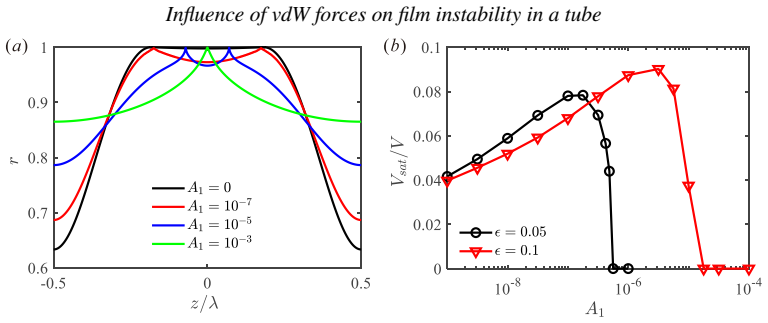
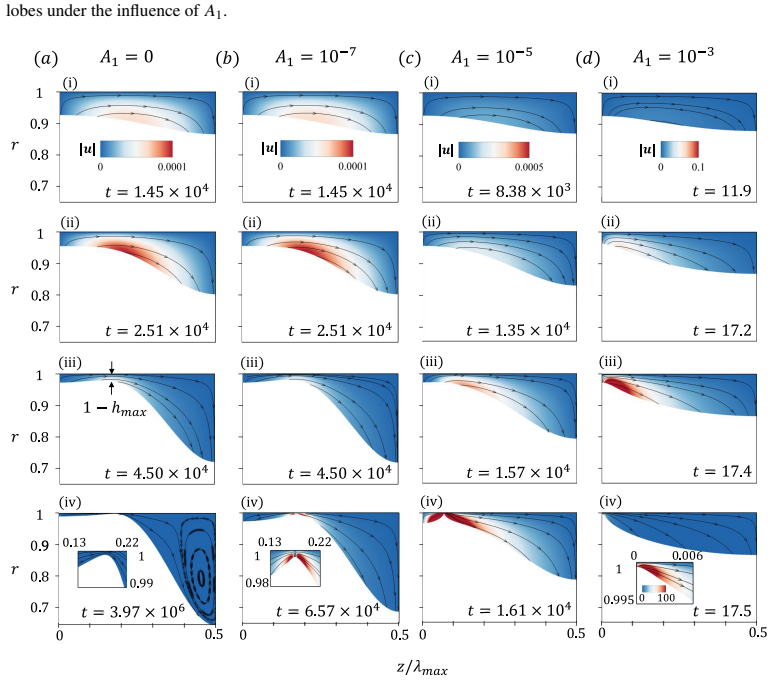
A theoretical framework based on the axisymmetric Stokes equations is developed to investigate the effects of van der Waals forces through linear stability analysis. The model reveals that van der Waals forces markedly enhance perturbation growth, reduce the dominant wavelength, and lower the critical film thickness that distinguishes collapse from non-collapse regimes. Direct numerical simulations of the Navier-Stokes equations both confirm these theoretical predictions and extend the analysis into the nonlinear regime. In this regime, van der Waals forces are found to alter the interfacial morphology and suppress the formation of satellite lobes. Both rupture and collapse follow a unive
What carries the argument
Axisymmetric Stokes equations augmented by a continuum van der Waals disjoining pressure term, solved via linear stability analysis and verified by Navier-Stokes simulations.
If this is right
- Perturbation growth rates increase with stronger van der Waals forces.
- The dominant unstable wavelength becomes shorter.
- The critical film thickness separating collapse and non-collapse regimes decreases.
- Satellite lobes are suppressed in the nonlinear stage.
- Both rupture and collapse obey the same one-third power-law scaling near the singularity.
Where Pith is reading between the lines
- The universal scaling may extend to other confined geometries where disjoining pressure drives breakup.
- Varying tube radius or film thickness in experiments could directly test the continuum assumption for van der Waals forces.
- Altered morphology without satellites could change droplet size distributions in microfluidic coating processes.
- If inertia becomes relevant at larger scales, the scaling exponent is expected to shift.
Load-bearing premise
The model assumes fluid inertia can be neglected and that van der Waals forces are adequately described by a standard continuum disjoining pressure even when the film is very thin.
What would settle it
Experimental measurements of breakup wavelength or time-to-rupture in nanotubes that deviate from the predicted linear growth rates or the one-third temporal scaling when van der Waals forces dominate.
Figures




read the original abstract
The instability of a liquid film in a nanotube is significantly influenced by van der Waals forces. A theoretical framework based on the axisymmetric Stokes equations is developed to investigate their effects through linear stability analysis. The model reveals that van der Waals forces markedly enhance perturbation growth, reduce the dominant wavelength, and lower the critical film thickness that distinguishes collapse from non-collapse regimes. Direct numerical simulations of the Navier-Stokes equations both confirm these theoretical predictions and extend the analysis into the nonlinear regime. In this regime, van der Waals forces are found to alter the interfacial morphology and suppress the formation of satellite lobes. Both rupture and collapse follow a universal temporal scaling law with exponent 1/3 and exhibit self-similar behavior near the singularity.
Editorial analysis
A structured set of objections, weighed in public.
Referee Report
Summary. The paper develops a linear stability analysis of an axisymmetric liquid film inside a tube using the Stokes equations augmented by a continuum van der Waals disjoining pressure. It reports that vdW forces increase the growth rate of perturbations, decrease the dominant wavelength, and reduce the critical film thickness separating collapse from non-collapse. Direct numerical simulations of the Navier-Stokes equations are used to confirm the linear predictions and to examine the nonlinear regime, where vdW forces are shown to modify interfacial morphology, suppress satellite lobes, and produce a universal temporal scaling with exponent 1/3 together with self-similar profiles near both rupture and collapse singularities.
Significance. If the central results hold, the work supplies a useful quantitative link between linear theory and nonlinear dynamics for thin-film instabilities in confined geometries at scales where vdW forces matter. The explicit matching of linear growth rates and wavelengths to DNS, together with the reported universal 1/3 scaling that is independent of the Hamaker constant, constitutes a clear strength. The findings are relevant to applications such as nanotube coating, capillary-driven flows, and nanoscale rupture processes.
major comments (2)
- [§4] §4 (nonlinear regime and self-similar analysis): the universal 1/3 temporal scaling and self-similar profiles for both rupture and collapse are derived under the assumption that the continuum disjoining pressure Π(h) ∝ −A/h³ remains valid as the minimum thickness h_min → 0. No regularization (Born repulsion, hydration forces, or molecular cutoff) is introduced or tested; the skeptic concern that molecular discreteness intervenes before the singularity is therefore load-bearing for the nonlinear claims.
- [§3.2 and §5] §3.2 (linear stability) and §5 (DNS validation): the reported agreement between Stokes linear growth rates and DNS is stated to hold, yet the manuscript does not quantify the Reynolds-number range over which the Stokes approximation remains accurate once inertia is restored in the DNS; a brief check of the neglected inertial terms at the dominant wavelength would strengthen the claim that the linear predictions are robust.
minor comments (2)
- [§2] Notation for the Hamaker constant and the precise form of the disjoining pressure should be stated explicitly in the governing-equation section rather than only in the appendix.
- [Figure 7] Figure captions for the self-similar profiles should include the precise rescaling used (e.g., the time-to-singularity exponent and the spatial scaling) so that readers can reproduce the collapse without consulting the text.
Simulated Author's Rebuttal
We thank the referee for the constructive and insightful comments on our manuscript. We address each major comment point by point below, providing the strongest honest responses based on the work presented. Where appropriate, we indicate revisions to be incorporated in the next version.
read point-by-point responses
-
Referee: [§4] §4 (nonlinear regime and self-similar analysis): the universal 1/3 temporal scaling and self-similar profiles for both rupture and collapse are derived under the assumption that the continuum disjoining pressure Π(h) ∝ −A/h³ remains valid as the minimum thickness h_min → 0. No regularization (Born repulsion, hydration forces, or molecular cutoff) is introduced or tested; the skeptic concern that molecular discreteness intervenes before the singularity is therefore load-bearing for the nonlinear claims.
Authors: We agree that the continuum disjoining pressure is an approximation whose validity diminishes as h_min approaches molecular scales. The 1/3 temporal scaling and self-similar profiles reported in §4 are derived directly from the model equations with Π(h) ∝ −A/h³; the exponent is independent of A because it arises from the dominant balance between capillary pressure, viscous resistance, and the singular disjoining term near the singularity. This feature is robust within the continuum framework and consistent with the DNS results that employ the same model. We will add a concise discussion paragraph in the revised §4 (and conclusions) explicitly acknowledging the limitation, noting that molecular discreteness or short-range repulsions would ultimately regularize the singularity, and referencing prior thin-film literature where analogous 1/3 scalings persist in molecular simulations until discreteness intervenes. This addition clarifies the scope of the claims without altering the reported scaling or profiles. revision: partial
-
Referee: [§3.2 and §5] §3.2 (linear stability) and §5 (DNS validation): the reported agreement between Stokes linear growth rates and DNS is stated to hold, yet the manuscript does not quantify the Reynolds-number range over which the Stokes approximation remains accurate once inertia is restored in the DNS; a brief check of the neglected inertial terms at the dominant wavelength would strengthen the claim that the linear predictions are robust.
Authors: We concur that an explicit Reynolds-number check would strengthen the validation section. In the revised manuscript we will add, in §5, a brief calculation of the local Reynolds number Re = ρ U λ / μ evaluated at the dominant wavelength λ and characteristic velocity U obtained from the linear growth rate σ_max for the parameter ranges examined (film thickness, tube radius, and Hamaker constant). For all cases considered, Re remains ≪ 1 (typically O(10^{-3})), confirming that the neglected inertial terms in the Stokes linear analysis are negligible compared with viscous and capillary forces. This estimate directly supports the observed agreement between the Stokes predictions and the full Navier–Stokes DNS. revision: yes
Circularity Check
No circularity: results follow directly from Stokes equations plus standard vdW term and DNS confirmation
full rationale
The derivation starts from the axisymmetric Stokes equations augmented by the standard continuum disjoining pressure, performs linear stability analysis to obtain growth rates and critical thicknesses, and uses independent DNS of the full Navier-Stokes equations to verify and extend into the nonlinear regime. The 1/3 temporal scaling and self-similarity are obtained by solving the time-dependent system near the singularity; they are not fitted parameters renamed as predictions nor defined in terms of the outputs. No self-citation is load-bearing for the central claims, and no ansatz is smuggled via prior work. The analysis is self-contained against the governing equations.
Axiom & Free-Parameter Ledger
free parameters (1)
- van der Waals strength (Hamaker constant)
axioms (3)
- domain assumption Axisymmetric flow with no azimuthal dependence
- domain assumption Stokes approximation (negligible inertia, Re << 1)
- domain assumption Continuum treatment of fluid and van der Waals forces at nanotube scales
Lean theorems connected to this paper
-
IndisputableMonolith/Cost/FunctionalEquation.leanwashburn_uniqueness_aczel unclear?
unclearRelation between the paper passage and the cited Recognition theorem.
disjoining pressure induced by vdW forces is modeled via the Derjaguin approximation Π=A/d³ ... Π1=A1/(1−r)³ and Π2=A2/(2r)³
-
IndisputableMonolith/Foundation/AlphaCoordinateFixation.leanJ_uniquely_calibrated_via_higher_derivative unclear?
unclearRelation between the paper passage and the cited Recognition theorem.
both rupture and collapse follow a universal temporal scaling law with exponent 1/3 and exhibit self-similar behavior near the singularity
What do these tags mean?
- matches
- The paper's claim is directly supported by a theorem in the formal canon.
- supports
- The theorem supports part of the paper's argument, but the paper may add assumptions or extra steps.
- extends
- The paper goes beyond the formal theorem; the theorem is a base layer rather than the whole result.
- uses
- The paper appears to rely on the theorem as machinery.
- contradicts
- The paper's claim conflicts with a theorem or certificate in the canon.
- unclear
- Pith found a possible connection, but the passage is too broad, indirect, or ambiguous to say the theorem truly supports the claim.
Reference graph
Works this paper leans on
-
[1]
Beaty, E. & Lister, J. R.2022 Nonuniversal self-similarity for jump-to-contact dynamics between viscous drops under van der waals attraction.Phys. Rev. Lett.129, 064501. Beaty, E. & Lister, J. R.2023 Inertial and viscous dynamics of jump-to-contact between fluid drops under van der waals attraction.J. Fluid Mech.957, A25. Ben-Noah, I., Friedman, S. P. & B...
work page 2022
-
[2]
Halpern, D. & Grotberg, J. B.2003 Nonlinear saturation of the rayleigh instability due to oscillatory flow in a liquid-lined tube.J. Fluid Mech.492, 251–270. Hammond, P. S.1983 Nonlinear adjustment of a thin annular film of viscous fluid surrounding a thread of another within a circular cylindrical pipe.J. Fluid Mech.137, 363–384. Heil, M., Hazel, A. L. &...
work page 2003
-
[3]
Gauthier-Villars. Qu´er´e, D., di Meglio, J.-M. & Brochard-Wyart, F.1989 Making van der waals films on fibers.Europhys. Lett.10(4),
work page 1989
-
[4]
Rayleigh, Lord1878 On the instability of jets.Proc. Lond. Math. Soc.s1-10(1), 4–13. Ruyer-Quil, C., Treveleyan, P., Giorgiutti-Dauphin´e, F., Duprat, C. & Kalliadasis, S.2008 Modelling film flows down a fibre.J. Fluid Mech.603, 431–462. Rykner, M., Saikali, E., Bruneton, A., Mathieu, B. & Nikolayev, V. S.2024 Plateau–rayleigh instability in a capillary: a...
work page 2008
discussion (0)
Sign in with ORCID, Apple, or X to comment. Anyone can read and Pith papers without signing in.