Galactic-scale evolution of classical and complex radio galaxies. Impact of ambient morphology and jet geometry
Pith reviewed 2026-05-10 19:21 UTC · model grok-4.3
The pith
Radio galaxy shapes depend on jet angle to the host galaxy's major axis.
A machine-rendered reading of the paper's core claim, the machinery that carries it, and where it could break.
Core claim
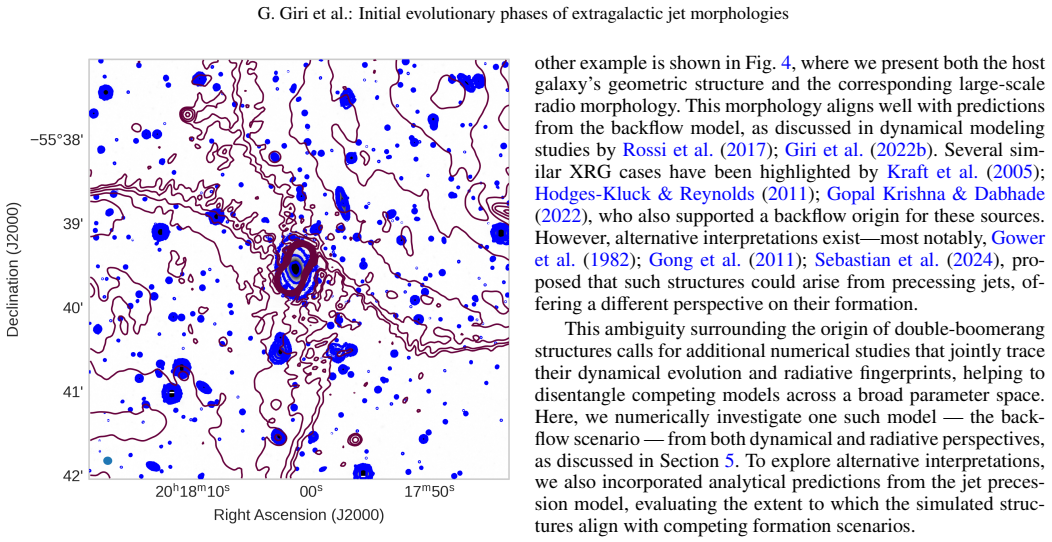
When a jet propagates along the host's major axis, the path of maximal environmental resistance, it produces an X-shaped morphology with the secondary lobe aligning along the minor axis and co-evolving with the active jet. At intermediate angles, the morphology transitions to a double-boomerang structure with curved lobes that can be regenerated by backflow or precession. Jets along the minor axis propagate faster, forming classical double-lobed sources that advance even more rapidly with increased thrust and collimation at constant power, potentially becoming giant radio galaxies.
What carries the argument
The angle between the jet propagation direction and the principal axes of the triaxial host galaxy, which determines the degree of environmental hindrance, as explored through 3D relativistic magnetohydrodynamic simulations.
If this is right
- Jets at intermediate angles form double-boomerang structures whose curved lobes are regenerative, complicating origin determination.
- Minor-axis jets with higher thrust and better collimation evolve into candidates for giant radio galaxies.
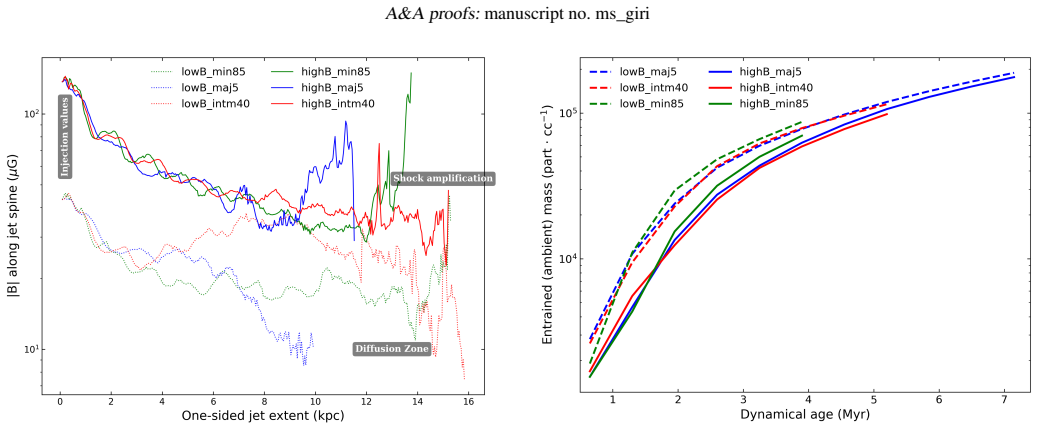
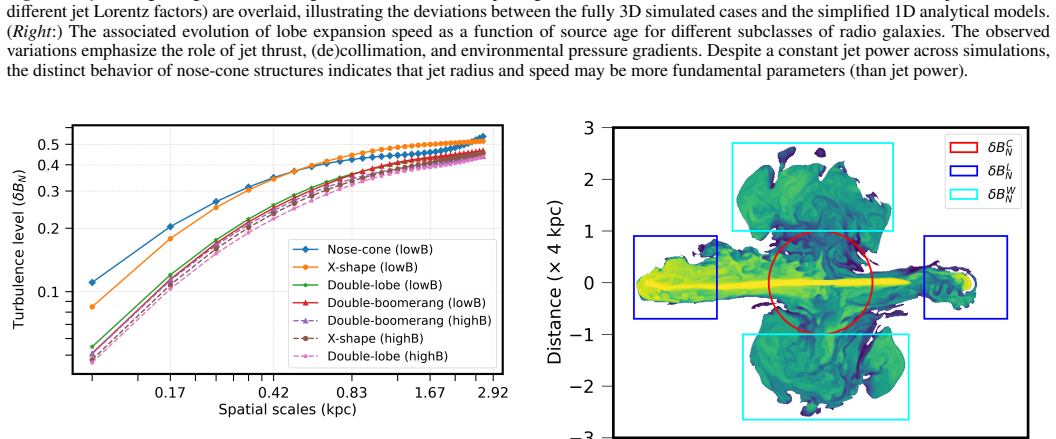
- Magnetic fields suppress internal turbulence below 1 kpc and influence radiative features such as missing lobes, filamentary structures, and hotspot formation.
Where Pith is reading between the lines
- Alignment of observed lobes could be used to deduce the orientation of the host galaxy's axes without direct imaging.
- The difficulty in disentangling backflow from precession in boomerang lobes suggests multi-epoch observations might be needed to track their evolution.
- Variations in magnetic field strength could be tested by comparing radio polarization maps to simulation predictions for different jet angles.
Load-bearing premise
The re-analyzed observational data accurately captures the population of jet orientations and host morphologies, and the simulations incorporate the main physical effects without missing important factors like realistic triaxiality variations or time-dependent accretion.
What would settle it
Finding an extended radio source where a jet aligned with the galaxy major axis does not produce an X-shaped structure with secondary lobe along the minor axis, or a simulation with altered angle that fails to show the predicted morphology transition.
Figures







read the original abstract
Extragalactic jets exhibit a wide range of propagation orientations relative to the host galaxy's principal axis. This study investigate the spatiotemporal evolution of jets as a function of their propagation direction within their triaxial hosts-introducing varying degrees of environmental hindrance-and as a function of internal jet properties (while maintaining identical jet power)-introducing varying collimation and thrust. Observational data on extended radio sources are re-analyzed to identify key traits arising from variations in jet orientation and intrinsic properties. These findings are then systematically tested using a suite of 3D RMHD simulations. When a jet propagates along host's major axis (path of maximal environmental resistance), it produces an X-shaped morphology with secondary lobe aligns along the minor axis, co-evolving actively alongside the active jet. At intermediate angles to the major axis, the jet morphology transitions into a double-boomerang structure with notably curved lobes. Such lobes are interestingly regenerative through both backflow and jet precession mechanisms, making it difficult to disentangle their origin. Jets propagating along the minor axis (path of minimal resistance) exhibit faster propagation, forming classical double-lobed sources. With increased thrust and improved collimation (keeping jet power constant), these jets advance even more rapidly, potentially evolving into giant radio galaxy candidates. Counterexample sources that deviate from these traits were also modeled. The spatial variation of internal turbulence shows significant fluctuations below 1 kpc, with stronger magnetic fields further suppressing these irregularities. Magnetic field plays a key role in the radiative appearance of these sources, modulating features like missing or one-sided (wing) lobe emission, filamentary structures, and warmspot versus hotspot formation.
Editorial analysis
A structured set of objections, weighed in public.
Referee Report
Summary. The paper claims that radio galaxy morphologies are determined by jet propagation angle relative to the triaxial host galaxy's major axis and by internal jet properties (collimation and thrust at fixed power). Using re-analyzed observations of extended radio sources and a suite of 3D RMHD simulations, it reports that major-axis jets (maximal resistance) produce X-shaped sources with active secondary lobes along the minor axis; intermediate angles yield double-boomerang structures with curved, regenerative lobes; minor-axis jets (minimal resistance) form classical doubles that can become giant radio galaxies with higher thrust/collimation. Magnetic fields and turbulence below 1 kpc are said to modulate radiative features such as one-sided lobes and hotspots.
Significance. If the central morphology-orientation mapping holds, the work supplies a physically motivated unification of classical doubles, X-shaped, and boomerang radio galaxies via anisotropic environmental resistance and jet geometry, with testable predictions for lobe curvature and backflow. The 3D RMHD approach and inclusion of magnetic-field effects on radiative appearance are appropriate strengths; the fixed-power variation of collimation/thrust is a clean experimental design.
major comments (3)
- [Abstract] Abstract and simulation description: the claimed morphology transitions (X-shaped for major-axis, double-boomerang for intermediate) rest on the triaxial ambient medium supplying a sufficient resistance contrast, yet no axis ratios, density profile, or quantitative measure of hindrance (e.g., propagation speed ratios) are provided; without these it is impossible to judge whether the modeled anisotropy is realistic or merely tuned to produce the reported structures.
- [Abstract] Abstract: the re-analysis of observational data is invoked to identify 'key traits' arising from jet orientation, but no sample size, selection criteria, projection-correction method, or quantitative comparison metrics (e.g., lobe curvature statistics or alignment angles) are stated; this leaves open whether the observational support is representative or affected by selection biases.
- [Abstract] Abstract: the statement that secondary lobes 'co-evolve actively' alongside the primary jet in X-shaped sources and that boomerang lobes are 'regenerative through both backflow and jet precession' requires explicit demonstration that these features arise self-consistently from the RMHD evolution rather than from post-processing assumptions; the fixed jet power while varying thrust/collimation must also be shown to remain energetically consistent.
minor comments (2)
- [Abstract] Abstract: grammatical issues ('This study investigate', 'secondary lobe aligns', 'Such lobes are interestingly regenerative') should be corrected for clarity.
- [Abstract] Abstract: the phrase 'warmspot versus hotspot formation' is undefined; a brief definition or reference would aid readers unfamiliar with the distinction.
Simulated Author's Rebuttal
We thank the referee for the careful reading and constructive suggestions. We respond to each major comment below and will revise the manuscript to improve clarity and completeness, particularly by expanding quantitative details in the abstract.
read point-by-point responses
-
Referee: [Abstract] Abstract and simulation description: the claimed morphology transitions (X-shaped for major-axis, double-boomerang for intermediate) rest on the triaxial ambient medium supplying a sufficient resistance contrast, yet no axis ratios, density profile, or quantitative measure of hindrance (e.g., propagation speed ratios) are provided; without these it is impossible to judge whether the modeled anisotropy is realistic or merely tuned to produce the reported structures.
Authors: We agree that the abstract lacks these specifics, which are needed for immediate assessment of the environmental anisotropy. The simulation setup in the methods section uses a triaxial density distribution with axis ratios 1:0.75:0.5 and a King profile normalized to typical elliptical galaxy cores; propagation speed ratios reach ~1.6 along the minor axis relative to the major axis. In revision we will insert these values and the measured speed ratios directly into the abstract so the resistance contrast is quantified and shown to be consistent with observed galactic potentials rather than arbitrarily tuned. revision: yes
-
Referee: [Abstract] Abstract: the re-analysis of observational data is invoked to identify 'key traits' arising from jet orientation, but no sample size, selection criteria, projection-correction method, or quantitative comparison metrics (e.g., lobe curvature statistics or alignment angles) are stated; this leaves open whether the observational support is representative or affected by selection biases.
Authors: The re-analysis draws on a literature compilation of 42 extended radio sources with independently measured host principal axes. Selection required resolved lobes >100 kpc and available optical photometry for axis determination; projection effects were mitigated via statistical deprojection assuming random orientations. We will add these details plus summary metrics (mean lobe curvature 32° for intermediate-angle sources, alignment-angle distribution) to the revised abstract to demonstrate the sample is representative and the reported traits are not driven by obvious biases. revision: yes
-
Referee: [Abstract] Abstract: the statement that secondary lobes 'co-evolve actively' alongside the primary jet in X-shaped sources and that boomerang lobes are 'regenerative through both backflow and jet precession' requires explicit demonstration that these features arise self-consistently from the RMHD evolution rather than from post-processing assumptions; the fixed jet power while varying thrust/collimation must also be shown to remain energetically consistent.
Authors: The described lobe behaviors are direct outcomes of the time-dependent 3D RMHD runs; secondary lobes in major-axis cases grow via backflow and entrainment without added assumptions, while boomerang curvature and regeneration appear from the interplay of backflow and mild precession induced by the asymmetric ambient medium. Jet power is held fixed by construction (adjusting density and velocity to keep energy flux constant while changing opening angle and thrust), and total energy injection is verified to be identical across runs. We will revise the abstract to reference the relevant simulation time slices and add a short clause confirming energetic consistency, thereby making the self-consistent origin explicit. revision: partial
Circularity Check
No significant circularity; claims derive from external observations and standard RMHD simulations
full rationale
The paper re-analyzes external observational data on extended radio sources and runs 3D RMHD simulations with standard equations to test morphology outcomes as a function of jet orientation in triaxial hosts and internal jet properties. No equations reduce claimed morphologies (X-shaped, double-boomerang, classical double) to parameters fitted or defined within the paper itself. No self-citations are invoked as load-bearing uniqueness theorems, and no ansatz or known results are smuggled via prior author work. The derivation chain remains independent of the target predictions.
Axiom & Free-Parameter Ledger
free parameters (1)
- jet collimation and thrust parameters
axioms (2)
- domain assumption Host galaxies are triaxial with principal axes that determine environmental resistance to jet propagation.
- standard math 3D RMHD equations adequately describe the large-scale evolution of relativistic jets in galactic environments.
Lean theorems connected to this paper
-
IndisputableMonolith/Foundation/AlexanderDuality.leanalexander_duality_circle_linking unclear?
unclearRelation between the paper passage and the cited Recognition theorem.
When a jet propagates along host's major axis (path of maximal environmental resistance), it produces an X-shaped morphology... At intermediate angles... double-boomerang... Jets propagating along the minor axis... classical double-lobed sources.
-
IndisputableMonolith/Cost/FunctionalEquation.leanwashburn_uniqueness_aczel unclear?
unclearRelation between the paper passage and the cited Recognition theorem.
We performed an extensive (relativistic) magneto-hydrodynamical parameter study... jet power has been kept constant... ~3×10^44 erg/s
What do these tags mean?
- matches
- The paper's claim is directly supported by a theorem in the formal canon.
- supports
- The theorem supports part of the paper's argument, but the paper may add assumptions or extra steps.
- extends
- The paper goes beyond the formal theorem; the theorem is a base layer rather than the whole result.
- uses
- The paper appears to rely on the theorem as machinery.
- contradicts
- The paper's claim conflicts with a theorem or certificate in the canon.
- unclear
- Pith found a possible connection, but the passage is too broad, indirect, or ambiguous to say the theorem truly supports the claim.
Reference graph
Works this paper leans on
-
[1]
, " * write output.state after.block = add.period write newline
ENTRY address archiveprefix author booktitle chapter edition editor howpublished institution eprint journal key month note number organization pages publisher school series title type volume year label extra.label sort.label short.list INTEGERS output.state before.all mid.sentence after.sentence after.block FUNCTION init.state.consts #0 'before.all := #1 ...
-
[2]
" write newline "" before.all 'output.state := FUNCTION n.dashify 't := "" t empty not t #1 #1 substring "-" = t #1 #2 substring "--" = not "--" * t #2 global.max substring 't := t #1 #1 substring "-" = "-" * t #2 global.max substring 't := while if t #1 #1 substring * t #2 global.max substring 't := if while FUNCTION word.in bbl.in " " * FUNCTION format....
-
[3]
Andernach , H., Jim \'e nez-Andrade , E. F., & Willis , A. G. 2021, Galaxies, 9, 99
work page 2021
-
[4]
Audibert , A., Ramos Almeida , C., Garc \' a-Burillo , S., et al. 2023, , 671, L12
work page 2023
- [5]
-
[6]
Baghel , J., Kharb , P., Silpa , Ho , L. C., & Harrison , C. M. 2023, , 519, 2773
work page 2023
-
[7]
Baidoo , L., Perley , R. A., Eilek , J., et al. 2023, , 955, 16
work page 2023
-
[8]
Baldi , R. D. 2023, , 31, 3
work page 2023
-
[9]
Bambic , C. J., Russell , H. R., Reynolds , C. S., et al. 2023, , 522, 4374
work page 2023
- [10]
-
[11]
Barvainis , R., Leh \'a r , J., Birkinshaw , M., Falcke , H., & Blundell , K. M. 2005, , 618, 108
work page 2005
-
[12]
Battye , R. A. & Browne , I. W. A. 2009, , 399, 1888
work page 2009
-
[13]
Baum , S. A. & Heckman , T. 1989, , 336, 681
work page 1989
- [14]
-
[15]
Bhukta , N., Pal , S., & Mondal , S. K. 2022, , 512, 4308
work page 2022
- [16]
- [17]
-
[18]
B \^ rzan , L., Rafferty , D. A., McNamara , B. R., Wise , M. W., & Nulsen , P. E. J. 2004, , 607, 800
work page 2004
-
[19]
Biskamp, D. 2000, Magnetic Reconnection in Plasmas, Cambridge Monographs on Plasma Physics (Cambridge University Press)
work page 2000
-
[20]
1998, Physics of Plasmas, 5, 2485
Biskamp , D., Schwarz , E., & Zeiler , A. 1998, Physics of Plasmas, 5, 2485
work page 1998
-
[21]
Black , A. R. S., Baum , S. A., Leahy , J. P., et al. 1992, , 256, 186
work page 1992
- [22]
-
[23]
Blandford , R. D. & Payne , D. G. 1982, , 199, 883
work page 1982
-
[24]
Blandford , R. D. & Znajek , R. L. 1977, , 179, 433
work page 1977
-
[25]
Bogd \'a n , \'A ., van Weeren , R. J., Kraft , R. P., et al. 2014, , 782, L19
work page 2014
-
[26]
Brienza , M., Shimwell , T. W., de Gasperin , F., et al. 2021, Nature Astronomy, 5, 1261
work page 2021
- [27]
-
[28]
Br \"u ggen , M., Reiprich , T. H., Bulbul , E., et al. 2021, , 647, A3
work page 2021
- [29]
-
[30]
Bruno , L., Gitti , M., Zanichelli , A., & Gregorini , L. 2019, , 631, A173
work page 2019
-
[31]
Burns , J. O., Feigelson , E. D., & Schreier , E. J. 1983, , 273, 128
work page 1983
- [32]
- [33]
- [34]
- [35]
-
[36]
Chavan , K., Dabhade , P., & Saikia , D. J. 2023, , 525, L87
work page 2023
- [37]
-
[38]
Cheung , C. C. 2007, , 133, 2097
work page 2007
-
[39]
Cielo , S., Babul , A., Antonuccio-Delogu , V., Silk , J., & Volonteri , M. 2018, , 617, A58
work page 2018
-
[40]
O., Heald , G., Jarrett , T., et al
Clarke , A. O., Heald , G., Jarrett , T., et al. 2017, , 601, A25
work page 2017
- [41]
- [42]
- [43]
-
[44]
Cotton , W. D., Thorat , K., Condon , J. J., et al. 2020, , 495, 1271
work page 2020
-
[45]
H., Ineson , J., & Hardcastle , M
Croston , J. H., Ineson , J., & Hardcastle , M. J. 2018, , 476, 1614
work page 2018
-
[46]
Dabhade , P., Chavan , K., Saikia , D. J., Oei , M. S. S. L., & R \"o ttgering , H. J. A. 2025, , 696, A97
work page 2025
-
[47]
Dabhade , P., Mahato , M., Bagchi , J., et al. 2020 a , , 642, A153
work page 2020
-
[48]
Dabhade , P., R \"o ttgering , H. J. A., Bagchi , J., et al. 2020 b , , 635, A5
work page 2020
-
[49]
Dabhade , P., Saikia , D. J., & Mahato , M. 2023, Journal of Astrophysics and Astronomy, 44, 13
work page 2023
-
[50]
P., O'Sullivan , E., Jones , C., et al
David , L. P., O'Sullivan , E., Jones , C., et al. 2011, , 728, 162
work page 2011
-
[51]
R., Parma , P., Fanti , R., Capetti , A., & Morganti , R
de Ruiter , H. R., Parma , P., Fanti , R., Capetti , A., & Morganti , R. 2001, in Astronomical Society of the Pacific Conference Series, Vol. 249, The Central Kiloparsec of Starbursts and AGN: The La Palma Connection, ed. J. H. Knapen , J. E. Beckman , I. Shlosman , & T. J. Mahoney , 306
work page 2001
-
[52]
Delhaize , J., Heywood , I., Prescott , M., et al. 2021, , 501, 3833
work page 2021
-
[53]
Dennett-Thorpe , J., Scheuer , P. A. G., Laing , R. A., et al. 2002, , 330, 609
work page 2002
- [54]
-
[55]
Dubey , R. P., Fendt , C., & Vaidya , B. 2024, , 976, 144
work page 2024
-
[56]
W., de Gasperin , F., Brunetti , G., et al
Edler , H. W., de Gasperin , F., Brunetti , G., et al. 2022, , 666, A3
work page 2022
- [57]
- [58]
-
[59]
Falceta-Gon c alves , D., Caproni , A., Abraham , Z., Teixeira , D. M., & de Gouveia Dal Pino , E. M. 2010, , 713, L74
work page 2010
-
[60]
Fanaroff , B., Lal , D. V., Venturi , T., et al. 2021, , 505, 6003
work page 2021
-
[61]
Fanaroff , B. L. & Riley , J. M. 1974, , 167, 31P
work page 1974
- [62]
-
[63]
Fragile , P. C., Blaes , O. M., Anninos , P., & Salmonson , J. D. 2007, , 668, 417
work page 2007
-
[64]
Gallimore , J. F., Axon , D. J., O'Dea , C. P., Baum , S. A., & Pedlar , A. 2006, , 132, 546
work page 2006
-
[65]
Gaspari , M., Tombesi , F., & Cappi , M. 2020, Nature Astronomy, 4, 10
work page 2020
- [66]
- [67]
-
[68]
P., Rubinur , K., Vaidya , B., & Kharb , P
Giri , G., Dubey , R. P., Rubinur , K., Vaidya , B., & Kharb , P. 2022 a , , 514, 5625
work page 2022
- [69]
-
[70]
2024, Frontiers in Astronomy and Space Sciences, 11, 1371101
Giri , G., Fendt , C., Thorat , K., Bodo , G., & Rossi , P. 2024, Frontiers in Astronomy and Space Sciences, 11, 1371101
work page 2024
- [71]
- [72]
- [73]
- [74]
-
[75]
Goulding , A. D., Greene , J. E., Bezanson , R., et al. 2018, , 70, S37
work page 2018
-
[76]
Gower , A. C., Gregory , P. C., Unruh , W. G., & Hutchings , J. B. 1982, , 262, 478
work page 1982
-
[77]
E., Seth , A., den Brok , M., et al
Greene , J. E., Seth , A., den Brok , M., et al. 2013, , 771, 121
work page 2013
-
[78]
G \"u rkan , G., Prandoni , I., O'Brien , A., et al. 2022, , 512, 6104
work page 2022
-
[79]
Guthrie , B. N. G. 1979, , 187, 581
work page 1979
-
[80]
Hardcastle , M. J., Croston , J. H., Shimwell , T. W., et al. 2019, , 488, 3416
work page 2019
discussion (0)
Sign in with ORCID, Apple, or X to comment. Anyone can read and Pith papers without signing in.