Robust H(curl)-based finite element methods for the incompressible MHD system
Pith reviewed 2026-05-10 18:48 UTC · model grok-4.3
The pith
H(curl)-conforming finite elements for velocity and magnetic field yield stable discretizations of time-dependent incompressible MHD on nonconvex domains.
A machine-rendered reading of the paper's core claim, the machinery that carries it, and where it could break.
Core claim
The authors introduce three stabilized formulations based on H(curl)-conforming finite elements for both velocity and magnetic field in the incompressible MHD system. These formulations are shown to be suitable for nonconvex polyhedral domains, with varying needs for Lagrange multipliers, and to exhibit pressure-robustness along with quasi-robustness with respect to the fluid and magnetic Reynolds numbers.
What carries the argument
H(curl)-conforming finite element spaces for both velocity and magnetic field, combined with stabilization terms that enforce divergence-free constraints and control oscillations at high Reynolds numbers.
If this is right
- The methods remain accurate for solutions with singularities induced by nonconvex geometry without requiring special treatment near edges or corners.
- Pressure-robustness decouples the velocity error from the quality of the pressure approximation.
- Quasi-robustness with respect to Reynolds numbers permits reliable results across laminar to convection-dominated regimes.
- The choice among the three stabilizations determines whether a Lagrange multiplier is needed for the magnetic field constraint.
Where Pith is reading between the lines
- The same H(curl) framework could be reused for other coupled systems that combine fluid flow with electromagnetic fields, such as plasma models.
- Adaptive selection of stabilization parameters based on local flow features might further improve efficiency without losing the proven robustness.
- Direct comparison with standard H1-conforming schemes on the same nonconvex test cases would quantify the practical gain in accuracy near singularities.
Load-bearing premise
Stabilization parameters can be chosen so the schemes stay stable and accurate for every Reynolds number and on arbitrary nonconvex polyhedral domains.
What would settle it
A simulation on a nonconvex polyhedral domain at high fluid or magnetic Reynolds number in which the computed velocity or magnetic field diverges or fails to converge at the expected rate for any choice of the stabilization parameters.
Figures


read the original abstract
We propose and analyze a class of finite element methods for the time-dependent incompressible magnetohydrodynamics system based on $H(\mathrm{curl})$-conforming discretizations for both the velocity and the magnetic field. This choice is guided by the aim of developing methods that are also suitable for the types of solutions arising in problems posed on nonconvex domains. Within this framework, we introduce three stabilized formulations, and study how the stabilization mechanisms employed influence their structural properties. In particular, we focus on suitability for nonconvex polyhedral domains, the need for Lagrange multipliers for the magnetic field, pressure-robustness, and quasi-robustness with respect to both the fluid and magnetic Reynolds numbers. The proposed formulations are further assessed through numerical experiments, highlighting their practical performance.
Editorial analysis
A structured set of objections, weighed in public.
Referee Report
Summary. The paper proposes and analyzes three stabilized H(curl)-conforming finite element discretizations for the time-dependent incompressible MHD system, using H(curl) elements for both velocity and magnetic field to handle solutions on nonconvex polyhedral domains. It examines the structural properties of the formulations (including the need for Lagrange multipliers, pressure-robustness, and quasi-robustness w.r.t. fluid and magnetic Reynolds numbers) and supports the claims with a priori analysis and numerical experiments.
Significance. If the uniformity of the stability and error bounds with respect to Reynolds numbers and domain geometry holds without hidden parameter dependencies, the work would provide practical, structure-preserving methods for MHD on complex domains that avoid common pitfalls like locking or the need for additional multipliers, advancing robust FEM for coupled incompressible flow problems.
major comments (2)
- [§4] §4 (stability analysis): The inf-sup and coercivity proofs for the three stabilized schemes rely on lower bounds for the stabilization parameters that are stated to be independent of Re_f and Re_m, but the constants in the estimates (e.g., in the discrete kernel control terms) contain factors that may grow with the solution regularity deficit on nonconvex domains; no explicit verification or counterexample test is given to confirm uniformity when re-entrant corners induce singularities below H^1.
- [§5] §5 (error estimates): The quasi-robustness claim in Theorem 5.2 asserts error bounds independent of Re_f and Re_m, yet the proof sketch invokes inverse inequalities and stabilization terms whose mesh-dependent constants are not shown to remain bounded uniformly when the domain is nonconvex; this directly affects the central assertion that the methods are suitable without additional constraints.
minor comments (2)
- [§3] The notation for the stabilization parameters (e.g., α, β, γ) is introduced without a consolidated table of admissible ranges; a summary table would improve readability.
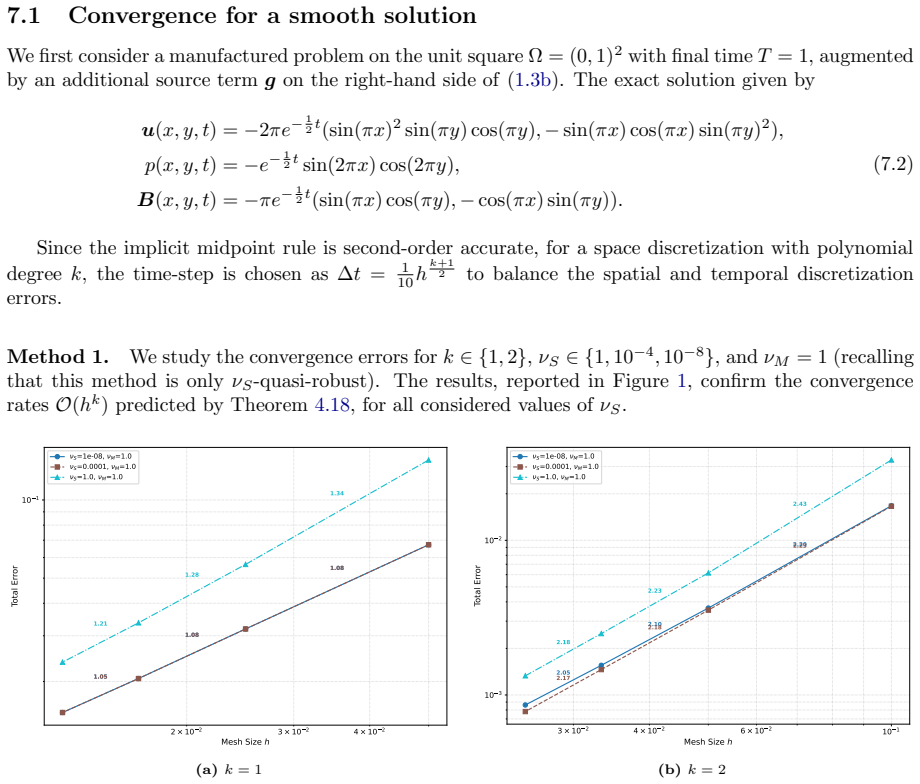
- [§6] Figure 6.1 (convergence plots) lacks error bars or multiple mesh families; adding these would strengthen the numerical evidence for robustness.
Simulated Author's Rebuttal
We thank the referee for the thorough review and valuable comments on our manuscript. We address the major comments point by point below.
read point-by-point responses
-
Referee: [§4] §4 (stability analysis): The inf-sup and coercivity proofs for the three stabilized schemes rely on lower bounds for the stabilization parameters that are stated to be independent of Re_f and Re_m, but the constants in the estimates (e.g., in the discrete kernel control terms) contain factors that may grow with the solution regularity deficit on nonconvex domains; no explicit verification or counterexample test is given to confirm uniformity when re-entrant corners induce singularities below H^1.
Authors: We thank the referee for this observation. The lower bounds for the stabilization parameters are derived to be independent of Re_f and Re_m through the coercivity and inf-sup conditions in Section 4. The constants in the discrete kernel control terms depend on the domain geometry and solution regularity but are independent of the Reynolds numbers by the structure of the stabilization. We will add a clarifying remark after the stability results to state this explicitly and include a numerical test on a nonconvex domain with re-entrant corners to demonstrate practical uniformity. revision: partial
-
Referee: [§5] §5 (error estimates): The quasi-robustness claim in Theorem 5.2 asserts error bounds independent of Re_f and Re_m, yet the proof sketch invokes inverse inequalities and stabilization terms whose mesh-dependent constants are not shown to remain bounded uniformly when the domain is nonconvex; this directly affects the central assertion that the methods are suitable without additional constraints.
Authors: We agree that the proof sketch in Theorem 5.2 would benefit from greater explicitness. The quasi-robustness follows from the stabilization design that removes Re_f and Re_m dependence in the error terms, and the inverse inequalities have constants independent of the Reynolds numbers. We will revise the proof to include a detailed step verifying uniformity of the mesh-dependent constants on nonconvex domains and add a reference to approximation results for H(curl) elements on polyhedra with singularities. revision: yes
Circularity Check
No significant circularity; derivations rest on standard FE theory
full rationale
The paper defines three stabilized H(curl) formulations from first principles using standard conforming spaces, then derives stability, pressure-robustness and quasi-robustness via inf-sup arguments and a priori estimates. No equation reduces to a fitted parameter renamed as prediction, no self-definition of the target quantities, and no load-bearing uniqueness theorem imported from the authors' prior work. Self-citations (if any) supply auxiliary results that are independently verifiable by standard FE analysis and do not close a tautological loop around the main claims. The analysis is therefore self-contained against external benchmarks.
Axiom & Free-Parameter Ledger
free parameters (1)
- stabilization parameters
axioms (2)
- domain assumption The computational domain is a nonconvex polyhedron
- standard math Standard Sobolev-space setting for the continuous MHD system
Lean theorems connected to this paper
-
IndisputableMonolith/Cost/FunctionalEquation.leanwashburn_uniqueness_aczel unclear?
unclearRelation between the paper passage and the cited Recognition theorem.
We introduce three stabilized formulations... focus on suitability for nonconvex polyhedral domains, the need for Lagrange multipliers..., pressure-robustness, and quasi-robustness with respect to both the fluid and magnetic Reynolds numbers.
-
IndisputableMonolith/Foundation/AlphaCoordinateFixation.leanalpha_pin_under_high_calibration contradicts?
contradictsCONTRADICTS: the theorem conflicts with this paper passage, or marks a claim that would need revision before publication.
For α sufficiently large, there is a positive constant β independent of h, ν_S, and ν_M such that a(vh,vh)+dh(vh,vh)≥β∥vh∥²_#
What do these tags mean?
- matches
- The paper's claim is directly supported by a theorem in the formal canon.
- supports
- The theorem supports part of the paper's argument, but the paper may add assumptions or extra steps.
- extends
- The paper goes beyond the formal theorem; the theorem is a base layer rather than the whole result.
- uses
- The paper appears to rely on the theorem as machinery.
- contradicts
- The paper's claim conflicts with a theorem or certificate in the canon.
- unclear
- Pith found a possible connection, but the passage is too broad, indirect, or ambiguous to say the theorem truly supports the claim.
Reference graph
Works this paper leans on
-
[1]
C. Amrouche, C. Bernardi, M. Dauge, and V. Girault. Vector potentials in three-dimensional non- smooth domains.Math. Methods Appl. Sci., 21(9):823–864, 1998
work page 1998
-
[2]
D. S. Balsara and M. Dumbser. Divergence-free MHD on unstructured meshes using high order finite volume schemes based on multidimensional Riemann solvers.J. Comput. Phys., 299:687–715, 2015. 32 (a)Unstabilized method (b)Method 1 (c)Method 2 (d)Method 3 Figure 6:Pressure approximation for the Orszag–Tang vortex problem at the final timeT= 0.4. 0.00 0.05 0....
work page 2015
-
[3]
L. Beir˜ ao da Veiga, F. Dassi, D. A. Di Pietro, and J. Droniou. Arbitrary-order pressure-robust DDR and VEM methods for the Stokes problem on polyhedral meshes.Comput. Methods Appl. Mech. Engrg., 397:Paper No. 115061, 31, 2022
work page 2022
-
[4]
L. Beir˜ ao da Veiga, F. Dassi, and G. Vacca. Robust finite elements for linearized magnetohydrody- 33 namics.SIAM J. Numer. Anal., 62(4):1539–1564, 2024
work page 2024
-
[5]
L. Beir˜ ao da Veiga, F. Dassi, and G. Vacca. Pressure and convection robust finite elements for magnetohydrodynamics.Numer. Math., 157(4):1161–1209, 2025
work page 2025
-
[6]
L. Beir˜ ao da Veiga, K. Hu, and L. Mascotto. Error estimates for a helicity-preserving finite element discretisation of an incompressible magnetohydrodynamics system.ESAIM Math. Model. Numer. Anal., 59(2):1075–1094, 2025
work page 2025
- [7]
- [8]
-
[9]
W. M. Boon, W. Tonnon, and E. Zampa. H(curl)-based approximation of the Stokes problem with weakly enforced no-slip boundary conditions.Comput. Methods Appl. Mech. Engrg., 448:Paper No. 118484, 2026
work page 2026
-
[10]
S. C. Brenner and L. R. Scott.The mathematical theory of finite element methods, volume 15 of Texts Appl. Math.New York, NY: Springer, 3rd ed. edition, 2008
work page 2008
- [11]
-
[12]
T. Chaumont-Frelet and M. Vohral´ ık. A stable local commuting projector and optimalhpapproxi- mation estimates inH(curl).Numer. Math., 156(6):2293–2342, 2024
work page 2024
- [13]
- [14]
-
[15]
D. A. Di Pietro, J. Droniou, and J. J. Qian. A pressure-robust discrete de Rham scheme for the Navier-Stokes equations.Comput. Methods Appl. Mech. Engrg., 421:Paper No. 116765, 21, 2024
work page 2024
-
[16]
J. Douglas Jr., T. Dupont, and L. Wahlbin. The stability inL q of theL 2-projection into finite element function spaces.Numer. Math., 23:193–197, 1974/75
work page 1974
-
[17]
A. Ern and J.-L. Guermond. Finite element quasi-interpolation and best approximation.ESAIM Math. Model. Numer. Anal., 51(4):1367–1385, 2017
work page 2017
-
[18]
A. Ern and J.-L. Guermond.Finite elements I. Approximation and interpolation, volume 72 ofTexts Appl. Math.Cham: Springer, 2020
work page 2020
-
[19]
F. Fambri, E. Zampa, S. Busto, L. R´ ıo-Mart´ ın, F. Hindenlang, E. Sonnendr¨ ucker, and M. Dumbser. A well-balanced and exactly divergence-free staggered semi-implicit hybrid finite volume / finite element scheme for the incompressible MHD equations.J. Comput. Phys., 493:Paper No. 112493, 48, 2023
work page 2023
-
[20]
G. Fu. An explicit divergence-free DG method for incompressible magnetohydrodynamics.J. Sci. Comput., 79(3):1737–1752, 2019
work page 2019
-
[21]
T. A. Gardiner and J. M. Stone. An unsplit Godunov method for ideal MHD via constrained transport.J. Comput. Phys., 205(2):509–539, 2005
work page 2005
-
[22]
E. S. Gawlik and F. Gay-Balmaz. A finite element method for MHD that preserves energy, cross- helicity, magnetic helicity, incompressibility, and divB= 0.J. Comput. Phys., 450:Paper No. 110847, 20, 2022
work page 2022
-
[23]
J.-F. Gerbeau. A stabilized finite element method for the incompressible magnetohydrodynamic equations.Numer. Math., 87(1):83–111, 2000
work page 2000
-
[24]
J.-F. Gerbeau, C. Le Bris, and T. Leli` evre.Mathematical methods for the magnetohydrodynamics of liquid metals.Numer. Math. Sci. Comput. Oxford: Oxford University Press, 2006. 34
work page 2006
-
[25]
V. Girault. Incompressible finite element methods for Navier-Stokes equations with nonstandard boundary conditions inR 3.Math. Comp., 51(183):55–74, 1988
work page 1988
-
[26]
V. Girault. Curl-conforming finite element methods for Navier-Stokes equations with nonstandard boundary conditions inR 3. InThe Navier-Stokes equations (Oberwolfach, 1988), volume 1431 of Lecture Notes in Math., pages 201–218. Springer, Berlin, 1990
work page 1988
-
[27]
M. He, P. E. Farrell, K. Hu, and B. D. Andrews. Helicity-Preserving Finite Element Discretization for Magnetic Relaxation.SIAM J. Sci. Comput., 48(2):B165–B183, 2026
work page 2026
-
[28]
R. Hiptmair and C. Pagliantini. Splitting-based structure preserving discretizations for magnetohy- drodynamics.SMAI J. Comput. Math., 4:225–257, 2018
work page 2018
- [29]
-
[30]
V. John, A. Linke, C. Merdon, M. Neilan, and L. G. Rebholz. On the divergence constraint in mixed finite element methods for incompressible flows.SIAM Rev., 59(3):492–544, 2017
work page 2017
-
[31]
F. Laakmann, K. Hu, and P. E. Farrell. Structure-preserving and helicity-conserving finite element approximations and preconditioning for the Hall MHD equations.J. Comput. Phys., 492:Paper No. 112410, 25, 2023
work page 2023
- [32]
-
[33]
M. Mitrea and S. Monniaux. The nonlinear Hodge-Navier-Stokes equations in Lipschitz domains. Differ. Integral Equ., 22(3-4):339–356, 2009
work page 2009
-
[34]
J.-C. N´ ed´ elec. Mixed finite elements inR3.Numer. Math., 35(3):315–341, 1980
work page 1980
-
[35]
F. W. J. Olver, D. W. Lozier, R. F. Boisvert, and C. W. Clark, editors.NIST handbook of mathe- matical functions. Cambridge: Cambridge University Press, 2010
work page 2010
-
[36]
S. A. Orszag and C.-M. Tang. Small-scale structure of two-dimensional magnetohydrodynamic turbulence.J. Fluid Mech., 90(1):129–143, 1979
work page 1979
-
[37]
A. Prohl. Convergent finite element discretizations of the nonstationary incompressible magnetohy- drodynamics system.M2AN Math. Model. Numer. Anal., 42(6):1065–1087, 2008
work page 2008
-
[38]
J. Sch¨ oberl. C++11 implementation of finite elements in NGSolve.Technical Report ASC-2014-30, Institute for Analysis and Scientific Computing, September 2014
work page 2014
-
[39]
D. Sch¨ otzau. Mixed finite element methods for stationary incompressible magneto-hydrodynamics. Numer. Math., 96(4):771–800, 2004
work page 2004
- [40]
-
[41]
G. A. Wimmer and X.-Z. Tang. Structure preserving transport stabilized compatible finite element methods for magnetohydrodynamics.J. Comput. Phys., 501:Paper No. 112777, 25, 2024
work page 2024
- [42]
-
[43]
Y. Zhang, A. Palha, M. Gerritsma, and L. G. Rebholz. A mass-, kinetic energy- and helicity- conserving mimetic dual-field discretization for three-dimensional incompressible Navier-Stokes equa- tions, part I: periodic domains.J. Comput. Phys., 451:Paper No. 110868, 23, 2022. 35
work page 2022
discussion (0)
Sign in with ORCID, Apple, or X to comment. Anyone can read and Pith papers without signing in.