Efficient Bayesian Inference in the Cox Model via Rank-Ordered Likelihood
Pith reviewed 2026-05-10 18:27 UTC · model grok-4.3
The pith
Two Gibbs samplers let Bayesian Cox models use the partial likelihood directly while handling ties and frailty.
A machine-rendered reading of the paper's core claim, the machinery that carries it, and where it could break.
Core claim
In the Cox proportional hazards model, Bayesian inference can proceed directly from the partial likelihood by representing the data in rank-ordered form and fitting Plackett-Luce or generalized Plackett-Luce models. Pólya-Gamma data augmentation then produces two Gibbs samplers, PL-Cox and GPL-Cox, that generate posterior samples without correction, accommodate tied event times, and extend naturally to shared frailty models.
What carries the argument
Rank-ordered data representation of the Cox partial likelihood, realized through Plackett-Luce models with Pólya-Gamma augmentation to enable Gibbs sampling.
If this is right
- Posterior samples require no post-hoc correction for validity.
- Tied event times are handled automatically without special adjustments.
- The samplers extend directly to shared frailty models with good computational efficiency.
- PL-Cox performs stably across varying tie levels; GPL-Cox scales better on large datasets.
Where Pith is reading between the lines
- The same rank-order device could simplify Bayesian analysis in other semiparametric models that rely on partial likelihoods.
- These samplers might combine with existing software for high-dimensional covariate screening in survival data.
- Extensions to interval-censored or competing-risks settings appear straightforward but remain untested.
Load-bearing premise
The rank-ordered Plackett-Luce representation exactly preserves the posterior distribution implied by the original Cox partial likelihood.
What would settle it
Run both proposed samplers and an established partial-likelihood MCMC on the same dataset; any systematic difference in the posterior means or credible intervals for the regression coefficients would indicate the representation has altered the target distribution.
Figures




read the original abstract
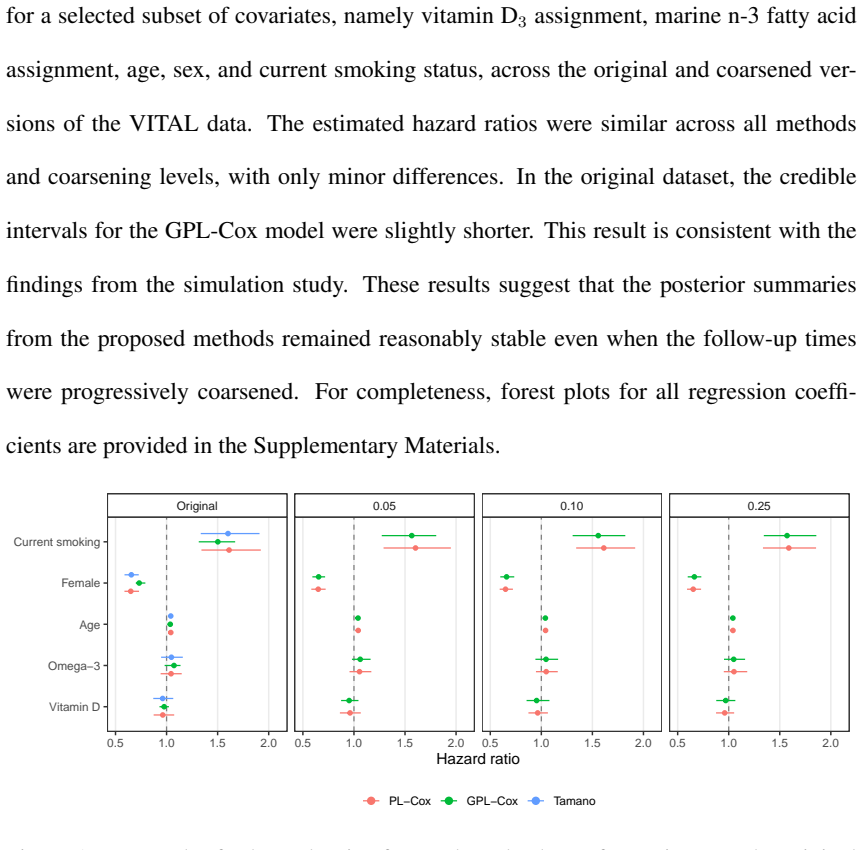
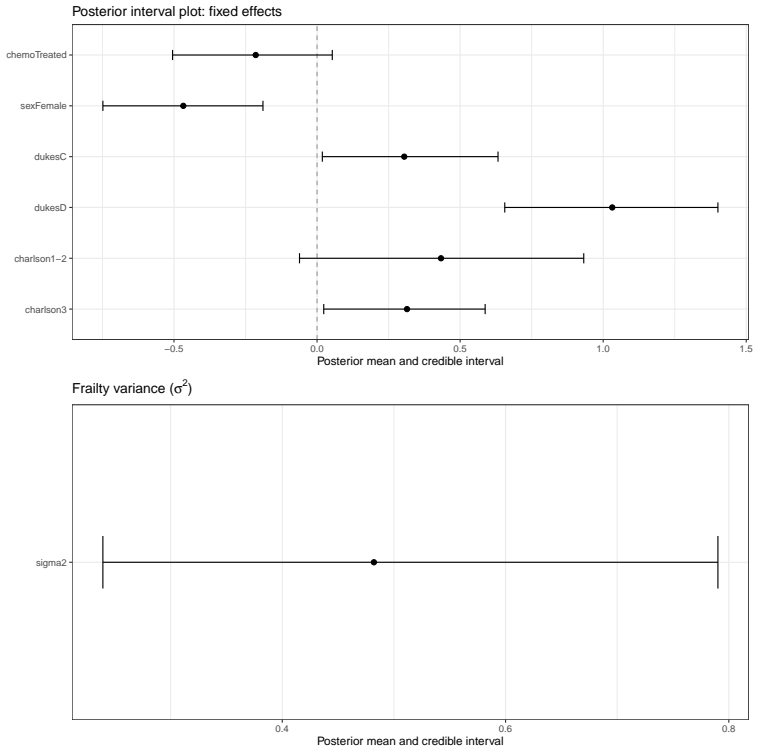
In Bayesian inference for the Cox proportional hazards model, modeling the baseline hazard function is challenging. Recently, direct Bayesian inference using the partial likelihood is considered in the framework of general Bayesian inference. In terms of posterior computation, several studies have examined sampling algorithms under the Cox model. In this study, we propose two Gibbs sampling algorithms for Bayesian inference in the Cox proportional hazards model, motivated by a rank-ordered data representation and based on the Plackett--Luce and generalized Plackett--Luce models with P'{o}lya--Gamma data augmentation, referred to as PL-Cox and GPL-Cox, respectively. The two proposed methods offer practical advantages, as they do not require correction of posterior samples, naturally handle tied event times, and are readily extensible to shared frailty models. In simulation study, we considered multiple survival model settings, including continuous and discrete survival time models, as well as scenarios with varying degrees of ties, and found that the PL-Cox model exhibited relatively stable performance. In analyses of a large real dataset, the proposed methods remained computationally feasible, and the GPL-Cox model showed more favorable computational scalability than the PL-Cox model. In analyses of real data incorporating shared frailty, both methods demonstrated good computational efficiency.
Editorial analysis
A structured set of objections, weighed in public.
Referee Report
Summary. The manuscript presents two Gibbs sampling algorithms called PL-Cox and GPL-Cox for performing Bayesian inference in the Cox proportional hazards model. The approach is based on a rank-ordered representation of the data and employs the Plackett-Luce model and its generalization, augmented with Pólya-Gamma variables, to facilitate sampling. The authors highlight that these methods do not require post-processing of samples, handle tied event times naturally, and can be extended to shared frailty models. They provide simulation results under various settings including ties and apply the methods to a large real-world dataset, noting good computational performance.
Significance. If the proposed rank-ordered likelihood exactly corresponds to the Cox partial likelihood, the paper offers an efficient and practical Bayesian inference framework for survival analysis that builds on established techniques. The extensibility to frailty models and the handling of ties are significant advantages for applied work. The simulation study covering continuous and discrete times with varying ties provides useful evidence of performance.
major comments (2)
- [§2.2] §2.2: The construction of the rank-ordered likelihood for right-censored data is not shown to explicitly truncate the rankings at the censoring times to match the risk sets in the standard partial likelihood. This is load-bearing for the claim that the resulting posterior is identical to that from the Cox partial likelihood; a derivation or proof of equivalence should be added.
- [§4.3] §4.3: In the real data analysis with shared frailty, the computational times are reported but without comparison to alternative Bayesian methods for frailty Cox models, making it hard to evaluate the claimed efficiency gains.
minor comments (2)
- [Abstract] Abstract: The abstract states that 'the PL-Cox model exhibited relatively stable performance' but does not specify the metrics (e.g., bias, coverage, MSE) used to reach this conclusion.
- [§5] §5: Some equations use notation for the Plackett-Luce parameters that could be better aligned with standard survival analysis notation to improve readability for the target audience.
Simulated Author's Rebuttal
We thank the referee for the constructive comments, which have helped us identify areas where the manuscript can be strengthened. We address each major comment below and will revise the manuscript accordingly.
read point-by-point responses
-
Referee: [§2.2] §2.2: The construction of the rank-ordered likelihood for right-censored data is not shown to explicitly truncate the rankings at the censoring times to match the risk sets in the standard partial likelihood. This is load-bearing for the claim that the resulting posterior is identical to that from the Cox partial likelihood; a derivation or proof of equivalence should be added.
Authors: We agree that an explicit derivation is required to establish the equivalence. In the revised manuscript we will expand Section 2.2 with a step-by-step derivation showing that the rank-ordered Plackett-Luce likelihood, when applied to right-censored data, truncates the rankings precisely at the censoring times. This truncation reproduces the risk sets of the standard Cox partial likelihood, thereby confirming that the resulting posterior is identical to the one obtained from the usual partial-likelihood formulation. revision: yes
-
Referee: [§4.3] §4.3: In the real data analysis with shared frailty, the computational times are reported but without comparison to alternative Bayesian methods for frailty Cox models, making it hard to evaluate the claimed efficiency gains.
Authors: We acknowledge that the absence of direct comparisons limits the strength of the efficiency claims. In the revision we will add a new paragraph in Section 4.3 that benchmarks the reported run times against at least one established Bayesian frailty Cox sampler (e.g., the MCMC implementation available in the survival or frailtypack packages) on the same dataset and hardware. This will provide readers with a clearer quantitative assessment of the computational advantages of PL-Cox and GPL-Cox. revision: yes
Circularity Check
No significant circularity; standard application of Plackett-Luce to rank-ordered Cox data
full rationale
The paper motivates Gibbs samplers (PL-Cox, GPL-Cox) by representing Cox partial likelihood via rank-ordered data and Plackett-Luce models with Pólya-Gamma augmentation. This is an application of established models rather than a self-definitional loop or fitted-input prediction. No load-bearing self-citations, uniqueness theorems imported from the authors, or ansatzes smuggled via prior work are present in the abstract or described chain. The central claim (equivalence for posterior inference) is presented as a modeling choice whose statistical properties are asserted to be preserved, not derived tautologically from the samplers themselves. Minor self-citation risk at most (score 1) but central derivation remains independent.
Axiom & Free-Parameter Ledger
axioms (2)
- domain assumption The partial likelihood of the Cox proportional hazards model admits an equivalent rank-ordered data representation.
- domain assumption Pólya-Gamma data augmentation yields tractable conditional distributions for Gibbs sampling under the Plackett-Luce model.
Lean theorems connected to this paper
-
IndisputableMonolith/Cost/FunctionalEquation.leanwashburn_uniqueness_aczel unclear?
unclearRelation between the paper passage and the cited Recognition theorem.
We propose two Gibbs sampling algorithms ... based on the Plackett–Luce and generalized Plackett–Luce models with Pólya–Gamma data augmentation, referred to as PL-Cox and GPL-Cox
-
IndisputableMonolith/Foundation/RealityFromDistinction.leanreality_from_one_distinction unclear?
unclearRelation between the paper passage and the cited Recognition theorem.
the partial likelihood can be interpreted as a sequence of selections from changing risk sets
What do these tags mean?
- matches
- The paper's claim is directly supported by a theorem in the formal canon.
- supports
- The theorem supports part of the paper's argument, but the paper may add assumptions or extra steps.
- extends
- The paper goes beyond the formal theorem; the theorem is a base layer rather than the whole result.
- uses
- The paper appears to rely on the theorem as machinery.
- contradicts
- The paper's claim conflicts with a theorem or certificate in the canon.
- unclear
- Pith found a possible connection, but the passage is too broad, indirect, or ambiguous to say the theorem truly supports the claim.
Reference graph
Works this paper leans on
-
[1]
Baker, R. (2020). New order-statistics-based ranking models and faster computation of outcome probabilities. IMA Journal of Management Mathematics 31, 33--48
work page 2020
-
[2]
Baker, R. and Scarf, P. (2021). Modifying Bradley -- Terry and other ranking models to allow ties. IMA Journal of Management Mathematics 32, 451--463
work page 2021
-
[3]
Bissiri, P. G., Holmes, C. C., and Walker, S. G. (2016). A general framework for updating belief distributions. Journal of the Royal Statistical Society: Series B (Statistical Methodology) 78, 1103--1130
work page 2016
-
[4]
Carvalho, C. M., Polson, N. G., and Scott, J. G. (2010). The horseshoe estimator for sparse signals. Biometrika 97, 465--480
work page 2010
-
[5]
Connors, Jr, A. F., Speroff, T., Dawson, N. V., Thomas, C., Harrell, Jr, F. E., Wagner, D., Desbiens, N., Goldman, L., Wu, A. W., Califf, R. M., Fulkerson, Jr, W. J., Vidaillet, H., Broste, S., Bellamy, P., Lynn, J., and Knaus, W. A. (1996). The Effectiveness of Right Heart Catheterization in the Initial Care of Critically III Patients . JAMA 276, 889--897
work page 1996
-
[6]
Cox, D. R. (1972). Regression Models and Life-Tables . Journal of the Royal Statistical Society. Series B (Methodological) 34, 187--220
work page 1972
-
[7]
Cox, D. R. (1975). Partial likelihood. Biometrika 62, 269--276
work page 1975
-
[8]
D ' Angelo, L. and Canale, A. (2023). Efficient posterior sampling for bayesian poisson regression. Journal of Computational and Graphical Statistics 32, 917--926
work page 2023
-
[9]
Hamura, Y., Irie, K., and Sugasawa, S. (2025). Robust Bayesian Modeling of Counts with Zero Inflation and Outliers : Theoretical Robustness and Efficient Computation . Journal of the American Statistical Association 120, 1545--1557
work page 2025
-
[10]
Henderson, D. A. (2025). Modelling and Analysis of Rank Ordered Data with Ties via a Generalized Plackett-Luce Model . Bayesian Analysis 20, 1109--1137
work page 2025
-
[11]
Kalbfleisch, J. D. (1978). Non- Parametric Bayesian Analysis of Survival Time Data . Journal of the Royal Statistical Society: Series B (Methodological) 40, 214--221
work page 1978
-
[12]
Kalbfleisch, J. D. and Prentice, R. L. (2002). The Statistical Analysis of Failure Time Data . John Wiley & Sons
work page 2002
-
[13]
MacFarlane, L. A., Cook, N. R., Kim, E., Lee, I.-M., Iversen, M. D., Gordon, D., Buring, J. E., Katz, J. N., Manson, J. E., and Costenbader, K. H. (2020). The Effects of Vitamin D and Marine Omega -3 Fatty Acid Supplementation on Chronic Knee Pain in Older US Adults : Results From a Randomized Trial . Arthritis & Rheumatology 72, 1836--1844
work page 2020
-
[14]
Manson, J. E., Cook, N. R., Lee, I.-M., Christen, W., Bassuk, S. S., Mora, S., Gibson, H., Gordon, D., Copeland, T., D'Agostino, D., Friedenberg, G., Ridge, C., Bubes, V., Giovannucci, E. L., Willett, W. C., and Buring, J. E. (2019). Vitamin D Supplements and Prevention of Cancer and Cardiovascular Disease . New England Journal of Medicine 380, 33--44
work page 2019
-
[15]
Polson, N. G., Scott, J. G., and Windle, J. (2013). Bayesian Inference for Logistic Models Using P \'o lya -- Gamma Latent Variables . Journal of the American Statistical Association 108, 1339--1349
work page 2013
-
[16]
Ren, B., Morris, J. S., and Barnett, I. (2025). The Cox-P \'o lya-Gamma algorithm for flexible Bayesian inference of multilevel survival models. Biometrics 81, ujaf121
work page 2025
-
[17]
Rondeau, V., Marzroui, Y., and Gonzalez, J. R. (2012). Frailtypack: An R Package for the Analysis of Correlated Survival Data with Frailty Models Using Penalized Likelihood Estimation or Parametrical Estimation . Journal of Statistical Software 47, 1--28
work page 2012
-
[18]
Sinha, D., Ibrahim, J. G., and Chen, M.-H. (2003). A Bayesian Justification of Cox 's Partial Likelihood . Biometrika 90, 629--641
work page 2003
-
[19]
Spiegelhalter, D. J., Best, N. G., Carlin, B. P., and Van Der Linde, A. (2002). Bayesian measures of model complexity and fit. Journal of the Royal Statistical Society: Series B (Statistical Methodology) 64, 583--639
work page 2002
-
[20]
Su, Y. and Zhou, M. (2006). On a connection between the Bradley -- Terry model and the Cox proportional hazards model. Statistics & Probability Letters 76, 698--702
work page 2006
-
[21]
Tamano, S. and Tomo, Y. (2025a). Efficient Gibbs Sampling in Cox Regression Models Using Composite Partial Likelihood and P \'o lya-Gamma Augmentation . http://arxiv.org/abs/2506.04675
-
[22]
Tamano, S. and Tomo, Y. (2025b). Location-- Scale Calibration for Generalized Posterior . http://arxiv.org/abs/2511.15320
discussion (0)
Sign in with ORCID, Apple, or X to comment. Anyone can read and Pith papers without signing in.