On supertoken graphs
Pith reviewed 2026-05-10 18:55 UTC · model grok-4.3
The pith
Supertoken graphs allow multiple tokens per vertex and yield bounds on independence, clique, and chromatic numbers.
A machine-rendered reading of the paper's core claim, the machinery that carries it, and where it could break.
Core claim
Supertoken graphs arise when the token placement on a base graph is allowed to put more than one token on any vertex. The resulting graphs have vertex sets corresponding to multisets of tokens and edges reflecting admissible placements; their independence number, clique number, and chromatic number admit explicit upper and lower bounds or exact determinations in terms of the base graph and token multiplicity. The p-augmented 2-token graphs of cycles form a new infinite family whose largest adjacency eigenvalue is determined or bounded as part of the construction.
What carries the argument
The supertoken graph construction, obtained by replacing single-token placements with multisets of tokens on the vertices of a base graph.
If this is right
- The chromatic number of any supertoken graph is at most the chromatic number of the base graph times the maximum token multiplicity.
- Exact clique numbers can be obtained when the base graph is vertex-transitive.
- The spectral radius of the p-augmented 2-token graphs of cycles is a continuous function of p and approaches a limit determined by the cycle's eigenvalues.
- Independence numbers of supertoken graphs on cycles equal the floor of half the number of distinct placements.
Where Pith is reading between the lines
- The same multiset construction could be applied to directed graphs or hypergraphs to obtain analogous parameter bounds.
- These graphs offer a combinatorial model for resource allocation where vertices represent servers with positive integer capacities.
- Spectral results on the cycle family suggest that closed-form eigenvalues may exist for other regular base graphs such as paths or complete graphs.
Load-bearing premise
The allowance of multiple tokens per vertex must produce a non-degenerate graph on which the independence, clique, and chromatic numbers admit bounds that are neither trivial nor collapse to the size of the full placement set.
What would settle it
Take the 2-token supertoken graph on a 5-cycle with augmentation parameter p=1 and compute its independence number by hand; if the value lies strictly outside the interval predicted by the paper's bound formulas, the claimed bounds are incorrect.
Figures


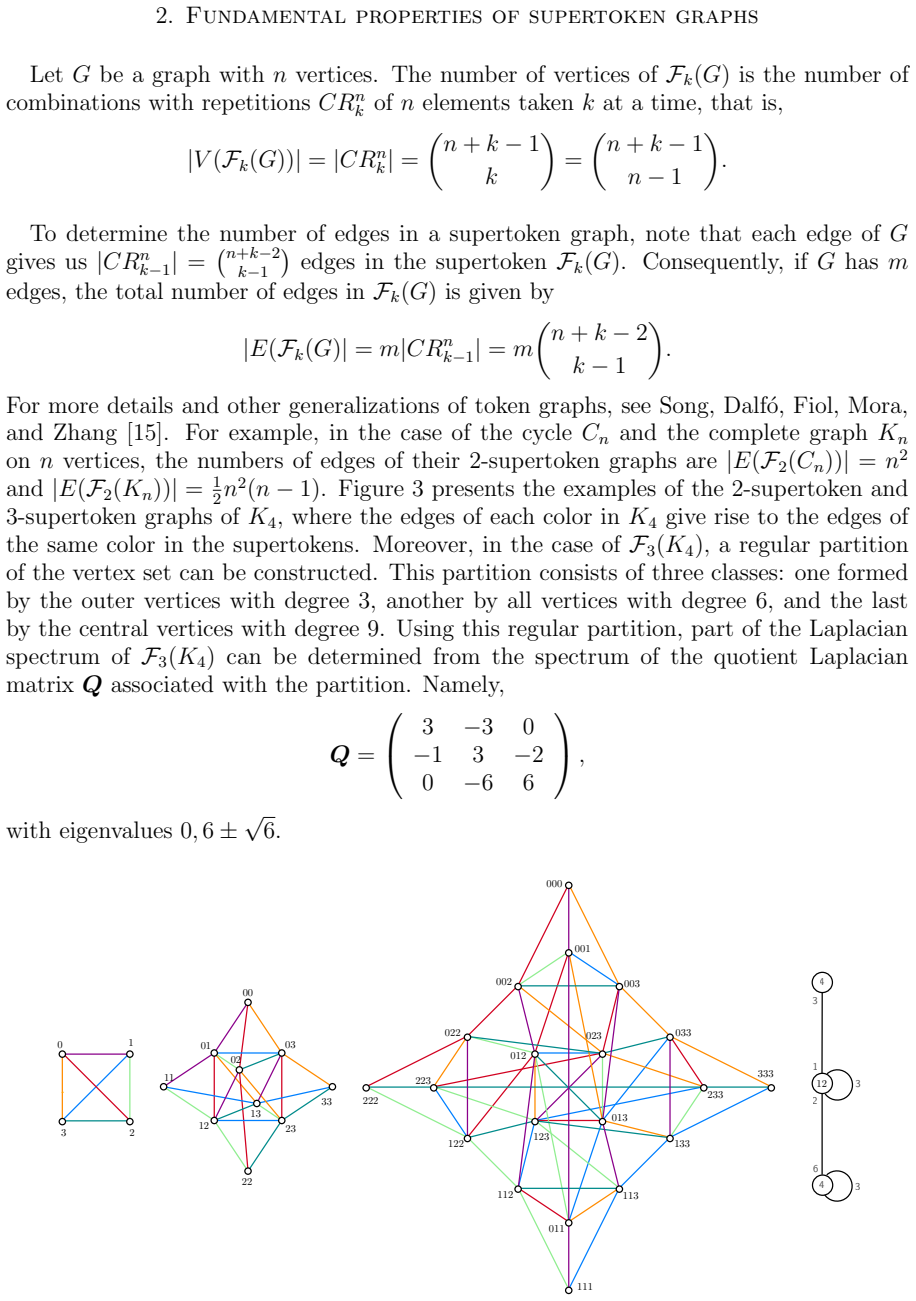


read the original abstract
We generalize the concept of token graphs to obtain supertoken graphs. In the latter case, there can be more than one token in a vertex. We formally define supertoken graphs and establish their basic properties. Moreover, we provide some bounds and exact values on the independence number, clique number, and chromatic number of these graphs. Finally, we construct a new infinite family of graphs, which we call the $p$-augmented 2-token graphs of cycles, and study their properties, including the spectral radius or largest adjacency eigenvalue.
Editorial analysis
A structured set of objections, weighed in public.
Referee Report
Summary. The paper generalizes token graphs to supertoken graphs, allowing multiple tokens per vertex via multisets or distributions. It formally defines these graphs, establishes basic properties, provides bounds and exact values for the independence number, clique number, and chromatic number, and constructs the infinite family of p-augmented 2-token graphs of cycles, analyzing their properties including the spectral radius.
Significance. If the results hold, this provides a natural, well-defined extension of token graphs that preserves the movement-based edge condition while enabling non-trivial parameter bounds and a concrete new infinite family with spectral analysis. The explicit constructions and focus on standard invariants strengthen the contribution to combinatorial graph theory and reconfiguration problems.
minor comments (3)
- Introduction: the motivation section would benefit from a short paragraph contrasting supertoken graphs with ordinary token graphs on a small example graph (e.g., C_4 with k=2) to highlight where multiplicity changes the structure.
- Definition of p-augmented 2-token graphs (likely §4): include an explicit small diagram or adjacency list for p=1 on C_5 to make the augmentation construction immediately verifiable.
- Chromatic-number bounds: the statement that certain exact values hold should specify the precise range of parameters (n,p,k) for which equality is attained, rather than leaving it implicit.
Simulated Author's Rebuttal
We thank the referee for their positive summary of our work on supertoken graphs, their assessment of its significance, and the recommendation for minor revision. We will incorporate minor improvements to the manuscript as appropriate.
Circularity Check
No significant circularity; definitions and bounds are self-contained
full rationale
The paper defines supertoken graphs explicitly as a direct generalization of token graphs (allowing multiple tokens per vertex) and constructs the p-augmented 2-token graphs of cycles by explicit rules. It then derives bounds and exact values for independence, clique, and chromatic numbers, plus spectral radius, via standard graph-theoretic arguments on these objects. No equations reduce to fitted parameters renamed as predictions, no self-citations are load-bearing for core claims, and no ansatzes or uniqueness theorems are imported from prior author work to force results. The derivation chain is independent of its inputs beyond the initial definitions.
Axiom & Free-Parameter Ledger
axioms (1)
- standard math Standard axioms of undirected simple graphs, including vertex/edge sets and adjacency relations.
invented entities (2)
-
supertoken graph
no independent evidence
-
p-augmented 2-token graph of a cycle
no independent evidence
Reference graph
Works this paper leans on
-
[1]
K. Audenaert, C. Godsil, G. Royle, and T. Rudolph, Symmetric squares of graphs,J. Combin. Theory B97(2007) 74–90
work page 2007
-
[2]
E. T. Baskoro, C. Dalf´ o, M. A. Fiol, and R. Simanjuntak, On some metric properties of supertoken graphs,Util. Math.123(2024) 19–33
work page 2024
-
[3]
D. M. Cvetkovi´ c, Graphs and their spectra,Publ. Elektrotehn. Fak. Ser. Mat. Fiz.354-356(1971) 1–50
work page 1971
-
[4]
C. Dalf´ o, M. A. Fiol, M. Miller, J. Ryan, and J. ˇSir´ aˇ n, An algebraic approach to lifts of digraphs, Discrete Appl. Math.269(2019) 68–76
work page 2019
-
[5]
H. de Alba, W. Carballosa, J. Lea˜ nos, and L. M. Rivera, Independence and matching numbers of some token graphs,Australas. J. Combin.76(3)(2020) 387–403
work page 2020
-
[6]
R. Fabila-Monroy, D. Flores-Pe˜ naloza, C. Huemer, F. Hurtado, J. Urrutia, and D. R. Wood, Token graphs,Graphs Combin.28(3)(2012) 365–380
work page 2012
-
[7]
C. M. Da Fonseca and V. Kowalenko, Eigenpairs of a family of tridiagonal matrices: three decades later,Acta Math. Hungar.160(2020) 376–389
work page 2020
-
[8]
Ghrist,Configuration spaces of graphs in robotics
R. Ghrist,Configuration spaces of graphs in robotics. In: New Directions in Applied Mathematics, IMA Volumes in Mathematics and its Applications, Springer, 2002
work page 2002
-
[9]
Hall, On representatives of subsets,J
P. Hall, On representatives of subsets,J. London Math. Soc.10:1(1935) 26–30
work page 1935
-
[10]
R. H. Hammack and G. D. Smith, Cycle bases of reduced powers of graphs,Ars Math. Contemp. 12(2017) 183–203
work page 2017
-
[11]
Losonczi, Eigenvalues and eigenvectors of some tridiagonal matrices,Acta Math
L. Losonczi, Eigenvalues and eigenvectors of some tridiagonal matrices,Acta Math. Hung.60(1992) 309–332
work page 1992
-
[12]
Lov´ asz, On the Shannon capacity of a graph,IEEE Trans
L. Lov´ asz, On the Shannon capacity of a graph,IEEE Trans. Inform. Theory25(1)(1979) 1–7
work page 1979
-
[13]
(2024), The On-Line Encyclopedia of Integer Sequences, Published electron- ically athttps://oeis.org
OEIS Foundation Inc. (2024), The On-Line Encyclopedia of Integer Sequences, Published electron- ically athttps://oeis.org
work page 2024
-
[14]
M. A. Reyes, C. Dalf´ o, M. A. Fiol, and A. Messegu´ e, On the spectra of token graphs of cycles and other graphs,Linear Algebra Appl.679(2023) 38–66
work page 2023
-
[15]
X. Song, C. Dalf´ o, M. A. Fiol, M. Mora, and S. Zhang, On generalized token graphs,Filomat40:2 (2026) 721–738
work page 2026
-
[16]
J. J. Watkins,Across the Board: The Mathematics of Chessboard Problems, Princeton University Press, 2007
work page 2007
-
[17]
J. L. A. Yebra, M. A. Fiol, P. Morillo, and I. Alegre, The diameter of undirected graphs associated to plane tessellations,Ars Combin.20B(1985) 159–171
work page 1985
-
[18]
Yueh, Eigenvalues of several tridiagonal matrices,Appl
W.-C. Yueh, Eigenvalues of several tridiagonal matrices,Appl. Math. E-Notes5(2005) 66–74. Departament de Matem`atica, Universitat de Lleida, Igualada (Barcelona), Catalonia Email address:monicaandrea.reyes@udl.cat Departament de Matem`atica, Universitat de Lleida, Igualada (Barcelona), Catalonia Email address:cristina.dalfo@udl.cat Departament de Matem `a...
work page 2005
discussion (0)
Sign in with ORCID, Apple, or X to comment. Anyone can read and Pith papers without signing in.